
Why Nugget Ice for Soda Creates a Different Mouthfeel Than Traditional Ice Cubes
Share:
-

-

-

-


Copied
Share:
-
-
-
-
Copied
At YUMYTH, we believe there is more to Nugget Ice for Soda than just the effect on temperature. The structure of ice also changes the perception of carbonation, how quickly your drink will be diluted, how hard you have to chew the ice, and the overall sensation of a drink on your palate.
Unlike many of their cubed counterparts, nugget ice is a structurally unique porous ice. Instead of large, dense pieces, nugget ice is comprised of smaller more light weight pieces. This soft compressed structure explains why many customers find nugget ice to be a marked improvement over traditional ice.
What Makes Nugget Ice Structurally Different?
The key difference is microstructure.
A conventional ice cube freezes into a relatively continuous, dense solid. Nugget ice consists of smaller ice crystals or flakes compacted into an irregular structure containing microscopic spaces and fracture points.
That structure changes several practical properties:
• Lower mechanical resistance: The nugget fractures more easily when chewed.
• Greater exposed surface: Many small pieces create more liquid-to-ice interfaces.
• More irregular contact: Soda moves between and around individual nuggets.
• Different melting behavior: Heat reaches a larger proportion of the ice surface.
• Stronger textural contribution: The ice becomes part of the drinking experience.
This is why Nugget Ice for Soda should not be viewed simply as a smaller version of cube ice.
| Property | Nugget Ice | Traditional Cube Ice |
| Internal structure | Compressed, porous | Dense, continuous |
| Bite resistance | Lower | Higher |
| Surface interaction | High | Lower |
| Texture in the mouth | Soft, crunchy | Hard, solid |
| Liquid contact | Multiple contact surfaces | Mainly outer surface |
| Role in soda | Cooling + texture | Primarily cooling |
Why Mouthfeel Matters in Soda
"Mouthfeel" refers to the physical and textural sensations created by food or beverages in the mouth. In soda, it involves more than bubbles.
Important variables include:
temperature, carbonation bite, bubble activity, lubrication, ice texture, particle movement, and mechanical resistance.
Carbonation generates a tingling, irritating sensation on the tongue. Research shows that carbonation's physical sensation intensity is affected by temperature. In one experimental setting, participants rated the carbonation intensity of Coca-Cola as stronger when the soda was served at 35°F as compared to when it was served at 59°F.
The addition of Nugget Ice for Soda creates a sensation similar to that created by regular ice, but provides a smoother edge and a lower temperature.
How Nugget Ice Changes the Drinking Experience
1. More Ice-to-Liquid Contact
Smaller pieces generally provide more total exposed surface than a few large cubes of comparable ice mass.
For soda, that means more interfaces where heat can transfer between the beverage and ice.
The result is not simply "colder ice." Instead, cooling is distributed through many individual nuggets throughout the glass.
From a heat-transfer perspective, actual performance still depends on:
• Initial soda temperature;
• Ice mass;
• Nugget size;
• Exposed surface area;
• Room temperature;
• Time in the glass.
That is why the amount of Nugget Ice for Soda matters as much as the ice shape itself.
2. Porosity Creates a Softer Bite
Hard cube ice requires considerable force to fracture. Nugget ice contains more internal discontinuities, so cracks can propagate through the nugget more easily.
For the drinker, this translates into a texture commonly described as:
• Soft;
• Airy;
• Lightly crunchy;
• Easy to break apart.
This lower bite resistance is one of the main reasons Nugget Ice for Soda feels integrated into the beverage rather than functioning only as a cooling block.
3. Soda Moves Around the Nugget Structure
The porous and irregular geometry also increases the spaces between ice pieces.
Soda fills these channels and coats the exposed surfaces of the nuggets. Toward the end of the drink, the remaining ice therefore continues to carry a thin layer of beverage around it.
We prefer to describe this as liquid retention around a porous ice structure, rather than claiming that the ice itself "absorbs" flavor deeply into the crystal. That distinction is more technically accurate.
What Happens to Carbonation?
A common question is whether Nugget Ice for Soda makes soda lose carbonation faster.
There is no single yes-or-no answer because two competing mechanisms are involved.
Lower Temperature Helps Retain CO₂
Cold temperatures solubilize CO₂. That's why older methods for keeping carbonation in soda included adding ice to the bottle and shaking the bottle. The CO₂ dissolves in the liquid if the temperature is lowered enough.
A cold drink also feels more carbonated due to the "bite" of the carbonation.
Ice Surfaces Can Promote Bubble Formation
At the same time, irregular surfaces can provide nucleation sites where dissolved CO₂ begins forming bubbles.
Therefore, carbonation retention depends on several factors:
Temperature + Surface condition + Pouring technique + Ice quantity + Time after pouring.
For example, aggressively pouring soda over a full glass of ice may generate more foaming than slowly pouring it down the side of the glass.
So the advantage of Nugget Ice for Soda is not that it automatically "preserves more fizz." Its value lies in combining cooling, carbonation sensation, and texture in a distinctive way.
Melting and Dilution: More Surface Area Has a Trade-Off
Surface area improves ice-to-liquid contact, but it also affects melting.
Small nuggets can exchange heat rapidly with the beverage. If too much ice is used—or if the drink remains untouched for a long period—dilution becomes more noticeable.
A well-balanced serving therefore depends on three variables:
• Enough ice mass to lower beverage temperature;
• Enough open space for soda circulation;
• A reasonable drinking time before excessive melting occurs.
This is an important technical point: Nugget Ice for Soda is about balancing heat transfer and texture, not simply maximizing the amount of ice.
Producing Consistent Nugget Ice: What the Machine Must Control
From our manufacturing perspective at YUMYTH, good nugget ice depends on more than refrigeration capacity.
The system must consistently manage:
- Ice formation – stable freezing conditions help control texture.
- Compression and shaping – the ice must form into recognizable soft nuggets.
- Ice discharge – finished nuggets need to leave the freezing mechanism smoothly.
- Water management – water supply and drainage affect continuous operation.
- Cleaning – internal water-contact areas require routine maintenance.
If the discharge path becomes blocked, production can become irregular. This is why the mechanical design surrounding ice movement is important.
YUMYTH YJ2001: Designing for Consistent Nugget Ice
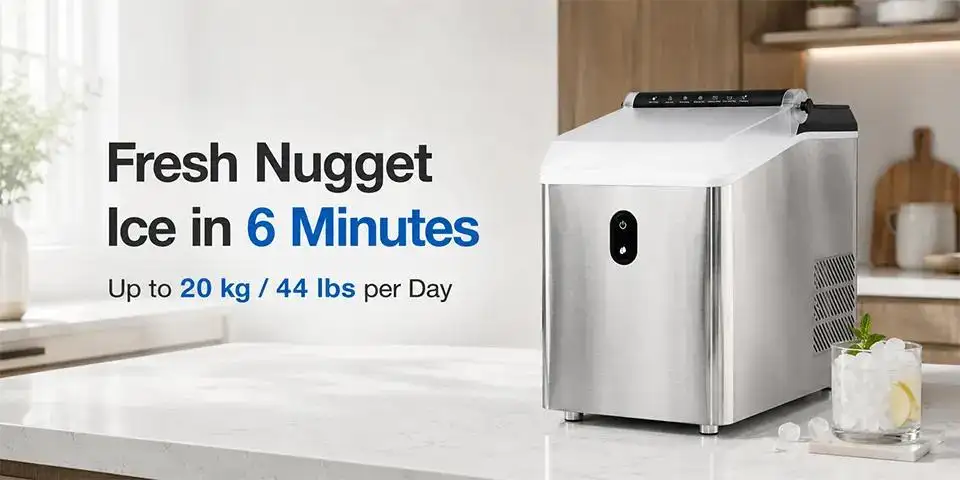
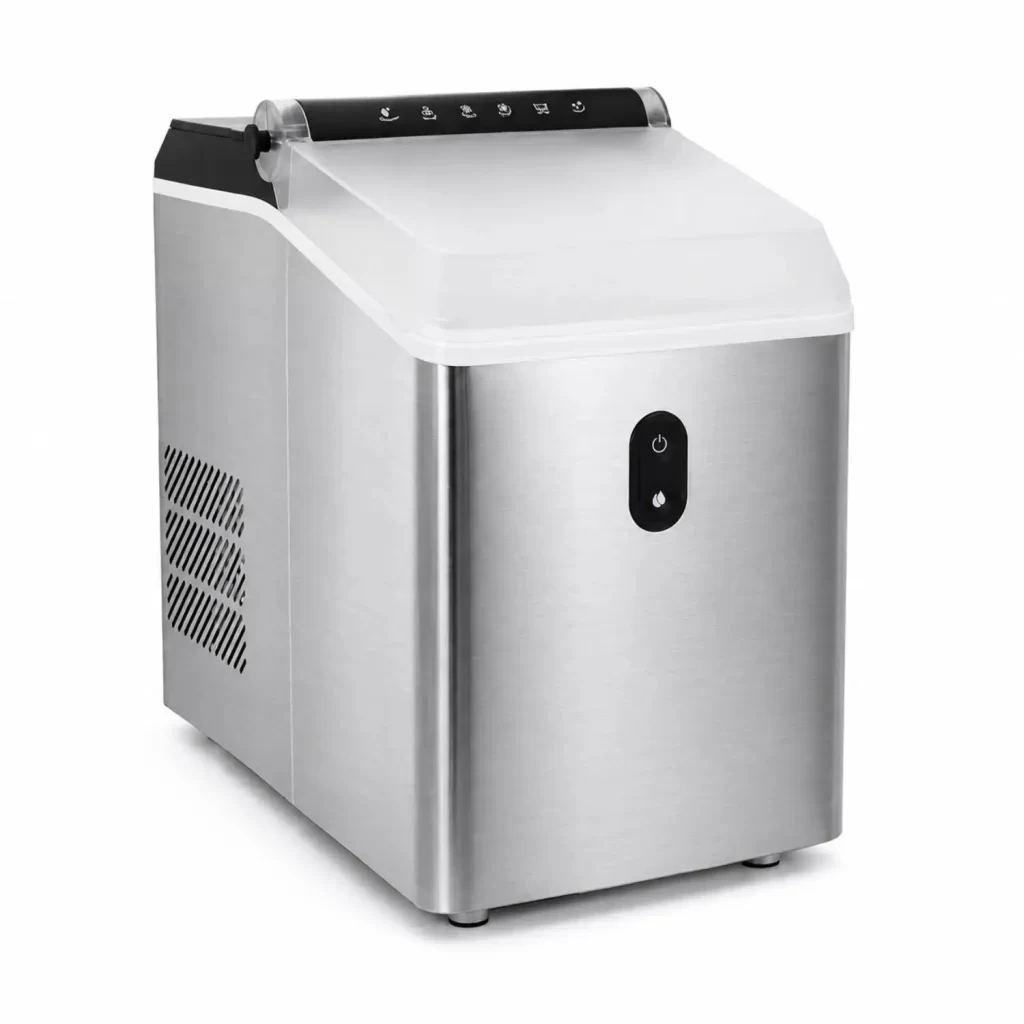
Our YUMYTH YJ2001 Countertop Chewable Nugget Ice Maker is designed around these operating requirements. It produces soft, chewable nugget ice suitable for soda and other chilled beverages.
| Technical Specification | YJ2001 |
| Ice Type | Chewable Nugget Ice |
| First Ice Time | 6 min at 25°C |
| Daily Ice Production | 20 kg/24 h |
| Ice Basket Capacity | 1.4–1.9 kg |
| Water Tank | 2.1 L |
| Rated Power | 150 W |
| Voltage | 110–120V / 220–240V |
| Noise Level | ≤55 dB* |
| Refrigerant | R600a |
| Product Size | 402 × 240 × 402 mm |
| Housing | Stainless Steel |
*Measured by YUMYTH under an ambient noise condition of ≤25 dB.
The following design details help with the mass production of Nugget Ice for Soda:
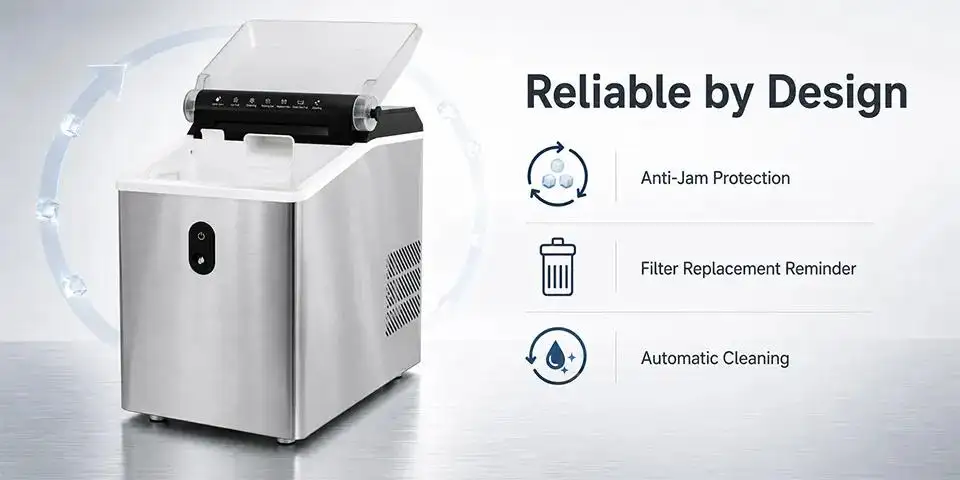
Anti-Jam Rotation
A mechanism that rotates the ice piece during production helps prevent jamming in the discharge chute.
Automatic Cleaning
The ice maker automatically performs a cleaning cycle to help maintain the system for optimal ice production.
Filter Replacement Alert
The control system is designed to remind the user to change the water filter to ensure water purity and purity of the ice. The system can do this during the production process.
Clear Operating Feedback
Indicators display Add Water, Ice Full, Defrosting, Making Ice, Replace Filter, Drain Tank Full, and Cleaning status, reducing guesswork during operation.
Why Nugget Ice for Soda Feels Different
The difference ultimately comes down to structure.
Traditional cubes primarily change beverage temperature. Nugget Ice for Soda changes several sensory variables at the same time:
Cooling + Surface interaction + Carbonation perception + Soft fracture + Chewing sensation + Melting.
That combination explains why nugget ice can feel more integrated with the soda itself.
At YUMYTH, our goal with the YJ2001 Countertop Chewable Nugget Ice Maker is to produce this texture consistently while keeping ice production, discharge, cleaning, and daily operation straightforward. With first ice available in as little as 6 minutes and production of up to 20 kg per 24 hours, the YJ2001 provides a practical way to explore how properly formed nugget ice can change the experience of soda.
For more technical specifications and design details, explore the YUMYTH YJ2001 Countertop Chewable Nugget Ice Maker.
FAQs
Q1. What type of ice does the YUMYTH YJ2001 produce?
The YUMYTH YJ2001 produces soft, chewable nugget ice. Its compact and porous texture makes it suitable for Nugget Ice for Soda, where the ice contributes both cooling and a softer mouthfeel.
Q2. How quickly can the YUMYTH YJ2001 make nugget ice?
Under YUMYTH's specified test condition of 25°C, the YJ2001 can produce its first batch of nugget ice in approximately 6 minutes, allowing users to prepare fresh Nugget Ice for Soda without a long startup period.
Q3. How much ice can the YUMYTH YJ2001 produce in one day?
The YJ2001 has a rated ice-making capacity of up to 20 kg per 24 hours, providing a steady supply of chewable nugget ice for soda and other chilled beverages.
Q4. What is the ice basket capacity of the YUMYTH YJ2001?
The ice basket can hold approximately 1.4–1.9 kg of nugget ice, giving users enough storage capacity for repeated drink preparation without constantly emptying the basket.
Q5. How large is the water tank?
The YUMYTH YJ2001 is equipped with a 2.1 L water tank. This supports countertop ice production while keeping the unit compact enough for everyday kitchen use.
Related Articles

Household Slush Machine: What to Know Before Buying One in 2026
2026-09-24
BY YUMYTH
A household slush machine makes frozen drinks at home. It works differently from a blender. A blender crushes ice into your drink, which adds water and waters down the flavor. ...

How Does a Nugget Ice Maker Work? A Look Inside the Ice-Making Process
2026-09-24
BY YUMYTH
Nugget ice looks simple enough. Small, soft pieces of ice drop into the bin, ready to go into a glass. But making that texture is quite different from making a ...
Nugget Ice Maker for Coffee Shop: How Ice Texture Affects Coffee
2026-09-24
BY YUMYTH
When choosing a Nugget Ice Maker for a Coffee Shop, there are many factors to consider aside from the rate of ice production. At YUMYTH, we consider the downstream implications ...
Why Nugget Ice for Soda Creates a Different Mouthfeel Than Traditional Ice Cubes
2026-09-24
BY YUMYTH
At YUMYTH, we believe there is more to Nugget Ice for Soda than just the effect on temperature. The structure of ice also changes the perception of carbonation, how quickly ...