
Custom Vacuum Sealer Trends 2026: Smarter Design & Control
Share:
-

-

-

-


Copied
Share:
-
-
-
-
Copied
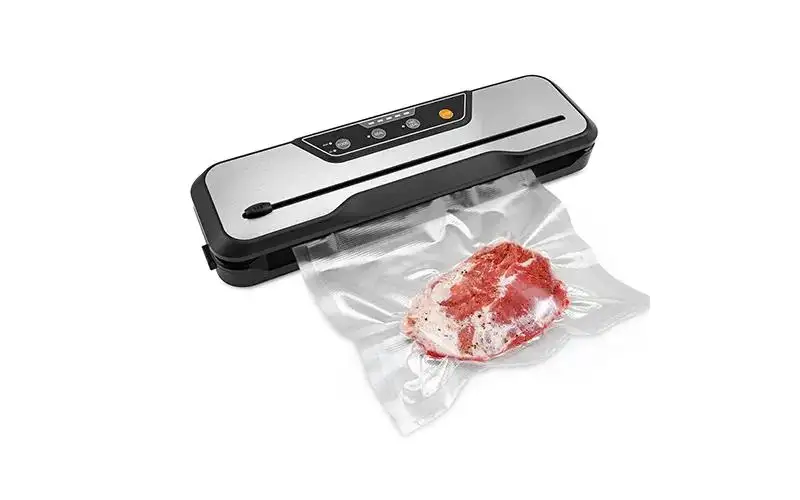
A Custom Vacuum Sealer in 2026 is becoming less about cosmetic changes and more about engineering the vacuum cycle around food type, bag material, sealing behavior, and user workflow.
From our perspective at YUMYTH, the important shift is toward controlled air extraction, tunable sealing parameters, packaging compatibility, and easier daily operation. These factors are closely connected. Changing the vacuum pump affects cycle time; changing the bag structure may require different sealing conditions; adding stronger suction may also create problems for delicate foods if control logic is not considered.
That is why modern Custom Vacuum Sealer development should be treated as a system rather than a list of features.
1. Smarter Vacuum Control: Pressure Is Only One Part of the System
The first specification buyers compare is vacuum pressure. However, the extraction process is determined by many factors, and vacuum pressure is only one of them.
Factors that affect the extraction process are:
•Vacuum pressure: The minimum pressure that the system can achieve.
•Airflow of the pump: The volume of air that the pump can remove per minute.
•Duration of the vacuum: The time for which the pump can operate and create a vacuum.
•Logic: Determines when the extraction process stops, and the port is sealed.
Systems may differ on the factors listed above.
A higher vacuum level does not automatically mean a better Custom Vacuum Sealer. Bread, berries, soft vegetables, and other delicate foods can deform before maximum vacuum is reached. Pulse control is therefore useful because the user can stop extraction according to the condition of the food rather than relying on one fixed cycle.
The VS6612X has configurations of -60 kPa/ 5 L/min and -80 kPa/8 L/min vacuum systems. It consumes 110 W. Bags up to 30 cm can be sealed with a single 3 mm sealing bar. STOP/PULSE control provides partial vacuum. This is useful when full vacuum is not desired.
| Vacuum Parameter | Importance |
| Pressure | Higher pressure allows greater suction. |
| Pump airflow | Higher airflow allows faster suction. |
| Pulse control | Used to protect delicate food by avoiding suction. |
| Cycle logic | Controls the function of vacuum and seal in series. |
Pulse Control and Cycle Logic are usually set to protect food, and thus are often used in combination.
2. Sealing Engineering Is as Important as Vacuum Performance
Removing air is only half of the process. The final package depends on whether the seal remains uniform and closed after the vacuum cycle.
A typical process follows:
Air extraction → Bag compression → Heating → Seal formation → Cooling
Seal quality is influenced by more than heating time. Important variables include:
•Film structure and thickness;
•Heating-element output;
•Sealing duration;
•Compression pressure;
•Contamination in the seal area;
•Cooling time before the joint is stressed.
If sealing energy is too low, the bond may be incomplete. Excessive heat can distort or over-soften the film. This is why a Custom Vacuum Sealer should be tested with the intended bag instead of assuming that one factory program works equally well with every material.
At YUMYTH, vacuum strength, sealing mode, and sealing time can be tuned during customization. For us, parameter adjustment should always be followed by validation with the target packaging material.
3. Sustainable Packaging Is Creating New Sealing Requirements
One important 2026 packaging trend is the continued development of recyclable mono-material multilayer structures as alternatives to harder-to-recycle multi-material laminates. Recent research shows that this transition can improve recyclability and reduce several environmental impacts, although laminate design remains critical.
For Custom Vacuum Sealer engineering, the important issue is not simply whether a bag is described as “sustainable.” What matters is how the actual film behaves under heat and pressure.
When evaluating a new bag structure, we look at:
•Sealing-layer behavior;
•Total film thickness;
•Heat response;
•Flexibility under vacuum;
•Resistance to wrinkling around the seal;
•Seal integrity after cooling.
Therefore, a change in packaging material may require a corresponding change in the Custom Vacuum Sealer program.
4. User-Centered Design Means Better Process Control
User-centered design should not mean adding more buttons. A better approach is to reduce uncertainty during each sealing cycle.
Consider the normal workflow:
Prepare bag → Position food → Select mode → Vacuum → Seal → Remove → Clean
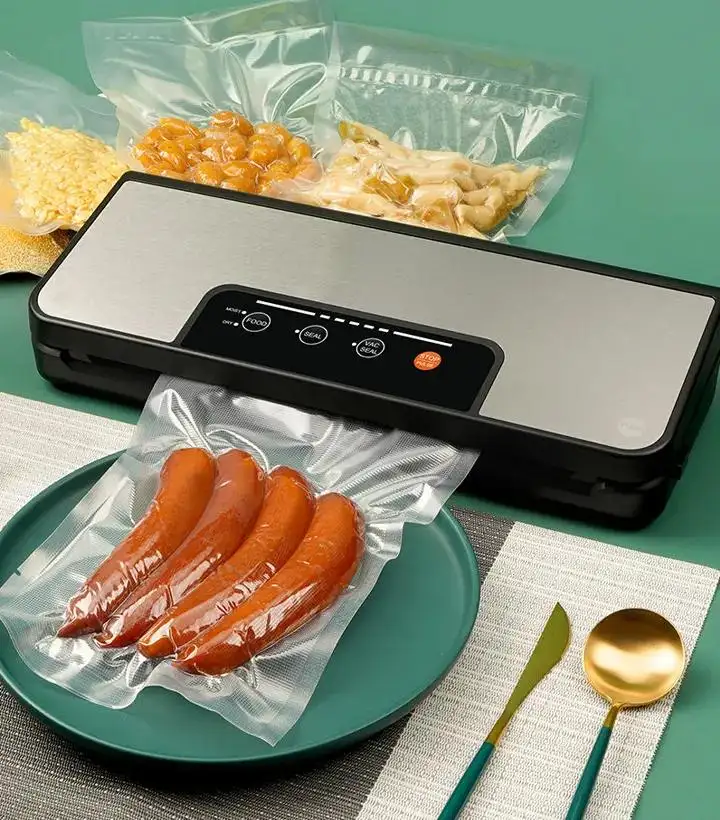
A well-designed Custom Vacuum Sealer can simplify several of these steps through dry/moist settings, normal/gentle pressure selection, pulse control, automatic lid movement, built-in cutters, and removable liquid-management components.
Our VS6680M demonstrates this approach. It uses an 8 L/min pump, reaches -80 kPa, operates at 120 W, and supports a maximum 30 cm working width with a 3 mm single sealing bar. It also integrates:
•Dry and moist food modes;
•Normal and gentle pressure settings;
•Automatic lid closing and opening;
•Pulse control;
•Removable drip tray;
•Built-in bag cutter;
•2 kg digital scale with 0.1 g resolution.
Its dimensions are 380 × 140 × 80 mm, providing these functions within a relatively compact countertop structure.
The engineering value lies in combining extraction, sealing, bag preparation, and cleanup into a more predictable workflow.
5. Moisture Management and Cleaning Should Be Designed In
Moist foods create another challenge: liquid may be pulled toward the vacuum channel before sealing is complete.
For this reason, Custom Vacuum Sealer development should consider:
•Dedicated dry/moist programs;
•Controlled extraction speed;
•Removable drip trays;
•Accessible vacuum channels;
•Removable or serviceable gaskets;
•Smooth surfaces around food-contact areas.
Cleaning is not simply a convenience feature. Residue around the seal area or vacuum path can affect hygiene and eventually interfere with consistent operation.
6. Customization Should Match the Required Engineering Depth
Not every Custom Vacuum Sealer needs a completely new structure.
| Requirement | Recommended Route |
| Logo / housing color | Existing platform |
| Packaging / accessories | Existing platform |
| Control-panel layout | Partial customization |
| Vacuum strength / seal time | Program tuning |
| New cover or internal layout | Structural modification |
| New operating concept | Deeper ODM development |
At YUMYTH, our customization scope includes appearance, interface, vacuum strength, sealing programs, bag capacity, removable components, voltage configuration, packaging, and accessories. Our manufacturing system combines injection molding, assembly, and quality control, which allows mechanical and functional changes to be evaluated within the same product-development process.
Looking Ahead
In 2026, a well-engineered Custom Vacuum Sealer is increasingly defined by how effectively vacuum performance, seal reliability, packaging compatibility, cleaning, user control, and product structure work together.
At YUMYTH, we base our initial designs on commercial vacuum sealers, and then enhance them with interfaces, structures, and accessories. We also partner with ODMs for deeper changes.
If you want to develop a Vacuum Sealer integrated with a specific storage workflow and experience, consider our Vacuum Sealers to learn about the parameters that can be changed for your project.
FAQs
Q1. What can YUMYTH customize on a Custom Vacuum Sealer?
YUMYTH can customize branding, housing color, control panels, vacuum settings, sealing programs, structure, accessories, packaging, voltage and plug configurations.
Q2. Can YUMYTH adjust vacuum pressure for different product requirements?
Yes. Depending on the selected platform, vacuum pressure and pump configuration can be adjusted to suit different food types, operating modes and product positioning.
Q3. Does YUMYTH support adjustable sealing time?
Yes. Sealing time and operating programs can be tuned according to the intended bag structure, thickness and sealing requirements.
Q4. Can YUMYTH develop a Custom Vacuum Sealer for delicate foods?
Yes. Pulse vacuum and gentle vacuum functions can be incorporated to provide greater control when sealing bread, berries and other easily compressed foods.
Q5. What vacuum performance is available on YUMYTH models?
Available platforms include configurations such as -60 kPa with 5 L/min airflow and -80 kPa with 8 L/min airflow, depending on the model and design requirements.
Related Articles

Household Slush Machine: What to Know Before Buying One in 2026
2026-09-24
BY YUMYTH
A household slush machine makes frozen drinks at home. It works differently from a blender. A blender crushes ice into your drink, which adds water and waters down the flavor. ...

How Does a Nugget Ice Maker Work? A Look Inside the Ice-Making Process
2026-09-24
BY YUMYTH
Nugget ice looks simple enough. Small, soft pieces of ice drop into the bin, ready to go into a glass. But making that texture is quite different from making a ...
Nugget Ice Maker for Coffee Shop: How Ice Texture Affects Coffee
2026-09-24
BY YUMYTH
When choosing a Nugget Ice Maker for a Coffee Shop, there are many factors to consider aside from the rate of ice production. At YUMYTH, we consider the downstream implications ...
Why Nugget Ice for Soda Creates a Different Mouthfeel Than Traditional Ice Cubes
2026-09-24
BY YUMYTH
At YUMYTH, we believe there is more to Nugget Ice for Soda than just the effect on temperature. The structure of ice also changes the perception of carbonation, how quickly ...