
Why One Vacuum Sealer Needs Two Vacuum Sealing Systems: Inside the CVS101 Chamber + External Vacuum Design
Share:
-

-

-

-


Copied
Share:
-
-
-
-
Copied
There is an awkward point in vacuum packaging that does not always show up on a specification sheet.
A machine may work perfectly well with coffee beans, meat portions or dried food, but the moment soup, marinade or a wet ingredient enters the bag, the packaging process changes. On the other hand, a traditional chamber machine handles liquids well but may feel unnecessarily cumbersome when someone simply wants to vacuum a bottle, container or a few everyday embossed bags.
That was one of the practical problems behind the YUMYTH CVS101 dual-mode chamber vacuum sealer.
Instead of asking the user to choose between a chamber machine and an external vacuum sealer, CVS101 puts both systems into one countertop unit.
It sounds like a small difference on paper. In daily use, it changes what the machine can actually do.
Two Vacuum Paths Instead of One
CVS101 does not use the same vacuum system for every job.
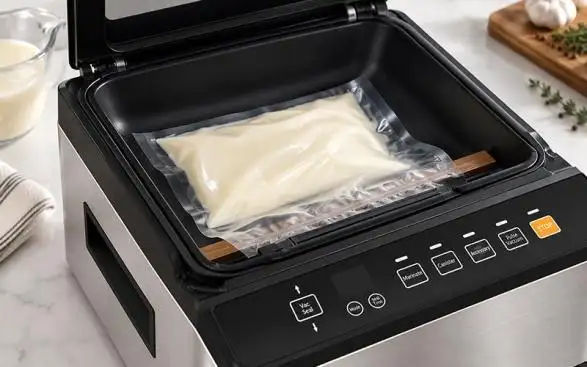
Inside the chamber, the machine can reach -98kPa vacuum pressure, supported by a 40L/min chamber vacuum pump. This is the side of the machine intended for demanding packaging jobs, particularly food with moisture or free-flowing liquid.
For conventional external vacuum packaging, the machine operates at up to -80kPa, with an 8L/min external vacuum system.
Why separate the two?
Because a bag of dry almonds and a pouch of marinated beef do not behave in the same way when air is removed.
With an external vacuum sealer, air is drawn directly from inside the bag. If there is a large amount of liquid inside, that liquid can travel toward the opening together with the escaping air.
A chamber system works differently. The bag is placed inside the chamber and pressure around the entire bag is reduced. This makes it much easier to package sauces, marinades and other high-moisture foods without treating them like a dry product.
CVS101 therefore lets the operator choose the method according to the food rather than forcing every product through the same process.
The Chamber Is Where CVS101 Does the Heavy Work
Open the tempered-glass lid and the chamber provides a working width of up to 28cm.
This is where foods such as fresh meat, fish, marinated ingredients, moist prepared foods and certain liquid-containing products can be packaged.
Vacuum time and sealing time can be preset independently. That is useful because there is no universal setting that works equally well for every bag and every product.
A dense piece of meat may need a different vacuum cycle from a delicate prepared ingredient. Bag thickness can also affect sealing time.
Rather than hiding those variables, CVS101 gives the operator control over them.
During operation, the display shows the remaining sealing time, so the user can see what the machine is doing instead of simply waiting for an indicator light to change.
At the end of the chamber cycle, the bag is closed by a 3mm × 2 double sealing bar.
For commercial users, that second seal line is more than a visual detail. If the package will be handled, stacked, transported or stored for a longer period, having two parallel sealing lines gives the bag an additional sealing barrier.
But Not Every Job Belongs Inside the Chamber
Imagine a small food business preparing packaged meat in the morning.
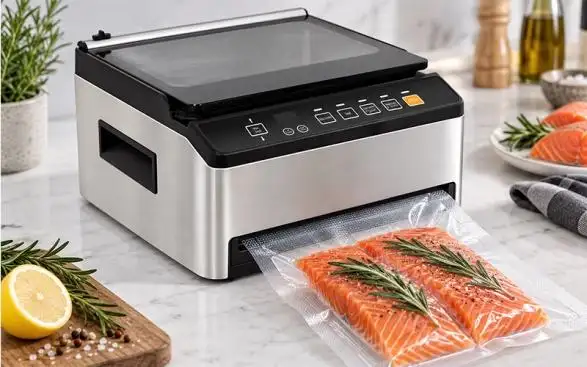
The chamber is useful for production batches. Later, however, the same operator may want to vacuum a storage container, remove air from a compatible zip bag or seal a few ordinary embossed vacuum bags.
There is little reason to place every one of those jobs inside a chamber.
That is where the external side of CVS101 becomes useful.
The external sealing area accepts bags up to 30cm wide and uses a 3mm sealing line. With up to -80kPa of external vacuum pressure, it handles the more familiar edge-vacuum workflow found on conventional countertop vacuum sealers.
An integrated cutter is also built into the machine, allowing bag material to be trimmed without keeping a separate cutting tool beside the sealer.
The result is a machine that can move between batch-style chamber work and quick daily packaging without changing equipment.
Bottles, Containers and Zip Bags Have Their Own Place Too
The external system is not limited to ordinary vacuum bags.
Through the Extra-VAC/Accessory function, CVS101 can work with compatible vacuum containers, bottles, valve bags and other vacuum accessories.
This can be useful in kitchens where vacuum packaging is part of a wider storage system rather than just a bag-sealing process.
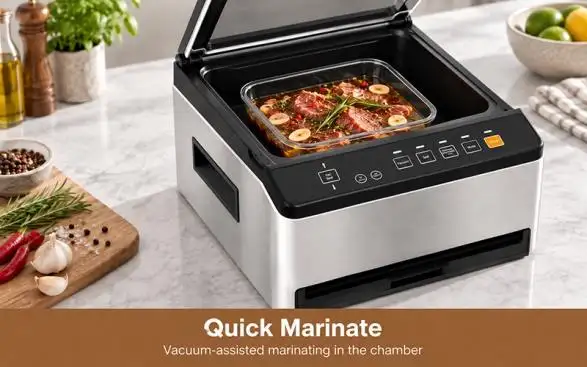
There is also a marinating function.
Holding the Extra-VAC/Marinate control for approximately three seconds activates the marinating cycle. Instead of leaving food to sit passively in marinade, the vacuum process changes the pressure around the ingredients during the cycle.
For restaurants, meal-preparation businesses or users experimenting with vacuum-assisted marinating, it adds another reason for the chamber to stay on the countertop instead of becoming a machine used only for storage.
Liquid Handling Is Also About Cleaning Afterwards
Performance matters, but anyone who has worked with raw meat or marinades knows that cleanup can become the less glamorous half of vacuum packaging.
Liquid residue happens.
CVS101 therefore includes a removable drip tray, allowing collected moisture to be removed and cleaned instead of becoming a difficult-to-reach part of the machine.
The power cord is detachable as well. It is a simple feature, but it makes moving, wiping and storing a 10.5kg machine considerably less awkward.
Silicone sealing gaskets are used around the vacuum area and are designed for repeated operation. These parts matter because maintaining an effective seal around the chamber is essential for generating stable vacuum pressure cycle after cycle.
Built for Repeated Use, Not Just an Occasional Bag
CVS101 is rated for 3,000 operating cycles, while endurance testing has been carried out up to 10,000 cycles.
That distinction is worth making.
The rated figure describes the intended operating life specification; the higher test figure reflects the endurance testing performed during product evaluation. It should not be read as a promise that every individual unit will automatically complete exactly 10,000 identical cycles under every operating condition.
What it does show is that repeated-cycle performance was considered during development.
The machine also incorporates NTC overheating protection and thermal fuse protection. Vacuum sealing combines pump operation with repeated heating at the sealing bar, so temperature management becomes increasingly relevant when the machine is used several times in succession.
A More Practical Format for Small Commercial Kitchens
A chamber vacuum sealer is often associated with large stainless-steel floor-standing equipment.
CVS101 approaches the category differently.
The machine measures approximately 398 × 355 × 229mm and weighs about 10.5kg, giving it the capacity of a chamber system while keeping it in a format that can still sit on a worktop.
Power is rated at 220W, with versions available for AC100–120V or AC220–240V, 50–60Hz, making the platform adaptable for different destination markets.
Depending on the product configuration, the exterior can be produced with a black-coated metal finish or stainless-steel appearance. The CVS101 Silver specification uses SUS430 together with ABS, PC and tempered glass components.
This combination makes the model particularly relevant to buyers who sit somewhere between ordinary household vacuum sealers and much larger professional chamber equipment.
Where Does CVS101 Make the Most Sense?
The strongest reason to consider CVS101 is not simply that it can reach -98kPa.
It is flexibility.
A butcher shop may mainly care about chamber packaging and double seals. A small restaurant may value liquid packaging and marinating. A meal-preparation business might switch constantly between moist food, dry ingredients and containers. A household user who buys food in bulk may simply want a more capable machine without moving to a large industrial chamber sealer.
The same hardware can cover those different workflows.
For distributors and appliance brands, this also creates an interesting product position. CVS101 does not compete only with basic external vacuum sealers, nor does it require the footprint of traditional commercial chamber equipment.
It sits between the two.
Key CVS101 Specifications at a Glance
| Vacuum System | Chamber + External |
| Chamber Vacuum Pressure | Up to -98kPa |
| External Vacuum Pressure | Up to -80kPa |
| Chamber Pump | 40L/min |
| External Pump | 8L/min |
| Rated Power | 220W |
| Chamber Working Width | Max. 28cm |
| External Bag Width | Max. 30cm |
| Chamber Seal | 3mm × 2 double seal |
| External Seal | 3mm single seal |
| Controls | 8 mechanical function buttons |
| Chamber Food Types | Dry, moist and liquid-containing food |
| Additional Functions | Accessory vacuum, pulse control, marinating |
| Dimensions | 398 × 355 × 229mm |
| Net Weight | 10.5kg |
| Safety | NTC overheating protection + thermal fuse |
| Voltage | AC100–120V / AC220–240V |
| Frequency | 50–60Hz |
One Machine, Fewer Compromises
The interesting part of CVS101 is not one individual specification.
It is the way the specifications work together.
The -98kPa chamber system deals with jobs that conventional external vacuum sealers often find difficult. The -80kPa external system keeps simple bag and accessory vacuuming convenient. Adjustable vacuum and sealing times give the operator more control, while the double chamber seal, removable drip tray, built-in cutter and thermal protection address the less visible details that become important after repeated use.
That makes CVS101 less about choosing between a chamber sealer and an external vacuum sealer.
It is about having both available when the food in front of you changes.
For appliance brands, distributors and professional buyers looking for an OEM/ODM chamber vacuum sealer, YUMYTH can support different market requirements including appearance, packaging, voltage and product configuration.
Contact YUMYTH to discuss CVS101 samples, specifications or OEM/ODM requirements.
Related Articles

Household Slush Machine: What to Know Before Buying One in 2026
2026-09-24
BY YUMYTH
A household slush machine makes frozen drinks at home. It works differently from a blender. A blender crushes ice into your drink, which adds water and waters down the flavor. ...

How Does a Nugget Ice Maker Work? A Look Inside the Ice-Making Process
2026-09-24
BY YUMYTH
Nugget ice looks simple enough. Small, soft pieces of ice drop into the bin, ready to go into a glass. But making that texture is quite different from making a ...
Nugget Ice Maker for Coffee Shop: How Ice Texture Affects Coffee
2026-09-24
BY YUMYTH
When choosing a Nugget Ice Maker for a Coffee Shop, there are many factors to consider aside from the rate of ice production. At YUMYTH, we consider the downstream implications ...
Why Nugget Ice for Soda Creates a Different Mouthfeel Than Traditional Ice Cubes
2026-09-24
BY YUMYTH
At YUMYTH, we believe there is more to Nugget Ice for Soda than just the effect on temperature. The structure of ice also changes the perception of carbonation, how quickly ...