2026 Freestanding Ice Maker Trends: Clear Ice, R290, and Smart Controls
Share:
-

-

-

-


Copied
Share:
-
-
-
-
Copied
A freestanding ice maker that can produce 12.6 kg of ice in a day may still not meet expectations. Its ice may turn cloudy because of short freezing cycles, it may produce ice slowly in a warm kitchen, and the storage basket may fill up well before the daily production is attained.
There are limitations that explain the reason for including the following design features in 2026: clear-ice technology, R290 refrigeration, and more advanced controls in ice machines. These features are connected design decisions.
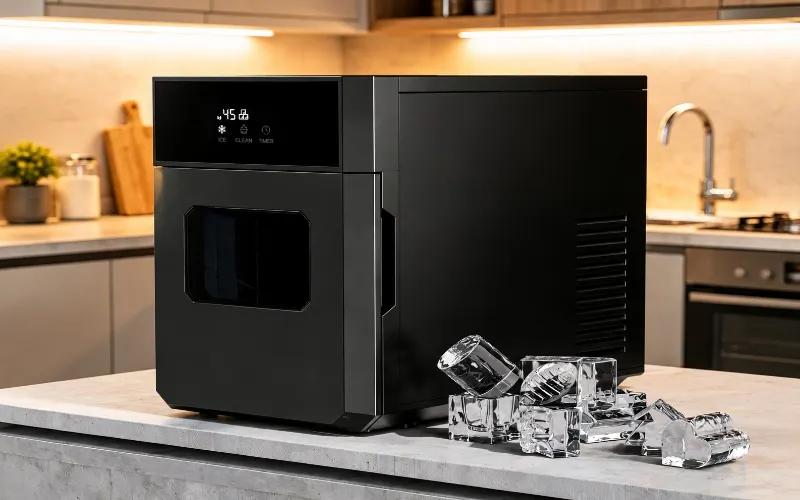
Our YI220007 Cube Ice Maker incorporates a compact design, R290 refrigeration and programmable control, thus being very convenient for multiple uses and offering a good degree of control to the end user.
What is Cloudy Ice? Is It Related to Freezing Speed?
The presence of impurities in water can lead to cloudy ice. If the freezing speed is too high, bubbles of gas don't have enough time to move to the ice front and get entrapped, therefore resulting in cloudy ice.
The process of obtaining clear ice is controlling the removal of heat and the freezing of water and moving water.
Longer freezing times does not always result in more clear ice. Other factors include hardness of water, dissolved gases, mold design, and direction of crystal growth.
The YUMYTH YI220007 has settings to produce ice in 15, 30, 45, and 60 minute cycles. The goal of longer cycles is to create better quality (i.e., more clear and dense) ice. The trade-off is the throughput of the system. Longer cycles result in fewer batches of ice produced in a given time period.
When comparing clear-ice performance of different models, potential buyers should look at:
• Internal defects (bubbles and cloudy regions) resulting from variations in the inlet water conditions.
• Geometric dimensions of finished ice.
• Repeatability of the cycle, (i.e., how consistently it meets performance expectations).
When assessing ice transparency, the evaluation should consider the total time it takes to produce ice. An exceptionally clear ice cube has little commercial value if it takes too long to produce and reduced the total usable output.
R290 Refrigeration: Lower Climate Impact, Stricter Safety Design
R290 is propane, a hydrocarbon refrigerant with low global warming potential. Its environmental characteristics make it relevant to refrigeration equipment designed for markets increasingly concerned with refrigerant-related emissions.
However, R290 carries an A3 safety classification because of its high flammability.
A refrigeration system cannot just be converted to R290 by simply changing the refrigerant charge. Other things such as the compressor, the mass flow of the refrigerant, the characteristics of the expansion device, the type of lubricant, and the positioning of the electrical components, must also be evaluated by a engineer.
YUMYTH indicates R290 for the YI220007, which has a rated electrical power of 240W.
In compact ice makers, the performance of the condenser is particularly sensitive to the conditions of the installation. Restricted ventilation may result in increasing the condensing temperature and pressure. This increases the workload of the compressor and reduces the available refrigeration capacity. Ice making cycles become longer.
A buyer of R290 models should validate labeling of refrigerant charge, integrity of the refrigeration circuit, electrical safety and compliance with the requirements of the applicable market.
IEC 60335-2-24 covers household and similar ice makers in its scope. Commercial refrigeration equipment and ice makers may be covered by IEC 60335-2-89. The correct standards depend on the equipment and its application.
240W rated power also does not represent the real energy consumed. Actual energy consumption depends on the mode of operation, the duration the compressor runs, and other auxiliary components, the environmental conditions, etc.
A meaningful efficiency comparison should report electrical energy consumed per kilogram of harvested ice under defined conditions.
Smart Controls: What Actually Improves Ice-Making Reliability?
Connected displays and mobile applications attract attention, but more elaborate interfaces do not necessarily improve freezing performance.
For a compact freestanding ice maker, basic control decisions often have greater practical consequences: when to begin production, which freezing mode to maintain, and how to respond when water is unavailable.
The YUMYTH YI220007 has three documented functions:
• Scheduled Start: The user can program ice-making to start in the next 1-12 hours. This gives the user the ability to produce ice at the appropriate time to meet demand; however, it does not increase the machine's ice making capacity.
• Mode Memory: The factory default is set to a 45-minute freezing cycle. Upon subsequent use, the controller remembers the last operating mode.
• Water-shortage protection: When the external water source is depleted, the shortage indicator flashes and ice-making or cleaning is paused.
These functions also introduce verification requirements.
For example, water-supply interruptions should be tested at different points in the freezing cycle. A controller that identifies an empty supply correctly during startup may behave differently after partial ice formation.
Importers should examine alarm recovery, mode retention, and behavior after power interruption. Any automatic restart or remote-connectivity capability should be confirmed separately rather than inferred from the term smart control.
Why Daily Ice Production and Storage Capacity Must Be Evaluated Separately
The YUMYTH YI220007 has a capacity of 12.6 kg/24 hours, while its storage basket accommodates approximately 12–20 ice pieces.
These figures represent different operating constraints.
Daily production measures the accumulated output, and determines the storage capacity of finished ice. Storage capacity represents the volume of finished ice that can remain in the ice maker before it has to be removed.
If the basket becomes full, further production may be restricted, or stopped, based on the machine's control logics. Therefore, a high theoretical daily output, does not mean that a high continuous unattended availability can be guaranteed.
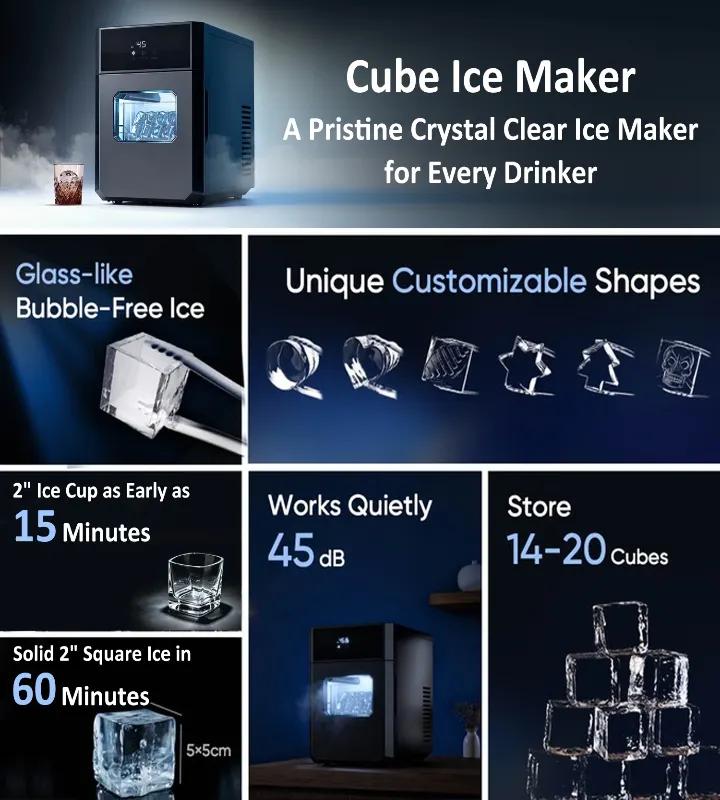
The YI220007 has dimensions of 382 x 254 x 355 mm and is intended for countertop placement. Due to its compact dimensions, it is suitable for domestic and office use and some small-scale beverage applications, but it should not be confused with a high capacity commercial floor-standing unit.
When evaluating capacity claims, buyers should request the test ambient temperature, incoming water temperature, selected ice mode, and method used to collect the 24-hour output.
These conditions are necessary for meaningful comparisons between suppliers.
Cleaning and Materials: The Less Visible Design Requirements
Long-term ice quality depends partly on water-circuit maintenance.
Undesired mineral buildup occurs on freezing surfaces and in water passages. Buildup obstructs heat transfer and may block the distribution of water and/or release of ice, creating hygienic concerns from stagnant water and untidiness in the system.
The YI220007 includes a cleaning mode that rinses the internal pipes and water tank. This mode supports basic maintenance; however, it should not be misinterpreted to mean the system automatically disinfects or removes mineral deposits.
YUMYTH discloses the materials used in the product to be ABS, silicone, and SUS304 stainless steel. Procurement teams should confirm which components of the product are of each material, particularly those which come in contact with water and/or finished ice.
For product approval, the assessment should consider refrigeration, the ability to clean and remove components, drain water, and food contact.
Evaluating YUMYTH's Cube Ice Maker for 2026 Product Programs
The YI220007 is a cube ice maker using R290 refrigerant and has 4 operation modes, scheduled functions, and the ability to make ice in different shapes with a quoted noise level of ≤48 dB.
From an evaluation standpoint, these features provide a basis for sample evaluations. Further evaluation and testing would be required for performance, assumptions on daily production, noise level measurements based on different conditions, and safety of the refrigerant for the intended market.
For the YUMYTH YI220007 Cube Ice Maker, or other technical discussions, and configuring the product, feel free to contact our team for sample and testing requirements.
FAQs
Q1. Does YUMYTH offer a freestanding ice maker?
YUMYTH offers the YI220007, a compact, self-contained countertop ice maker measuring 382 × 254 × 355 mm. It is not a floor-standing commercial unit.
Q2. How does YUMYTH produce clearer ice cubes?
The YI220007 provides 15-, 30-, 45-, and 60-minute freezing modes. Longer cycles are designed for clearer, more solid ice, although results also depend on water quality and operating conditions.
Q3. What is the daily production capacity of YUMYTH's ice maker?
The YI220007 has a offered standard production capacity of 12.6 kg per 24 hours. Its storage basket holds approximately 12–20 ice pieces.
Q4. Does YUMYTH use R290 refrigerant?
Yes. The YI220007 uses R290 propane refrigerant, which has low global warming potential. Its A3 flammability classification requires appropriate safety design and compliance verification.
Q5. Is YUMYTH's ice maker energy-efficient?
The YI220007 has a rated power of 240W. Actual energy efficiency depends on operating conditions and should be evaluated through measured electricity consumption per kilogram of ice.
Related Articles

How Does a Slush Machine Work Without Ice?
2026-10-29
BY arafatshuvo509
Traditional blender's use of crushed ice to mix an ingredient into a thick, cold drink is replaced by today's slush makers which are able to achieve the same result using ...
Compressor Slush Machine: Cooling System and Mixing Technology
2026-10-29
BY arafatshuvo509
A compressor slush machine utilizes an integral refrigeration process with continuous mechanical agitation of the refrigerated liquid to produce semi-frozen (slushy) liquids by creating ice crystals directly from the liquid. ...
Ice Maker for Small Kitchen: Compact Design for Apartment Living
2026-10-27
BY YUMYTH
An ice maker that fits on an apartment countertop may still be difficult to operate. A wall can obstruct condenser airflow, an overhead cabinet can prevent the lid from opening ...
2026 Freestanding Ice Maker Trends: Clear Ice, R290, and Smart Controls
2026-10-27
BY YUMYTH
A freestanding ice maker that can produce 12.6 kg of ice in a day may still not meet expectations. Its ice may turn cloudy because of short freezing cycles, it ...