Ice Maker for Small Kitchen: Compact Design for Apartment Living
Share:
-

-

-

-


Copied
Share:
-
-
-
-
Copied
An ice maker that fits on an apartment countertop may still be difficult to operate. A wall can obstruct condenser airflow, an overhead cabinet can prevent the lid from opening fully, and a small ice basket may interrupt production long before the machine reaches its advertised daily capacity.
Brands sourcing an ice maker for a small kitchen have to take into account a few different constraints. Smaller external dimensions create an even greater challenge for engineers to find an optimal balance between the performance of the refrigeration system, usable capacity, behavioral acoustic performance and access for maintenance.
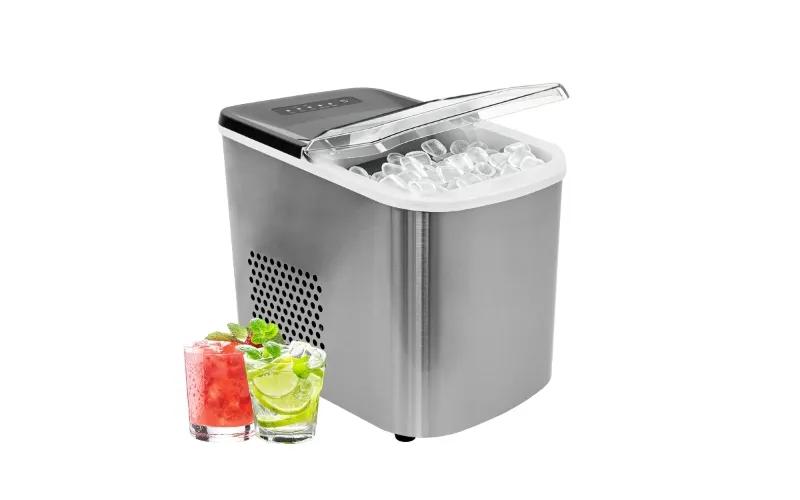
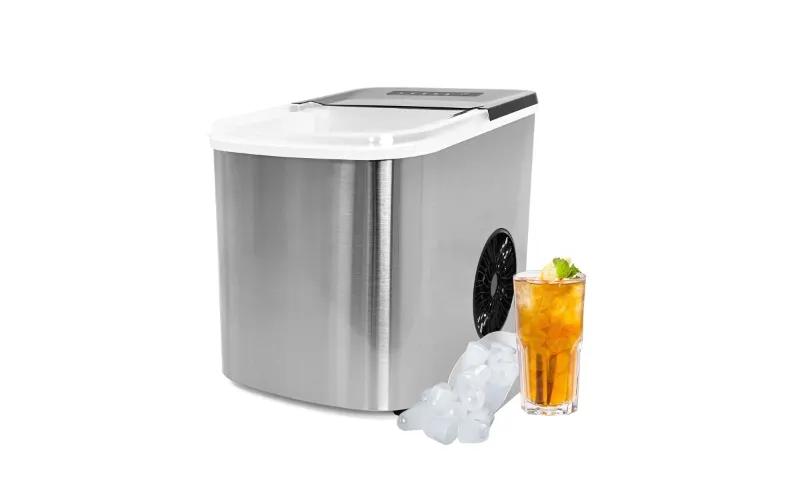
The YZ1501 Bullet Ice Maker by YUMYTH is a great reference when evaluating countertop ice making machines designed to be used in residential apartments and other similar space constrained environments.
1. Compact Dimensions do not Define Installation Space
The YZ1501 has external dimensions of 340 x 241 x 295 mm and weighs 8.9 kg with the power cord connected. Thus its countertop area is about 0.082 m².
This distinction becomes very important for kitchens with shallow countertops and/or closely spaced cabinets.
Any ice making machine needs clearance for three different functions.
•Heat Rejection: The condenser needs to be able to release heat and flow air. It is important that there is clearance around the entire ice making machine, including near the walls and other adjacent appliances.
•Ice Retrieval: The lid of the ice making machine needs to be able to open far enough for the basket to be removed without contacting any overhead cabinets.
•Water Management: Users have to be able to access the machine for filling and for maintenance to remove any water that may accumulate in the bottom.
The YZ1501 has a 1.1 meter (approx. 3.6') long power cord, so the location of the power outlet also needs to be considered.
For an evaluation of a potential purchase, place a physical sample of the ice making machine on a representative kitchen countertop and verify clearances to the ceiling (e.g. with the lid open) to confirm adequate clearances for heat rejection. The clearances needed for heat rejection are defined in the operating instructions and need to be trusted, not estimated based on the dimensions of kitchen wall units.
2. What Limits Ice Production in a Confined Kitchen?
A countertop ice maker employs the vapor-compression refrigeration cycle to transfer heat from the water to the surrounding air. The compressor pumps the refrigerant to increase its pressure, and the resulting high-pressure vapor is condensed in the condenser to give up its heat to the surrounding air. The low pressure vapor then enters the evaporator to provide the cold surface for ice formation.
A confined kitchen limits the air flow and the warm condenser exhaust may circulate back to the air intake. This may raise the condensing temperature and increase the load on the compressor and therefore, extend the ice making cycle.
The YZ1501 uses R290 refrigerant with a rated power of 170 W.
R290 is a flammable refrigerant with favorable refrigeration properties and a lower global warming potential. However, design, construction, and the selection of electrical components require appropriate safety controls and measures.
The 170 W rating does not indicate the daily energy consumption. The energy use is dependent on the ambient condition, the water temperature, the duration of production and interruptions.
For apartment applications, buyers should request verification of the following performance:
•Ice-cycle duration at representative room and water temperatures.
•Condenser inlet and exhaust temperatures during sustained production.
•Average power consumption during multiple cycles.
•Recovery after a full-basket or low water interruption.
A single short cycle under laboratory conditions should not be used to establish performance in the field.
3. How Much Ice Capacity Is Actually Usable?
When evaluating an Ice Maker for Small Kitchen, household demand should drive analysis rather than production.
The YUMYTH YZ1501 allows for adjustment of ice bulk size to large or small.
| Production Time | YZ1501 Data | Buyer Consideration |
| Small ice | 3.5 minutes for 9 pieces | Quicker access to small ice |
| Large ice | 5 minutes for 9 pieces | large ice for drinks |
| Daily production | 24 hours for 12 kg | Nominal production, not storage |
| Water tank | 1.52 L | Affects refill frequency |
| Ice basket | 1.26 L | Affects how much ice can be collected |
The difference between production and storage is very relevant.
A machine rated for 12kg per day does not mean it will yield that amount without assistance. There are many factors including how long the user is willing to wait between refills, when the user removes the accumulated ice, and if the water system detects the basket is full.
The YZ1501 does have indicators for low water and a full basket, but that does not necessarily mean the ice will stay frozen for a long time.
Hollow bullet ice takes up more surface area contact with drinks, which cools the drink faster, but smaller ice melts faster.
4. Noise, Materials, and Structural Compromises
Reducing the volume of the housing makes it harder to separate the compressor and fan from the water system and outer case, which makes isolation of vibration and absorption of noise more challenging.
The YZ1501 states a noise level of 45 dB. Again, absent a defined measurement distance and conditions of use, this value provides limited basis for comparison to competing models.
The various operations of this unit (i.e. compressor, fan, and ice harvester) create a distinguishable sounds. In a studio apartment, the intermittent impact noise of the ice harvester may be more annoying than the continuous sound of the compressor.
The true test for this model is the complete assessment of the noise created during the ice-making cycle and the release of the harvested ice. This assessment should be performed with the model placed on a kitchen counter.
Material Trade-Offs
The YZ1501 relies on the use of stainless steel, ABS and PC.
From a manufacturing perspective, each material has distinctive characteristics.
•Stainless steel is strong and rigid; however, sheet metal can be problematic, particularly if not adequately damped to reduce vibration.
•ABS is also strong and rigid, and has a reasonable temperature tolerance, which may vary depending on the grade and thickness of the part.
•PC can also be rigid; however, it is also impact-resistant and transparent, and depends on the materials with which it is in contact.
The material list does not define each component. It is also important to consider the application (i.e. the temperature, the chemical, and the food-contact sensitivity) to determine if the material is appropriate.
5. Cleaning Access Can Affect Long-term Usability
A compact ice maker operates by repeated exposure to water, minerals, and moisture. There are water contact components which, if they cannot be easily accessed, may cause scale and deposits to form, even if the refrigeration system is functioning properly.
The YZ1501 has a cleaning function which is intended to rinse the internal water circuit. This doesn't eliminate the need for manual cleaning.
There are water contact components which, based on the operating instructions, need to be inspected and cleaned regularly.
Prior to procurement, buyers should assess the practice of cleaning the water passages, whether the basket can be removed without spilling, and the overall practicality of the cleaning procedures.
In addition, repeated-cycle testing should evaluate consistency of ice release and the performance of water level and basket full detection sensors, after normal use.
6. What Should OEM Buyers Confirm Before Procurement?
For product lines focused on the apartment market, we suggest validating the appliance to actual installation conditions before approving its configuration.
Final tests must be performed on the YZ1501 Bullet Ice Maker to assess repeated-cycle reliability, thermal performance and acoustic behavior.
YUMYTH offers OEM/ODM customization such as color options, voltage and plug variations, labeling, housing color, packaging and functional variations. Changes affecting electrical and/or mechanical system or housing geometry require a detailed evaluation and applicable compliance testing.
For detailed specifications or to discuss OEM requirements, contact YUMYTH or provide us with your target market and installation conditions.
FAQs
Q1: What makes YUMYTH's ice maker suitable for small kitchens?
YUMYTH's YZ1501 measures 340 × 241 × 295 mm, offering a compact countertop design for apartments, studio kitchens, and other space-limited environments.
Q2: How much ventilation space does a compact ice maker need?
Adequate clearance is required around the condenser air inlets and outlets. Buyers should follow YUMYTH's installation instructions and avoid enclosed cabinets that restrict airflow.
Q3: How quickly does the YUMYTH YZ1501 produce ice?
The YZ1501 produces nine small bullet ice pieces in as fast as 3.5 minutes or nine large pieces in approximately five minutes under specified operating conditions.
Q4: Is a 12 kg/day ice maker sufficient for apartment use?
YUMYTH's YZ1501 has a rated output of 12 kg per 24 hours. Actual suitability depends on household demand, water refilling, ice removal, and operating conditions.
Q5: What are the water tank and ice basket capacities?
The YUMYTH YZ1501 features a 1.52 L water tank and a 1.26 L ice basket, supporting repeated ice-making cycles with periodic refilling and ice removal.
Related Articles

How Does a Slush Machine Work Without Ice?
2026-10-29
BY arafatshuvo509
Traditional blender's use of crushed ice to mix an ingredient into a thick, cold drink is replaced by today's slush makers which are able to achieve the same result using ...
Compressor Slush Machine: Cooling System and Mixing Technology
2026-10-29
BY arafatshuvo509
A compressor slush machine utilizes an integral refrigeration process with continuous mechanical agitation of the refrigerated liquid to produce semi-frozen (slushy) liquids by creating ice crystals directly from the liquid. ...
Ice Maker for Small Kitchen: Compact Design for Apartment Living
2026-10-27
BY YUMYTH
An ice maker that fits on an apartment countertop may still be difficult to operate. A wall can obstruct condenser airflow, an overhead cabinet can prevent the lid from opening ...
2026 Freestanding Ice Maker Trends: Clear Ice, R290, and Smart Controls
2026-10-27
BY YUMYTH
A freestanding ice maker that can produce 12.6 kg of ice in a day may still not meet expectations. Its ice may turn cloudy because of short freezing cycles, it ...