
Kitchen Appliance OEM Slushie Machine: How to Source and What to Look For
Share:
-

-

-

-


Copied

Share:
-
-
-
-
Copied
A kitchen appliance OEM slushie machine is not the same as a commercial frozen drink machine with your logo on it. The design requirements, certification standards, material grades, safety features, and consumer expectations are different — and sourcing from a commercial OEM factory without understanding those differences produces a product that does not fit its intended market. A kitchen appliance buyer expects a machine that operates quietly on a countertop, uses food-safe certified materials, includes a child lock, and cleans in minutes. A commercial operator expects throughput capacity and NSF compliance.
This guide covers what the kitchen appliance OEM slushie machine category requires specifically, what differentiates quality kitchen appliance OEM manufacturers from commercial suppliers, what certifications apply, and how to evaluate and choose an OEM partner whose engineering actually matches the kitchen use context you are building for.
What Is a Kitchen Appliance OEM Slushie Machine?
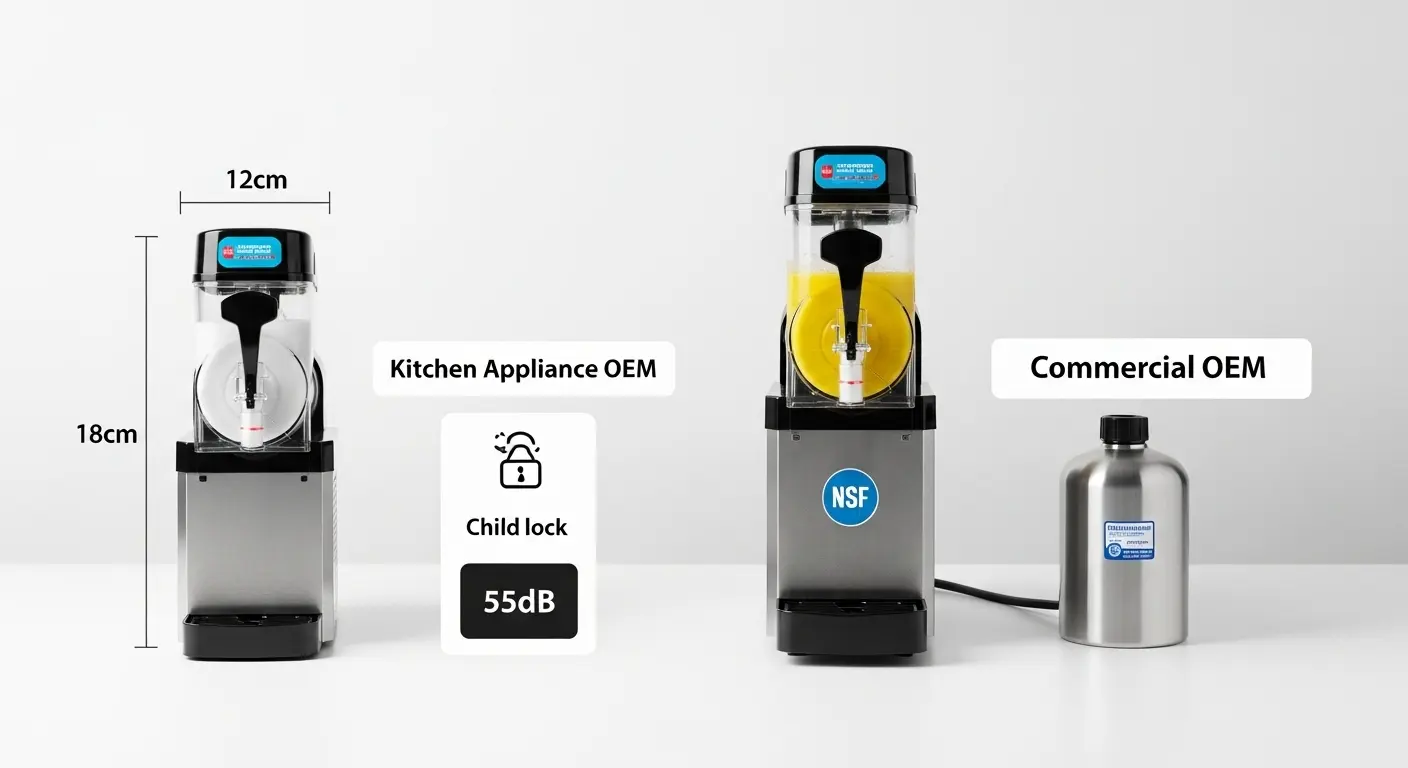
A kitchen appliance OEM slushie machine is a slushie machine designed, engineered, and manufactured for household and light-use countertop kitchen environments — built by an OEM manufacturer and sold under a brand buyer's own label. The "kitchen appliance" designation is not just a market segment; it carries specific design, material, noise, safety, and certification requirements that distinguish these machines from commercial frozen drink equipment.
How Kitchen Appliance OEM Differs from Commercial OEM
Commercial frozen drink machines are engineered for continuous high-volume operation in foodservice environments — high capacity, high throughput, NSF/ANSI 7 compliance, stainless construction throughout, and a service infrastructure designed for field technician access. Noise, countertop footprint, and child safety are not design priorities. Throughput and cleanability to commercial health code standards are.
A kitchen appliance OEM slushie machine inverts those priorities. Compact countertop dimensions are specified during engineering because the product lives in a kitchen. Noise must be kept at or below 55dB because it operates in a domestic environment during parties, family gatherings, and daily home use. Food-grade ABS and food-grade silicone are the material standards because household food contact regulations for consumer appliances are different from commercial NSF requirements. Child lock, auto-off, and overheat protection are consumer safety expectations — and in some markets, regulatory requirements — that commercial machines typically do not include.
Choosing a commercial OEM factory for a kitchen appliance OEM slushie machine produces a product that fails these expectations, even if the core freeze functionality works. The engineering context is wrong from the start.
OEM vs. ODM for Kitchen Appliance Slushie Machines
OEM — you bring the engineering specification, the manufacturer builds to it — gives full product ownership and differentiation. It requires 6–12 months of development, custom tooling, and higher volume commitment. Right for established kitchen appliance brands with specific engineering requirements and a clear market position.
ODM — the manufacturer owns a kitchen appliance slushie machine platform, you adapt and brand it — is faster, lower cost, and starts from a product that has already been validated for kitchen use. Right for brands entering the category for the first time, or for importers who need a proven platform to build a brand around. Most first-time kitchen appliance OEM slushie machine buyers start with ODM and move to full OEM as their brand scales.
Kitchen Appliance OEM Slushie Machine: Design Standards That Matter
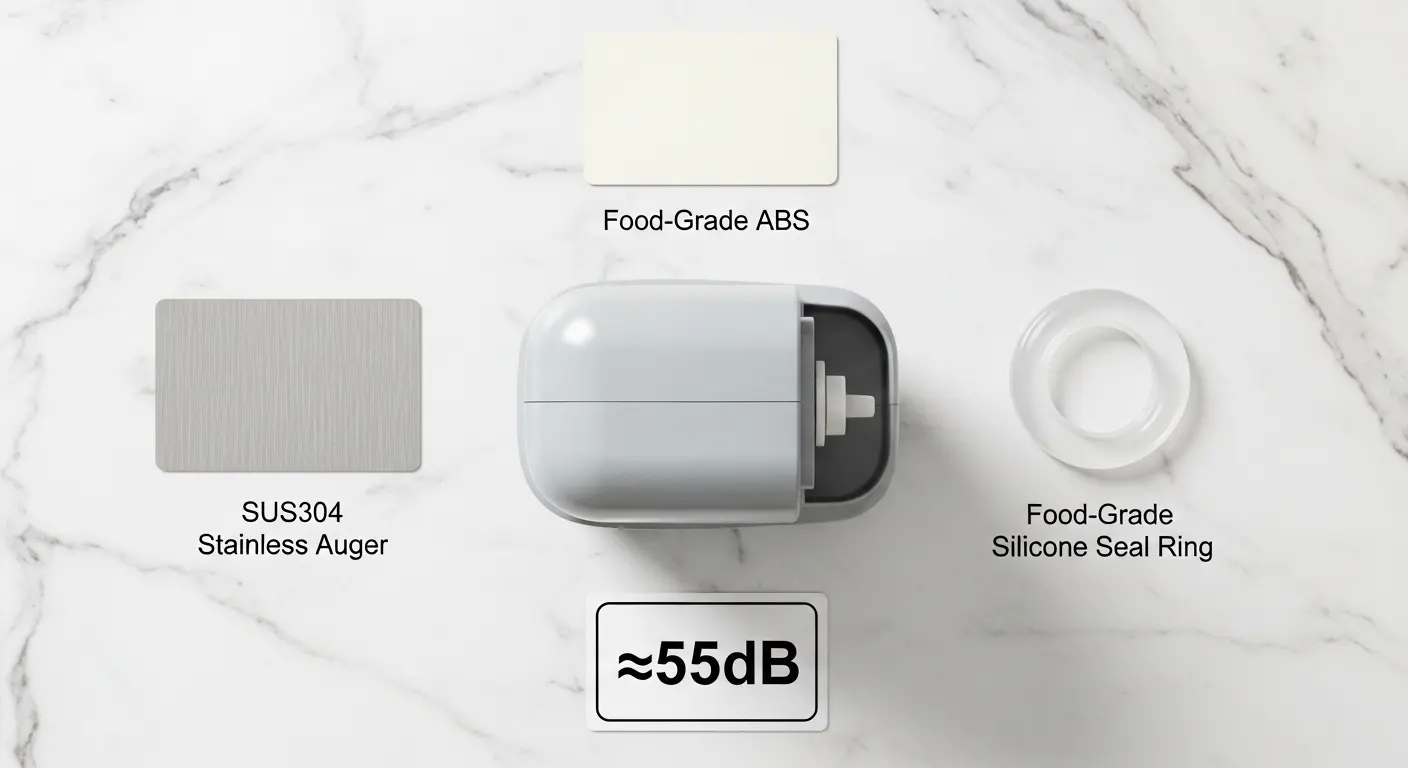
These are the engineering characteristics that define a quality kitchen appliance OEM slushie machine — and the ones to verify in any OEM partner's product documentation.
Noise Rating
A kitchen appliance OEM slushie machine must operate quietly. 55dB or below is the functional standard for a kitchen countertop appliance — comparable to a normal conversation level. A machine that operates at 65–70dB in a kitchen is loud enough to disrupt the surrounding environment, which creates negative consumer reviews and returns, regardless of freeze performance.
A real kitchen appliance OEM manufacturer specifies the noise rating in their product documentation with a precise decibel figure. If a supplier's listing says "quiet operation" without a decibel rating, they have not verified their product against this standard — or they know the number and prefer not to publish it.
Material Safety Standards
Kitchen appliance OEM slushie machines contact food directly — drinks, dairy, alcohol, citric mixes. The material standards for food contact components are non-negotiable for consumer markets: food-grade ABS for the bowl and machine body, food-grade (FDA or LFGB-compliant) silicone for the seal ring and gaskets, and SUS304 stainless steel for the auger and internal structural components .
These are not the cheapest material choices. They are the correct ones for a kitchen appliance OEM product that will be used with acidic fruit mixes, sugary syrups, and dairy liquids across hundreds of use cycles. A kitchen appliance OEM manufacturer who specifies these grades has made deliberate engineering decisions. One who describes materials only as "food-safe" or "BPA-free" without grade identification has not.
Child Safety and Consumer Features
Consumer kitchen appliance markets in the US, EU, and most developed markets require or strongly expect child lock functions on appliances that operate with moving mechanical parts. A kitchen appliance OEM slushie machine should include child lock as a documented feature — not as a marketing addition, but as a verified control system element.
Similarly, auto-off after a defined run cycle, overheat protection, and clearly labeled operational modes are consumer safety and usability features that kitchen appliance buyers expect. These are design decisions that happen at the engineering stage — they cannot be added to a commercial machine after the fact.
Compact Form Factor and Countertop Design
A kitchen appliance OEM slushie machine is designed for a countertop, not a commercial preparation area. This means specific dimension constraints — the machine must fit under standard kitchen cabinets, on a standard countertop depth, and next to typical kitchen appliances. Weight matters too: a home kitchen appliance that weighs more than 12kg is difficult for most users to move for cleaning access.
Real kitchen appliance OEM manufacturers document their machine dimensions precisely: height, width, depth, and net weight. These are engineering outputs. They confirm that countertop fit was a design consideration, not an afterthought .
Certifications Required for Kitchen Appliance OEM Slushie Machines
Certification requirements for kitchen appliance OEM slushie machines depend on the target market. Confirming that an OEM partner holds — or can obtain — the relevant certifications is a mandatory step before committing to a production order.
CE (EU and UK): Required for selling in the European Union and United Kingdom. CE for kitchen appliances covers electrical safety (Low Voltage Directive), electromagnetic compatibility, and in some categories, food contact material compliance. The certification is issued per model — the model number on the certificate must match the specific kitchen appliance OEM slushie machine you are ordering.
ETL or UL (North America): North American markets require ETL or UL certification for electrical safety on kitchen appliances. These certifications are model-specific and issued by independent testing laboratories. An OEM partner who already holds ETL or UL on the specific platform you are ordering removes the 8–12 week certification timeline from your launch plan.
LFGB (Germany / EU food contact): LFGB certification covers food contact material safety — confirming that the silicone, ABS, and stainless components meet EU food safety standards for materials that contact food and drink. This is particularly relevant for kitchen appliance OEM slushie machines sold in Germany and broader EU markets.
FDA (US food contact): FDA food contact compliance is the US equivalent — confirming that food contact materials meet FDA 21 CFR standards. For kitchen appliance OEM slushie machines entering US retail channels, FDA food contact compliance documentation strengthens the product's regulatory position significantly.
Confirm that any kitchen appliance OEM partner you work with holds current certifications on the specific platform you plan to order, and request original certification documents — not website logos — before placing a deposit.
How to Evaluate a Kitchen Appliance OEM Slushie Machine Partner
Most problems in kitchen appliance OEM slushie machine sourcing trace back to a single evaluation failure: choosing a factory that builds commodity slushie machines and calling it a kitchen appliance OEM partner. Here is the evaluation framework that filters out the wrong options.
Request the full platform technical spec sheet. A real kitchen appliance OEM manufacturer for slushie machines provides: model number, rated voltage, rated power in watts, noise level in decibels, coolant type, capacity in liters, machine dimensions in millimeters, net and gross weight, and container loading quantities. This is not a marketing document — it is an engineering output. Factories that produce this immediately control their product. Factories that produce a brochure instead do not.
Verify kitchen-specific feature documentation. Ask specifically about child lock, auto-off cycle, overheat protection, cleaning access, and dishwasher-safe component designation. A real kitchen appliance OEM manufacturer documents these features with specific descriptions — not just checkboxes on a feature list. Ask how the child lock is implemented and how it is disabled during operation. The answer tells you whether it is a real engineered feature or a marketing label.
Check for auger engineering. The auger system is the most significant differentiator in kitchen appliance slushie machine quality. A basic auger rotates in one direction at one speed. A quality kitchen appliance OEM slushie machine features an intelligent auger reversal system that monitors resistance, reverses direction on detection of buildup or jam, and restarts automatically. Ask specifically how the auger handles thick mixes and over-freeze conditions. If the answer is vague, the system is basic.
Request sample units and test them. Test a sample unit through at least ten complete use and cleaning cycles before committing to production. Specifically test: freeze time with different liquid types (water-based slush, dairy milkshake, alcohol cocktail), noise level in a quiet kitchen environment, cleaning access and seal ring reassembly, child lock function, and auto-off behavior.
Verify R&D and engineering capability. A kitchen appliance OEM manufacturer who controls their product design can describe their R&D process, patent holdings, and engineering team capability. Ask about the number of engineers on the product development team, whether they hold patents on any machine features, and what the product revision process looks like. These answers distinguish genuine OEM manufacturers from assembly factories.
Yumyth as a Kitchen Appliance OEM Slushie Machine Partner
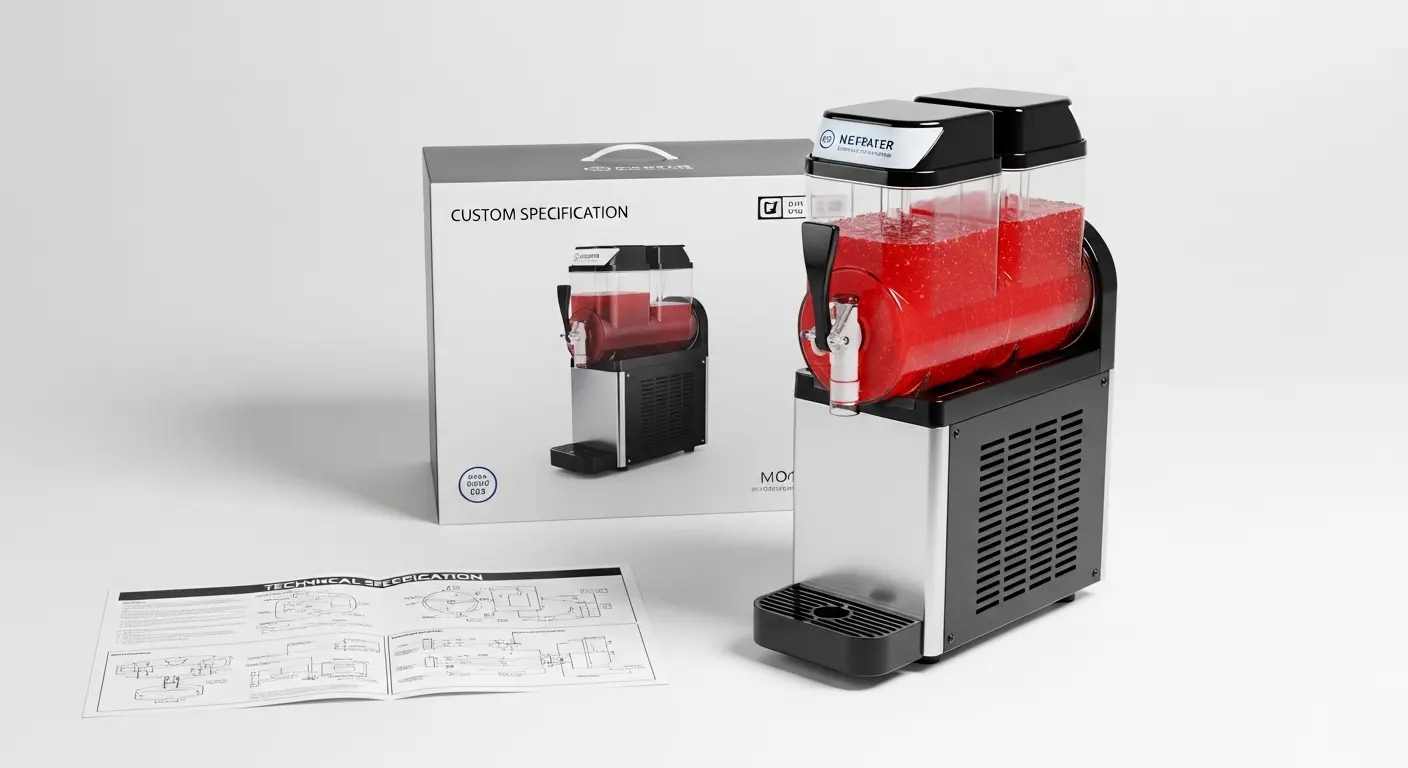
Yumyth is a direct kitchen appliance OEM slushie machine manufacturer with two verified home-use platforms available for OEM and ODM adaptation.
The YX1801 — the Yumyth Mini Slush Machine — is a 61oz kitchen appliance slushie machine rated at 200W, operating at ≤55dB. Dimensions: 322mm × 175mm × 392mm, net weight 9.2kg. Materials: food-grade ABS, food-grade silicone, SUS304 stainless steel contact components. Coolant: R290. Features include six preset programs (Slush, Wine, Milkshake, Cocktail, Coffee, Custom), six-stage texture control, patented intelligent auger reversal with automatic jam protection, 3-minute quick rinse cycle, child lock, auto-off, and detachable handle with dishwasher-safe silicone seal ring. Container loading: 540/20GP, 1080/40GP, 1296/40HQ.
The YX1802 — the Yumyth Slush and Ice Cream Maker — adds ice cream mode alongside all six slush programs at 220W. Dimensions: 452mm × 175mm × 398mm, net weight 10.2kg, same material standards and patented auger system throughout. For kitchen appliance brands targeting dual-function positioning — one countertop machine for frozen drinks and frozen desserts — the YX1802 covers both use cases in a single kitchen-appropriate form factor.
Both platforms support kitchen appliance OEM and ODM customization: branding, color, packaging, feature configuration, and market-specific certification adaptation. Quality control covers incoming material inspection, in-process assembly, and finished product performance testing.
For kitchen appliance brand buyers who want to understand how slush machines and ice cream machines compare in engineering design and user experience before selecting an OEM platform, the ice cream vs slush machine guide walks through both machine types in detail. And for brands building a broader kitchen appliance frozen food line, the industry insights section covers how the home frozen drink machine category is evolving — relevant context for positioning a kitchen appliance OEM slushie machine launch.
Kitchen Appliance OEM vs. Commercial OEM: A Direct Comparison
Understanding how kitchen appliance OEM and commercial OEM differ in practical terms helps brand buyers select the right manufacturing partner category from the start.
| Factor | Kitchen Appliance OEM | Commercial OEM |
|---|---|---|
| Capacity | 48–88oz (1.4–2.6L) | 3L–45L per tank |
| Noise spec | ≤55dB (documented) | Not typically specified |
| Material standard | Food-grade ABS, silicone, SUS304 | Full stainless, NSF construction |
| Child safety features | Child lock, auto-off standard | Not required |
| Key certifications | CE, ETL, UL, LFGB, FDA | NSF/ANSI 7, dairy certification |
| Countertop dimensions | Specified (fits under cabinet) | Not constrained |
| Weight | 9–11kg typical | 20–60kg+ |
| Packaging | Consumer retail packaging | Commercial/freight shipping |
| Typical ODM MOQ | 200–500 units | 50–200 units |
| After-sales support | Direct consumer online | Commercial field service |
For brands selling to households and small hospitality venues, kitchen appliance OEM is the appropriate manufacturing category. Commercial OEM produces machines built for a different operational context — and marketing them into consumer kitchens creates performance and safety gaps that reviews, returns, and regulatory compliance will surface quickly.
For kitchen appliance brands also considering complementary product categories, the ice makers buying guide covers kitchen-grade ice appliances that pair naturally with a slushie machine in a home frozen drink setup. The vacuum sealers guide covers another kitchen appliance category relevant for brands building frozen beverage product bundles or subscription programs.
What to Expect from a Kitchen Appliance OEM Slushie Machine Order
Timeline — standard ODM kitchen appliance order on a certified platform:
- Supplier evaluation, sample request, and testing: 2–4 weeks
- Artwork approval and pre-production sample: 2–3 weeks
- Certification under brand name (if required): 8–16 weeks
- Production run: 3–5 weeks
- Sea freight to North America: 20–30 days
- Sea freight to Europe: 25–35 days
Total realistic timeline: 45–75 days for a straightforward ODM order on an already-certified kitchen appliance platform. Add 8–16 weeks if CE or ETL certification under your specific brand name is required from scratch.
Cost structure: For a quality kitchen appliance OEM slushie machine on a documented ODM platform, FOB unit prices at ODM MOQ typically range from $45–$95 depending on platform, volume, and customization scope. Below this range, compromises in material grade, compressor quality, or QC process are nearly always present. Custom color, packaging design, and certification costs are additional line items — factor these into your full landed cost before finalizing retail pricing.
Frequently Asked Questions
What is a kitchen appliance OEM slushie machine?
A kitchen appliance OEM slushie machine is a slushie machine designed specifically for household kitchen use — with quiet operation (≤55dB), food-grade certified materials, child safety features, compact countertop dimensions, and consumer-facing certifications (CE, ETL, LFGB) — built by an OEM manufacturer and sold under a brand buyer's own label. It differs from a commercial slushie machine OEM product in design priorities, material standards, and certification requirements.
How is kitchen appliance OEM different from commercial slushie machine OEM?
Kitchen appliance OEM slushie machines are engineered for domestic countertop use — quiet, compact, multi-mode, and built with food-grade certified materials and child safety features. Commercial OEM machines are engineered for foodservice operations — high capacity, NSF-compliant, continuous-use construction, and field-serviceable design. Using a commercial OEM platform to supply a kitchen appliance product creates mismatches in noise, size, safety features, and certification that consumer markets will penalize through returns and reviews.
What certifications does a kitchen appliance OEM slushie machine need?
The required certifications depend on your target market. CE is required for the EU and UK. ETL or UL is required for North America. LFGB (Germany/EU) and FDA (US) certifications cover food contact material compliance for components that contact drinks. Confirm that an OEM partner holds current certifications on the specific platform you are ordering, and request original certification documents rather than website logos.
How do I know if a kitchen appliance OEM slushie machine manufacturer is reliable?
Verify through specific material grade documentation, quantified performance specs (watts, decibels, liters, millimeters), original certification documents matched to the specific model, replacement parts availability by component name, and documented kitchen-specific features (child lock, auto-off, noise rating). A real kitchen appliance OEM slushie machine manufacturer answers all of these without hesitation. A factory without genuine engineering ownership deflects to marketing materials and vague claims.
Related Articles

Household Slush Machine: What to Know Before Buying One in 2026
2026-09-24
BY YUMYTH
A household slush machine makes frozen drinks at home. It works differently from a blender. A blender crushes ice into your drink, which adds water and waters down the flavor. ...

How Does a Nugget Ice Maker Work? A Look Inside the Ice-Making Process
2026-09-24
BY YUMYTH
Nugget ice looks simple enough. Small, soft pieces of ice drop into the bin, ready to go into a glass. But making that texture is quite different from making a ...
Nugget Ice Maker for Coffee Shop: How Ice Texture Affects Coffee
2026-09-24
BY YUMYTH
When choosing a Nugget Ice Maker for a Coffee Shop, there are many factors to consider aside from the rate of ice production. At YUMYTH, we consider the downstream implications ...
Why Nugget Ice for Soda Creates a Different Mouthfeel Than Traditional Ice Cubes
2026-09-24
BY YUMYTH
At YUMYTH, we believe there is more to Nugget Ice for Soda than just the effect on temperature. The structure of ice also changes the perception of carbonation, how quickly ...