
ODM Slush Machine Engineering: Smart Cooling and Auger Control
Share:
-

-

-

-


Copied
Share:
-
-
-
-
Copied
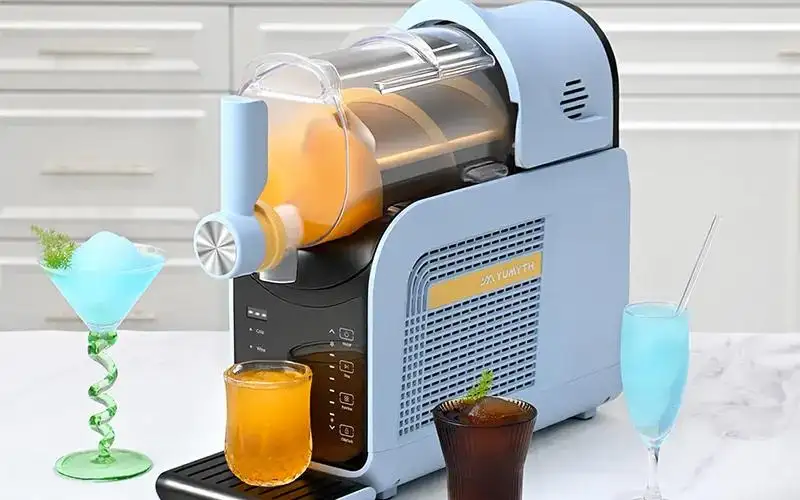
Our team at YUMYTH, takes a system-level approach to product development. For instance, an ODM Slush Machine is more than a frozen drink dispenser. It is a refrigeration and mechanical system. Stable slush quality is more than the sufficient capacity of a compressor. It is the synthesis of a number of elements such as mechanical protection, firmware logic, refrigeration, and the control of temperature and auger movement.
For this reason, smart control has become an important part of modern ODM Slush Machine development.
What Makes an ODM Slush Machine Truly "Smart"?
A smart ODM Slush Machine should be able to detect operating changes, interpret them through the control board, and adjust system behavior.
The basic control chain is:
Sensor Input → PCB / Firmware → Cooling or Auger Response → New Feedback
This creates a closed-loop system.
| Design Area | Basic Machine | Smart ODM Slush Machine |
| Cooling | Fixed operation | Feedback-based control |
| Auger | One-way rotation | Reversible / protected rotation |
| Texture | Mainly time dependent | Temperature + mixing dependent |
| Protection | Basic shutdown | Jam and overload response |
| User Control | Limited modes | Multiple programs and texture settings |
| ODM Capability | Appearance changes | Hardware + firmware customization |
For ODM projects, this distinction is critical. A different control algorithm can change freeze time, motor load, texture, noise, and long-term reliability.
Temperature Sensors Are Only One Part of the Control System
In an ODM Slush Machine, sensors do not work independently. Their value depends on how the PCB and firmware interpret operating data.
A practical system may monitor:
• Beverage temperature
• Liquid volume or operating condition
• Auger resistance
• Program stage
• Abnormal motor behavior
At YUMYTH, the YX1801 platform uses temperature and liquid-condition monitoring to support intelligent auger adjustment.
The important engineering principle is simple:
A sensor measures. The controller decides. The actuator responds.
This means the real performance of an ODM Slush Machine depends on sensor accuracy, firmware thresholds, control timing, and component response—not on the sensor alone.
Why Auto-Reverse Auger Design Matters
The auger affects both how heat is transferred and the texture of the product.
The freezing process occurs in a series of steps. To begin, ice formation begins at the beverage's contact point with the freezing surface. In order to maximize the surface area of the beverage in contact with the freezing surface, previously formed ice is removed through the use of an auger.
Using this process results in:
• More uniform ice crystals
• Faster freezing
• Less irregular and localized freezing
• A better and more consistent product
Thickening of the beverage increases its viscosity and mechanical resistance.
From an engineering perspective:
Increased resistance of the liquid by the auger results in increased motor torque.
This can result in:
• Failure of the gearbox
• Failure of the motor
• Localized buildup of ice
• Loud scraping sounds
• Stalling of the auger
Inequalities in the texture of the frozen product.
Because of this, it is beneficial to have auto-reverse controls in a Slush Machine.
Auto-Reverse Control Logic
A typical sequence can be simplified as:
Normal Rotation
→ Resistance increases
→ Control system detects abnormal load
→ Auger pauses or reverses
→ Frozen material redistributes
→ Normal operation resumes
The YUMYTH YX1801 uses intelligent auger reversal and jam-protection logic to reduce mechanical stress and improve mixing stability.
Intelligent Cooling Is About Balance, Not Maximum Cold
A common misunderstanding is that stronger cooling automatically produces better slush.
It does not.
A system must balance refrigeration and movement to create Slush.
Factors that influence consistency include:
| Factor | Impact on Texture |
| Beverage Temperature | Level of Freezing |
| Tank Volume | Total Thermal Load |
| Auger Speed | Size of Crystals |
| Refrigeration Capacity | Removal of Heat |
| Program Logic | Order of Freezing |
| Ambient Temperature | Performance of Condenser |
| Holding Time | Consistency |
A machine must balance these factors. Changes to one affects others.
For instance, increasing tank volume increases the time needed to freeze the Slush. Similarly, increasing the capacity of the refrigeration system without balancing it with increased agitation would result in Slush with heavy ice build-up along the inner wall of the tank.
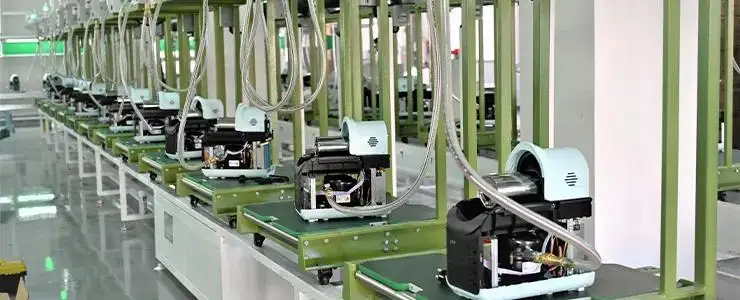
This is why YUMYTH develops the refrigeration, mixing, and control system as one integrated platform.
How YUMYTH Coordinates Cooling and Mixing
The YX1801 ODM Slush Machine uses:
• 1.8 L / 61 oz capacity
• 200 W rated power
• R290 refrigerant
• 5 preset programs
• 1 Custom mode
• 6 texture / temperature levels
• Intelligent auger reversal
• Automatic jam protection
• ≤55 dB operating noise
These specifications are not isolated features. They form a coordinated system.
The control flow can be summarized as:
Beverage Condition
↓
Sensor Feedback
↓
PCB + Firmware Logic
↓
Compressor / Auger Decision
↓
Cooling and Mixing Response
↓
Texture Adjustment
This closed-loop approach gives the system more control over freezing behavior than a simple timer-based machine.
More Than Skin-Deep Changes are Needed with ODM Development
When looking at ODM development, from an engineering point of view, we need to look at changes to both the visible and the hidden systems.
Visible Systems
These include:
• Exterior design
• Control panels
• Button functions
• Logic
• Firmware
• User Interface
Hidden Systems
Changes may also include:
• Temperature controls
• Timing
• Holding
• Protection
• Behavior of various systems
• Logic flow
• Designs
• User-interface systems
Mechanical and Refrigeration Systems
Changes may include:
• Geometric design of various systems
• Structures
• Piping and air flow systems
• Various components
From an engineering perspective, changes to a slush machine are not simple and require evaluation of the machine systems as a whole.
For example:
Changing auger geometry may improve mixing, but it can also increase motor torque, current draw, and gearbox load.
This is where ODM engineering becomes more important than simple product customization.
How We Validate an ODM Slush Machine Before Production
An ODM Slush Machine should not move directly from prototype to production after one successful test.
At YUMYTH, validation should focus on repeatability.
Key areas include:
Refrigeration Performance
• Freeze-time stability
• Temperature consistency
• Texture repeatability
• Condenser heat rejection
Mechanical Performance
• Auger startup torque
• Reverse response
• Gearbox load
• Vibration
• Jam recovery
Firmware Performance
• Program transitions
• Sensor response
• Error handling
• Protection logic
Production Consistency
• Component tolerance
• Assembly variation
• Noise level
• Final-unit performance
This step is especially important because prototype performance does not automatically guarantee mass-production consistency.
Conclusion
A smart ODM Slush Machine is not defined by one sensor, one program, or one automatic feature. Its performance comes from coordination between refrigeration, sensing, auger control, firmware, and mechanical protection.
At YUMYTH, the YX1801 platform combines a 1.8 L capacity, 200 W power rating, R290 refrigerant, six texture settings, intelligent auger reversal, automatic jam protection, and ≤55 dB operation in one integrated design.
Brands creating a new ODM Slush Machine can contact us for engineering assessment and evaluation, as well as design and firmware changes. We can also help create prototypes and prepare for production. The YX1801 can be used to help refine ideas for control systems, design and aesthetics, and other changes to improve performance.
FAQs
Q1. What ODM services does YUMYTH provide for slush machines?
YUMYTH supports ODM Slush Machine development from product concept and exterior design to structural engineering, electronic development, prototyping, testing, and production preparation.
Q2. Can YUMYTH customize the control programs of an ODM Slush Machine?
Yes. Depending on project requirements, YUMYTH can evaluate customized program settings, temperature control logic, operating sequences, and other firmware-related functions.
Q3. What is the capacity of the YUMYTH YX1801 Slush Machine?
The YUMYTH YX1801 has a 1.8 L / 61 oz capacity, providing a compact platform for household frozen beverage preparation.
Q4. What refrigerant does the YUMYTH YX1801 use?
The YX1801 uses R290 refrigerant, which is integrated into its compact refrigeration system.
Q5. How does the auto-reverse auger work in the YX1801?
The intelligent auger system can adjust or reverse rotation when operating conditions change, helping redistribute frozen material, reduce localized buildup, and protect the drive system.
Related Articles

Household Slush Machine: What to Know Before Buying One in 2026
2026-09-24
BY YUMYTH
A household slush machine makes frozen drinks at home. It works differently from a blender. A blender crushes ice into your drink, which adds water and waters down the flavor. ...

How Does a Nugget Ice Maker Work? A Look Inside the Ice-Making Process
2026-09-24
BY YUMYTH
Nugget ice looks simple enough. Small, soft pieces of ice drop into the bin, ready to go into a glass. But making that texture is quite different from making a ...
Nugget Ice Maker for Coffee Shop: How Ice Texture Affects Coffee
2026-09-24
BY YUMYTH
When choosing a Nugget Ice Maker for a Coffee Shop, there are many factors to consider aside from the rate of ice production. At YUMYTH, we consider the downstream implications ...
Why Nugget Ice for Soda Creates a Different Mouthfeel Than Traditional Ice Cubes
2026-09-24
BY YUMYTH
At YUMYTH, we believe there is more to Nugget Ice for Soda than just the effect on temperature. The structure of ice also changes the perception of carbonation, how quickly ...