
How Are Slush Machines Tested Before Mass Production?
Share:
-

-

-

-


Copied

Share:
-
-
-
-
Copied
The slush machine must meet a number of tests prior to mass production, including refrigeration efficiency, beverage consistency, electrical safety, mechanical strength, food contact surface and parts, firmware, cleaning, noise, packaging, and production tolerances.
Testing one single piece of an attractive sample of engineering is not sufficient. The manufacturer is responsible for ensuring that the final design will perform as required in realistic conditions and that the factory can achieve the same performance with the production tooling, final suppliers, trained operators and standard inspection.
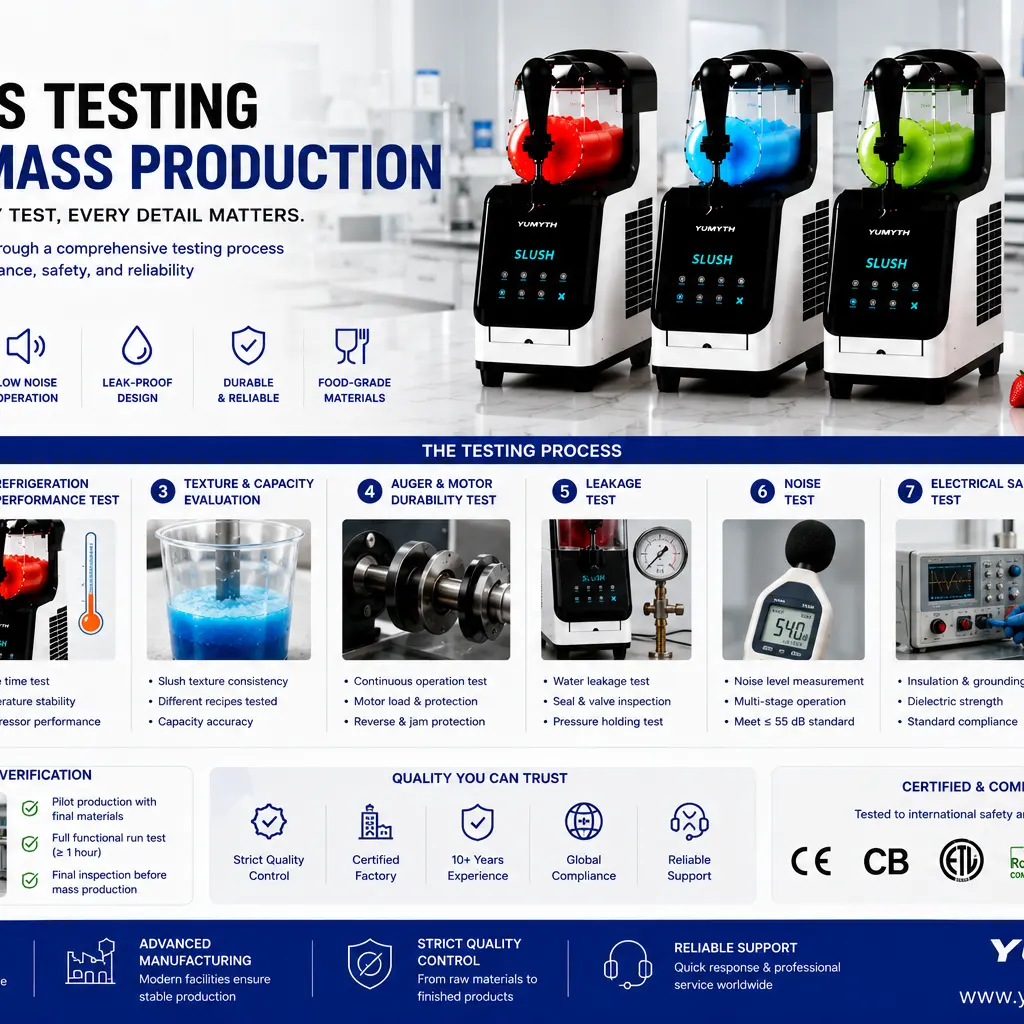
YUMYTH's published OEM/ODM process includes compliance and performance testing, certification, packaging development and pilot-run production prior to mass production. This step-by-step approach enables them to find design and manufacturing problems prior to buying materials or assembling parts in large numbers.
Requirements and Acceptance Criteria Come First
Testing should begin with a written product specification.
The document should define:
- Working capacity;
- Rated voltage and frequency;
- Refrigerant and charge;
- Supported beverage types;
- Target freeze time;
- Noise limit;
- Texture settings;
- Maximum operating temperature;
- Cleaning method;
- Safety requirements;
- Packaging configuration.
There must be measurable acceptance criteria for each of the important requirements. The term “fast freezing” is very general. Useful requirement: Volume of beverage, initial beverage temperature, Brix level, ambient temperature, program selection, maximum time to reach approved texture.
Without controlled conditions, different samples cannot be compared fairly.
Engineering Prototype Testing
Early prototypes are used to evaluate the basic product architecture before production tooling is finalized.
Engineers test whether the compressor, condenser, evaporator, capillary tube, fan, auger motor, gearbox, sensors, control board, and firmware operate together correctly.
Typical engineering checks include:
- Refrigeration-system balance;
- Evaporator temperature;
- Compressor temperature;
- Motor current;
- Auger speed;
- Sensor accuracy;
- Airflow;
- Power consumption;
- Beverage circulation;
- Control-panel response.
At this stage, the purpose is not only to obtain a successful slush drink. Engineers must identify operating margins and understand what happens when conditions are less favorable.
Freeze-Time and Texture Testing
Freeze-time testing measures how long the machine takes to transform a defined liquid mixture into an approved semi-frozen texture.
The test report should record:
- Beverage recipe;
- Brix level;
- Alcohol concentration;
- Fill volume;
- Starting liquid temperature;
- Ambient temperature;
- Supply voltage;
- Selected program;
- Final beverage temperature;
- Time to completion.
Different conditions should be tested, since generally a refrigerated beverage will freeze before a room temperature mixture. Production-test examples published by YUMYTH show that pre-chilled liquids got to slush readiness first when compared to liquids at room temperature, which is why starting temps have to be included in all freeze-time claims.
In addition, the appearance of the finished product should be tested for smoothness, uniform dispersion, dispensability and holding. Engineers need to be aware of the presence of large ice crystals, watery areas, hard frozen layers, and separation.
Recipe Compatibility Testing
A slush machine may be advertised for juice, soda, coffee, cocktails, mocktails, or dairy-based drinks. These formulations do not freeze in the same way.
Testing should cover the declared operating range, including:
- Minimum and maximum Brix;
- Approved alcohol concentration;
- Low- and high-viscosity liquids;
- Minimum and maximum fill levels;
- Drinks containing approved fruit or dairy ingredients.
A low-sugar recipe can freeze too hard and increase auger resistance. A high-alcohol or high-sugar beverage may remain too soft.
The manufacturer should establish validated recipe windows rather than claiming that every liquid can be used.
Auger Load and Jam-Protection Testing
The auger and drive system operate under increasing resistance as the beverage thickens.
Engineers should monitor motor current and confirm that the machine can distinguish normal thickening from an abnormal obstruction. Tests may intentionally create difficult operating conditions to evaluate:
- Automatic auger reversal;
- Compressor interruption;
- Motor thermal protection;
- Retry limits;
- Error messages;
- Protective shutdown.
The machine should recover safely from temporary ice buildup. When the obstruction remains, it should stop rather than repeatedly stressing the gearbox, motor, shaft, or coupling.
YUMYTH describes its slush platform as using dual-direction mixing for clog prevention and motor protection, making verification of this function an important part of product testing.
Leakage and Dispensing Tests
Leakage testing should be completed after assembly, after repeated operation, and after the food-contact parts have been removed and reinstalled.
Inspectors should check:
- Tank-to-base sealing;
- Rim seals;
- Dispensing valve;
- Nozzle;
- Internal connections;
- Drip tray area.
The machine should also be tested with different approved textures. A valve that works correctly with water may drip, block, or close slowly when dispensing thick slush.
Repeated handle operation helps evaluate valve wear, seal compression, spring behavior, and long-term closure performance.
Cleaning and Reassembly Testing
A slush machine must remain practical to clean after sugary, acidic, colored, alcoholic, coffee, or dairy recipes.
Testers should complete the full user process:
- Dispense the remaining beverage.
- Run the approved rinse program.
- Remove the tank, auger, seals, valve, lid, and drip tray.
- Wash and dry the components.
- Reassemble the machine.
- Repeat the leakage and operating tests.
Various conditions should be investigated, as, in general, a cold beverage will freeze first, and a warm beverage last. Production-test examples published by YUMYTH show that pre-chilled liquids got to slush readiness first when compared to liquids at room temperature, which is why starting temps have to be included in all freeze-time claims.
The final product's appearance should also be checked for smoothness, even dispersion, dispensability and holding as well. It is important for engineers to know about the presence of large ice crystals, watery areas, hard frozen layers and separation.
Noise and Vibration Testing
Noise should be measured throughout the complete cycle, not only when the beverage is still liquid.
Important stages include:
- Compressor startup;
- Fan operation;
- Early mixing;
- Ice formation;
- Final thickening;
- Auger reversal;
- Holding mode;
- Dispensing;
- Cleaning.
The loudest condition may occur when the auger is moving a thick mixture.
Various conditions should be investigated, as, in general, a cold beverage will freeze first, and a warm beverage last. Production test samples from YUMYTH demonstrate that pre-chilled liquids reach slush readiness earlier than liquids at room temperature so pre-chilled liquid starting temps must be included in all freeze-time claims.
The final product's appearance should also be checked for smoothness, even dispersion, dispensability and holding as well. The knowledge of the presence of large ice crystals, watery areas, hard frozen layers and separation is important for the engineers.
Electrical and Refrigeration Safety Testing
Household compressor appliances require formal safety evaluation against the standards applicable to their target markets.
IEC 60335-2-24:2025 covers household refrigerating appliances, ice-cream appliances, ice makers, and compression-type appliances using flammable refrigerants. It addresses common hazards associated with these products and is used together with the general requirements of IEC 60335-1.
Depending on the product and market, testing may cover:
- Protection against electric shock;
- Earthing;
- Insulation;
- Leakage current;
- Dielectric strength;
- Temperature rise;
- Abnormal operation;
- Moving-part access;
- Motor protection;
- Refrigerant leakage;
- Flammable-refrigerant risks.
Certification samples must match the intended production construction. Changes to the compressor, PCB, motor, power cord, refrigerant charge, ventilation, housing, or safety-related firmware may require additional review.
Food-Contact Material Verification
Every component that touches the beverage should be identified by exact material grade and supplier.
The review should include:
- Beverage tank;
- Auger;
- Evaporator surface;
- Seals;
- Lid contact surfaces;
- Valve;
- Nozzle;
- Dispensing channel.
Material declarations and test reports should match the final production bill of materials. A general statement such as “food grade” is not sufficient.
The manufacturer should also confirm that the materials tolerate the intended beverages, operating temperatures, alcohol exposure, cleaning chemicals, and repeated washing cycles.
Reliability and Durability Testing
Reliability testing repeats real operating cycles to identify failures that may not appear during one demonstration.
Tests can include:
- Repeated freezing and holding cycles;
- Auger start and stop cycles;
- Automatic reversal cycles;
- Valve operation;
- Control-button operation;
- Tank removal and installation;
- Cleaning cycles;
- Power interruption and restart.
Inspectors should monitor changes in noise, freeze time, leakage, motor current, seal condition, appearance, and dispensing performance.
Failures should result in documented root-cause analysis and corrective action rather than only replacement of the affected sample.
Packaging and Transport Validation
The packaging must protect the compressor mounts, refrigerant tubing, transparent tank, control panel, dispensing handle, and removable accessories.
Production-representative packed units should be evaluated for shock, vibration, stacking pressure, and incorrect orientation risks.
After transport testing, the machine should be unpacked and retested for:
- Exterior damage;
- Internal movement;
- Refrigeration leakage;
- Unusual vibration;
- Control functions;
- Freeze performance;
- Dispensing leakage.
A machine can pass laboratory performance tests and still fail in the market when its packaging does not protect the sealed refrigeration system.
Pilot-Run Production
Pilot production is the final bridge between development and mass production.
The pilot run should use:
- Final molds;
- Approved suppliers;
- Final firmware;
- Production work instructions;
- Normal assembly operators;
- Final testing equipment;
- Retail packaging.
YUMYTH lists pilot-run production as a separate stage after compliance testing, certification, and packaging design, and before mass production.
Random pilot units should be compared with the approved golden sample. Open issues must be corrected and verified before full production begins.
Production Quality-Control Plan
Once the design is approved, the factory needs a written quality-control plan.
YUMYTH describes a process including incoming quality control, in-process inspection, final functional testing with a one-hour run test, and optional pre-shipment inspection.
The production plan should define:
- Which components are inspected;
- Which tests apply to every unit;
- Which tests are sampled;
- Acceptance limits;
- Traceability requirements;
- Handling of failed machines;
- Retesting after repair.
Final inspection should not replace design validation. It confirms that production units remain within the limits already established during development and pilot testing.
Conclusion
Engineering verification, performance test, recipe validation, jam protection test, leakage test, cleaning evaluation, noise measurement, safety certification, durability test, packaging validation and pilot production are all performed before slush machines go into mass production.
Repeatability is the most critical one. A machine should be able to repeat this performance over many units, under a range of typical beverage conditions, in repeated cycles, and with normal manufacturing variation.
The product should go into mass production only after all the tooling, parts, firmware, documentation, packaging and production process are completed and have been passed through a "pilot run" verification process.
Related Articles
How We Test Every Ice Maker Before Packaging
2026-09-15
BY YUMYTH
A step-by-step look at refrigerant handling, cooling verification, leak detection, corrective action and electrical safety testing For an ice maker, reliable performance is determined long before the carton is sealed. ...
Guide for Brands Looking for a Reliable Vacuum Sealer OEM Supplier
2026-09-14
BY YUMYTH
When you are sourcing kitchen appliances for your retail brand, finding a dependable vacuum sealer OEM supplier is rarely just about getting the lowest unit price. It is about protecting ...

Why Ice Shape Matters: Understanding 10mm × 15mm Cylindrical Nugget Ice
2026-09-14
BY YUMYTH
More Than Ice Production — The Ice Itself Shapes the Consumer Experience When sourcing a nugget ice maker, buyers often focus first on production capacity, water tank size, ice basket ...

Ice Maker Sourcing Guide: How to Find the Right Factory
2026-09-10
BY YUMYTH
Sourcing an ice maker looks straightforward on paper. Find a supplier, agree on a price, place an order. But anyone who has actually done this knows the process is rarely ...