
Slushie Machine ODM: What It Means, What's Possible, and How to Start
Share:
-

-

-

-


Copied

Share:
-
-
-
-
Copied
Slushie machine ODM is the fastest route from "I want to sell a branded frozen drink machine" to having a real product on shelves. Instead of spending 12 months engineering a machine from scratch, you start with a manufacturer's existing, validated design — then adapt it for your brand, your market, and your retail channel. The engineering is already proven. The production process is already running. You build on top of that.
For most brand owners, distributors, and importers entering the slushie machine category, ODM is the practical answer — not a shortcut, but the right tool for the job. This guide covers what slushie machine ODM actually involves, what customization is genuinely possible, how to evaluate manufacturers before committing, and what the timeline and cost picture looks like in practice.
What Is Slushie Machine ODM?
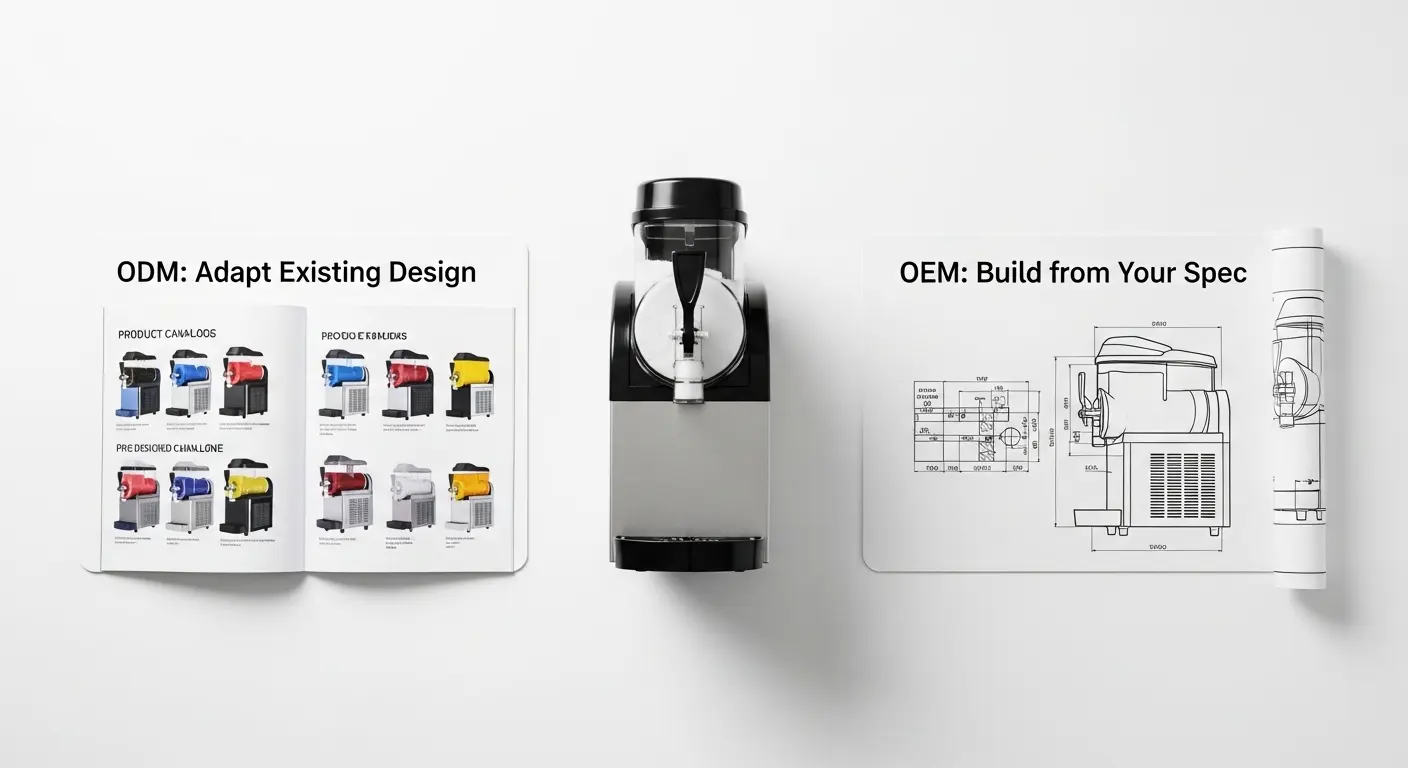
ODM stands for Original Design Manufacturer. In the slushie machine ODM context, a manufacturer owns an existing product design — a validated home-use slushie machine, a commercial frozen drink maker, or a dual-function slush and ice cream unit — and makes it available to brand buyers who want to sell it under their own identity.
You do not commission the engineering. The core machine already exists and has production history behind it. What you do is select the platform that fits your market, then layer your brand onto it through appearance customization, packaging, and potentially some feature modifications.
How ODM Differs from OEM
OEM (Original Equipment Manufacturer) means the buyer brings the product design. The manufacturer builds to those buyer-specified requirements. Full OEM requires engineering ownership from the buyer's side, custom tooling investment, and significantly longer development timelines — typically 6 to 12 months before a first production run.
Slushie machine ODM starts from the opposite direction. The manufacturer holds the product design. The buyer adapts and brands it. Lead times are much shorter, tooling costs are lower or eliminated, and the product enters production with an established quality baseline rather than a first-run prototype.
In practice, many brands start with ODM to enter the market quickly and develop full OEM products as volume and brand equity build. The two paths are not mutually exclusive — they are sequential stages in a product line's evolution.
What "Adapting an Existing Design" Actually Means
Adapting a slushie machine ODM platform does not mean just adding a logo. Depending on the manufacturer's capability, adaptation can include exterior color and finish changes, control panel labeling and language, packaging design and box artwork, instruction manual localization, accessory inclusion, and in some cases feature selection modifications — enabling or disabling specific preset modes for a target market.
What stays fixed is the core engineering: the auger system, the compressor specifications, the cooling architecture, the material grades, and the certifications the machine already holds. This is actually the main benefit of ODM — you inherit proven engineering without paying to develop it.
What You Can Customize in a Slushie Machine ODM Order
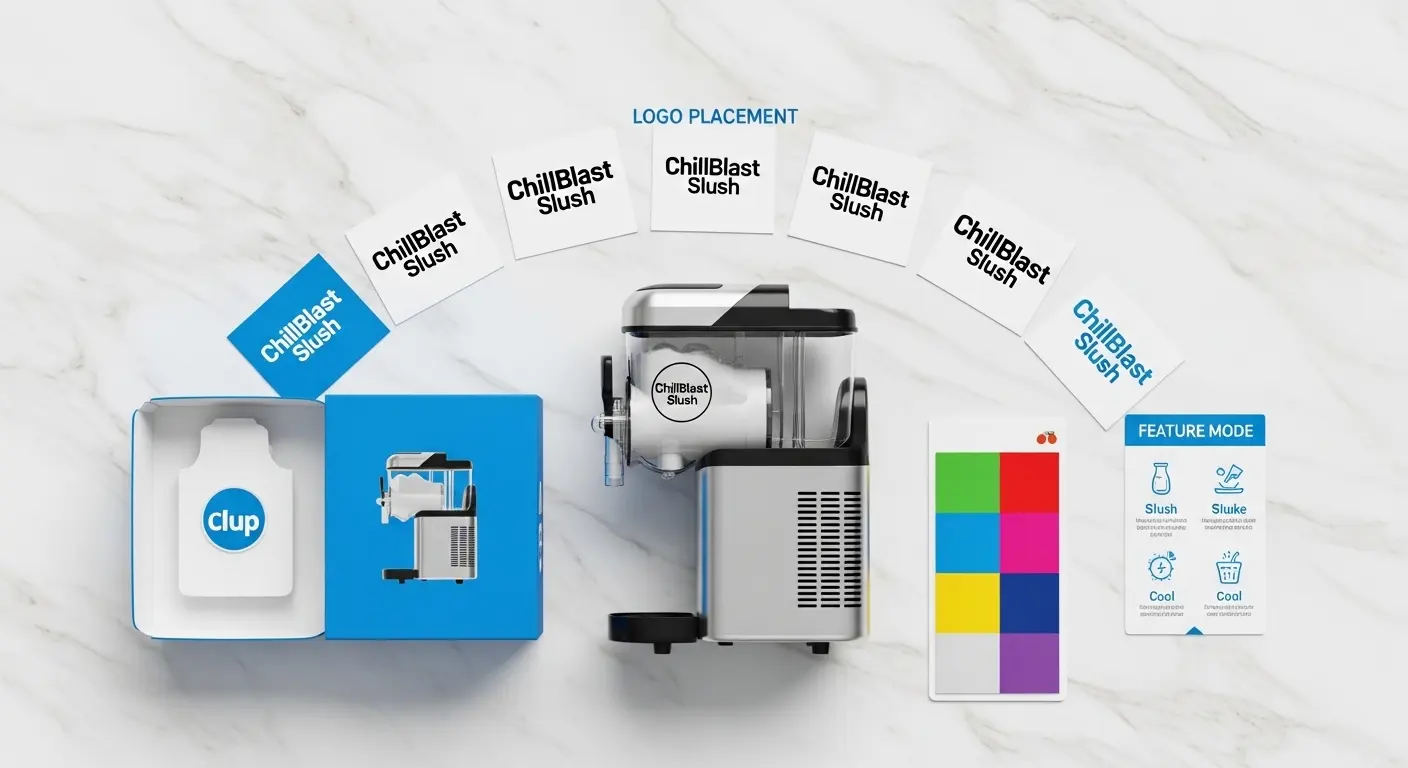
Understanding the scope of customization available in a slushie machine ODM arrangement helps set realistic expectations before you enter negotiations with a manufacturer.
Branding and Appearance
The most common and straightforward customizations in slushie machine ODM cover the exterior identity of the machine. This includes your brand name and logo on the machine body (typically via laser engraving, silk printing, or panel insert replacement), color selection from a manufacturer's available options or a custom color run at sufficient volume, and finish changes between matte and gloss surfaces.
For buyers who need a machine that looks visually distinct from other brands using the same ODM platform, investing in a custom color run — typically available from 200+ units — creates genuine shelf differentiation even when the underlying engineering is shared.
Packaging
ODM packaging customization is typically the fastest and lowest-cost modification available. Box artwork, brand messaging, product photography, retail barcode placement, and retail insert design are all within scope for most slushie machine ODM manufacturers. Some manufacturers can also adapt packaging dimensions slightly to accommodate specific retail shelf requirements.
Feature Selection and Mode Configuration
Some slushie machine ODM manufacturers allow modification of the preset mode selection — enabling or disabling specific programs for a target market. For example, a brand launching into a non-alcoholic market might want the cocktail mode removed or relabeled. A brand targeting the coffee category might want the coffee preset highlighted in control panel labeling.
What typically cannot be changed through feature selection modification is the underlying control logic — the temperature calibration, freeze cycle management, and auger reversal system. These are core engineering elements tied to the machine's performance certification.
Market-Specific Certifications
This is where slushie machine ODM gets more complex and where buyers frequently underestimate lead time. If your target market requires CE certification (EU/UK), ETL or UL (North America), PSE (Japan), or KC (Korea), the ODM manufacturer needs to either already hold those certifications on the platform you are ordering or obtain them for your order. Certification under your brand name specifically is sometimes required, which adds 8–12 weeks to the timeline.
Confirm which certifications the manufacturer already holds on the platform before assuming they transfer automatically to your branded product.
What Cannot Be Changed in Slushie Machine ODM (And Why)
This is the part most first-time buyers need to understand clearly before entering a slushie machine ODM negotiation.
The following elements are typically fixed in ODM — they cannot be changed without moving into full OEM territory:
- Core cooling architecture — compressor specification, refrigerant type (e.g. R290), and cooling cycle parameters are set during product engineering. Changing them requires re-engineering and re-certification.
- Auger design and reversal system — if the manufacturer has a patented auger system, it cannot be modified for a third-party buyer without licensing. This is worth checking before selecting a platform.
- Material grades — food-grade ABS, silicone, and SUS304 stainless are specified in the product's food contact certifications. Changing material grades invalidates those certifications and requires re-testing.
- Structural dimensions — physical dimensions are tied to the approved product design in regulatory documentation. Changes require new filings.
- Power and frequency ratings — AC voltage and frequency specifications are set for target markets (e.g. AC100-120V/60Hz for North America, AC220-240V/50Hz for Europe). This is typically handled by market variant selection, not modification.
Understanding these fixed elements actually makes the slushie machine ODM process simpler. You select the right platform for your market — one that already meets the technical requirements — and build your brand around its proven specifications.
How to Evaluate a Slushie Machine ODM Partner
Choosing the right slushie machine ODM partner determines whether your product launch succeeds or creates problems that take years to fix. Here is a practical evaluation framework.
Check the Manufacturer's Documented Platforms
A credible slushie machine ODM manufacturer publishes detailed technical specifications for the platforms they offer for ODM adaptation. This means model number, material grades, rated voltage, power, capacity, noise rating, coolant type, dimensions, and loading quantities. If a manufacturer presents products with vague descriptions and no specific technical documentation, they are not in a position to guarantee production consistency across an ODM order.
As a reference point: Yumyth's YX1801 platform lists rated power at 200W, capacity at 61oz/1.8L, noise at ≤55dB, coolant as R290, and loading quantities of 540/20GP, 1080/40GP, 1296/40HQ. That level of specification detail is what a reliable slushie machine ODM partner provides.
Request Engineering Specs, Not Just Photos
Before committing to any slushie machine ODM platform, ask for the full technical spec sheet — not the marketing brochure. Specifically request: material grade certifications for food contact components, compressor specification, certification documents (CE, ETL, or equivalent), and the engineering description of the auger system. A manufacturer who can supply these documents without hesitation controls their product. One who deflects to sales materials does not.
Sample Testing Before Production
Request a sample unit of the specific ODM platform before placing a production order. Test the machine through at least ten complete use and cleaning cycles. Evaluate freeze time, texture consistency at each setting, noise level, clog behavior with different liquid types, and cleaning access quality. A sample test surfaces production quality issues at a cost of one unit — not a full container.
Certifications for Your Target Market
Confirm that the manufacturer holds relevant certifications for your target market on the specific platform you are ordering. Ask for the original certification documents — not photocopies — and check that the model number on the certificate matches the platform you have selected. CE and ETL certificates are model-specific, not brand-wide.
Yumyth as a Slushie Machine ODM Partner
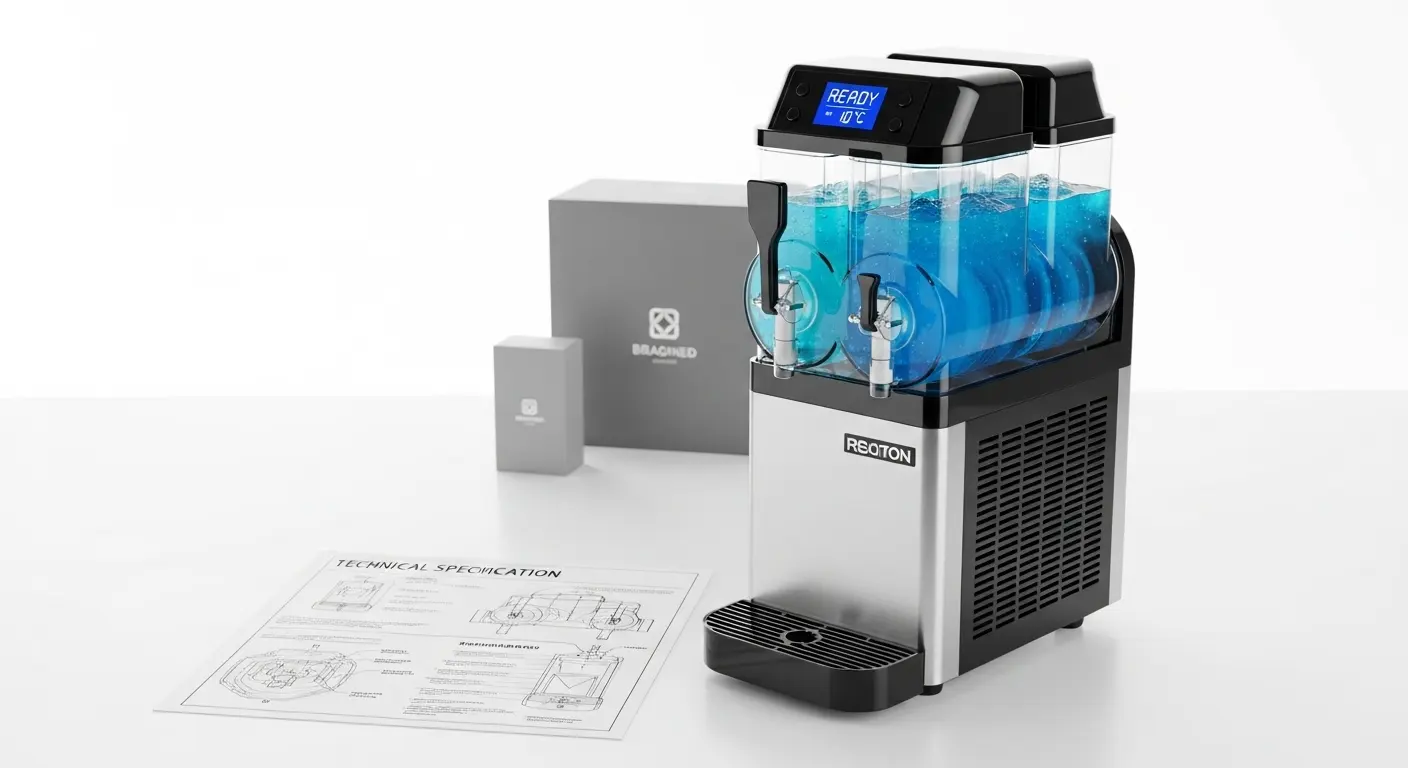
Yumyth operates as a direct slushie machine ODM manufacturer, offering verified ODM adaptation on two documented home-use platforms.
The YX1801 — available as the Yumyth Mini Slush Machine — is a 61oz compact slushie machine rated at 200W, operating at ≤55dB, with food-grade ABS, food-grade silicone, and SUS304 stainless steel contact components. Six preset programs (Slush, Wine, Milkshake, Cocktail, Coffee, Custom), six-stage texture control, intelligent auger reversal with jam protection, a 3-minute quick rinse cycle, and a detachable handle with removable silicone seal ring define the platform. Loading quantities are 540 per 20GP container, 1080 per 40GP, and 1296 per 40HQ.
The YX1802 — the Yumyth Slush and Ice Cream Maker — adds ice cream mode alongside the six slush programs, rated at 220W with identical material standards and the same intelligent auger reversal system. For brands targeting a dual-function positioning — one machine for frozen drinks and frozen desserts — the YX1802 platform supports both use cases with verified engineering.
Both platforms support ODM customization covering appearance, branding, packaging, and market-specific requirements. Yumyth's manufacturing process integrates quality control at incoming material inspection, in-process assembly checks, and finished product performance testing stages — verifiable before any production order is placed.
For brands building a broader frozen beverage product line, the industry insights section covers category trends, feature evolution, and market positioning data relevant to product launch planning in the home frozen drink segment.
Slushie Machine ODM for Home-Use vs. Commercial Machines
The slushie machine ODM process differs notably between home-use and commercial platforms. Understanding the distinction saves time during the supplier evaluation stage.
| Factor | Home-Use ODM | Commercial ODM |
|---|---|---|
| Typical platform capacity | 48–88oz (1.4–2.6L) | 3L–45L per tank |
| Key certifications | CE, ETL, UL, LFGB | NSF/ANSI 7, dairy certification |
| Noise rating | ≤55dB specified | Not typically a stated target |
| Material standards | Food-grade ABS, silicone, SUS304 | Full stainless, NSF-compliant construction |
| Feature customization range | Mode selection, texture presets | Tank number, dispensing system, panel layout |
| Typical ODM MOQ | 200–500 units | 50–200 units |
| Branding surface area | Compact — limited exterior area | Larger machine body, more branding surface |
| Lead time (ODM order) | 45–90 days from order confirmation | 60–120 days |
For brand buyers targeting household consumers, home entertainment, or small hospitality venues, home-use ODM platforms are the right entry point. For cafe chains, convenience store operators, and event businesses needing continuous high-volume output, commercial ODM platforms apply — with different certification requirements and service infrastructure considerations.
For buyers thinking about how a slushie machine product fits into a broader frozen food appliance line, the ice cream vs slush machine guide provides useful positioning context when deciding between a slush-only platform and a dual-function ODM base. Complementary appliance categories worth noting for bundled product line launches include the ice makers category and the vacuum sealers category, both of which pair naturally with a branded frozen drink machine in retail or DTC channels.
Cost and Timeline: What to Expect from a Slushie Machine ODM Order
First-time slushie machine ODM buyers frequently underestimate the full timeline, especially when certification under their brand name is required. Here is a realistic breakdown.
Customization and sampling: 2–4 weeks. After confirming the ODM platform and customization scope, the manufacturer produces a branded sample for your review. This stage includes artwork approval, color match confirmation, and packaging mock-up review. Sample testing adds another 1–2 weeks.
Certification (if required): 8–16 weeks. If the platform is being certified under your brand name in a specific market, this is the longest timeline variable. CE certification in Europe and ETL in North America both require third-party laboratory testing and documentation filing. If the manufacturer already holds a transferable certification, this stage is eliminated or shortened significantly.
Production run: 3–5 weeks. Once the order is confirmed and pre-production approval is signed off, the production timeline for an ODM batch typically runs 3 to 5 weeks depending on order volume and factory schedule. For larger orders, production may be staggered.
Shipping: 2–5 weeks. Sea freight from China to North America typically takes 20–30 days. Europe runs 25–35 days. Air freight compresses this to 5–7 days at significantly higher cost.
Total realistic timeline from contract to warehouse receipt: 45–75 days for a straightforward ODM order on a certified platform, or 90–150 days if certification under your brand name is required from scratch. Plan the launch timeline accordingly.
Frequently Asked Questions
What is slushie machine ODM?
Slushie machine ODM (Original Design Manufacturer) is a sourcing arrangement where a manufacturer makes an existing, proven slushie machine design available for brand buyers to purchase, adapt, and sell under their own brand identity. The buyer customizes appearance, branding, and packaging — and sometimes feature selection — while the core engineering, materials, and certifications belong to the manufacturer's original platform.
What is the difference between slushie machine ODM and OEM?
In ODM, the manufacturer owns the product design and the buyer adapts it. In OEM, the buyer owns the product design and the manufacturer builds to those specifications. ODM is faster, lower cost, and requires no upfront engineering investment. OEM gives the buyer full product ownership and differentiation but requires 6–12 months of development lead time and custom tooling investment. Most brands start with ODM and move to OEM as volume scales.
What can I customize in a slushie machine ODM order?
In a typical slushie machine ODM order, you can customize exterior color and finish, brand name and logo placement, packaging artwork, instruction manual language and design, and sometimes feature selection or mode labeling. Core engineering elements — the auger system, compressor specifications, material grades, certified dimensions, and power ratings — are fixed to the original platform and cannot be changed without moving into full OEM development.
How many units do I need to order for a slushie machine ODM?
Minimum order quantities for slushie machine ODM vary by manufacturer and customization scope. For straightforward branding and packaging customization on an existing platform, MOQs typically start at 200–500 units for home-use machines. Custom color runs typically require higher volume (often 500+ units) to justify tooling changeover costs. Confirm MOQ for each specific customization type early in the conversation with any ODM manufacturer.
How do I verify that a slushie machine ODM manufacturer is reliable?
Request the full technical specification sheet for the ODM platform — including material grades, power ratings, noise level, coolant type, and certifications. Ask for sample units and test them thoroughly before committing. Request certification documents in their original format and verify that the model number matches the platform you are ordering. Check factory verification through platforms like Made-in-China or Accio, and request information about quality control checkpoints during production.
Related Articles
How We Test Every Ice Maker Before Packaging
2026-09-15
BY YUMYTH
A step-by-step look at refrigerant handling, cooling verification, leak detection, corrective action and electrical safety testing For an ice maker, reliable performance is determined long before the carton is sealed. ...
Guide for Brands Looking for a Reliable Vacuum Sealer OEM Supplier
2026-09-14
BY YUMYTH
When you are sourcing kitchen appliances for your retail brand, finding a dependable vacuum sealer OEM supplier is rarely just about getting the lowest unit price. It is about protecting ...
Why Ice Shape Matters: Understanding 10mm × 15mm Cylindrical Nugget Ice
2026-09-14
BY YUMYTH
More Than Ice Production — The Ice Itself Shapes the Consumer Experience When sourcing a nugget ice maker, buyers often focus first on production capacity, water tank size, ice basket ...

Ice Maker Sourcing Guide: How to Find the Right Factory
2026-09-10
BY YUMYTH
Sourcing an ice maker looks straightforward on paper. Find a supplier, agree on a price, place an order. But anyone who has actually done this knows the process is rarely ...