
Slushie Machine OEM: How the Process Works and What to Look For
Share:
-

-

-

-


Copied

Share:
-
-
-
-
Copied
A slushie machine OEM partnership is where most frozen drink product launches either build a solid foundation or create problems that take years to surface. Get it right and you have a machine that performs consistently, carries your brand credibly, and ships reliably. Get it wrong — by choosing a trading company masquerading as a manufacturer, or by skipping key quality verification steps — and you are dealing with inconsistent product quality, unreachable suppliers, and warranty claims you cannot fulfill.
This guide is written for importers, distributors, private-label brands, cafe chains, and product entrepreneurs who want to source a slushie machine OEM partner for the first time or replace a supplier that is not delivering. It covers what OEM and ODM mean in practical terms, how the process works from inquiry to shipping, what to verify before signing anything, and what a reliable slushie machine OEM partner looks like in terms of documented capabilities.
What Is Slushie Machine OEM? (And How It Differs from ODM)
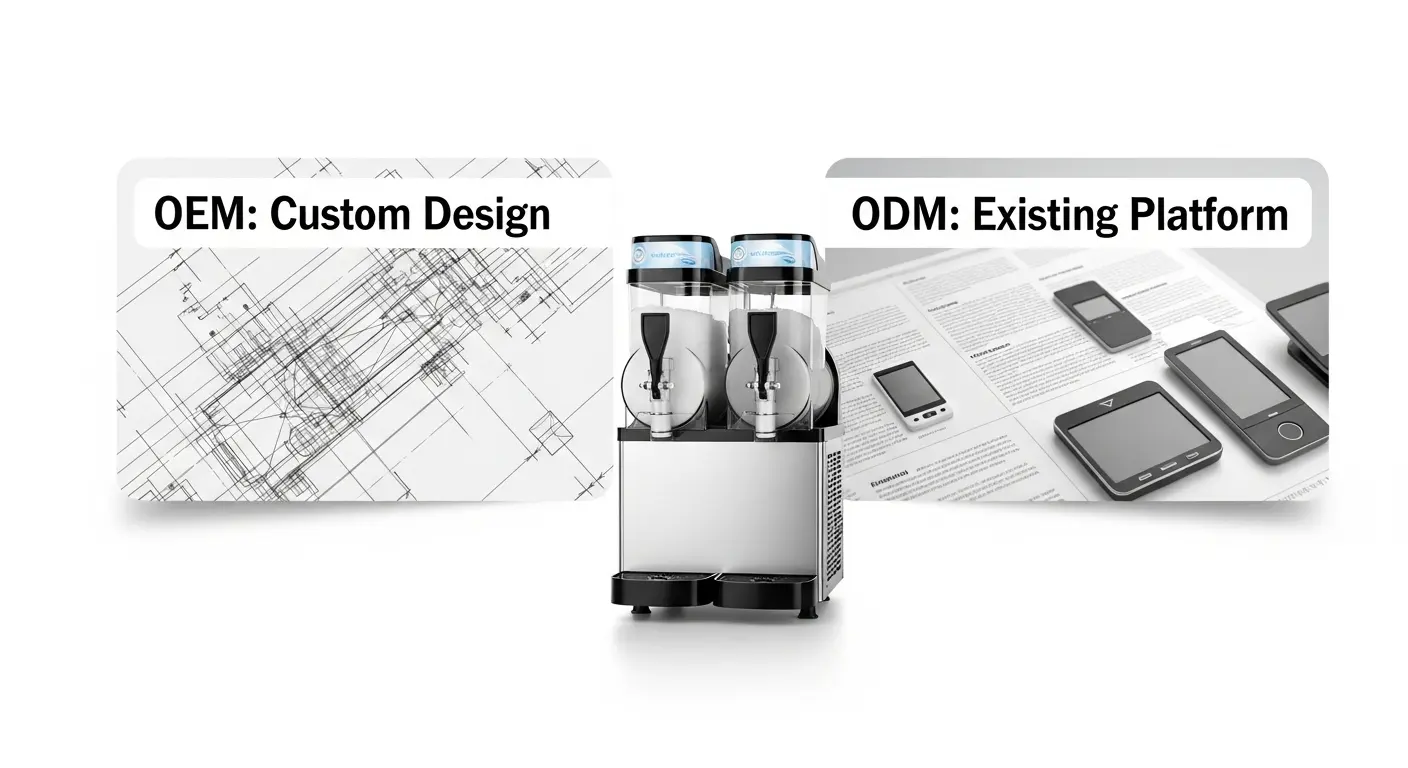
These two terms appear together constantly in B2B sourcing — but they describe different commercial relationships, and mixing them up leads to mismatched expectations early in the process.
OEM Explained
OEM stands for Original Equipment Manufacturer. In the slushie machine OEM context, this means a manufacturer builds a machine to your specifications. You bring the design requirements: capacity, material grades, feature set, color, branding, packaging, and any performance targets. The manufacturer produces to those requirements under your brand identity.
True OEM requires the buyer to own — or commission — the product design. You are not selecting from a catalog. You are specifying what gets built. This gives you full product ownership, higher differentiation from competitors, and complete control over the specification. In return, it requires higher minimum order quantities, longer lead times for tooling and prototyping, and more upfront engineering investment.
For established brands launching a proprietary home slushie machine line, OEM is the right path. For a first-time sourcing buyer, ODM is typically the faster, lower-risk entry point.
ODM Explained
ODM stands for Original Design Manufacturer. In slushie machine ODM, the manufacturer owns an existing product design that you can purchase, adapt, and sell under your brand. You select from existing platforms — a 61oz single-function machine, a dual-function slush and ice cream model, a commercial 3L unit — and customize the elements that make it yours: logo, color, packaging, sometimes control panel layout or feature selection.
ODM is faster because the base engineering already exists and has been validated through production runs. It is lower cost because tooling has already been amortized. For most distributors and private-label brands entering the slushie machine category, ODM is the right starting point — especially if you want to get to market in one to two quarters rather than 12 months.
Yumyth offers ODM services on the YX1801 and YX1802 platforms, allowing business buyers to adapt either machine for their brand, market, or retail channel requirements .
Which Is Right for Your Business?
Choose OEM if you have a specific product design, want full IP ownership, and have the volume and timeline to support custom tooling. Choose ODM if you want to launch faster, at lower upfront cost, with a product that has proven engineering and production history. Most businesses start with ODM and move to OEM as volume and brand equity grow.
How the Slushie Machine OEM Process Works Step by Step
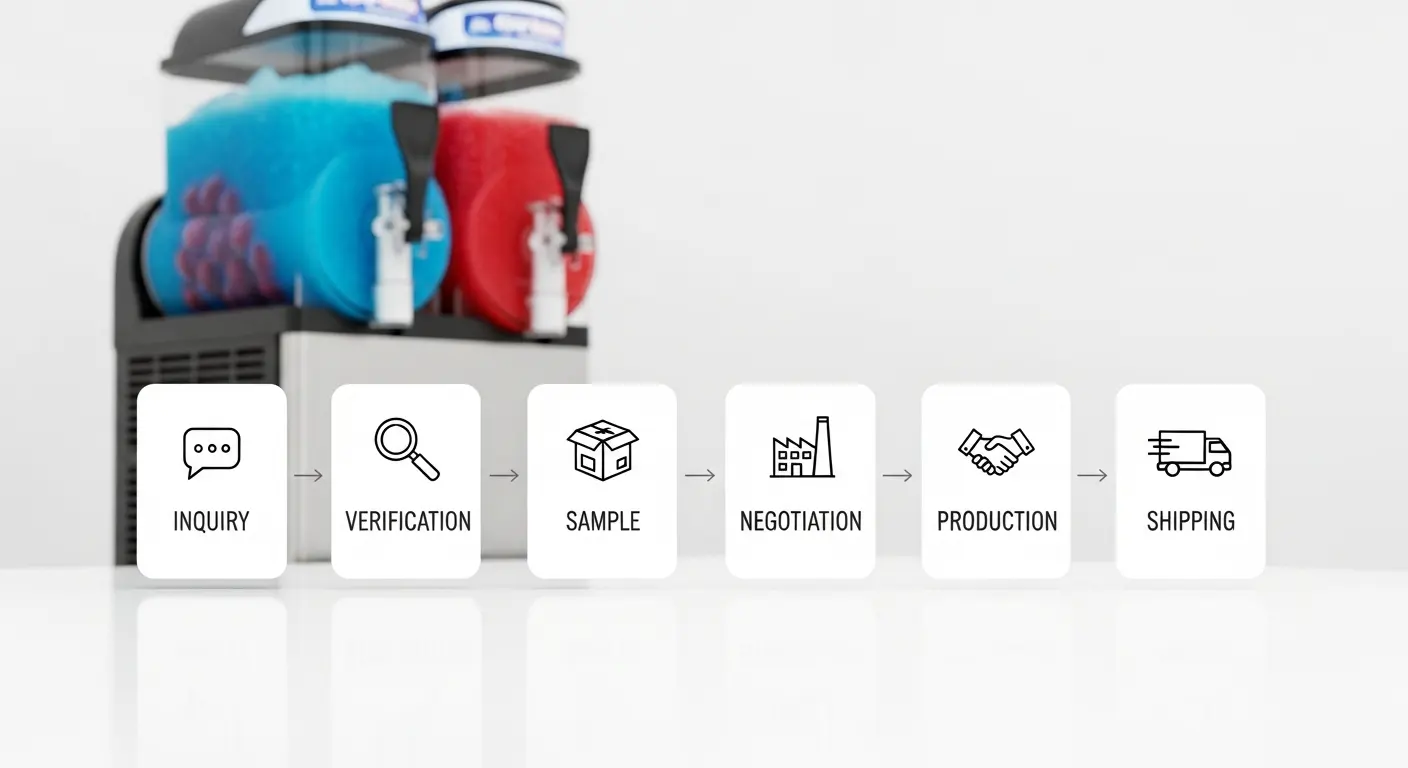
For buyers approaching a slushie machine OEM relationship for the first time, here is how the process typically unfolds from first contact to container loading.
Step 1 — Define your requirements. Before contacting any manufacturer, document your target: capacity range, machine type (home-use or commercial), feature requirements, material expectations, target retail price, and intended market region (which determines certification requirements — CE for Europe, ETL/UL for North America, etc.). A manufacturer who asks you the right questions early is signaling real engineering capability. One who immediately quotes without understanding your requirements is likely a trading company.
Step 2 — Request factory verification. Ask the manufacturer for ISO 9001 certification, food-contact material certifications (FDA, LFGB), and any market-specific safety certifications. Ask for factory audit reports or request a video audit. Verify that the supplier is listed as a manufacturer — not just a trading company — on platforms like Alibaba or Made-in-China.
Step 3 — Request product samples. A credible slushie machine OEM partner will supply a sample unit — typically at cost — before any production commitment. Test that sample rigorously: freeze time, auger performance, noise level, cleaning access, texture range, and how it holds up through ten to twenty cleaning cycles. Samples exist precisely to surface production quality before you commit to volume.
Step 4 — Negotiate terms. Key terms to establish before signing: MOQ (minimum order quantity), unit pricing at your target volume, lead time from order confirmation to shipping, tooling cost ownership and IP protection, warranty terms, quality inspection rights, and after-sales spare parts commitment.
Step 5 — Production run with quality checkpoints. A reliable slushie machine OEM partner integrates quality control at multiple production stages — incoming material inspection, in-process assembly checks, and finished-product performance testing. Ask specifically how QC is structured and whether you can arrange third-party inspection (via SGS, Bureau Veritas, or equivalent) before container loading.
Step 6 — Shipping and logistics. Loading quantities matter for freight cost calculation. The Yumyth YX1802, for example, loads at 540 units per 20ft container, 1,080 per 40ft container, and 1,296 per 40ft high-cube . Knowing this upfront lets you plan order quantities around container utilization, which directly affects landed cost.
What to Look for in a Slushie Machine OEM Partner
Choosing the wrong slushie machine OEM partner is an expensive mistake. Here are the specific verification points that separate reliable manufacturers from suppliers who will cost you customers and money.
Material Certifications and Specs
A credible slushie machine OEM manufacturer specifies its materials with precision: food-grade ABS for the bowl and body, food-grade (FDA or LFGB-compliant) silicone for the seal ring, and SUS304 stainless steel for internal components like the auger. These are not marketing terms — they are material grade designations that correspond to specific compliance certifications.
Ask for the material test reports, not just the product spec sheet. A manufacturer who controls their production can produce these documents. A trading company typically cannot.
Engineering and R&D Capability
A genuine slushie machine OEM partner has an in-house R&D function — a team that designed the machine and can modify it to your specifications. Ask about the engineering team size, the product development timeline for modifications, and whether they hold any patents on their technology. Yumyth's intelligent auger reversal system and detachable handle design are patented engineering features — not sourced components .
Manufacturers with real engineering capability can also support customization of performance parameters: adjusting freeze speed, changing texture range, modifying the control panel layout. Trading companies cannot do any of this.
Quality Control at Each Production Stage
A production quality control process should cover three stages: incoming raw material inspection, in-process assembly checks, and finished product performance testing. Ask the manufacturer to describe their QC process specifically. If the answer is vague — "we check everything" — push for specifics: what instruments, what tolerances, what defect rate targets, and what happens to units that fail.
ISO 9001 certification indicates a documented quality management system. CE, ETL, or equivalent safety certifications indicate that finished products have been independently tested against market-specific standards.
IP Protection and Contract Terms
This is where many first-time slushie machine OEM buyers make costly mistakes. Before sharing custom design specifications, branding files, or feature requirements, establish a signed NDA (Non-Disclosure Agreement) and clarify ownership of any tooling created for your product. Tooling ownership should be documented in the contract — if you paid for it, it should belong to you, with clear restrictions on the manufacturer using the same tooling for other buyers.
After-Sales Support and Spare Parts
A slushie machine OEM partner who controls their product engineering can supply spare parts by component name — seal rings, auger sections, dispense valves, control boards — because they specified those components. Commit to a supplier who agrees to supply spare parts for a defined period post-purchase, and document this in the agreement. This protects your end customers and your brand reputation long after the initial shipment.
Home-Use vs. Commercial Slushie Machine OEM: Key Differences
The slushie machine OEM process looks different depending on whether you are sourcing home-use or commercial machines. Understanding the distinction saves time during the supplier evaluation stage.
| Factor | Home-Use OEM | Commercial OEM |
|---|---|---|
| Typical capacity | 48–88oz (1.4–2.6L) | 3L–45L per tank |
| Key certifications | CE, ETL, UL, LFGB | NSF/ANSI 7, dairy certification |
| Noise rating target | ≤55dB | Not typically specified |
| Material focus | Food-grade ABS, silicone, SUS304 | Full stainless construction |
| Customization scope | Color, branding, mode settings | Capacity, tank number, dispensing system |
| Typical MOQ | 200–500 units | 50–200 units |
| Lead time (ODM) | 45–90 days | 60–120 days |
For home-use slushie machine OEM, the engineering priorities are quiet operation, compact dimensions, multi-mode functionality, and safe material grades for household food contact. Commercial OEM focuses on throughput capacity, NSF-required cleanability standards, and service network compatibility.
Yumyth specifically develops and manufactures home-use slushie machines with documented engineering on both platforms — making it a relevant slushie machine OEM partner for brands targeting household, small-business, or event-use markets. For broader context on how the home frozen beverage equipment market is developing, the industry insights section covers category trends and manufacturer positioning.
Why Yumyth Is a Verified Slushie Machine OEM Partner
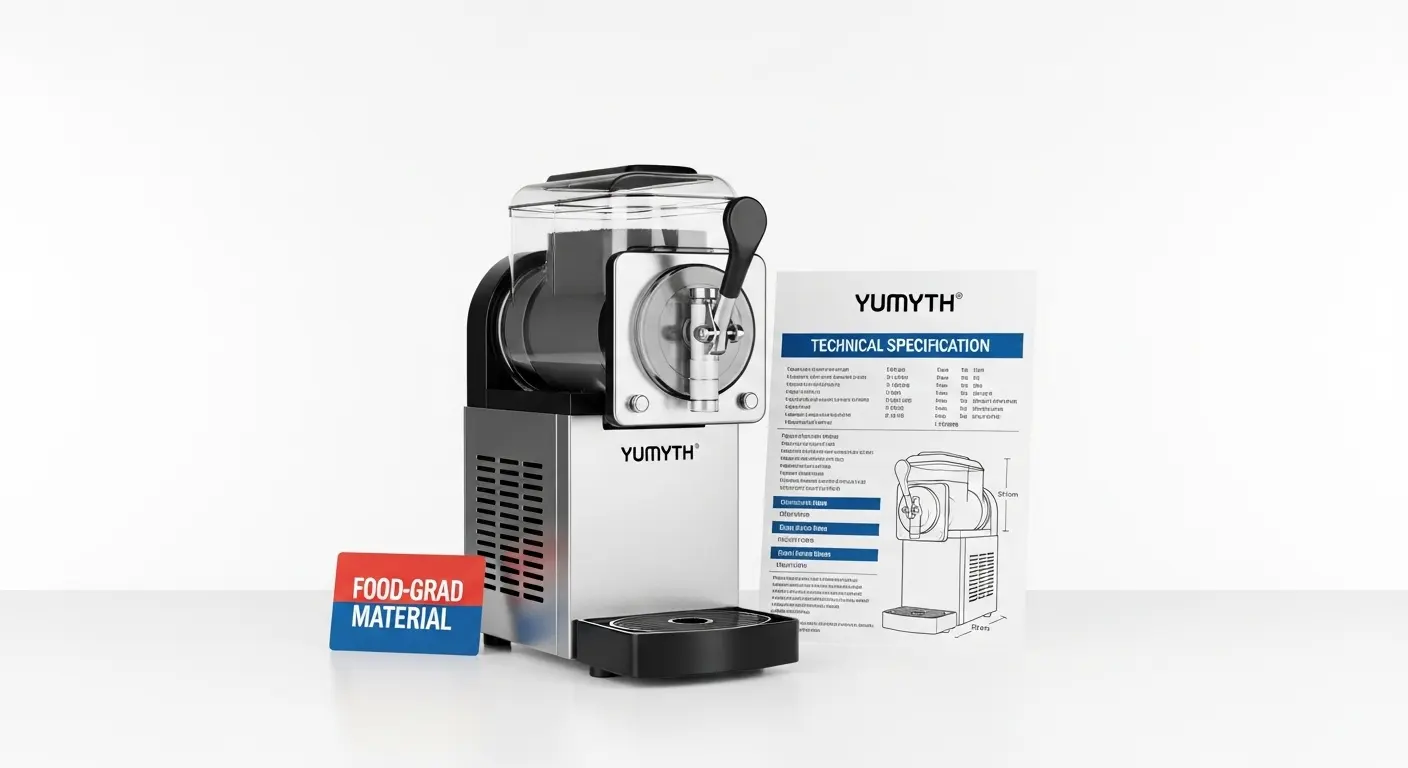
Yumyth operates as a direct home slushie machine OEM manufacturer — not a trading company, not a distributor, and not a private-label reseller of another manufacturer's product. Both current platforms — the Yumyth Mini Slush Machine (YX1801) and the Yumyth Slush and Ice Cream Maker (YX1802) — carry full engineering documentation.
The YX1802 specification sheet includes: rated voltage (AC100-120V / AC220-240V), rated power (220W), coolant (R290), capacity (61oz / 1.8L), noise (≤55dB), machine dimensions (452mm × 175mm × 398mm), net weight (10.2kg), gross weight (11.3kg), and container loading quantity (540/20GP, 1080/40GP, 1296/40HQ) . These are not marketing claims — they are production-verified specifications that allow buyers to plan freight, customs, and retail positioning before placing an order.
The intelligent auger reversal system — with automatic jam protection that detects stalls, shuts down, and restarts — is a patented engineering feature owned by Yumyth, not sourced from a third-party component supplier. Food-grade ABS, food-grade silicone, and SUS304 stainless steel are specified as the contact material standard across both platforms.
OEM and ODM services support customization from appearance and branding through functional modifications, with quality control integrated at incoming material, in-process assembly, and finished product stages. For business buyers comparing slushie machine types before specifying an OEM order, the ice cream vs slush machine guide covers how both machine types differ in design and use case — relevant context when deciding which platform to build a product around.
Common Mistakes Buyers Make When Choosing a Slushie Machine OEM
These are the errors that show up repeatedly in sourcing gone wrong — and all of them are preventable.
Choosing on price alone. A lower unit price from a supplier without documented material specs and quality certifications means a lower-grade product. The savings at the factory gate disappear quickly in warranty claims, returns, and brand damage. Specifically, buying a machine with uncertified food-contact materials creates liability risk in markets with strict food safety regulation.
Not requesting a sample before committing to volume. A spec sheet describes a machine. A sample tells you how it actually performs — freeze time, texture consistency, noise level, cleaning ease, and how the control panel functions in practice. Never commit to a production run without physically testing a sample unit through at least ten use and cleaning cycles.
Skipping IP documentation. Many first-time buyers assume a supplier will not copy their branding or sell the same tooling to a competitor. This assumption is wrong without a signed agreement. IP protection clauses, NDA terms, and tooling ownership documentation belong in the contract before any design work begins.
Not verifying after-sales capability. Ask the manufacturer directly: can you supply a replacement seal ring in 18 months? Can you supply a spare auger section? If the answer is vague or the supplier does not list spare parts anywhere on their platform, you are dealing with a trading company that cannot support your customers after the initial sale.
Ignoring certification requirements by market. CE certification is required for selling in Europe. ETL or UL is required for North America. If you are selling in a regulated market and your supplier cannot provide the relevant certification documentation, the product cannot legally be sold there regardless of its quality. Confirm certifications match your target market before the sourcing conversation goes further.
For buyers incorporating frozen drink machines into a broader beverage program and thinking about complementary appliances, the ice makers buying guide and the vacuum sealers guide cover additional equipment categories that pair well with slushie machines in home-use and small-business contexts.
Frequently Asked Questions
What does slushie machine OEM mean?
Slushie machine OEM (Original Equipment Manufacturer) means a manufacturer builds a machine to a buyer's specifications — the buyer brings the design requirements, the manufacturer produces to those requirements under the buyer's brand. The buyer owns the product design. This differs from ODM, where the manufacturer already owns a product design that the buyer can adapt and brand for their own market.
What is the minimum order quantity for slushie machine OEM?
Minimum order quantities for slushie machine OEM vary by manufacturer and customization scope. For ODM (adapting an existing design), MOQs typically range from 200 to 500 units for home-use machines. For full OEM (custom engineering and tooling), MOQs are typically higher because tooling amortization requires volume to become cost-effective. Yumyth's loading capacity of 540 units per 20ft container gives a practical reference point for planning a minimum viable OEM order.
How long does a slushie machine OEM order take from inquiry to delivery?
For ODM orders adapting an existing design, the timeline from confirmed order to delivery typically runs 45 to 90 days depending on customization scope and production schedule. Full OEM with custom tooling typically requires 3 to 6 months from final design approval to first production run. Shipping adds transit time depending on destination market.
What certifications should a slushie machine OEM partner have?
The certifications needed depend on your target market. CE certification is required for selling in the European Union and UK. ETL or UL certification is required for North America. ISO 9001 indicates a documented quality management system. Food-contact material certifications (FDA, LFGB) confirm that the materials touching your drink meet food safety standards. Ask for actual certification documents — not just logos on a website.
Can I customize the features and design of a slushie machine OEM order?
Yes, through either OEM or ODM arrangements. ODM customization typically covers branding, color, packaging, and sometimes feature selection or control panel layout. Full OEM customization can cover capacity, machine dimensions, feature set, material specifications, and complete design ownership. The scope of customization available depends on whether the manufacturer has real engineering and R&D capability — which should be verified through sample requests and engineering documentation before committing.
Related Articles
How We Test Every Ice Maker Before Packaging
2026-09-15
BY YUMYTH
A step-by-step look at refrigerant handling, cooling verification, leak detection, corrective action and electrical safety testing For an ice maker, reliable performance is determined long before the carton is sealed. ...
Guide for Brands Looking for a Reliable Vacuum Sealer OEM Supplier
2026-09-14
BY YUMYTH
When you are sourcing kitchen appliances for your retail brand, finding a dependable vacuum sealer OEM supplier is rarely just about getting the lowest unit price. It is about protecting ...
Why Ice Shape Matters: Understanding 10mm × 15mm Cylindrical Nugget Ice
2026-09-14
BY YUMYTH
More Than Ice Production — The Ice Itself Shapes the Consumer Experience When sourcing a nugget ice maker, buyers often focus first on production capacity, water tank size, ice basket ...

Ice Maker Sourcing Guide: How to Find the Right Factory
2026-09-10
BY YUMYTH
Sourcing an ice maker looks straightforward on paper. Find a supplier, agree on a price, place an order. But anyone who has actually done this knows the process is rarely ...