
Auger jam protection test
Share:
-

-

-

-


Copied
Share:
-
-
-
-
Copied
Auger Jam Protection Test for Home Slush Machines
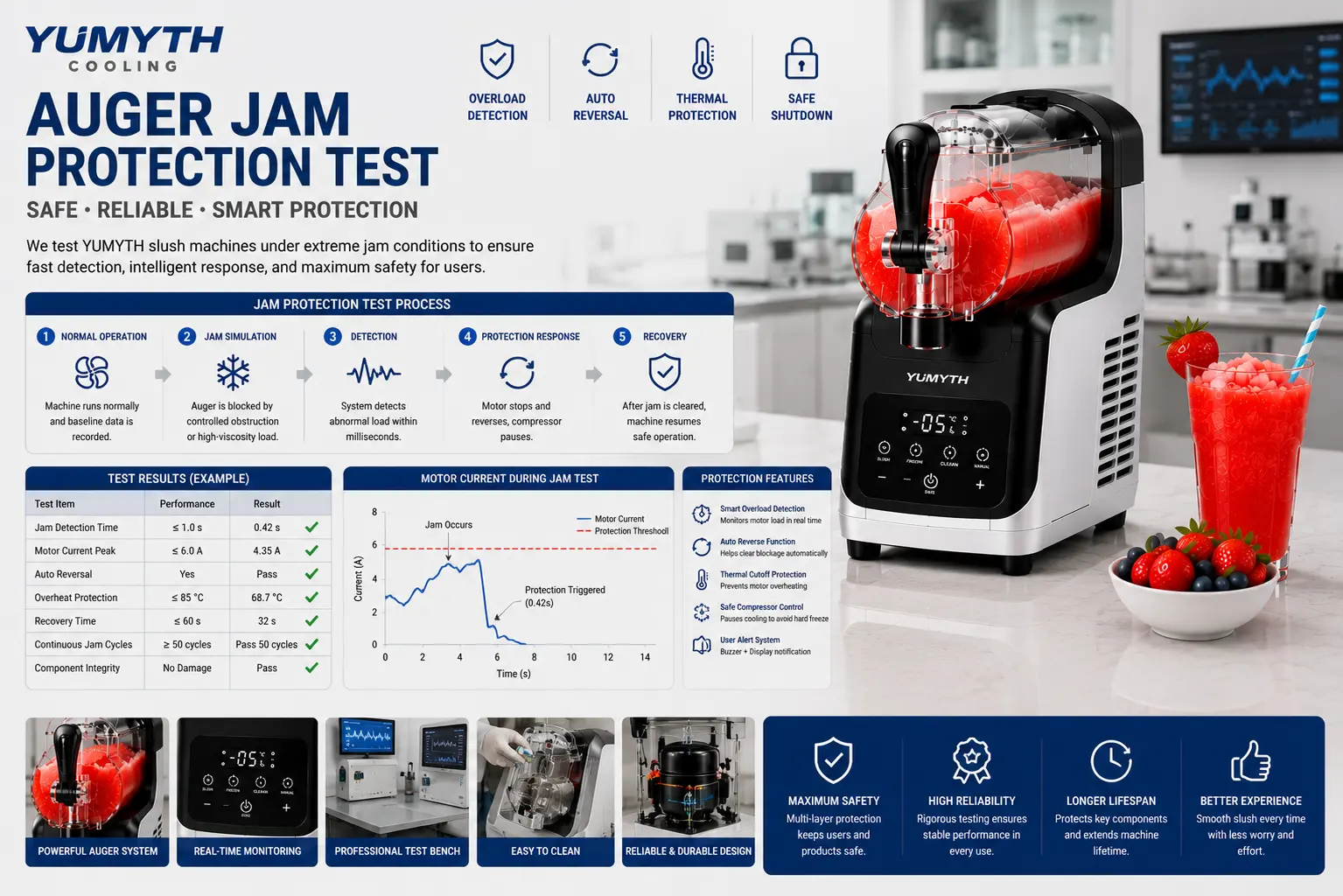
One of the main safety attributes of home slush machines is augers that prevent jams. In normal operation, the auger rotates continuously to remove the ice crystals from the cooling surface, and to keep the beverage moving and keep it smooth and dispensable.
A foreign object may get in the way of the mixing path or the mixture may freeze too hard, causing the auger to slow or stop altogether. This subsequently causes the motor to consume excessive current and heat, the gearbox, drive coupling, scraper, and boat to undergo abnormal mechanical stress.
A professional auger jam protection test result will determine if the appliance can detect excessive resistance, can stop or reverse the drive system, can control refrigeration, can protect critical parts and can recover safely after the auger is removed.
The reasons why Auger Jamming should be tested.
Slush machine jamming can be caused by an inappropriate recipe, lack of sugar, too much ice buildup, solid ingredients, improper assembly, dried residue or mechanical deformation.
The test should not presume that all jams are due to consumer misuse. A motor-driven mechanism can also get locked during internal wear, due to failure of its parts or due to production variation or any unforeseen external interference. UL technical guidance states that if the mechanical load is too great, it will cause the motors to overheat, and locked shaft will generate "winding heat" from the electrical energy supplied to the motors. Motor protection should then regulate temperatures and avoid potential fire or electric shock hazards when the motor is locked up.
The goal for appliance manufacturers is not just to stop the auger from stopping. The product should go into a controlled temperature prior to the motor, gearbox, wiring, control board or plastic surrounding overheating to a dangerous degree.
Explain the Protection Architecture.
Engineers need to record what the appliance is meant to do to detect and resolve the jam before testing is started.
Some potential protection measures are:
- * Motor-current sensing;
- * Motor-speed feedback;
- * Hall-effect position sensing;
- * Back-electromotive-force monitoring;
- * Condensing or housing temperature sensing; and
- A thermal motor protector;
- A mechanical torque limiting device; and
- * Firmware-based operating timers.
Current, temperature, position or back-EMF signals can be utilized for electronic motor controls to detect abnormal loading on the motor. If a locked or overloaded condition is identified, the control system could switch off the motor drive.
A good design may be more than one layer thick. The software can identify the jam in a timely fashion, and a thermal protector gives independent protection in case of a sensor, control circuit or algorithm malfunction.
Set up a Normal-Operation Baseline.
First measure the machine under normal working conditions by the engineering staff. This provides a reference for separating a true jam from the natural increase in auger load, as thickened beverages become thicker.
The following should be documented on the baseline test:
- * Water supply temperature and flow rate; and
- * Ambient temperature;
- Beverage recipe and Brix;
- * Fill volume;
- * Starting liquid temperature;
- * Selected program;
- * Motor current;
- * Auger speed;
- * Motor current; and* Motor on/off cycle.
- * Gearbox temperature;
- * Evaporator temperature;
- * Compressor operating state.
Testing should include the entire liquid cooling to slush texture to extended holding process. The maximum normalcurrent can be observed towards the end of the freezing period, which may lead to false jam warnings, if a protection level is only based on the start-up data.
Multiple cycles and appliances should be measured to account for motor, gearbox, sensor, recipe and manufacturing variance.
Apply controlled jam simulation methods.Employ controlled jam simulation techniques.
A jam should be introduced in a repeatable way! To add ice cubes or solid objects as needed at random could lead to varying mechanical conditions and cause damage before data of value is gathered.
There are several engineering approaches that can be taken:
Fixed mechanical obstruction: An auger is mechanically stopped at a specified point.
Progressive torque loading: A test fixture with a slowly applied resistance to be met by the protection system.
High-viscosity load: a validated test mixture is developed to produce a controlled overload but without the introduction of hard foreign objects.
Hard-freeze simulation: A low-Brix recipe or change in the control condition results in excessive ice formation under carefully controlled lab conditions.
The method selected should simulate the resistance that the product is intended to control. A locked rotor test is not equivalent to a slow overload test. One measures sudden stop, other measures the response of the system when torque is increased.
Outline the key elements of the MDR process.
A report should be made of the time lapse between the onset of abnormal resistance and the protection response.
Important events include:
- The increasing of speed of the auger starts to decrease.
- 2. The motor current is outside of the normal range.
- 3. Firmware detects a potential blockage.
- 4. (If applicable) The compressor is stopped.
- 5. Auger stops or reverses.
- 6. An error message is displayed.
- 7. The system goes into a locked or recoverable state.
This will create unnecessary high current and component temperatures when the response is delayed. If the level is sensitive, though, it's too likely to disrupt normal operation when the beverage is temporarily thick.
The resulting protection logic might then be a combination of magnitude and duration. If the current is high for a short duration, it can be tolerated and if it is high for a longer duration, protective action will take place.
Evaluate Automatic Reversal
Some slush machines will reverse the auger when there is too much resistance. Reversal can cause a temporary ice bridge, redistribute the mixture, or clear mixture from the scraper.
The test should be used to check:
- * Delay before reversal;
- * Reverse direction and speed;
- * Maximum reversal duration;
- Number of times you are allowed to attempt the task;
- * Pause between attempts;
- * Current during reverse operation;
- Final action should be taken if the obstruction still exists.
Reversal should not be repeated ad nauseam. If the blockage cannot be removed, the machine should stop and prompt the user to review the recipe, fill level, assembly or food contact components.
The compressor should also be taken into account. If the auger is not moving, it may be more difficult to recover the frozen blockage if cooling continues at a high rate.
Monitor Thermal Performance
Temperature monitoring is vital since the motor may still be producing heat without any visible movement.
Thermocouples or other appropriate sensors can be installed on:
- * Switches, if available; and
- * Motor housing;
- * Gearbox housing;
- * Drive electronics;
- * Wiring terminals;
- * Nearby plastic components;
- Control power devices on the control board.
IEC 60335-1:2020 is general general safety requirements for household electrical appliances, and IEC 60335-2-24:2025 covers household refrigerating appliances, ice-cream appliances and ice makers, compression-type appliances that use flammable refrigerants. Specific conditions for the abnormal operation or acceptance of a specific slush machine should be determined with the aid of a qualified certification laboratory.
The test time should be extended until protective cycling or temperature stabilization or final shutdown occurs, not after the first error is made.
Test Auto Reset and Manual Recovery
Once a jam response, engineers should know how the appliance will be returned to service.
Alternatives to recovery are:
- * Efficiency by detecting low power and restarting automatically after a few seconds;
- Restart after motor cools;
- * Restart when user presses a control:
- Re-connect power only after restart;
- Permanent – shutdown that requires service.
The automatic restart function is handy, but may be risky or harmful if the obstruction is still present. Frequent cycling start-up and stop can also generate extra heat and mechanical shock.
UL offers several guidance on motor protection techniques, such as, automatic reset, manual reset, thermal cut-off and electronic control strategies. The answer is dependent on end-use safety evaluation, motor and appliance architecture.
The user interface should explicitly indicate if the appliance is cooling down, recovery is in progress, waiting for manual inspection.
Repeat Jam-Cycle Test multiple times
A protection system might function properly during a particular event, but fail over time.
A durability programme should repeat controlled “jamming” over several cycles and checks should be made on:
- * Auger deformation;
- * Scraper wear;
- * Drive-coupling damage;
- * Gearbox backlash;
- * Motor temperature drift;
- * Connector discoloration;
- Need to replace relays or transistors;
- * Software error history;
- * Seal leakage;
- * Vessel damage.
Production representative components and final firmware should be included. Prototype motors, machined augers, or temporary control boards could behave differently from production motors and augers.
The machine should go through a series of normal recipe tests after several cycles and not produce excessive noise, leakage, vibration or preparation time.
Introduce Protection-System Faults
In situations where electronic protection is used as a safety means, engineers need to take into account possible faults in the detection path.
Examples include:
- * Disconnected current sensor;
- * Incorrect sensor signal;
- * Blocked Hall sensor;
- * Current sensor open or short circuit; and
- * Stalled cooling fan;
- * Frozen software state;
- * Failed motor-control transistor;
- Lost control board to control board communication.
To see if an independent protective layer is effective if the primary detection is not.
Plan fault testing with the certification laboratory because the requirements that apply to a function or circuit depend on the function or circuit being relied upon for safety.
Define Acceptance Criteria
Acceptance criteria should be specified in the test plan prior to testing.
A good design will show the student that:
- The jam is detected during the window of response; and
- The motor is de-energised or controlled properly;
- Temperatures stay within approved range;
- There is no smoke, flame or hazardous warping; and
- The gearbox and drive coupling are still firmly restrained;
- The compressor does not aggravate the blockage;
- * The user is given a clear warning;
- For an automatic restarting, there isn't repeated hazardous stress;
- Normal operation will resume when the cause is corrected.
Judging a machine by whether it lives or not is not enough. Protection should also prevent the possibility of hidden damage which may result in failure in subsequent use.
Create an outline for the Final Test Report.Outline the Final Test Report.
Your auger jam protection report should include:
- Product model/sn;
- Several versions of the motor, gearbox, and control board; and
- * Firmware version;
- * Part or parts to be tested; and
- * Toe-in and toe-out dimensions; and
- - Ambient and electrical conditions;
- * Wind chill; and
- * Test to see if your network requires more or less bandwidth;
- * Reversal sequence;
- * Compressor response;
- * Temperature curves;
- * Warning and recovery behavior;
- * Repeated-cycle results;
- * Fault-condition results;
- A photographic and video record;
- * Final engineering conclusion.
Conclusion
The Auger jam protection testing assesses the total interaction between all the components of the mixing motor, gearbox, sensors, software, refrigeration system and user interface.
A good system should detect abnormal resistance earlier than the occurrence of excessive heat or mechanical damage. It should program the auger and compressor, and try to recover only within the safe zone, and should give clear instructions to the user when intervention is needed.
Controlled jam testing helps appliance brands and OEM manufacturers by helping to ensure safer products, longer-lasting components, lower warranty claims, and more consistent frozen-drink performance.
Related Articles
How We Test Every Ice Maker Before Packaging
2026-09-15
BY YUMYTH
A step-by-step look at refrigerant handling, cooling verification, leak detection, corrective action and electrical safety testing For an ice maker, reliable performance is determined long before the carton is sealed. ...
Guide for Brands Looking for a Reliable Vacuum Sealer OEM Supplier
2026-09-14
BY YUMYTH
When you are sourcing kitchen appliances for your retail brand, finding a dependable vacuum sealer OEM supplier is rarely just about getting the lowest unit price. It is about protecting ...

Why Ice Shape Matters: Understanding 10mm × 15mm Cylindrical Nugget Ice
2026-09-14
BY YUMYTH
More Than Ice Production — The Ice Itself Shapes the Consumer Experience When sourcing a nugget ice maker, buyers often focus first on production capacity, water tank size, ice basket ...

Ice Maker Sourcing Guide: How to Find the Right Factory
2026-09-10
BY YUMYTH
Sourcing an ice maker looks straightforward on paper. Find a supplier, agree on a price, place an order. But anyone who has actually done this knows the process is rarely ...