“
In commercial beverage equipment, especially slush machines, safety and compliance certifications affect legal responsibilities, insurance coverage, installation options, and long-term operating costs.
—— Foodservice Equipment Guide
A common question from buyers is: what is the difference between CE and ETL for slush machines, and which one do I actually need?
This page gives a practical, business-focused comparison of CE vs ETL for slush machines, explains what each certification means, and helps you decide which is most appropriate for your market and application.
It is written for distributors, chain operators, and business owners who need reliable, compliant frozen beverage equipment, rather than technical theory alone.
01
COMPLIANCE SYSTEMS
Understanding CE and ETL
What is CE certification for slush machines?
The CE marking is a mandatory conformity mark for products sold in the European Economic Area (EEA) and is recognized in some other regions.
For slush machines, CE indicates that the equipment meets the relevant European directives and standards, which typically include:
• Low Voltage Directive (LVD) – electrical safety
• EMC Directive – electromagnetic compatibility
• Machinery Directive, when applicable – mechanical safety and moving parts
• Eco-design and energy-related product regulations, where relevant
Key characteristics of CE for slush machines
• Self-declaration system: manufacturers assess conformity, compile a technical file, and affix the CE marking.
• Focus on essential requirements: safety, health, environmental and consumer protection.
• Market access requirement: mandatory for most electrical and mechanical equipment placed on the EU market.
For EU and many international distributors, CE is the basic requirement to legally sell and install slush machines.
What is ETL certification for slush machines?
ETL is a product safety certification mark provided by Intertek, a Nationally Recognized Testing Laboratory (NRTL) in North America.
For slush machines sold into the United States and Canada, ETL indicates that the equipment has been independently tested and found to comply with appropriate safety standards, such as:
• UL (Underwriters Laboratories) standards
• CSA (Canadian Standards Association) standards
Key characteristics of ETL for slush machines
• Third-party testing and certification: Intertek performs independent lab testing and ongoing factory audits.
• Accepted across the U.S. and Canada: recognized by authorities having jurisdiction, building inspectors, and many insurance providers.
• Equivalent to UL and CSA marks: ETL is treated on par with UL and CSA from a regulatory perspective.
For North American operators, an ETL mark on a slush machine is usually a prerequisite for installation in commercial premises.
02
CORE DIFFERENCES
CE vs ETL for Slush Machines
Geographic scope and market access
• CE: primarily required for products sold in the European Union and the European Economic Area. It is also recognized in some parts of the Middle East, Africa, and other regions that reference EU directives.
• ETL: primarily required or strongly preferred for products sold in the United States and Canada. It is used by many multinational brands as a standard mark for North American compliance.
If you operate in multiple regions, slush machines may need both CE and ETL for smooth market access.
Compliance approach: self-declaration vs independent testing
• CE marking: the manufacturer conducts risk assessments and testing, compiles technical documentation including design data, test reports, risk assessments and user manuals, issues an EU Declaration of Conformity, and applies the CE mark.
• ETL certification: Intertek manages the testing program, tests the product against relevant UL and CSA standards, audits the factory periodically, and grants and monitors use of the ETL mark.
This difference affects how buyers assess trust and traceability. Third-party certification such as ETL often gives inspectors and insurers more confidence, especially in North America.
Safety and performance focus
Both CE and ETL aim to ensure safe, reliable equipment, but they use different frameworks.
• CE focuses on conformity with EU directives and harmonized standards, covering electrical safety, mechanical safety, EMC performance, and environmental and user protection.
• ETL focuses on conformity with UL and CSA standards, covering electrical safety, construction features, fire and shock protection, and sanitation where specific standards apply.
For slush machines, both systems reduce safety risks for operators and customers, but in practice ETL is the standard in North America, while CE is essential in the EU.
03
BUSINESS CASE
Why Certification Matters
1. Legal and regulatory compliance
Using uncertified equipment in a commercial setting can lead to delays or denial during building inspections, insurance coverage issues, extra liability in the event of accidents, and enforcement actions from local authorities.
• In the EU, CE is a legal requirement.
• In North America, ETL or another NRTL mark such as UL is often required by code or by the authority having jurisdiction.
For distributors and chain operators, certification underpins your ability to operate legally and consistently across locations.
2. Insurance and risk management
Many insurance policies for restaurants, cafés, cinemas, and convenience stores specify that installed electrical equipment must be certified by recognized bodies.
• Certified slush machines lower fire and electrical risks.
• They strengthen your position when showing due diligence.
• They help prevent claims from being rejected because of non-compliant equipment.
For chain operations, using CE- and ETL-certified machines gives you a structured way to manage risk across multiple stores and countries.
3. Operational safety and reliability
Slush machines combine refrigeration, mixing motors, electrical control systems, and food contact materials. Certification helps ensure safe operation under continuous duty cycles, proper thermal management of electrical components, controlled mechanical motion and guarded moving parts, and stable performance under varying environmental conditions.
Certification does not guarantee perfect reliability, but it correlates with more robust design and safer engineering choices.
04
BUYING SCENARIOS
Practical Buying Scenarios
Scenario 1: European chain café or cinema
• CE marking is mandatory for slush machines.
• Check the availability of CE documentation, including the Declaration of Conformity and test reports.
• Check compliance with relevant EU directives.
• Check fit with local installation rules and hygiene requirements.
For multi-country operations within the EU, CE simplifies deployment of standardized equipment across borders.
Scenario 2: U.S. or Canadian convenience store network
• ETL certification or another NRTL marking should be a standard requirement for all slush machines.
• Confirm ETL listing status and covered standards.
• Confirm compatibility with local electrical codes and plug types.
• Confirm whether the machine also has NSF or similar sanitation approval, where relevant.
Local inspectors are familiar with ETL, UL, and CSA marks, so ETL-certified slush machines tend to pass inspection with fewer issues.
Scenario 3: Global brand with multi-region operations
If your brand operates across Europe, North America, and other regions, the most efficient approach is to standardize on slush machines designed with multi-region compliance:
• CE-marked units for the EU and markets that rely on EU rules.
• ETL-certified versions for the U.S. and Canada.
• Consistent mechanical and refrigeration design to simplify training and maintenance.
A supplier that understands both frameworks can streamline rollout and lifecycle management.
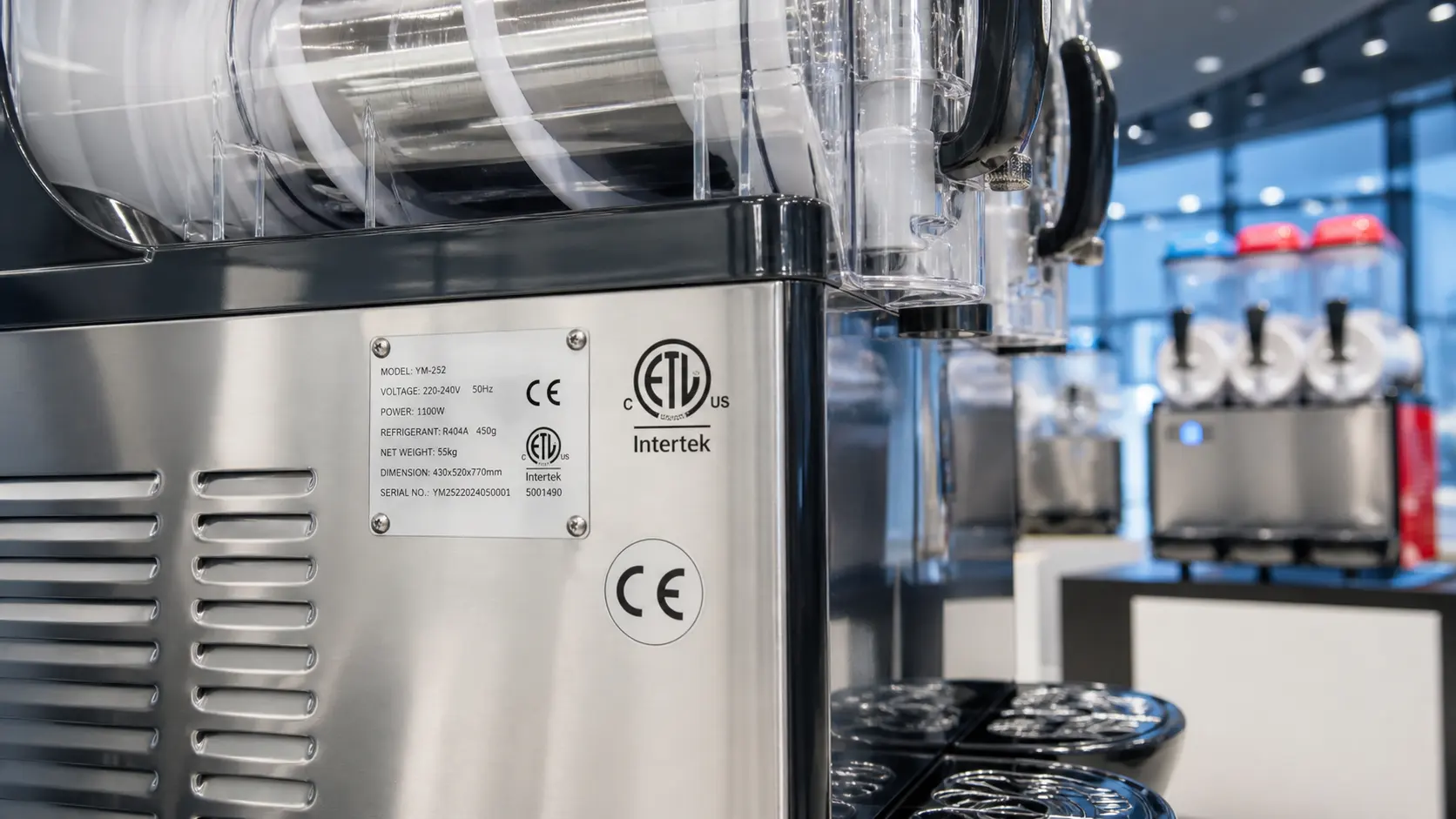
— Certified commercial slush machines with CE and ETL marks
05
BUYER CHECKLIST
Questions to Ask Before Purchasing
Seeing a logo on a brochure is not enough. Ask:
1. Which certifications does this model carry? CE for the EU, ETL for North America, or both?
2. What specific standards or directives does the certification cover? For CE: LVD, EMC, and the Machinery Directive if applicable. For ETL: the relevant UL and CSA standards.
3. Is the certification valid for the exact model and configuration I am buying? Confirm model numbers, voltage variants, and options.
4. Can you provide supporting documentation if requested? This may include the CE Declaration of Conformity and ETL listing certificates or references to online listings.
5. Is the product designed for my local electrical and regulatory environment? Check voltage, frequency, plug type, and installation category.
Clear answers to these questions help ensure you are investing in compliant, future-proof slush equipment.
How certification influences total cost of ownership
• Reduced installation and compliance friction: certified slush machines tend to pass inspections quickly, avoid repeat visits from inspectors or electricians, cut downtime before opening or remodeling, and lower soft costs.
• Lower risk of non-compliant equipment replacement: an uncertified or wrongly certified machine may cause direct replacement costs, lost product and sales during downtime, and extra installation and logistics spending.
• Support for brand protection: a safety incident linked to non-compliant beverage equipment can damage your reputation. Certified slush machines support a controlled risk environment and help protect your brand image.
06
PROJECT PLANNING
How to Choose
Step 1: Define your target region or regions
• Mainly EU: CE is mandatory.
• Mainly U.S. or Canada: ETL, UL, or CSA is normally required.
• Multi-region: choose equipment with both CE and ETL, or region-specific models with equivalent safety frameworks.
Step 2: Align with regulatory and corporate standards
• Review local regulations and internal engineering guidelines.
• Confirm that they require recognized certifications for beverage equipment.
• Check any extra standards for food contact and sanitation.
Step 3: Select suppliers who design for compliance
• Understand both European and North American compliance frameworks.
• Design slush machines for safety, reliability, and global use.
• Provide clear documentation and technical support for installers, distributors, and operators.
Certification and technical features: what professional buyers should evaluate
Certification is one piece of the picture. Professional buyers should also look at the machine’s technical design and how it supports safe, long-term operation.
A well-designed slush machine should have a compressor and motor sized for continuous duty, proper insulation and grounding, safe wiring and component layout, overload protection, and solid thermal management.
Assess the control panel layout and readability, access to cleaning and maintenance points, protection from hot surfaces and moving parts, and clear user instructions and warning labels.
Certification frameworks require risk assessment and user information, which supports safer daily operation.
07
SUMMARY
Summary Comparison
CE for slush machines
Required in the European Union and European Economic Area. It uses manufacturer self-declaration with structured technical documentation, focuses on EU directives covering electrical safety, EMC, machinery, and related topics, and is best for businesses operating in Europe or markets that rely on EU regulations.
ETL for slush machines
Required or preferred in the United States and Canada. It uses independent NRTL testing and factory inspections, focuses on UL and CSA safety standards covering electrical, mechanical, and fire safety, and is best for businesses operating in North America where inspectors expect NRTL marks.
For global brands, it is best to treat CE and ETL as complementary frameworks and ensure slush machines are certified for each target region.
FAQs: CE vs ETL for slush machines
Do I need both CE and ETL for the same slush machine?
It depends on where you will install and operate the equipment. Only Europe: CE is normally enough. Only the U.S. or Canada: ETL, UL, or CSA is normally required. Global or multi-region operations: models or variants with both CE and ETL give flexibility and simplify multi-country deployment.
Is ETL better than CE for slush machines?
Neither is universally “better”. CE is the central requirement in Europe, while ETL is a key NRTL mark in North America. The right choice depends on where the machine is installed and which regulatory system applies.
Can a machine with CE be used legally in the U.S.?
In many commercial installations in the U.S., inspectors expect equipment to be certified by an NRTL such as ETL, UL or CSA. A CE mark alone usually does not replace NRTL certification. Always confirm with local authorities and your internal standards.
Does ETL cover sanitation for slush machines?
ETL mainly covers electrical and mechanical safety. Sanitation may require separate standards or certifications such as NSF. Treat safety certification and sanitation requirements as separate but related topics.
How can I verify that a slush machine is truly certified?
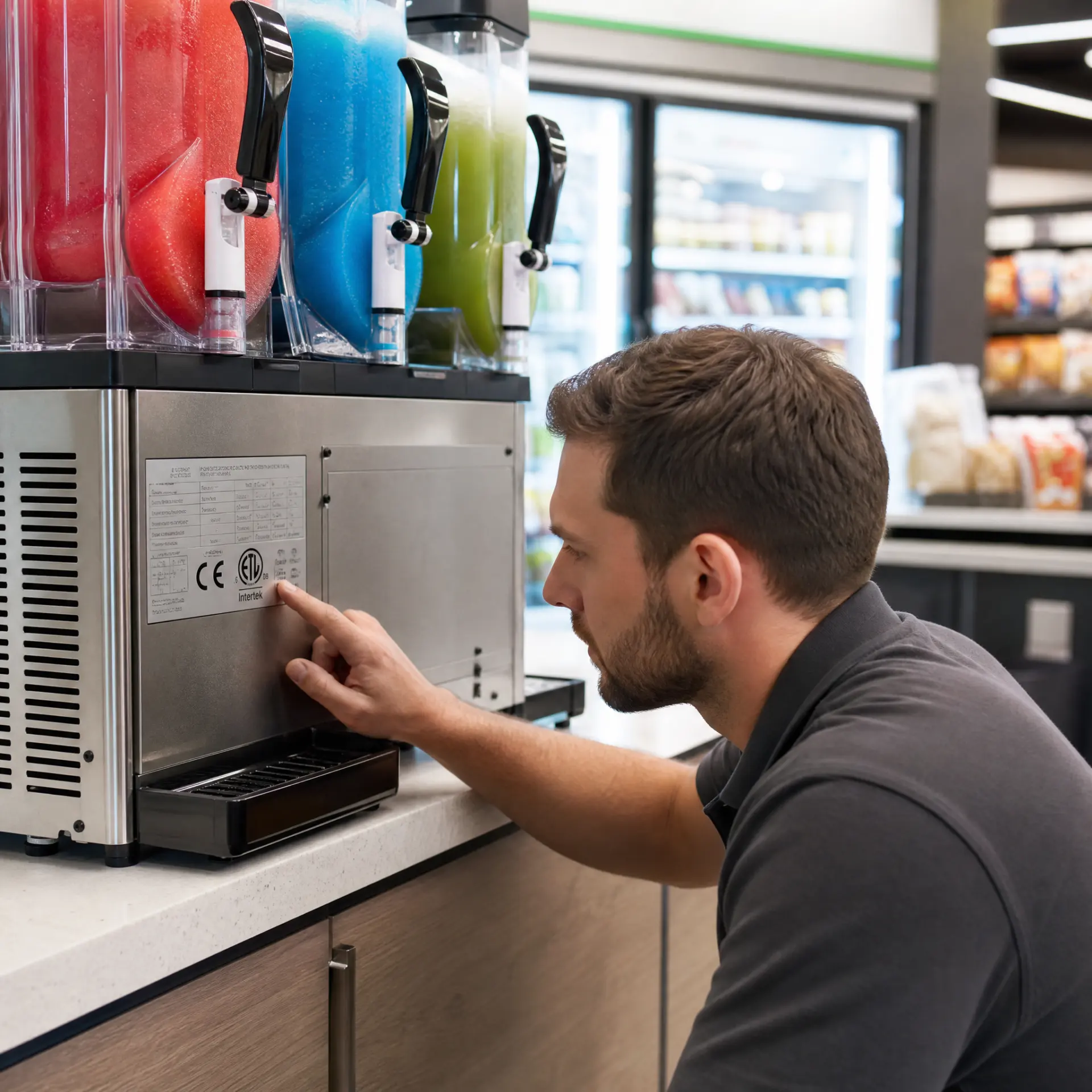
• Check the data plate on the machine for CE or ETL marks.
• Request documentation from the supplier, including the CE Declaration of Conformity and ETL listing information.
• Confirm the model against public listings where available.
— Verifying certification marks on an installed slush machine
∞
CONCLUSION
Making Confident, Compliant Choices
Choosing between CE and ETL for slush machines is about matching your equipment to your market, legal environment, and risk strategy:
• Use CE-certified slush machines in the European market and in regions that follow EU directives.
• Use ETL-certified slush machines, or other NRTL marks, in the United States and Canada.
• For global operations, work with suppliers who understand both systems and can provide suitable models or dual-region solutions.
Treat certification as a strategic selection factor rather than a minor technical detail. Doing so helps you avoid compliance problems, support smoother installations, and provide safer, more reliable frozen beverage service for your customers.