What affects certification lead time?
Share:
-

-

-

-


Copied
Share:
-
-
-
-
Copied
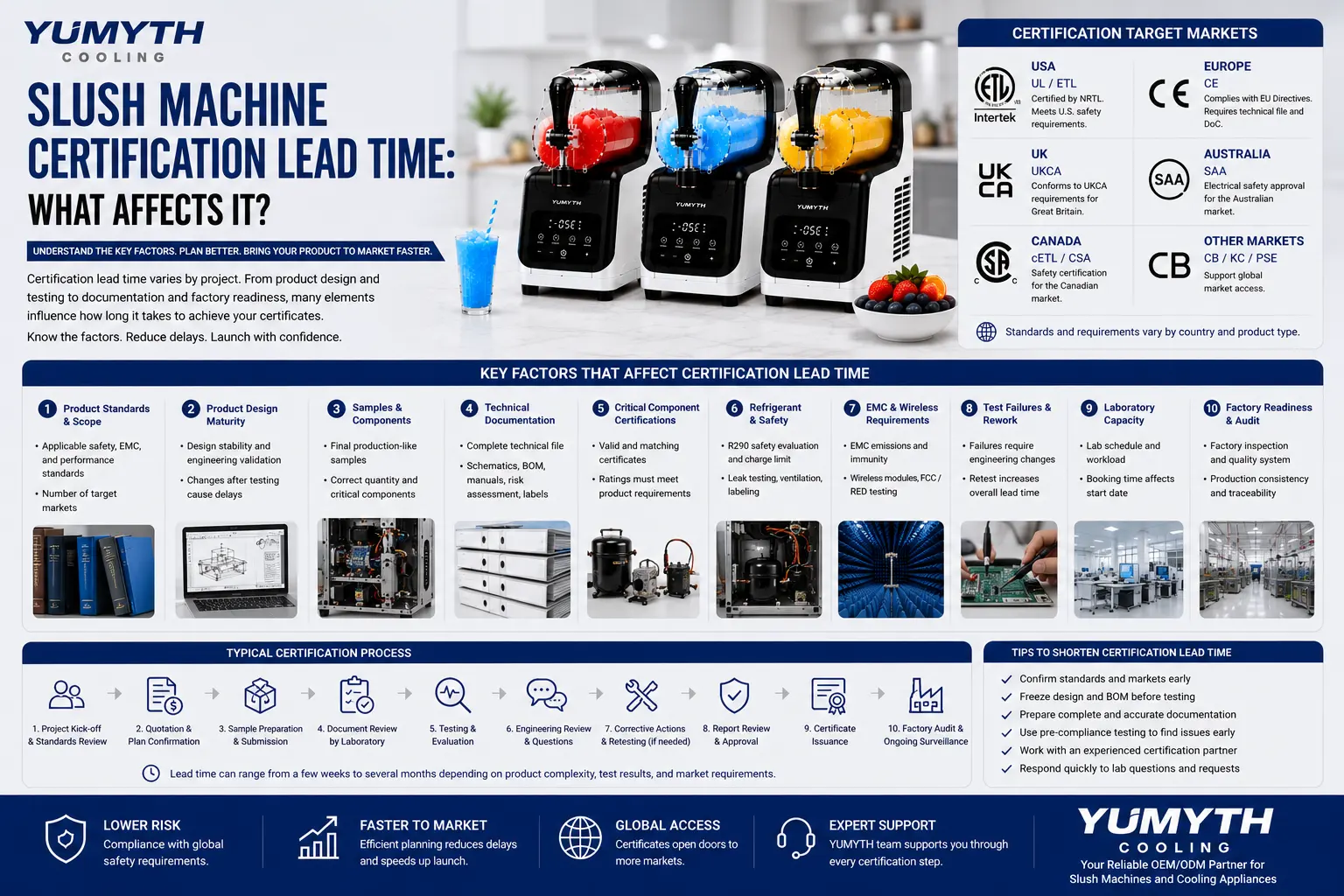
One of the most crucial variables to consider in a home slush machine launch is the certification lead time. Appliance brands want certification to start after the final product design is completed, but the decisions are made relatively early in the process that determines the schedule.
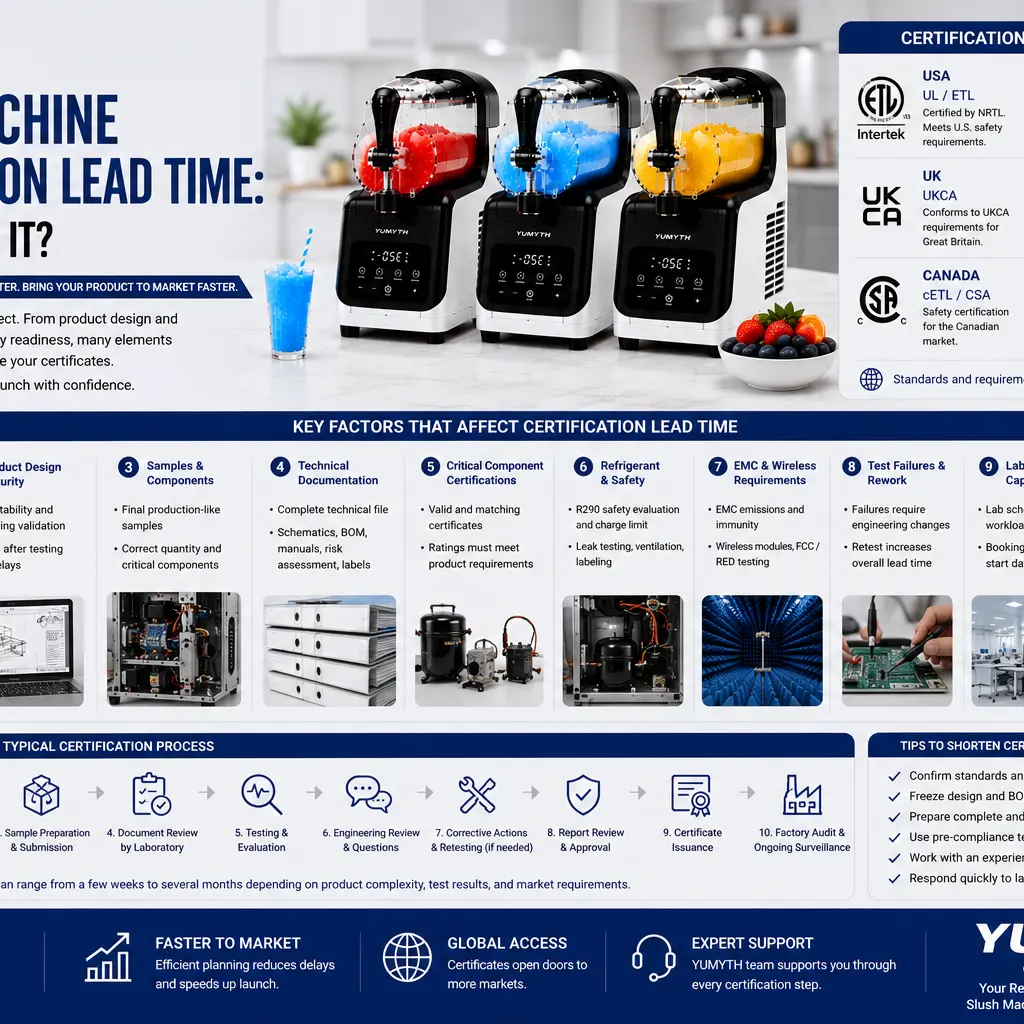
A certification project can be accelerated as a result of the applicable standards, target markets, refrigerant, electrical versions, critical components, food-contact materials, software, documentation or sample readiness.
If there is an existing platform that is already mature, it can pass through testing relatively easily. If an appliance is outdated, it might need to be re-viewed, sample modified, and retested if it is a new appliance, refrigeration is different, wireless connectivity is present, multiple voltage versions, or not all technical files are available.
The product classification must first be confirmed.
The appliance needs to be identified in the laboratory, and the relevant standards identified.
A home slush machine can incorporate all the following functions: refrigeration, mechanical food processing, dispensing, heating protection, removable food-contact parts, and digital controls. Its classification can be based upon its purpose, home use or commercial use, rated capacity, and functions.
IEC 60335-1 provides the general safety requirements for household and similar electrical appliances. The requirements for the product are then dealt with via the relevant Part 2 requirements. For example, IEC 60335-2-14:2025 is for household electric kitchen machines, and other standards are for refrigerating, ice-making or commercial dispensing equipment. The selection of the correct standard combination will be determined by the certification body and not just from the product name.
In cases where classification is not certain, the lab may require a preliminary technical review before it can quote and schedule a complete project. This can prolong the project before the formal testing process has even started.
The more target markets you have, the more work you need to do.The more target markets the more work you need to do.
There are different conformity systems in the United States and the EU.
In the United States, electrical product certification can be obtained by a third party recognized as a Nationally Recognized Testing Laboratory by OSHA. An NRTL conducts tests and certifies products against acceptable product safety requirements that it has established and then, upon certification, provides the manufacturer with permission to use its registered certification mark.
For the EU market the CE marking is the manufacturer's declaration that the product meets all the relevant EU legal requirements. Technical documentation and an EU Declaration of Conformity must support that conclusion. A certificate of conformance for CE marking is not a certificate of conformance that the manufacturer doesn't have to bear responsibility for.
A single project for the US, EU, UK, Australia and other markets may present some engineering evidence, but this will not be enough to satisfy separate reviews of national standards, labels, plugs, voltage versions, declarations and responsible parties.
The product design maturity does have a very high impact.
Samples should be identical to the production design when undergoing certification testing.
An incomplete prototype results in a high risk of changes being made to:
- The Refrigerant Circuit / compressor;
- * The cable's connector; and
- * The mechanism that drives the auger (either motorized or geared);
- The power cord and plug;
- * The thermal protector;
- * The enclosure;
- * Ventilation openings;
- Seals and food-contact materials.
If an important component is modified after the testing, the lab must decide if historical test results continue to be valid. Further testing or altogether new samples may be necessary.
Typically, the fastest certification projects start once the brand and OEM supplier have finished their engineering validation, resolved some key performance issues, and locked the critical bill of materials.
Sample preparation may delay the start of the project.Preparation of the sample may delay project start.
The laboratory is not able to start testing until the appropriate quantity of complete samples, accessories, components and supporting documentation are received.
Certification samples should employ the final:
- * Electrical rating;
- * Compressor;
- * Refrigerant and charge;
- * Motor;
- * PCB;
- * Firmware;
- * Wiring;
- * Housing materials;
- * Power cord;
- * Labels and warnings.
Certain tests may render the appliance unsafe to use, or internal circuits need to be accessed. The laboratory may then ask for several sets of complete units, unassembled pieces, spare motors, plastic samples, PCBs or specifically prepared test points.
The schedule may also be impacted by shipping. If the appliance is equipped with a refrigeration system, it might need travelling documentation and special packing. If the sample is damaged during transport it may have to be replaced before testing can proceed.
Technical Documentation is Incomplete, Which Leads to Review Delays.
Technical documentation is an explanation about the design, manufacture and control of the appliance. According to EU guidance, this documentation should show compliance with all the requirements and help the EU Declaration of Conformity.
A certification package can consist of:
- * Product specifications;
- * Circuit diagrams;
- * Wiring diagrams;
- * Refrigeration drawings;
- * Bill of materials;
- * Critical component certificates;
- * Plastic material information;
- * Risk assessment;
- * Software information;
- * Rating-label artwork;
- * User instructions;
- * Food-contact documentation.
Inconsistencies or missing documents result in questions both within the laboratory and between the laboratory, factory, component suppliers and brand. As an instance, the sample can consist of one relay model whereas the bill of materials can consist of another.
A controlled documentation package prepared in advance of the arrival of samples can minimize the inactive waiting time during the laboratory review.
The components must match the product in order to achieve the certification.
While some aspects of the evaluation may be simplified when using recognized or certified components, this can only be done if the ratings, conditions of use, and certification information for the component conforms with the finished appliance.
The compressor certificate does not necessarily cover the entire slush machine system. The laboratory still needs to assess the installation, protection, ventilation, wiring and use of the compressor in the refrigeration system.
If the following conditions are not met, problems can occur:
- * Certificates have been issued or are no longer available;
- * Model numbers do not match;
- * Ratings are insufficient;
- The supplier is unable to issue the necessary reports; or
- The use of a component is outside its approved conditions;
- Production factory is not the same as the documented source.
Documentation of the components should be gathered when selecting the supplier, not after the laboratory testing has determined that the evidence is missing.
This means, for R290 refrigeration, additional planning must be done.
R290 can be used as a refrigerant in a low-GWP refrigeration platform but the refrigerant must be charged appropriately, the tubing needs to be protected, any possible leakages must be identified, electrical components should be evaluated for flammability, the ambient environment has to be ventilated and labelling and abnormal operation needs to be taken into account.
The laboratory might ask for detailed information about the refrigerant circuit, the location of the components, the refrigerant charge procedure, production leak testing, and service instructions.
An alteration of the refrigerant, compressor, condenser, and/or cabinet ventilation can influence the cooling performance and the safety evaluation. Therefore, it is recommended that an R290 system be stabilized prior to the preparation of formal certification samples.
Multiple tests are added for EMC and Wireless Functions.
Electromagnetic emissions and immunity testing may be required for digital controls, displays, motors, relays and switching power supplies.
The FCC's main equipment authorisation mechanisms in the United States are Certification and Supplier's Declaration of Conformity. The route used depends upon the type of radio-frequency device.
Digital circuitries can be present in a machine that is not designed for wireless communications, but may need to be evaluated. The WiFi or Bluetooth is an intentional transmitter, and can increase the scope of testing and documentation.
While some development effort can be saved by incorporating a previously certified wireless module, the final appliance will still need to be properly installed, their antennas controlled, labeled and they will require user information.
PCB filters, grounding changes, cable routing changes, shielding and/or firmware changes are often necessary for EMC failures. These changes can be used to help extend the review schedule if it starts late.
The most significant unpredictable factor is test failures.
Normal product development may not detect problems that can be discovered in the laboratory.
Possible failures include:
- * Excessive component temperature;
- * Inadequate insulation;
- * Leakage current;
- * Abnormal motor heating;
- * Insufficient strain relief;
- * Accessible moving parts;
- * Enclosure deformation;
- * Refrigerant-related safety issues;
- * Excessive electromagnetic emissions.
The failure correctability time will vary based on the cause of the failure. A label change could be done in a matter of hours, whereas a housing change, PCB change, airflow change or refrigeration change can take multiple engineering validation rounds and tooling.
There are many issues that can be discovered before actual testing through a pre-compliance review. It does not eliminate certification but will decrease the likelihood of finding simple design issues at the most costly part of the project.
The Calendar is affected by the laboratory capacity.
A project, even if it is prepared for is still reliant on laboratory availability.
There are acoustic rooms, environmental chambers, EMC equipment, flammable-refrigerant testing, or long-duration abnormal-operation testing facilities with limited capacity at some of the facilities. Waiting time can be longer during the peak seasons.
But, brands should reserve laboratory capacity before completion of final samples. But if the product is not available at the time of the set testing time, then it can be a problem to book it too early.
The project programme should allow for:
- * Initial document review;
- * Emergency response; and
- * Testing;
- * Engineering questions;
- * Corrective modifications;
- * Retesting;
- * Report review;
- Preparation of certificates or declaration.
The final approval can be impacted by Factory Inspection.
Typically, US NRTL certification will include controls that are designed to ensure consistency of production units with the NRTL certified construction. OSHA is recognizing NRTL programs, which involve factory monitoring of facilities that make products with NRTL marks.
For the factory that has not been used by the certification body before, an initial inspection or manufacturing assessment may be necessary before it gets certified to use the mark.
The factory should be able to prove the following:
- Controlling BOM;
- * Incoming inspection;
- * Electrical safety testing;
- * Refrigerant process control;
- * Calibration;
- * Traceability;
- * Nonconforming-product control;
- * Engineering-change procedures.
Unfortunately, approval can be delayed if the product is not ready for manufacturing at the factory.Unfortunately, the product can be delayed even after it has passed the laboratory testing if it is not ready at the factory for manufacturing.
Having multiple product versions adds complexity.More product versions = more complexity.
A brand could be interested in having multiple colors, capacities, plug types, voltage ratings, compressors, or control panels that all fall under one certification program.
Others may be addressed as a model family or may need samples and/or testing. The entire model matrix should be checked by the laboratory prior to testing.
Compared to controlled model expansion, delays are caused by the need for the test plan, report, labels and critical components list to be rewritten many times.
The best way to do this is to determine all the intended market versions at the outset and find out what parts can be shared.
A Practical Planning Range
Once final samples and documents have been received in the lab, a simple project that is built on an established platform can take several weeks to complete.
When it comes to a more complex project, it may take several months if you add new tooling, several voltage versions, R290, wireless functions, extensive EMC work, test failures, and new factory authorization.
The ranges should be used only as planning guides and not as a minimum or maximum time. The laboratory chosen should develop a plan for the project based on the final construction and target markets.
How brands can decrease certification lead time.
To enhance the schedule, appliance brands and OEM suppliers should:
- Early confirmation of standards and markets.
- 2. Completing pre-compliance testing.
- 3. Freezing of critical components prior to submission.
- 4. Writing complete technical documents.
- 5. booking laboratory time for early.
- Providing Adequate final samples and spares.
- 7. Checking labels and manuals prior to testing.
- 9. Speed in answering laboratory questions.
- 9. Prevention of formal evaluation changes in the design.
- 10. Making preparations for surveillance and control of production in the factory.
Conclusion
The speed at which the laboratory can test is not the only factor for certification lead time.
The final schedule is dependent on product classification, market scope, design maturity, product documentation, component approvals, R290 requirements, EMC performance, sample availability, test failures and factory readiness.
The best approach is to embed certification into product design right from the start of design for appliance brands. A fully developed design, bill of materials, technical file, and manufacturing process can help minimize delays and ensure a more predictable design to market process.
Related Articles
How We Test Every Ice Maker Before Packaging
2026-09-15
BY YUMYTH
A step-by-step look at refrigerant handling, cooling verification, leak detection, corrective action and electrical safety testing For an ice maker, reliable performance is determined long before the carton is sealed. ...
Guide for Brands Looking for a Reliable Vacuum Sealer OEM Supplier
2026-09-14
BY YUMYTH
When you are sourcing kitchen appliances for your retail brand, finding a dependable vacuum sealer OEM supplier is rarely just about getting the lowest unit price. It is about protecting ...

Why Ice Shape Matters: Understanding 10mm × 15mm Cylindrical Nugget Ice
2026-09-14
BY YUMYTH
More Than Ice Production — The Ice Itself Shapes the Consumer Experience When sourcing a nugget ice maker, buyers often focus first on production capacity, water tank size, ice basket ...

Ice Maker Sourcing Guide: How to Find the Right Factory
2026-09-10
BY YUMYTH
Sourcing an ice maker looks straightforward on paper. Find a supplier, agree on a price, place an order. But anyone who has actually done this knows the process is rarely ...