
Guide for Brands Looking for a Reliable Vacuum Sealer OEM Supplier
Share:
-

-

-

-


Copied
Share:
-
-
-
-
Copied
When you are sourcing kitchen appliances for your retail brand, finding a dependable vacuum sealer OEM supplier is rarely just about getting the lowest unit price. It is about protecting your brand's reputation. A poor-quality food vacuum sealer leads to high return rates, customer complaints about freezer burn, and wasted inventory.
B2B buyers need to know exactly what specifications separate a premium machine from a disposable one. Using the latest VS6121 model as an industry benchmark, we are going to break down the critical features you must demand from your manufacturing partner before signing a purchase order.
Core Performance Metrics in a Food Vacuum Sealer
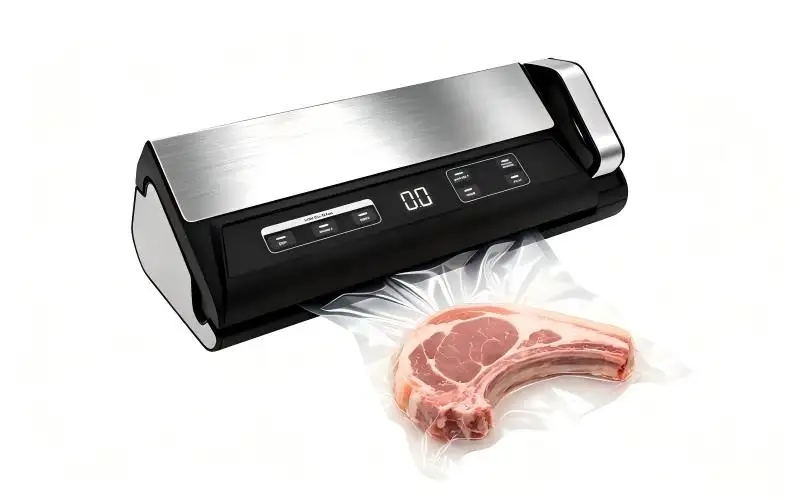
If a machine cannot remove oxygen efficiently and seal the bag flawlessly, nothing else matters. When evaluating a potential vacuum sealer, pay close attention to the internal mechanics.
| Category | Specification |
| Rated Voltage | AC 100-120W~50/60Hz; AC 220-240V~50/60Hz |
| Rated Power | 120W |
| Vacuum Pressure | -80kPa |
| Vacuum Pump | 8L/min |
| Noise Level | <76dB |
| Sealing System | |
| Seal Type | Double Sealing Wires, low voltage 12V |
| Seal Width | 3.0mm×2 |
| Max Sealing Width | 300mm |
| Materials | |
| Housing | ABS |
| Decorative Panel | Stainless Steel |
| Dimension&Packing | |
| Product Size | 407*175*146mm |
| Color Box | 450*188*224mm |
| Carton Size | 465*392*468mm, 4PCS |
| N.W/G.W | 2.23/3.15KG |
| Loading QTY | 20GP: 1120PCS, 40HQ: 2396PCS |
| Certification | CE-LVD, CB, EMC, ERP, ETL,ROHS,REACH, PAHS, SCCP |
Uncompromising Suction Power
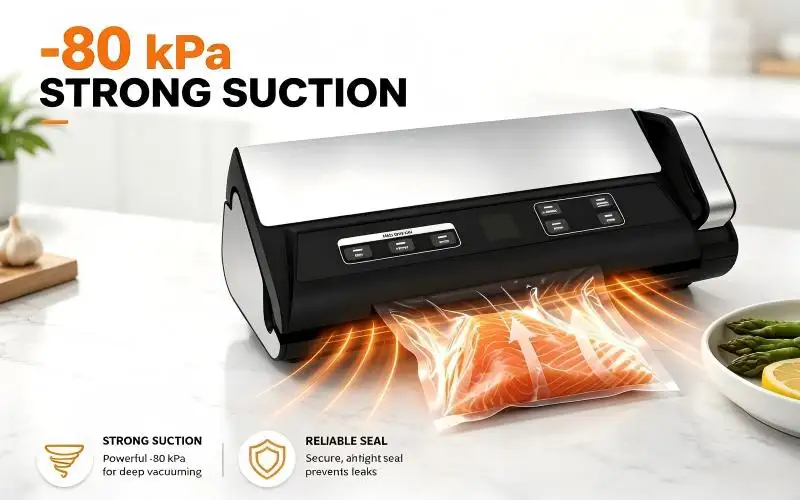
The heart of any food vacuum sealer is its pump. A lot of generic models on the market struggle with dense or moist foods because their motors simply lack the necessary torque. You should look for a machine that delivers a genuine -80 kPa of vacuum pressure. This level of strong suction ensures deep vacuuming, which fast and efficiently locks in flavor and extends the life of the food. Additionally, an efficient pump should operate at a flow rate of around 8 L/min while keeping the noise level below 76 dB at a one-meter test distance. This creates a powerful yet relatively quiet experience for the end-user.
Double-Wire Sealing Technology
The seal itself is where many low-cost devices fall short; suction is only half the fight. To stop air leaks, a premium vacuum sealer OEM provider will improve the heating components. For instance, a tight, airtight seal is maintained by using two flat heating wires (each 3.0 mm wide) running on a low 12V power. The machine is quite adaptable for daily kitchen duties since it can easily fit ordinary home bag sizes with a maximum sealing width of 300 mm.
User-Centric Features That Drive Retail Sales
Your customers want a machine that is very simple to operate, not just one that functions. Retail ratings and repeat business are directly impacted by the use of clever, ergonomic designs.
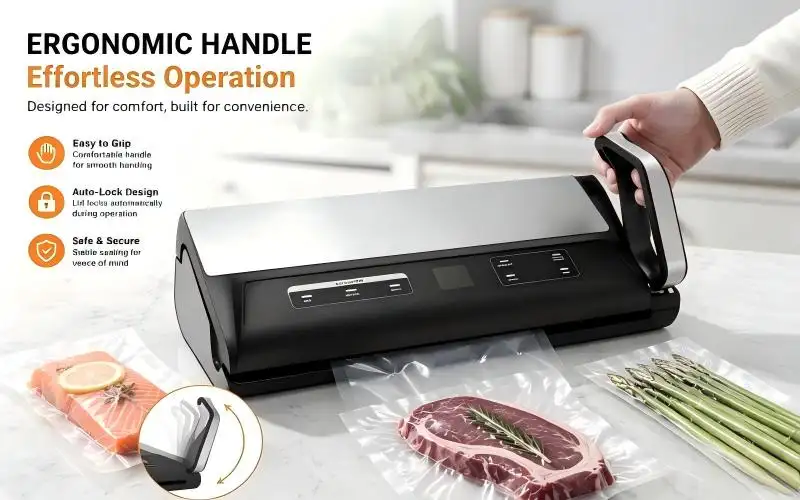
Auto-Lock Design and Ergonomic Handle
Customers detest having to forcefully press down on a machine's two sides in order to lock it. The user experience is radically altered by an ergonomic handle. The lid locks on its own while in use thanks to its auto-lock feature. With its smooth handling and solid sealing, this easy-to-grip handle gives the user piece of mind without demanding a lot of physical power.
Digital Displays and Intelligent Controls
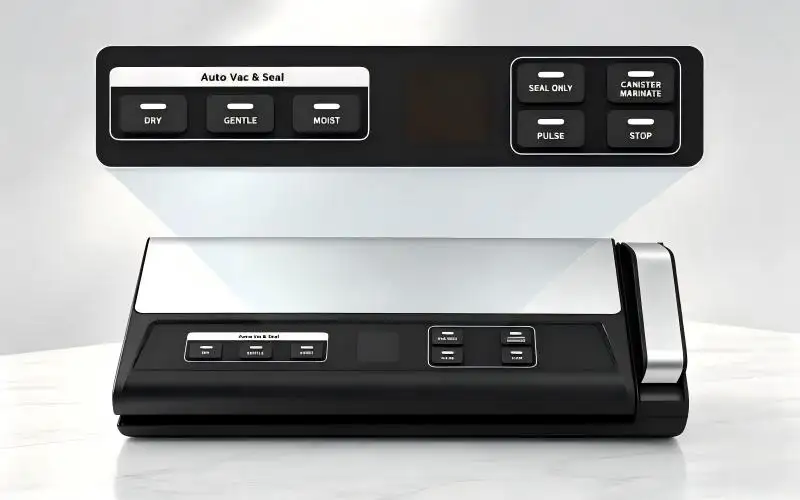
Today's kitchen appliances demand intuitive interfaces. If you want your food vacuum sealer to stand out, it needs a smart, highly accurate control board. Look specifically for a real-time digital countdown screen. Showing users exactly how many seconds are left in a cycle eliminates guesswork and builds trust in the machine's performance.
Versatility is also non-negotiable. Your unit's control panel must offer dedicated Dry, Gentle, and Moist modes within its automatic cycle. Throw in manual overrides—like Seal Only, Pulse, and Canister/Marinate options—and you empower consumers to safely pack everything from easily crushed berries to liquid marinades.
Solutions for Integrated Storage
Consumers hate hunting through cluttered drawers for loose plastic bags. A truly premium model solves this by housing a massive 28 x 600 cm roll right inside the unit. Pair that internal storage chamber with a built-in cutter, and users can size, slice, and seal bags on demand. It is a simple layout upgrade that massively boosts how much shoppers are willing to pay for your product.
Why Partnering with the Right Vacuum Sealer OEM Supplier Matters?
Sketching a solid product concept is the easy part; scaling it up without losing quality takes a factory with proven manufacturing chops. Your chosen vacuum sealer OEM supplier has to operate strictly by the book to meet rigorous international compliance.
Premium Materials and Build Quality
How a machine feels out of the box tells the buyer exactly how long it will last. Opt for tough ABS plastic bodies wrapped in sleek stainless steel accents—this combination resists daily kitchen abuse while looking sharp on a countertop. Don't compromise on the interface either; specify PET/PC materials for the control panel so the buttons remain highly responsive after years of heavy meal prep.
Global Certifications for Market Entry
Try selling uncertified electronics in North America or Europe, and customs will stop you immediately. Skip any manufacturer that hesitates to show their compliance paperwork. You need absolute proof that their units carry valid CE, CB, and ETL marks. These stamps guarantee that critical internal parts—like a 120W motor engineered to handle either 100–120V or 220–240V grids—are legally safe for global retail.
Conclusion: Elevate Your Product Line Today
Launching a profitable food vacuum sealer shouldn't feel like a gamble. When you prioritize rugged suction power, fail-proof double-wire seals, and smart touches like ergonomic grips and visual timers, your product will naturally stand out in a crowded market.
If your goal is to source a category-leading machine like the VS6121, you need an OEM supplier who understands the engineering side just as much as the retail strategy. Stick with factories that deliver certified safety, durable build materials, and the exact functionality your end-users actually care about.
Related Articles
How We Test Every Ice Maker Before Packaging
2026-09-15
BY YUMYTH
A step-by-step look at refrigerant handling, cooling verification, leak detection, corrective action and electrical safety testing For an ice maker, reliable performance is determined long before the carton is sealed. ...
Guide for Brands Looking for a Reliable Vacuum Sealer OEM Supplier
2026-09-14
BY YUMYTH
When you are sourcing kitchen appliances for your retail brand, finding a dependable vacuum sealer OEM supplier is rarely just about getting the lowest unit price. It is about protecting ...

Why Ice Shape Matters: Understanding 10mm × 15mm Cylindrical Nugget Ice
2026-09-14
BY YUMYTH
More Than Ice Production — The Ice Itself Shapes the Consumer Experience When sourcing a nugget ice maker, buyers often focus first on production capacity, water tank size, ice basket ...

Ice Maker Sourcing Guide: How to Find the Right Factory
2026-09-10
BY YUMYTH
Sourcing an ice maker looks straightforward on paper. Find a supplier, agree on a price, place an order. But anyone who has actually done this knows the process is rarely ...