
Chamber Vacuum Sealer Machine for Soups and Sauces: How Liquid Overflow Is Controlled
Share:
-

-

-

-


Copied
Share:
-
-
-
-
Copied
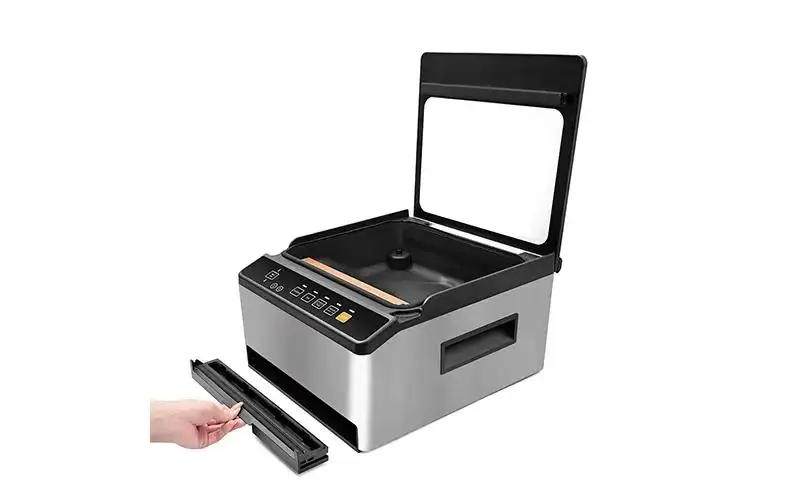
Liquid packaging is an example of the differentiation between a Chamber Vacuum Sealer Machine and a standard external vacuum sealer. Liquids can migrate from the package during the sealing process. Soup, sauces, marinades, fish, and even some cuts of meat contain enough liquid to seep from the package. Sealing liquid in the seal area can cause the seal to fail and the liquid will enter the evacuation path.
Controlling the flow of liquid is made easy with a properly designed Chamber Vacuum Sealer Machine. These types of machines extract air from the bag surrounding the bag mouth instead of pulling a partial vacuum in the bag. YUMYTH has taken advantage of this concept in the CVS101 where a -98K Pa vacuum chamber is combined with a readily available 40 L/min pump, manual vacuum control along with a double seal, and a dedicated external sealing mode.
Why External Vacuum Sealing Struggles With Liquids
An external machine keeps the outside of the bag at atmospheric pressure while removing air through the open bag end. The resulting pressure differential compresses the bag and drives air—and potentially liquid—toward the vacuum channel.
Typical problems include:
•Marinades entering the vacuum port;
•Soup moving into the seal area;
•Oil or moisture reducing seal consistency;
•Additional cleaning between packages;
•Difficulty controlling thin or warm liquids.
The issue is therefore not simply excessive suction. It is primarily the vacuum path and pressure distribution.
How a Chamber Vacuum Sealer Machine Controls Liquid Movement
With a Chamber Vacuum Sealer Machine, the filled bag is positioned completely inside the chamber. As the pumps evacuate the chamber, pressure decreases outside and inside the bag at approximately the same time.
This changes liquid behavior substantially.
| Technical Factor | Chamber Vacuum | External Vacuum |
| Evacuation area | Entire chamber | Bag opening |
| Pressure around bag | Falls during cycle | Remains atmospheric |
| Direct flow toward vacuum port | Low | High |
| Liquid packaging | Well suited | More difficult |
| Smooth chamber bags | Compatible | Normally unsuitable |
| Typical products | Soup, sauce, marinades | Dry and moist solids |
The CVS101 Chamber Vacuum Sealer Machine uses three pumps to provide 40 L/min chamber airflow and a rated vacuum pressure of -98 kPa. External mode operates separately at -80 kPa and 8 L/min, making it more appropriate for routine dry-food packages.
Deep Vacuum Does Not Mean Zero Liquid Expansion
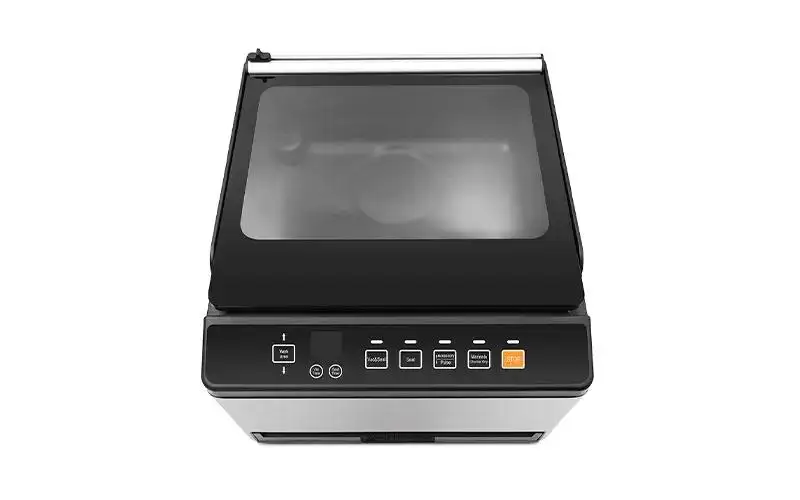
A Chamber Vacuum Sealer Machine reduces direct liquid suction, but liquid can still foam or boil as chamber pressure decreases.
There is a scientific reason as to why it is possible. Lower absolute pressures mean lower boiling temperatures, making water-based liquids easier to boil. Warm Soup will thus boil with bubbles first in a vacuum than when chilled.
Certain factors work jointly to affect liquid packaging performances:
•Temperature of liquid: Warmer liquid takes less time to vaporize.
•Vacuum endpoint: Difficulty of operation of some products to process a complete vacuum.
•Vacuum time: Vacuum time increases foam production.
•Pump flow: Rapid loss of chamber pressure with fast discharge.
•Viscosity: Liquid and thicker sauce processing times will vary.
•Bag headspace: More empty bag space allows the liquid to expand.
This is why the CVS101 includes manual vacuum time control. Operators can stop evacuation according to product behavior rather than forcing every package through the maximum -98 kPa cycle.
Maximum Vacuum vs. Controlled Vacuum
| Vacuum Strategy | Technical Benefit | Main Limitation |
| Maximum vacuum | Lower residual air | Greater foaming risk |
| Short vacuum cycle | Better liquid stability | Higher residual air |
| Manual vacuum time control | Adjustable vacuum endpoint | Requires process setup |
| Fixed automatic cycle | Good repeatability | Less adaptable to changing liquids |
For wet products, the correct objective is controlled vacuum, not simply the highest available vacuum number.
Vacuum Pressure, Pump Flow and Chamber Volume Work Together
Buyers comparing a Chamber Vacuum Sealer Machine should distinguish vacuum pressure from pump capacity.
Vacuum Pressure
Vacuum pressure describes how far chamber pressure can be reduced. It affects residual air and package compression after pressure returns.
Pump Flow
Pump flow, expressed in L/min, describes evacuation capacity. Higher flow can shorten the time required to reach a target pressure, but cycle performance also depends on:
•Chamber internal volume;
•Loaded product volume;
•Selected vacuum endpoint;
•Gasket condition;
•System leakage;
•Control-program timing.
For this reason, comparing only "-98 kPa vs -90 kPa" provides an incomplete assessment. The CVS101 pairs -98 kPa chamber vacuum with 40 L/min airflow, while maintaining a compact 398 × 355 × 229 mm machine structure.
Liquid Temperature and Product Type Determine the Process Setting
There is no universal liquid setting for a Chamber Vacuum Sealer Machine.
| Product | Main Process Risk | Practical Control Direction |
| Chilled soup | Moderate bubbling | Controlled deeper vacuum |
| Warm soup | Early boiling | Reduce vacuum duration |
| Thin sauce | Rapid movement | Increase bag headspace |
| Thick sauce | Slower movement | Longer evacuation may be possible |
| Marinated meat | Free liquid around solids | Use chamber mode |
| Dry food | Minimal liquid risk | External mode may be faster |
Where food-handling procedures allow, cooling liquid products before vacuum packaging generally makes the vacuum process easier to control.
Seal Design Matters After Vacuuming
Preventing overflow is only half of the packaging process. The Chamber Vacuum Sealer Machine must also produce a stable seal after evacuation.
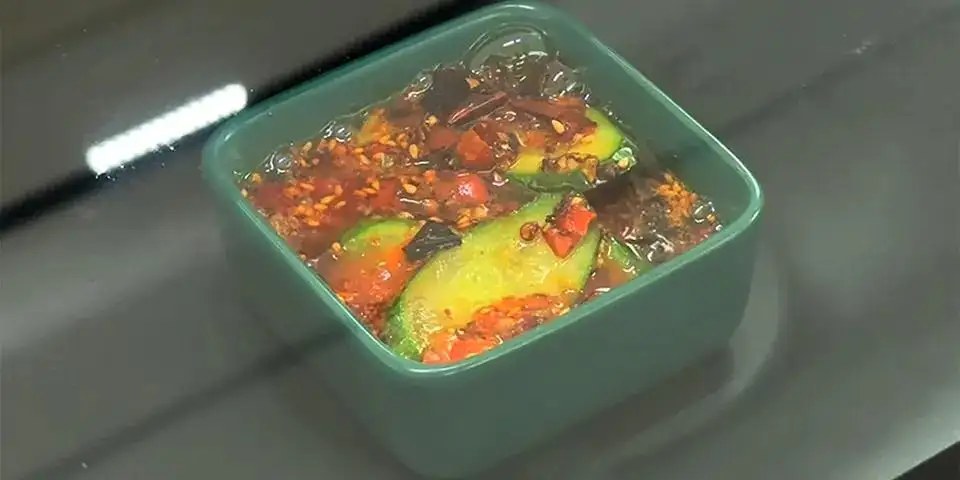
The CVS101 chamber mode uses a 3 mm × 2 double sealing bar with a maximum work width of 28 cm. External mode uses a 3 mm single seal for bags up to 30 cm.
Double sealing provides two sealing lines, which can add useful redundancy for wet-food packages. However, double sealing cannot compensate for heavy oil, sauce, or moisture contamination on the sealing surface.
Before sealing:
•Keep the bag opening flat;
•Remove folds from the seal area;
•Maintain sufficient headspace;
•Wipe away visible liquid;
•Match seal time to bag structure and thickness.
Smooth Chamber Bags vs Textured Bags
Bag compatibility also affects operating cost and workflow.
The CVS101 Chamber Vacuum Sealer Machine supports both smooth chamber bags and textured bags in chamber mode. External mode requires textured bags because embossed channels provide an airflow path when the bag is compressed outside a chamber.
This dual-mode arrangement allows buyers to use chamber bags for liquid and batch packaging while retaining external vacuum capability for bulky or everyday products.
Cleaning and Thermal Control for Repeated Wet-Food Cycles
Liquid applications place greater emphasis on machine hygiene and thermal management.
YUMYTH integrates:
•A removable drip tray for excess liquid;
•SUS430 stainless steel and smooth ABS surfaces;
•A toughened-glass chamber lid for process visibility;
•Detachable power cord for easier cleaning and placement;
•External mode with NTC overheating protection;
•External mode with thermal fuse protection.
The CVS101 is rated for 3,000 operating cycles and tested to 10,000 cycles under YUMYTH validation conditions. For commercial buyers, cycle data should still be evaluated together with actual sealing frequency, cooling intervals, product temperature, and maintenance procedures.
Selecting the Right Chamber Vacuum Sealer Machine for Liquids
A reliable Chamber Vacuum Sealer Machine should be evaluated as a pressure-control and sealing system rather than simply by its maximum vacuum rating.
For liquid products, the key relationship is:
Liquid Temperature + Vacuum Endpoint + Pump Flow + Headspace + Bag Type + Seal Condition
YUMYTH's CVS101 integrates -98 kPa chamber vacuum systems, 40 L/min triple-pump configurations, manual vacuum time control, double sealing, smooth-bag compatibility, external vacuum mode, and liquid management components that can be removed all on one device.
When considering a chamber vacuum sealer machine, YUMYTH can assist distributors in meeting private label specifications for appliance brands/ food-packaging, based on the liquid, bag format and sealing requirements, local electricity standard, and the targeted market.
FAQs
Q1. Does CVS101 use single or double sealing?
The CVS101 utilizes a 3 mm × 2 double sealing bar with a maximum working gap of 28 cm in the chamber mode. In the external mode, a single sealing bar is utilized and can be used for bags of up to 30 cm in width.
Q2. Why is chamber mode better for liquids than external vacuum mode?
Chamber mode reduces pressure over the entire bag and pulls air throughout the bag opening, whereas in external mode only air is pulled through the opening. This controls liquids such as soups, sauces, and marinades that tend to move and splash during the removal of air.
Q3. Does the CVS101 always need to operate at -98 kPa when sealing liquids?
A -98 kPa vacuum is not always needed for liquid products. shorter vacuum cycles may be used for warm liquids or liquids that are prone to foaming. The CVS101 offers manual vacuum time control, allowing the operator to control the end of the vacuum cycle.
Q4. What is the vacuum pump capacity of the YUMYTH CVS101?
The chamber mode of the CVS101 utilizes three vacuum pumps and has a maximum flow rate of 40 L/min at a vacuum level of -98 kPa. External mode of the CVS101 has a vacuum level of -80 kPa and a maximum flow rate of 8 L/min.
Q5. What vacuum bags can be used with the CVS101 Chamber Vacuum Sealer Machine?
For the chamber mode, vacuum bags for textured and smooth surfaces can be used. For the external mode, vacuum bags of textured surfaces must be used. The embossed surfaces of textured bags allow for air to escape during bag compression.
Related Articles
How We Test Every Ice Maker Before Packaging
2026-09-15
BY YUMYTH
A step-by-step look at refrigerant handling, cooling verification, leak detection, corrective action and electrical safety testing For an ice maker, reliable performance is determined long before the carton is sealed. ...
Guide for Brands Looking for a Reliable Vacuum Sealer OEM Supplier
2026-09-14
BY YUMYTH
When you are sourcing kitchen appliances for your retail brand, finding a dependable vacuum sealer OEM supplier is rarely just about getting the lowest unit price. It is about protecting ...
Why Ice Shape Matters: Understanding 10mm × 15mm Cylindrical Nugget Ice
2026-09-14
BY YUMYTH
More Than Ice Production — The Ice Itself Shapes the Consumer Experience When sourcing a nugget ice maker, buyers often focus first on production capacity, water tank size, ice basket ...

Ice Maker Sourcing Guide: How to Find the Right Factory
2026-09-10
BY YUMYTH
Sourcing an ice maker looks straightforward on paper. Find a supplier, agree on a price, place an order. But anyone who has actually done this knows the process is rarely ...