
How Do I Evaluate a Slush Machine Factory in China?
Share:
-

-

-

-


Copied

Share:
-
-
-
-
Copied
To determine if a slush machine factory in China will meet your needs, you must go beyond checking out their website, product catalogue, quotation, or certificate logos. An attractive sample can be produced by a supplier, but may not have the engineering capability, process control, testing equipment or component traceability to ensure stable mass production.
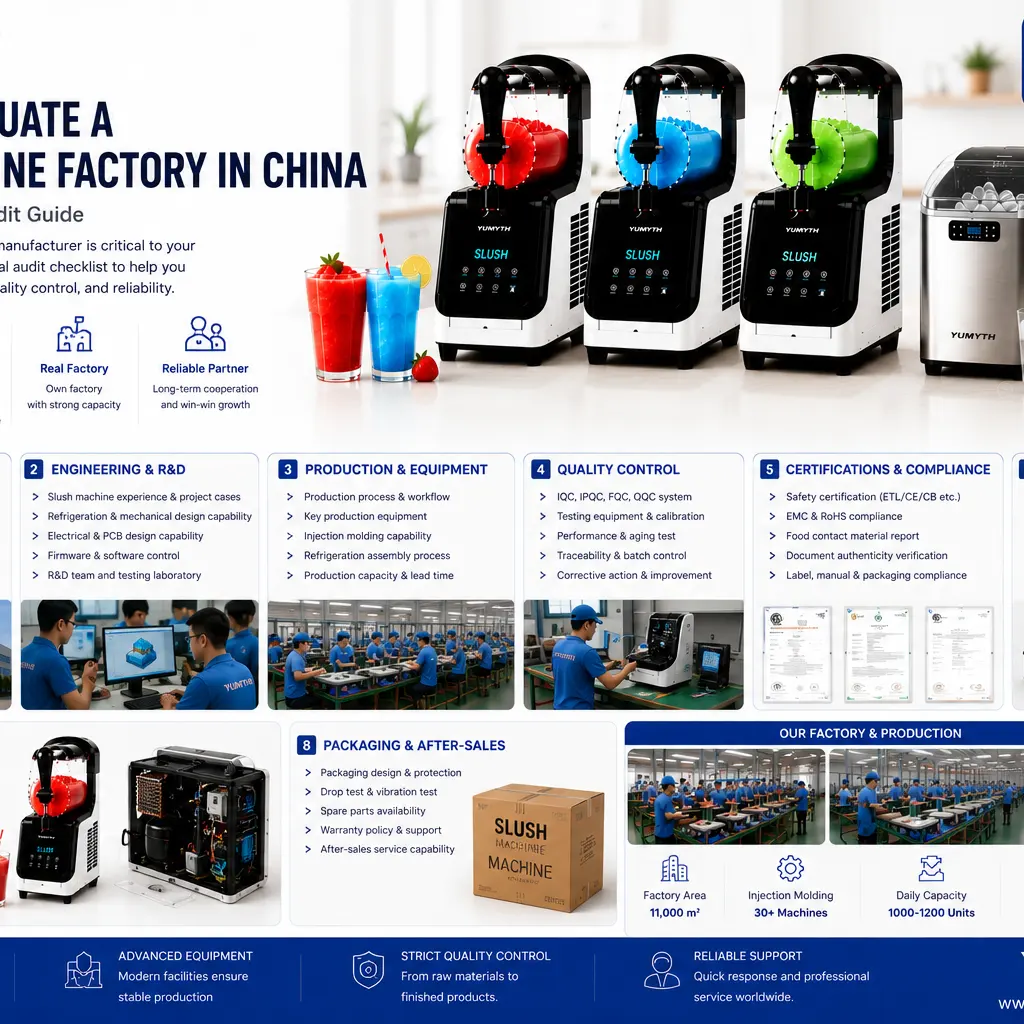
Several functions are integrated in one compressor-based slush machine: refrigeration, mechanical mixing, electronic controls, firmware, food contact materials, parts for dispensing and packaging. Buyers should thus consider the entire manufacturing system, and not just the final product.
An audit of the factory can establish a structure to uncover risks prior to tooling, certification, component ordering and manufacturing.
Make sure that the supplier is the actual manufacturer.
The first question is whether the company makes the slush machine or is primarily a trading business.
Request and compare:
- * Business license;
- * Registered company name;
- * Factory address;
- * Bank account information;
- * Product certificates;
- * Export documents;
- * Factory audit reports.
Names and addresses of the company should be consistent throughout these documents.
When visiting the factory or during a live video audit request that the supplier demonstrate the current production line, refrigeration assembly area, testing stations, raw-material warehouse, finished-goods warehouse, and company signage.
A real manufacturing entity ought to be able to clarify which operations it undertakes in house and what it out sources. Compressors, motors, PCBs or specialized components are common examples of outsourcing items, but the factory should have control over the specifications, supplier approval, incoming check, assembly and testing along with engineering changes.
Visit the Factory and explore their Product Experience.
You can't simply assume that a general kitchen appliance factory will be able to make compressor-based slush machines.
Inquire about the supplier's experience with the company in:
- * Refrigeration circuits;
- * Flammable liquefied petroleum gases (LPG); and
- * Beverage freezing;
- * Auger mixing systems;
- * Food-contact components;
- * Electrical safety testing;
- * Frozen drink firmware.
Ask for examples of the work the engineering team has done with slush machines and have them discuss how sugar, alcohol, fill volume, ambient temperature and starting liquid temperature affect the freezing time.
A good factory needs to know the reasons behind the freezing too hard of a low-sugar drink, the reason a high-alcohol cocktail may not freeze, and how auger motor current can be used to sense excessive resistance.
Review the Engineering Team's performance.
Interviews with refrigeration, mechanical design, electronics, firmware, tooling, testing and quality assurance Gurus.
Ask the engineering team to explain:
- * How compressor capacity is selected;
- * The reasons for optimizing amounts of refrigerant charge; and
- * How to measure the air flow in the condenser;
- The effects of the auger geometry on texture;
- * Timing of the sensors; and
- * Advantages of using a vehicle-to-carrier signal for navigation; and
- Appendix: How new recipes are tested.
The team needs to be capable of giving drawings, controlled specifications, test methods, engineering change records etc.
One supplier who uses only one outside consultant might not be able to get the other person's expertise available at a moment's notice when an issue arises during the certification or pilot production.
Conduct the auditing of the Quality Management System.
An ISO 9001 is a recognized framework that can be used to set-up, maintain, and continually improve a quality management system. A certificate does not, however, mean that the factory implements efficient controls in all production orders.
Look at actual completed records not blank forms that have been set up for an audit.
Important records include:
- * Incoming inspection reports;
- * Production work instructions;
- * Equipment calibration records;
- * Operator training records;
- * Nonconforming-product reports;
- * Corrective-action reports;
- * Final inspection reports;
- * Customer complaint investigations;
- * Supplier performance reviews.
Request the quality manager to point to a recent production batch and show how a single machine can be traced from the compressor to the electrical test report to the inspection status to the motor to the PCB to the charge of refrigerant to the firmware.
Discuss Incoming Component Control
The quality of the slush machine is greatly influenced by the quality of the components needed to be purchased.
Examine the method of verification used by the factory:
- * Compressors;
- * Electrical motors and gearboxes; and
- * Condenser fans;
- * PCBs;
- * Temperature sensors;
- Power cords and plugs;
- * Beverage tanks;
- * Augers;
- * Silicone seals;
- * Dispensing valves.
Incoming inspection to verify more than appearance. Electrical ratings, dimensions, material grades, supplier batch numbers, sensor accuracy and motor performance are examples of critical specifications.
Rejected components should be marked and physically removed from accepted components. Inquire if suppliers' defect rates, delivery performance, corrective actions, and change control are used to evaluate them.
Inspect Refrigeration Production
The production area for refrigeration requires careful inspection as the freezing time, refrigeration temperature, noise and reliability of the compressor are sensitive to small variations in process.
Discuss procedures for:
- * Refrigerant tube forming;
- * Brazing;
- * Vacuum evacuation;
- * Refrigerant charging;
- * Leak testing;
- * Compressor installation;
- * Fan motor and housing; and
- Tube routing and protection.
Valid calibration records for charging scales, vacuum gauges, leak detectors and electrical test equipment.
When using R290, check the factory's ventilation, refrigerant storage, operator training, controls of ignition sources, leak detection procedures, and emergency protocols.
IEC 60335-2-24:2025 covers specific safety requirements of household refrigerating appliances, ice-cream appliances and ice makers, including compression type appliances that use flammable refrigerants.
The course is designed to assess the concepts of Assembly-Line Process Control.
Controlled work instructions, assembly fixtures, torque specifications and inspection checkpoints should be utilized in a good factory.
Review the installation of operators:
- * Compressor mounts;
- * Refrigerant tubing;
- * Auger motors;
- * Drive couplings;
- * Beverage tanks;
- * Seals;
- * Dispensing valves;
- * Wiring connectors;
- * Control panels.
Importance components should not be based solely on the operator's experience. The use of fixtures, keyed connectors, alignment marks and barcode verification can minimize assembly errors.
Monitor actual production; not just a demo that is made for the audit. Ensure that operators consistently adhere to the documented process.
Evaluate Product Safety and Certification capability
The general safety requirements for household and similar electrical appliances are specified in IEC 60335-1, and specific requirements for product risks covered by applicable part 2 standards. Household ice-cream appliances and refrigerating equipment for cleaning and preparing ice-cream are covered by the current edition of IEC 60335-2-24.
In the United States, OSHA's contribution to the Nationally Recognized Testing Laboratory program is a recognition program that identifies organizations which test and certify products for specific scopes and issue registered marks that may be used.
Ask for model specific documentation, such as:
- * Safety certificate;
- * Complete test report;
- * Critical component list;
- * EMC report;
- * Food-contact reports;
- * Exposure Assessment Report; and
- * Rating-label artwork;
- * User manual.
Make sure that the model number, manufacturer's address, voltage, refrigerant, compressor, PCB, motor, and power cord all agree with the machine you are interested in.
A certificate for a similar model will not be accepted.
Evaluate Performance Testing
More than just turning the machine on and off should be tested in the factory.
Request to inspect the procedures and records for:
- * Freeze-time testing;
- * pH and conductivity measurements; and
- * Alcohol-range testing;
- * High-ambient operation;
- * Auger jam protection;
- * Leakage;
- * Noise and vibration;
- * Repeated freezing cycles;
- * Extended holding;
- * Component durability.
The beverage formulation, fill volume, starting temperature, ambient temperature, supply voltage, ventilation clearance, selected program and texture endpoint should be defined when performing tests.
Statements like “slush ready in 15 minutes” are of little technical merit if not used in a controlled test.
Ask for the raw data not just a marketing summary.
Conduct Research on Test Cleaning and Food-Contact Design
Check all parts that come in contact with the drink – such as the tank, auger, lid, seals, valve, nozzle and the drink path.
Look for:
- * Rough surfaces;
- * Molding flash;
- * Deep grooves;
- * Trapped-water areas;
- * Difficult seal removal;
- * Incorrect assembly risk;
- * Odor;
- Stress marks or cracks.
Clean all by yourself. Take them apart, clean them and put them back together and do another leak check.
An automatic rinse mode may be used to loosen residues, but must not be used as a substitute for full rinse unless the entire food contact system has been validated for this purpose.
The following table summarizes the capability of mold and plastic parts production.
In cases of special housing, tank, auger, handle or lid production, check the tooling and injection molding capabilities of the supplier.
Confirm:
- Who is responsible for the mold;
- * How much they are stored; and
- The materials used are:
- * The types of inspections that may be required; and
- * How to keep up with the maintenance process of molds;
- How tools are being protected to suit the needs of the customer.
Transparency in tanks and sealing parts are particularly demanding on stability of the molding process. The leakage and poor auger alignment can be caused by warping, shrinkage variation, rough surfaces, or dimension errors.
Examine Final testing and following up.
Appliances should be subjected to controlled tests for function and for electricity, before being wrapped up in packaging.
Examples of final checks can include:
- * Ground continuity;
- * Dielectric strength;
- * Leakage current;
- * Compressor operation;
- * Fan operation;
- * Auger rotation;
- * Control-panel functions;
- * Sensor response;
- * Leakage inspection;
- * Appearance and labeling.
IEC 60335-1 covers, reasonably foreseeable electrical, mechanical, thermal and fire hazards of household and similar appliances.
Question what happens if machines fail, how they are isolated, how they are repaired, how they are retested and how they are recorded. When repairing an appliance, if any appliance has failed, the appliance should be retested for all the safety and functional tests that were previously applicable to it.
Review Packaging & Transport Validation
The packaging should ensure that the transparent tank, dispensing handle, compressor mounts, control panel, and refrigerant tubing are protected.
Request records for:
- * Drop testing;
- * Vibration testing;
- * Carton compression;
- * Packed-product inspection;
- * Post-transport functional testing.
Following the packaging tests, the machine should be retested for leakage, unusual noises, damage to the refrigerant system and freezing performance.
Audit Pilot Production
Don't go directly from an approved sample to a large production run.
Request a trial run with:
- * Final tooling;
- * Approved suppliers;
- * Final firmware;
- * Production operators;
- * Intended test equipment;
- * Final packaging.
Randomly select pilot units for comparison with the approved golden sample.
Check for freeze time, texture, noise, leakage, appearance, labels, accessories and packaging. Open pilot-production problems should be documented and addressed before mass production of the product.
Conclusion
An evidence-based assessment of the engineering, refrigeration production, quality management, certification, testing, food-contact control, tooling, assembly, traceability, and packaging in a slush machine factory in China is necessary to evaluate a slush machine factory.
It is not always the case that the factory with the longest certificate record, the lowest quotation or the biggest building is the best supplier. The manufacturer who can prove repeatable production, controlled components, full technical documentation, reliable testing, transparent corrective actions, and product support over the long haul.
A comprehensive factory audit, inspection of samples that represent the production volume and inspection of pilot production can help minimize the risk of delays in certification, variations in batches, warranty claims, and costly product recalls.
Related Articles
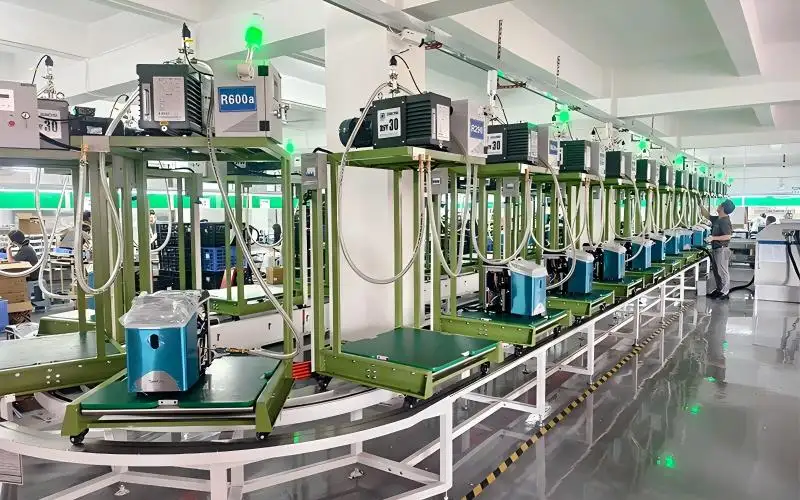
How We Test Every Ice Maker Before Packaging
2026-09-15
BY YUMYTH
A step-by-step look at refrigerant handling, cooling verification, leak detection, corrective action and electrical safety testing For an ice maker, reliable performance is determined long before the carton is sealed. ...
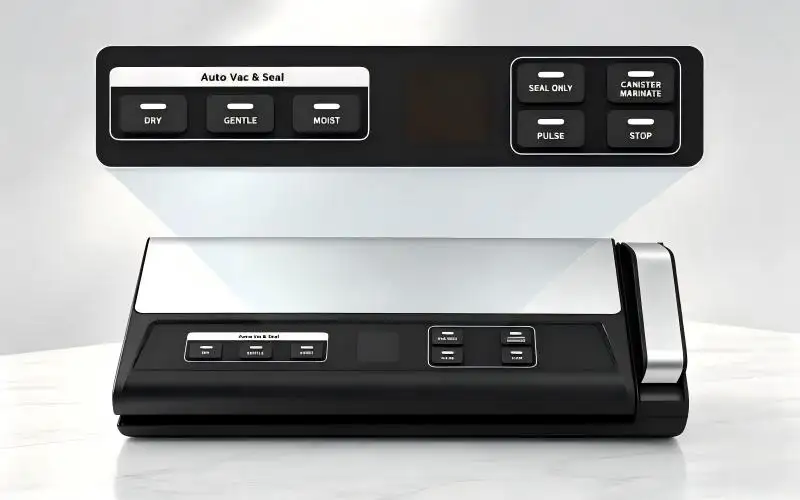
Guide for Brands Looking for a Reliable Vacuum Sealer OEM Supplier
2026-09-14
BY YUMYTH
When you are sourcing kitchen appliances for your retail brand, finding a dependable vacuum sealer OEM supplier is rarely just about getting the lowest unit price. It is about protecting ...

Why Ice Shape Matters: Understanding 10mm × 15mm Cylindrical Nugget Ice
2026-09-14
BY YUMYTH
More Than Ice Production — The Ice Itself Shapes the Consumer Experience When sourcing a nugget ice maker, buyers often focus first on production capacity, water tank size, ice basket ...

Ice Maker Sourcing Guide: How to Find the Right Factory
2026-09-10
BY YUMYTH
Sourcing an ice maker looks straightforward on paper. Find a supplier, agree on a price, place an order. But anyone who has actually done this knows the process is rarely ...