
Common defect and corrective-action report
Share:
-

-

-

-


Copied

Share:
-
-
-
-
Copied
A defect and corrective action report is a common defect report to help the appliance brand and OEM manufacturers to identify the quality defects, identify the affected products, understand the root cause and ensure that the same defect does not reoccur.
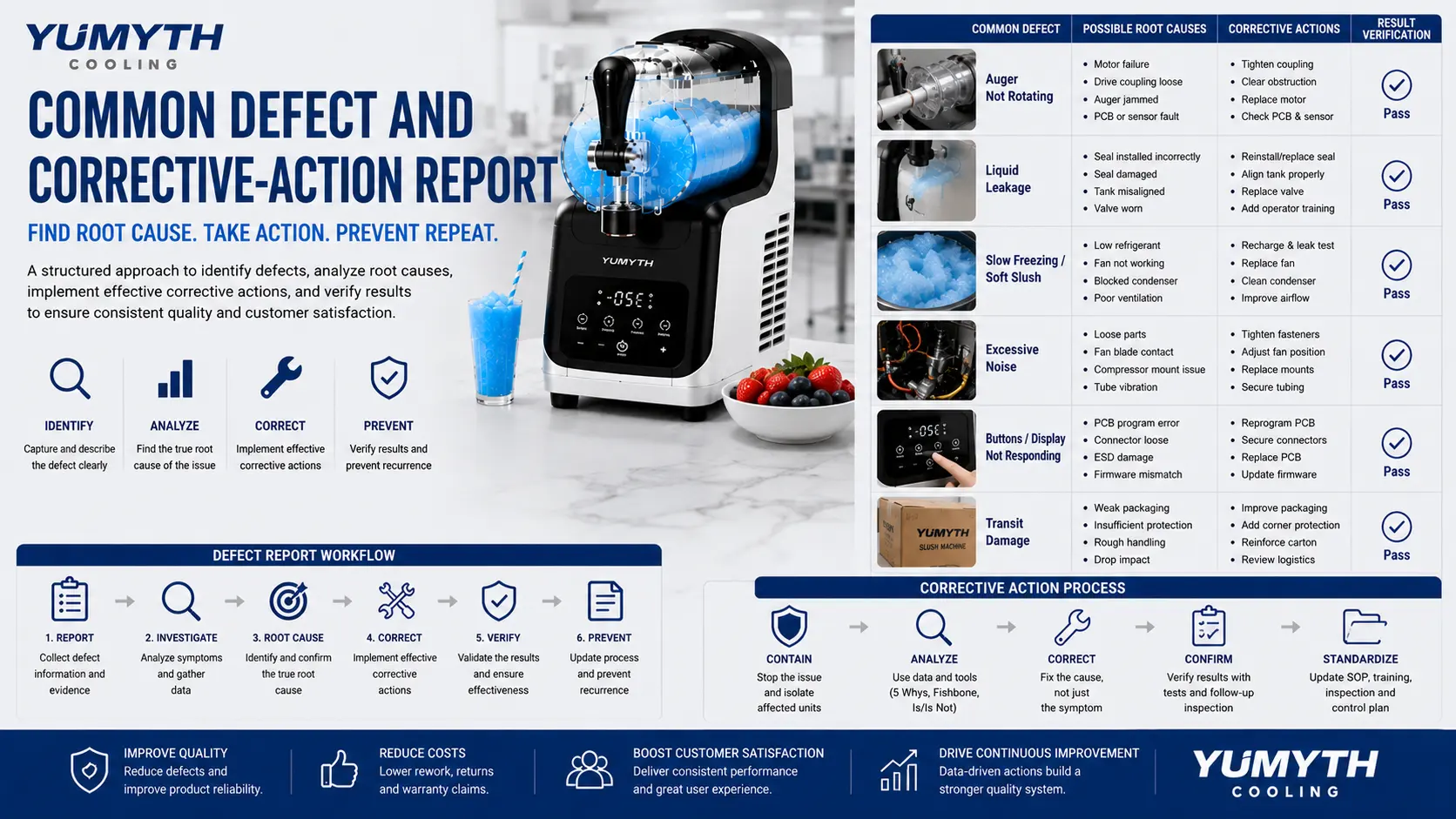
Home slush machines may have a variety of defects, such as refrigeration, mechanical mixing, food contact component, electrical controls, software, appearance, packaging, or production process. A superficial problem seen at the last moment might cause the product to leak, have a poor texture, make a lot of noise, jam the auger or fail entirely after shipping.
A good report isn't a simple "the unit was repaired. It should describe the cause of the problem, the number of products that may be impacted, the immediate response to the problem, the process that was modified, and the means of proving the effectiveness of the corrective action.
Clearly define the Defect.
The first step is to describe the problem in measurable terms.
A weak description is something that can be said as:
The machine isn't functioning correctly.
A good description of a defect should include the following:
- * Type and version of browser; and
- * Serial or batch number;
- * Production date;
- Actually inspection or customer location;
- * Operating condition;
- * Expected performance;
- * Actual result;
- * Defect frequency;
- Evidence in the form of photographs or tests.
For example:
Three units from production batch A2406 were over the approved preparation-time limit during their freezing test in the standard 2.0-liter procedure. Low condenser airflow and high compressor-shell temp were observed in all three units.
This description provides the engineering and quality teams with sufficient information to get started on the investigation.
Identify root causes not symptoms
A customer complaint typically represents the symptom, rather than the cause.
Examples include:
- The machine will not freeze.
- * “The auger stops.”
- Water is leaking from the tank.
- “The product is noisy.”
- “But the buttons won't work.”
There are multiple possible causes for each symptom. For instance, if the slow-freezing machine happens, the causes may be errors in the refrigerant charge, blockage in the condenser, a faulty fan, inadequate contact between the sensors and the food, an unsuitable beverage formulation, or incorrect software configuration.
The report should not jump to the conclusion right away. The teams should gather data and test each possible cause one at a time.
Common Refrigeration Defects
The defects related to refrigeration have direct impact on freezing time, beverage temperature, texture and compressor reliability.
Common problems include:
- * Incorrect refrigerant charge;
- * Refrigerant leakage;
- * Restricted capillary tube;
- * Poor brazed joint;
- * Incorrect compressor model;
- * Condenser fan failure;
- * Blocked ventilation;
- * Evaporator sensor misplacement;
- * Insufficient insulation;
- * Hot-air recirculation.
Immediate containment measures include holding the affected production batch, reviewing refrigerant charge records, examining brazed joints and further cooling tests.
Corrective actions might include recalibration of charging equipment, modification of brazing parameters, installation of tube-positioning fixtures, modification of leak-test procedures, or method change of fan inspection.
The report should confirm that the correction does not increase the noise, electrical loads, or component temperatures.
The next time you head to the beach, keep an eye out for auger and drive-system defects.
During the freezing process the auger, motor, gearbox, drive coupling and scraper are subjected to varying loads.
Common defects include:
- * Auger misalignment;
- * Excessive positioning differences; and
- * Worn drive coupling;
- * Loose motor fasteners;
- * Gearbox noise;
- * Incorrect auger direction;
- Failure to switch back to the default page; and
- *Too much overload;
- * Contact with the tank by the scraper.
If the auger stops, this does not necessarily indicate a problem with the motor. The recipe may have frozen too hard or the tank may be improperly installed.
The investigation should include a comparison of motor current, auger speed, beverage Brix, temperature, assembly condition and protection response.
Corrective action can involve modifying tolerances on individual components, providing better assembly fixtures, modifying firmware thresholds, altering the coupling material, or adding a final rotation check at the end of the production line.
Leakage Defects
One of the most frequently cited quality complaints with removable food contact parts is leakage.
Leakage can occur anywhere, such as:
- * Beverage tank joints;
- * Seal-ring grooves;
- * Dispensing valves;
- * Nozzle connections;
- * Tank-to-base interfaces;
- * Refrigeration tubing;
- * Condensation drainage paths.
Possible root causes: seal is twisted, the seal is not the correct hardness, the valve surface is damaged, the plastic tank is warped, the seal is not being compressed correctly, there is too much molding flash, or the assembly sequence is incorrect.
The corrective action report should determine if the problem was caused by material, design, tooling, operator handling or inspection.
The temporary action could include a 100% test of the specific batch. The seal groove may need to be revised, visual instructions may need to be improved, a dedicated installation fixture may be used or there may be tighter dimensional control required for a permanent action.
Noise and Vibration Defects.Noise and Vibration Defects.
Unusual sounds may mean that parts are touching, parts are out of alignment, or that mechanical wear is occurring.
Common sources include:
- * Fan blades touching the headlights; and
- * Loose cabinet panels;
- * Compressor mount problems;
- A contact between refrigerant tubing and the housing; and
- * Auger scraping;
- * Gearbox knocking;
- * Drive coupling looseness;
- * Relay chatter.
Complaints should be duplicated with a defined beverage load and operating stage, for use by quality teams. A blank machine might not show a sound that is present only at the end of the mixture's texture.
Methods of frequency analysis, vibration measurement, and isolation of components can assist with identifying the source.
These corrective actions could involve changing the hardness of the mounts, increasing the distance between the fan blades and the panels, using tube clips to secure the tubes, stiffening the panels, or adjusting the alignment of the auger.
A defect in the electrical or control system.Failure of electrical or control system.
Electrical issues could occur with start up, buttons, sensors, motors, compressors, displays and safety protection.
Typical defects include:
- * Loose wiring connectors;
- * Incorrect PCB version;
- * Firmware mismatch;
- * Low sensor temperature; and
- * Display failure;
- * Touch-panel sensitivity variation;
- * Relay failure;
- * Poor grounding;
- * Incorrect plug or voltage version.
Affected products must not be packaged or shipped until they have been contained. The team should determine if the issue is only in one component batch or in multiple production orders.
Keyed connectors might be used, PCB programming control might be improved, bar code verification could be implemented, electrical testing may be revised, connector retention features may be added, or software version locking may be used.
A product which has been repaired must undergo the full applicable electrical and functional test sequence.
Food-Contact and Cleaning Defects
Food-contact components should be easily cleanable, washable, and properly connected.
Typical quality issues are:
- * Rough internal surfaces;
- * Molding flash;
- * Odor;
- * Staining;
- * Cracked transparent tanks;
- * Seal deformation;
- * Water collected in hollow spaces;
- * Components installed backward;
- * Dishwasher-related warping.
It is important that this investigation confirms the resin, colourant, elastomer, supplier batch, moulding conditions and cleaning exposure.
When a part does not pass a test in the course of a production run, and the material is marked as "food grade," it does not provide insight into the reason for the failure.
This can be corrected by adjusting the molding temperature, better polishing of the tools, adjustments to material drying controls, replacement of a colorant, redesigning the drainage, or an update to the dishwasher use instructions.
Appearance Defects and Assembly Defects.
Cosmetic defects can impact on customer acceptance and brand reputation, but not necessarily basic function.
Common examples include:
- * Surface scratches;
- * Uneven gaps;
- * Incorrect color;
- * Misaligned logos;
- * Dirty transparent parts;
- * Loose screws;
- * Damaged control panels;
- * Missing protective films;
- * Incorrect labels.
The report should identify if it is due to incoming material, assembly handling, fixtures, packaging or inspection.
Solutions can be protective trays, gloves, new workstation layout, new appearance samples, new lighting, or more clear acceptance standards.
Packaging and Transit Defects.
It is possible for a product to be inspected at the factory to be damaged upon arrival due to packaging.
Common defects of transportation are:
- * Broken tanks;
- * Damaged dispensing handles;
- * Compressor mount movement;
- * Crushed cartons;
- * Accessory scratches;
- * Refrigeration tubing damage;
- * Missing components.
This investigation should explore carton strength, condition of the insert, product movement, packing orientation, drop-test results, vibration exposure and consistency of packing in the factory.
Possible corrective measures include providing more robust corner protection, modifying the geometry in the insert, changing accessory placement, or making more stringent carton requirements.
Packaging modifications must be confirmed by production representative transport testing, not just by visual assessment.
Engage in using a Structured Root-Cause Method
There are several ways to support RCA.
The 5 Whys method is used to ask the question why five times until the cause of the defect in the process is determined.
A fishbone diagram can be used to list possible causes by categories, such as:
- * Material;
- * Machine;
- * Method;
- * Measurement;
- * Personnel;
- * Environment.
An Is/Is Not analysis is a comparison of where and when the problem is occurring to where and when it is not occurring.
The team should validate suspected root cause by testing. Just because a cause makes sense, it can't automatically be accepted.
For instance, if the seal is suspected to be faulty, changing the seal should always stop the leak and putting back the suspect seal should recreate the leak under controlled conditions.
Identify the difference between Corrective, Corrective Action, and Preventive Action
These words shouldn't be used as synonyms.
Correction corrects the affected product. Examples are replacing a seal, mending wiring or recharging a refrigeration system.
Corrective action eliminates the identified cause of the problem being corrected. This can be as simple as switching a fixture, adjusting a process parameter or adding barcode verification.
By taking preventive measures, you will minimize the risk of the same problems cropping up at other locations. This could be done through various methods such as applying the enhanced seal-control process to other models, or incorporating the failure mode into future design reviews.
Not replacing the process that causes the defect is not a complete corrective action.
Verify Effectiveness
A corrective action must be left open until it is proven to be effective.
Verification may include:
- * Additional production inspections;
- * Repeated performance tests;
- * New rain and water resistance testing; and
- Discussion on a few later batches;
- * Reduced defect frequency;
- No complaints from repeat customers;
- * Successful supplier audit;
- New process capability information.
The verification period should be sufficiently long to ensure that the problem is not just temporarily 'gone'.
If the defect reoccurs, the originally identified root cause or corrective action may not have resolved the issue.
Outline the Final Report
A corrective-action report written by a professional should include:
- 1. Defect description;
- 2. Impacted models and batches;
- 3. Immediate containment;
- 4. Risk assessment;
- 5. Investigation data;
- 6. Confirmed root cause;
- 7. Replacing affected items;
- 8. Permanent corrective action;
- 9. Preventive action;
- 10. Responsible owners;
- 11. Completion dates;
- 12. Effectiveness verification;
- 13. Supporting photographs and records;
- 14. Final approval.
The report should also be used to update controlled documents like work instructions, inspection requirements, drawings, bills of material, training records, and supplier specifications.
Conclusion
The common defect and corrective-action report is more than a note of a quality problem. It is a formal process of converting failures into measurable process improvements.
In home slush machines, good reports must relate symptoms to refrigeration, mechanical, electrical, food-contact, assembly and packaging causes. They should include evidence, clear responsibilities, permanent process changes and effectiveness verification.
Repeated defects, warranty costs, shipment delays and customer complaints can be minimized by appliance brands and OEM manufacturers who have a system in place to manage corrective actions. Most importantly, they can develop a production system which can produce safer, more consistent and more reliable products over time.
Related Articles
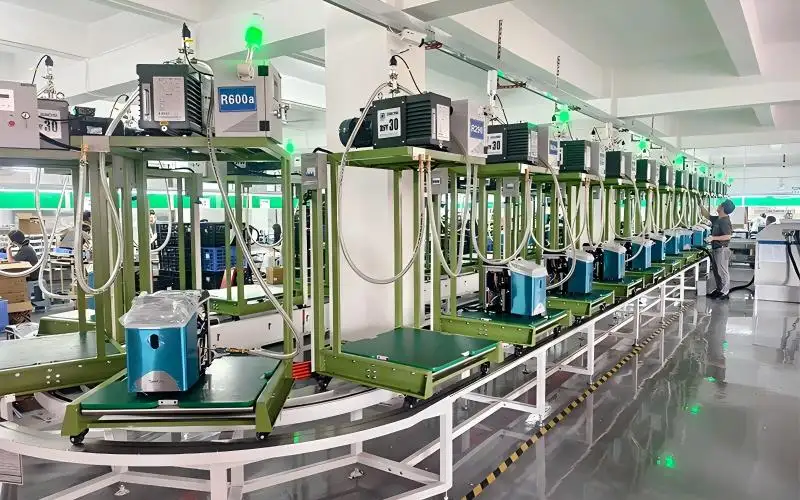
How We Test Every Ice Maker Before Packaging
2026-09-15
BY YUMYTH
A step-by-step look at refrigerant handling, cooling verification, leak detection, corrective action and electrical safety testing For an ice maker, reliable performance is determined long before the carton is sealed. ...
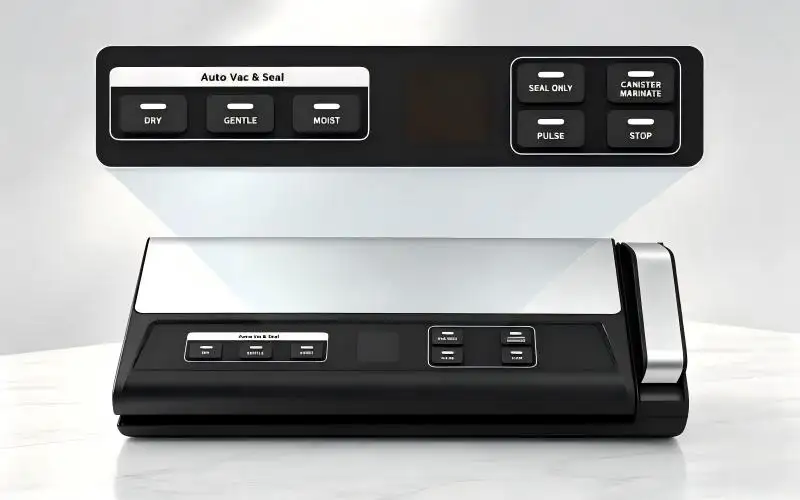
Guide for Brands Looking for a Reliable Vacuum Sealer OEM Supplier
2026-09-14
BY YUMYTH
When you are sourcing kitchen appliances for your retail brand, finding a dependable vacuum sealer OEM supplier is rarely just about getting the lowest unit price. It is about protecting ...

Why Ice Shape Matters: Understanding 10mm × 15mm Cylindrical Nugget Ice
2026-09-14
BY YUMYTH
More Than Ice Production — The Ice Itself Shapes the Consumer Experience When sourcing a nugget ice maker, buyers often focus first on production capacity, water tank size, ice basket ...

Ice Maker Sourcing Guide: How to Find the Right Factory
2026-09-10
BY YUMYTH
Sourcing an ice maker looks straightforward on paper. Find a supplier, agree on a price, place an order. But anyone who has actually done this knows the process is rarely ...