
Component durability test
Share:
-

-

-

-


Copied
Share:
-
-
-
-
Copied
Home Slush Machine Durability Testing.
The reliability, safety, cleaning and service-life of a home slush machine is directly a function of component durability. These machines are capable of refrigeration, mechanical mixing, dispensing, electronic control, and removable parts that come into contact with food, packaged into a single, compact unit!
The low temperatures, vibrations, repeated assembly, sticky beverage residue, cleaning chemicals, motor torque, transportation impacts, and material dimensional changes are the components' typical environment of use. The initial demonstration of a part which is working may cause it to become loose, cracked, stained, noisy, or hard to assemble on repeated use.
A professional component durability test is used to assess the life span performance of a single component or an entire assembly. It should include realistic operating loads, potential misuse, cleaning exposure, thermal cycling and production variation.
Specify what components need to be validated.Identify components that require validation.
The program to guarantee durability must start with a thorough risk assessment of the component. The order of parts should be assigned based on operating frequency, load, safety function, food contact and effect on the performance of the appliance.
Typically consists of:
- * Beverage tank;
- * Auger and scraper;
- * Drive coupling;
- * Compressor; and
- * Use of a single valve and handle to dispense the drink;
- * Seals and gaskets;
- * Working surface and area for handle; and
- * Drip tray;
- Control buttons and display;
- * Compressor mounts;
- * Condenser fan;
- * Refrigeration tubing;
- * Wiring connectors;
- Plastic shell and structure inside.
IEC 60335-1 deals with reasonably foreseeable hazards of household and similar electrical appliances. In IEC 60335-2-24:2025, specific safety requirements are given for refrigerating appliances, ice-cream appliances and ice makers. Specific tests, and their applicability, for a particular frozen drink appliance should be verified with a qualified certification laboratory.
Testing for product durability should complement rather than substitute for formal product safety evaluation.
Define and record a Production-Representative baseline.Set and record a Production-Representative baseline.
Engineers should take measurements of all samples before accelerated testing can be performed.
The baseline inspection could involve:
- * Dimensions and tolerances;
- * Component weight;
- * Surface appearance;
- * Seal hardness;
- * Locking force;
- * Dispensing-handle force;
- * Auger rotational resistance;
- * Motor current;
- * Gearbox noise;
- * Leakage performance;
- * Electrical continuity;
- * Beverage freezing performance.
Photographs should be used for documenting stress marks, molding lines, surface defects and assembly positions. This will allow for easy detection of progressive deterioration over time.
Samples should be made with final production materials, tooling, surface treatments, approved supplier firmware and approved suppliers. Machined prototypes or temporary parts might have different characteristics than mass-produced parts.
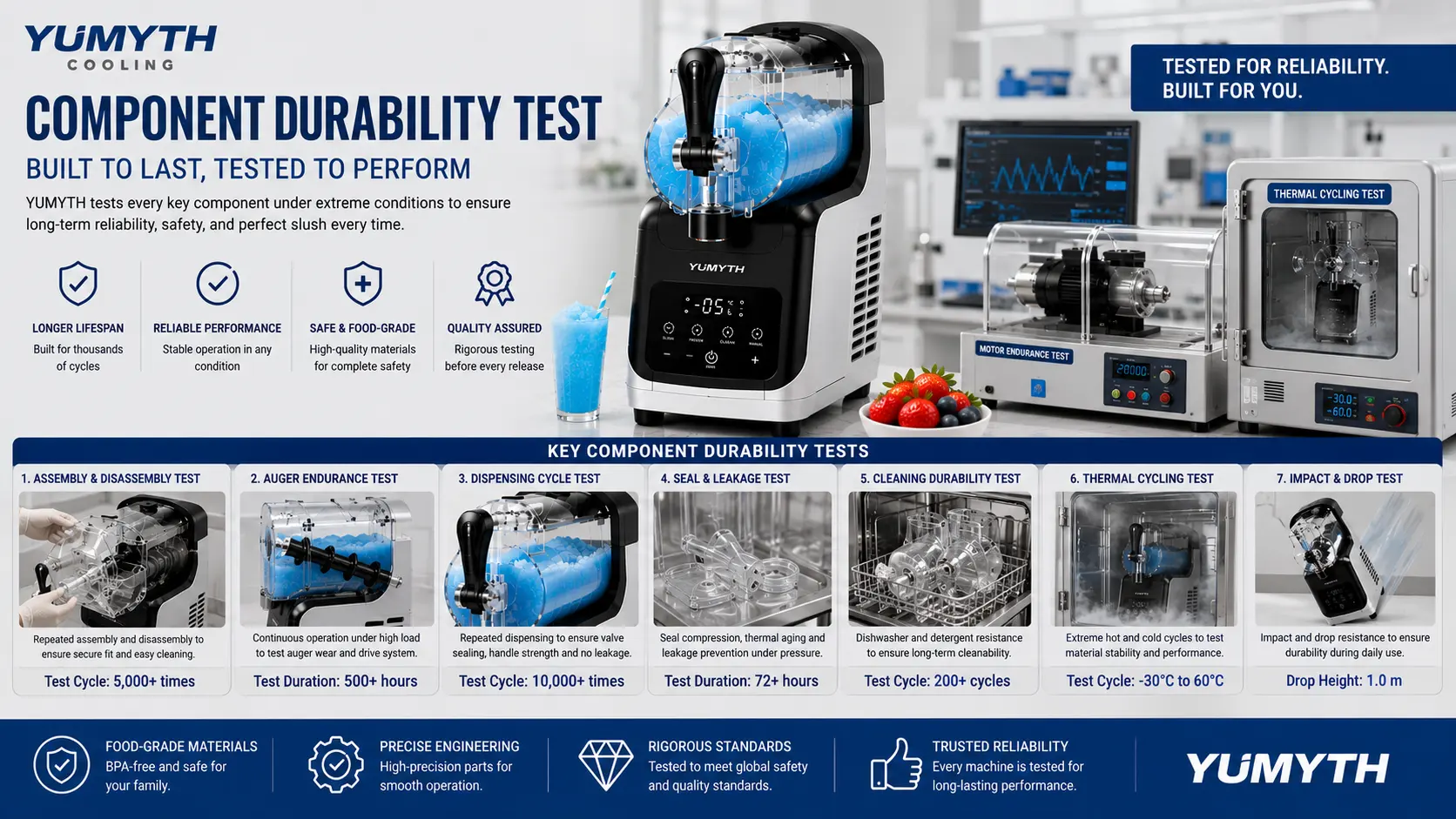
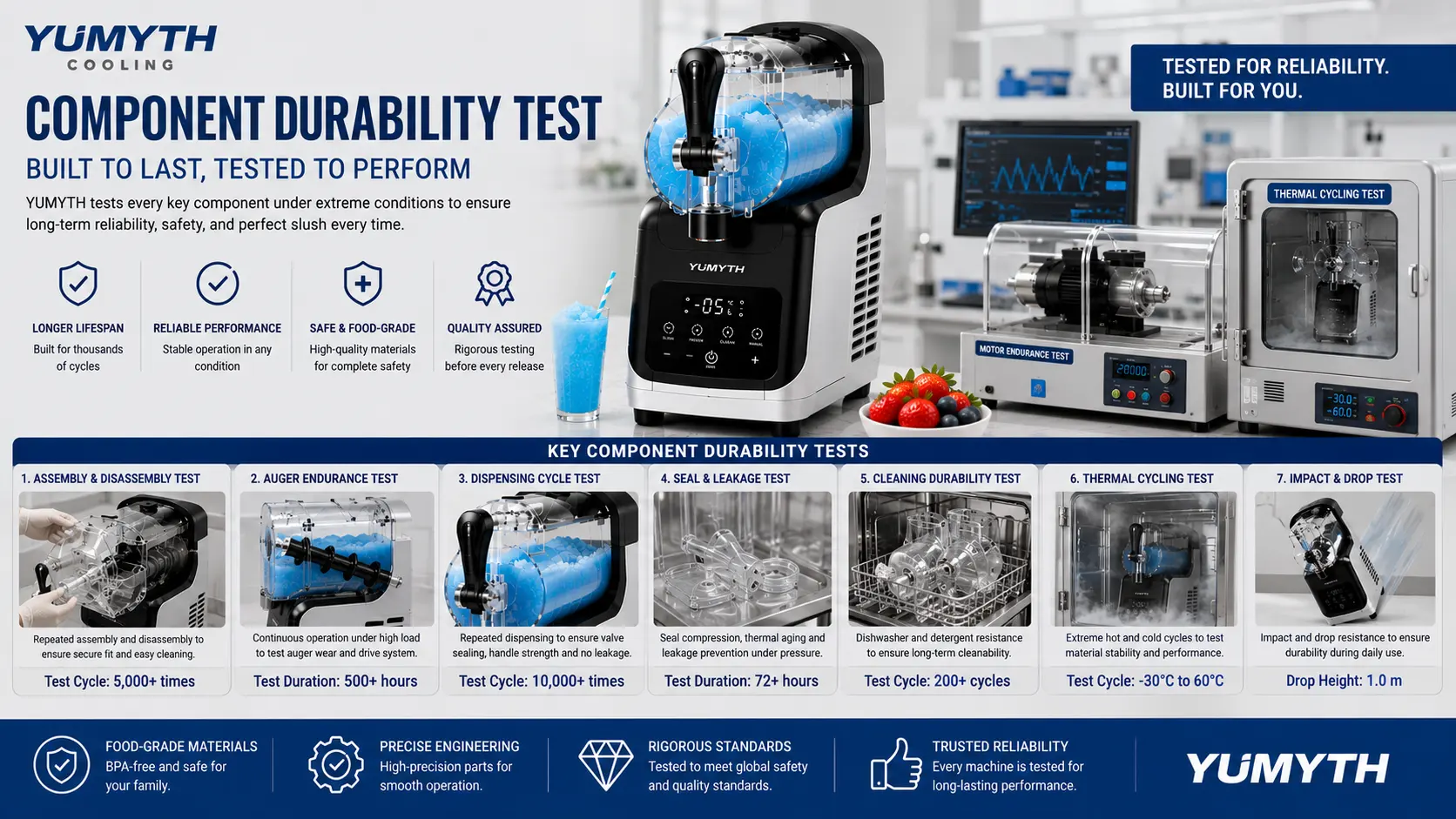
The test is repeated assembly and disassembly.In the test, repeated assembly and disassembly occurs.
Parts that come in contact with food may be washed and dried after each use. The beverage tank, auger, seal, lid, valve and drip tray should therefore be able to be removed, washed and replaced again and again.
A controlled cycle test should simulate the entire user process:
- Unlock and take off vessel.
- 3. Take off the lid and auger.
- Remove the dispensing parts and seals.
- 4. Reinstall every component.
- 5. Secure the vessel in the appliance.
- 7. conduct a brief functional test.
The test should monitor:
- * Locking-force changes;
- * Broken or bent paper clips;
- * Stress whitening;
- * Cracks around corners;
- * Seal stretching;
- * Misalignment;
- * Reduced tactile feedback;
- * Incorrect assembly risk.
The component shouldn't only be intact. It should remain properly fitted and give a clear indication that it is properly fitted.
Run the Auger and Drive-Systems Endurance.Test Auger and Drive-System Endurance.
The mechanical loads on the auger system are variable. Ice crystals and viscosity increase as a beverage becomes more resistant.
The recipes for endurance testing should consist of controlled recipes for normal load and high load operating conditions. Engineers should document motor current, auger speed, automatic reversal, noise, vibration, and gear box temperature.
The following should also be checked for the drive system:
- * Coupling wear;
- * Gearbox backlash;
- * Shaft deformation;
- * Scraper damage;
- * Auger cracks;
- * Loose fasteners;
- * Lubricant leakage;
- * Increased startup resistance.
Testing for jam protection should be given separately. A controlled obstruction can be used to check the condition of overload sensing, motor shutdown, automatic reversal and thermal protection after long periods of service.
Validate Dispensing Components
The valve and handle can be used numerous times throughout parties or family use. Seals, pivots, springs, locking mechanisms and contact surfaces can become worn when put under repeated movement.
A dispensing-cycle test should simulate beverage loads on the valve. This test should assess:
- * Opening force;
- * Closing force;
- * Dripping after closure;
- * Handle looseness;
- * Seal wear;
- * Return-spring performance;
- * Outlet blockage;
- * Beverage flow consistency.
Also, it is recommended to test the valve following detergent exposure as this and the resulting heat and seal removal can impact valve performance.
Water and a representative sugary beverage should be tested for leakage. A syrup's viscosity and sticky residue can cause problems that may not be identified with water.
Testing seals using compression and thermal cycling.
Seals are sensitive to compression, temperature, chemicals and installation.
A seal may start to stop the leak and over time cause a permanent compression set. May also bend, stretch, firm and bulge or become inelastic after repeated cleaning.
Testing should include:
- Multiple installation and removal;
- * Compression cycles;
- * Low-temperature exposure;
- * Warm-water exposure;
- * Cleaning-detergent contact;
- * Beverage-acid exposure;
- * Alcohol abuse when supported; and
- Leakage checks following each test stage.
The groove and the neighbouring housing should be assessed in conjunction with the seal. An otherwise acceptable material may be injured by sharp edges, poor lead-in geometry or too great a compression.
Create Manual and Dishwasher Cleaning.
The parts that come into contact with the food may be exposed to warm water, detergent, brushes, dishwasher spray and heated drying.
For cleaning durability testing, it is important to determine if repeated exposure leads to:
- * Plastic warping;
- * Surface clouding;
- * Cracking;
- * Color fading;
- * Printed-marking damage;
- * Odor retention;
- * Seal deformation;
- * Reduced locking strength;
- * Scratched food-contact surfaces.
NSF standards for food equipment are focused on material safety, hygienic design, construction and performance. For each of the equipment categories, appropriate standards can apply to beverage dispensers, ice-making equipment or food-equipment materials. These principles are helpful during the phase of planning for cleanability and durability but the criterion must be determined by the product's application.
The claims made on a dishwasher-safe must be backed by repeated cycle testing with the same production material, colorant, marking method, and component design.
Perform Thermal-Cycle Testing
Slush machine parts are constantly being exposed to both ambient temperature and near freezing temperatures during operation and warm temperatures during cleaning.
Materials have different rates of expansion and contraction. The clearances of a transparent plastic tank, metal evaporator, silicone seal, and polymer auger can thus vary with every cycle.
Thermal testing should include assessment of:
- * Auger-to-vessel clearance;
- * Seal compression;
- * Tank alignment;
- * Locking performance;
- * Dispensing-valve fit;
- * Cracking near inserts;
- * Condensation-related changes;
- * Housing deformation.
Appliance should be tested for complete after thermal cycling to ensure it still freezes, mixes, dispenses and holds beverages normal.
Test Impacts and Drop resistance.
Any items that can be removed can be put in a sink or a kitchen floor. The appliance could be impacted during transportation or during handling on the countertop.
Component drop testing should consider the most vulnerable orientations, including:
- * Tank corners;
- * Handles;
- * Valve projections;
- * Lid locking tabs;
- * Auger ends;
- * Control-panel edges.
It is not only to determine total failure. Engineers need to check for concealed cracks, loss of sealing, deformation, sharp edges and changes that prevent assembly.
Vibration and repeated shock and package drops with final retail carton and internal protection should also be tested to evaluate packaging. If compressor mounts or refrigeration tubing have been damaged, the damage may only be evident when the appliance is in use.
Control deterioration of noise and vibration
The initial symptom of durability issues is usually noise.
Loose panel, worn coupling, damaged auger, old compressor mount, or out-of-balance fan may raise noise before it breaks.
Therefore, noise and vibration should be measured before, during and after endurance testing. All of the above conditions should be the same for comparing beverage recipes.Fill volume, ambient condition, and operating program should be the same when comparing beverage recipes.
The inspection should note:
- * New rattling sounds;
- * Gearbox knocking;
- * Auger scraping;
- * Fan contact;
- * Panel resonance;
- * Compressor movement;
- * Refrigerant tubing vibration.
UL Solutions lists household food-preparation appliances as one of the categories in which it tests and certifies small appliances and emphasizes the need to consider the entire appliance structure, rather than just the appearance of its components.
Install, test and maintain electrical and control components.
After repeated use buttons, touch controls, relays, motors, sensors, connectors and wiring harnesses should be able to perform their functions.
The durability programme can consist of:
- * Use the Activity Director's tools; and
- * Power-switch cycles;
- Insertion and removal of connectors;
- * Compressor cycling;
- * Motor start-stop cycles;
- * Sensor thermal cycling;
- * Display operation;
- * Power interruption and restart;
- High and low voltage operation in the test plan.
Connectors should be checked for looseness, discoloration, corrosion and heat damage. Should avoid being exposed to vibration, sharp objects, condensation or moving parts.
All components used for overload, temperature or jam protection should be subjected to further fault- and endurance-testing.
Chemical and stain resistance.
Food-contact and visible parts can be exposed to fruit acids, coffee, milk by-products, alcoholic drinks, syrup, food coloring and cleaners.
Whole-formulations, not individual ingredients, should be used in chemical exposure tests.
The test should assess:
- * Staining;
- * Odor absorption;
- * Surface softening;
- * Stress cracking;
- * Loss of transparency;
- * Seal swelling;
- * Printed-marking damage;
- Changes in mechanical properties.
The amount of exposure and temperature should be realistic based on use and cleaning. Components should be assessed following both short and long term repeated exposure.
Verify performance following durability testing.
A full functional assessment should be completed at the end of the program.
The final evaluation should be to repeat the baseline tests and compare:
- * Freeze time;
- * Beverage texture;
- * Motor current;
- * Noise;
- * Leakage;
- * Dispensing performance;
- * Control response;
- * Cleaning and assembly;
- * Protection functions.
The component can appear satisfactory during visual inspection, and yet the component may cause slower freezing, higher motor load, possible leakage or unstable operation.
The final judgement, therefore, must be made on the basis of the whole appliance, rather than cosmetics only.
Use this outline to organize your Test Report.
The following documents should be submitted:
- Product model and serial number;
- * Model and material numbers;
- * Material specifications;
- * Sample quantity;
- * Baseline measurements;
- * Test methods;
- * Cycle definitions;
- * Environmental conditions;
- * Inspection intervals;
- * Failure criteria;
- * Individual sample results;
- * Photographs and data curves;
- * Failure analysis;
- * Corrective actions;
- * Final engineering conclusion.
Failure and interrupted tests should be included with the results not just successful samples.
Conclusion
Appliance manufacturers use component durability testing to help them determine their weaknesses before a slush machine gets to mass production.
A complete program should include mechanical cycling, cleaning exposure, thermal changes, chemical resistance, impact, vibration, electrical operation, leakage inspection and final performance testing.
Durability does not just mean that a part lasts a certain number of cycles, for appliance brands and OEM manufacturers. The component must fit properly and be safe to use, and it should be easy to clean up while allowing frozen drinks to be prepared consistently.
Production-representative testing under realistic and accelerated conditions decreases the number of warranty claims, enhances the planning of spare parts, increases the level of product specifications and ensures a satisfactory user experience.
Related Articles
How We Test Every Ice Maker Before Packaging
2026-09-15
BY YUMYTH
A step-by-step look at refrigerant handling, cooling verification, leak detection, corrective action and electrical safety testing For an ice maker, reliable performance is determined long before the carton is sealed. ...
Guide for Brands Looking for a Reliable Vacuum Sealer OEM Supplier
2026-09-14
BY YUMYTH
When you are sourcing kitchen appliances for your retail brand, finding a dependable vacuum sealer OEM supplier is rarely just about getting the lowest unit price. It is about protecting ...

Why Ice Shape Matters: Understanding 10mm × 15mm Cylindrical Nugget Ice
2026-09-14
BY YUMYTH
More Than Ice Production — The Ice Itself Shapes the Consumer Experience When sourcing a nugget ice maker, buyers often focus first on production capacity, water tank size, ice basket ...

Ice Maker Sourcing Guide: How to Find the Right Factory
2026-09-10
BY YUMYTH
Sourcing an ice maker looks straightforward on paper. Find a supplier, agree on a price, place an order. But anyone who has actually done this knows the process is rarely ...