
What Is the MOQ for a Custom Slush Machine?
Share:
-

-

-

-


Copied

Share:
-
-
-
-
Copied
MOQ – also known as minimum order quantity – varies based primarily on the amount of deviation from the manufacturer's platform of the desired product.
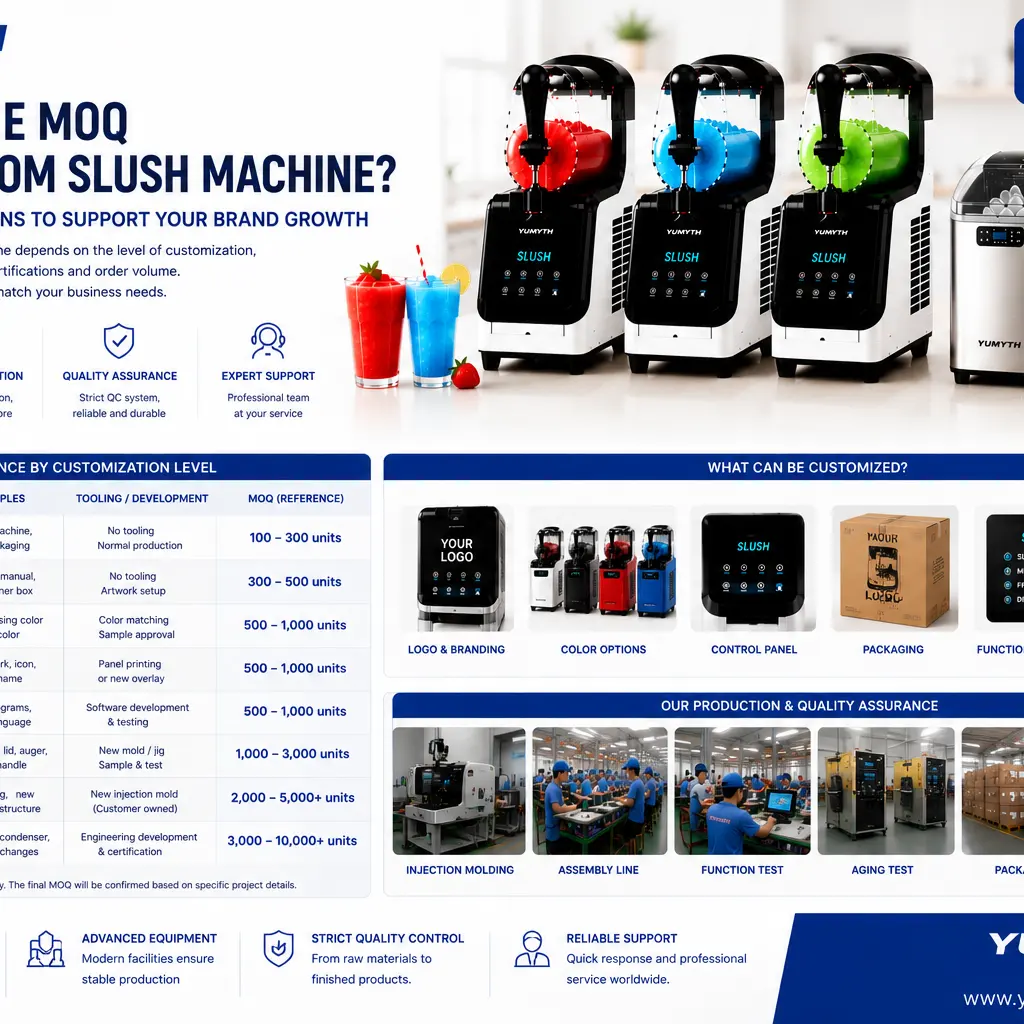
If a buyer decides to provide their logo and customized carton to an existing model they might get a relatively flexible MOQ. Normally, a project that will involve an exclusive color, new control panel, custom firmware, structural changes, injection molds or a new refrigeration system will need a higher order commitment.
There are no common MOQs for every factory and project. The final quantity represents the needs of components purchases, packaging manufacturing, line change cost, tooling investment, engineering, certification and manufacturer inventory risk.
These factors can inform the appliance brand about the level of customization they should offer based on their budget for launching and projected sales.
Typically, the MOQ is the lowest for the standard models.
The lowest starting quantity is usually offered at the time the customer purchases an existing slush machine that will remain unchanged in structure and function.
The machine can be operated by the manufacturer's standard:
- * Housing colors;
- * Beverage tank;
- * Auger;
- * Control panel;
- * Firmware;
- * Compressor;
- * Voltage configuration;
- * Packaging.
It is possible that the factory could mix the customer's order with other production orders since the components are already used for regular production.
An indicative MOQ is normally around 100 to 300 units per standard machine, subject to availability of stocks and supplier production policy. There are some factories that will allow for smaller trial orders, but the unit price is typically higher.
This is best for market testing, product evaluation, online retailing and regional distribution.
Basic Private-Label Customization
A private label order typically embodies the same design as the existing machine with the customer's branding.
Common changes include:
- * Product logo;
- * Rating label;
- * User manual;
- * Warranty card;
- * Barcode;
- * Carton artwork.
In this type of project, the MOQ is frequently more dependent on the printed materials than on the assembly of the appliances.
A factory might be able to manufacture a few dozen pieces of a machine, but the carton supplier might need hundreds of printed cartons. There are also independent minimums for manuals, labels and protective packaging.
The quantity of the planning range can be about 300 to 500 units per model and electrical version for basic private label customization. Sometimes the exact amount can be trimmed, even when a neutral carton is used with customised branded labels, instead of a fully customised retail carton.
Custom Housing Colors
If the color of the appliance is changed, the MOQ will be higher as it will require the preparation of special plastic resin, color masterbatch, paint, or surface treatment, provided by the factory.
A custom plastic color may require:
- * Color matching;
- * Trial molding;
- * Customer approval;
- * Minimum resin preparation;
- * Equipment cleaning;
- * Separate inventory control.
=========================
Usually lower order quantities are acceptable for standard factory colors of black, white or silver. Depending on the number of customized components and the material supplier's minimum batch size, approximately 500 to 1000 units may be needed for a unique Pantone color.
If multiple plastic components are manufactured using different resins, achieving the same surface properties can be more challenging. The tank, housing, panel, handle and decorative parts may be required to be colored separately.
Brands can lower the initial MOQ by modifying one of the visible panels instead of changing all the molded parts.
Custom Retail Packaging
The commercial MOQ often relies on packaging for private label projects.
A custom package may consist of:
- * Full-color retail carton;
- * Shipping carton;
- * Molded pulp inserts;
- * Foam protection;
- * Accessory box;
- * Recipe booklet;
- * Printed manual.
Typically, carton manufacturers will impose setup fees for printing plates, cutting dies, lamination and material preparation. Small amounts could be technically feasible, but too costly.
If the package is fully customized to the retail customer, a practical MOQ of 500-1,000 units. Some suppliers may even offer the option for the customer to buy additional packaging and keep them on hand for future orders.
The buyer should check the storage cost, the responsibility of damages, the rules of changing artworks, and how unused packaging is to be disposed of if the product is discontinued before accepting this arrangement.
Customizing the Control Panel with artwork and displaying it.
Moderate MOQ may be needed if only the artwork of the control panel is changed. Sometimes the factory can retain the existing PCB and firmware and simply change the icons, program names, colours or branding.
Printing quantity could be based on panel printing process or membrane-switch supplier. The planning MOQ for a project like this is about 500 units.
For more advanced display customization, a dedicated LCD/LED panel, touch interface or screen artwork may be necessary. The minimum quantities for these components might be greater, particularly if they are sourced from a single supplier.
The buyer must find out if the customization affects only the appearance or also the electronic components.
A new firmware, functional customization.
The effect of firmware customization on the operation of the slush machine.
Possible changes include:
- * New drink programs;
- * Temperature targets;
- * Texture settings;
- * Cleaning cycles;
- * Auger reversal;
- * Error messages;
- * Completion alerts;
- * Child-lock behavior.
Although it is a software change, it may not be supported by new molds but will still need engineering, testing, documentation and production version control.
The factory needs to ensure all PCBs are programmed with the correct firmware and that there is no mixing the customized firmware with the standard production.
A working firmware project is likely to need some 500 to 1000 units or at least a separate engineering fee.
The manufacturer will consider a smaller first order if the customer pays for engineering and validation separately. But the size of the expected annual volume still plays a role, as it is important for the supplier to have a certain software version for the customer over the years.
There are a variety of Voltage and Plug Versions.
MOQ can sometimes be determined on a single electrical configuration basis.
As an example, an order might contain:
- * 120V/60Hz with a US plug;
- * 220–240V/50Hz with an EU plug;
- * 220–240V/50Hz with a UK plug.
The versions may use different compressors, motors, fans, power cords, plugs, labels, relays or PCBs.
However, it is not always a 1,000 machine production batch. Each of the electrical versions may be considered separately by the supplier.
To control MOQ, brands should avoid launching too many countries and product configurations at the same time. It may be easier to buy and certify components for a single primary market.
Structural Customization
These are structures that need replacing such as new tanks, lids, augers, dispensing handles, drip trays, housings or internal mounting parts.
These projects may require:
- * Industrial design;
- * Engineering drawings;
- * Prototypes;
- * Mold-flow analysis;
- * New fixtures;
- * Reliability testing;
- * Packaging redevelopment.
Even if the customer pays the factory for the new injection molds, the factory may still need the investment of more production. Commercial justification is required for plastic resin, custom parts, operator training and assembly line setup.
The MOQ for a structural customization project is normally between 1,000 and 3,000.
Normally a small pilot production order is followed by a larger confirmed mass production order from supplier.
New Injection Molds
When a new design for housing, a larger tank, custom handles, special dispensing systems or new removable food contact components are needed, new molds will often be required.
The MOQ of mold cost and production are different business concerns.
The customer's payment of the mold could make the mold owner the customer or the exclusive user of the mold, but the factory needs to have enough quantity to buy materials and arrange the molding and assembly process efficiently.
Important questions include:
- Who is the owner of the mould?
- * Is it exclusive to the customer?
- What will happen to the mold after it is made?
- Who is responsible for the maintenance?
- * Can the mold be transferred?
- What is the smallest amount of molding that can be done?
- How many times do the trial corrections take place?
Even if the initial production run is small, several new molds may need several thousand units per year.
Refrigeration-System Customization
The highest MOQ usually applies in cases of change of the core refrigeration platform requested by the customer.
Possible changes include:
- * Compressor model;
- * Refrigerant;
- * Evaporator;
- * Condenser;
- * Capillary tube;
- * Fan;
- * Refrigerant charge;
- * Cooling capacity;
- * Cabinet airflow.
These changes have an impact on freeze time, noise, power consumption, component temperature, safety, and certification and therefore must be engineered.
There may be 3,000 units or more, and a credible annual forecast of this number, required for a dedicated refrigeration platform. There may also be development, sample, testing, and certification fees charged by the factory.
In most cases, new brands of appliances that are using an existing refrigeration system and shaping the product experience that consumers see is a safer play.
Certification can have a positive impact on the commercial commitment.
Electrical safety, EMC, food-contact or environmental compliance testing may be required for a customized machine.
The costs of certification include:
- * Laboratory fees;
- * Test samples;
- * Engineering support;
- * Documentation;
- * Retesting;
- * Factory inspection.
This customer/supplier should decide which party will be responsible for the certificate and technical file.
The supplier can accommodate the MOQ when the customer pays the certification fees separately. Typically, though, it is easier to invest in a market-specific approval when the brand plans on reordering.
Modifications to the compressor, PCB, motor, housing, refrigerant system or safety-related firmware can lead to higher certification costs and longer development time.
What are the ways to lower the initial MOQ?
Brands can decrease the quantity to just the essential customization for the initial project, which helps them save money.
One practical approach to launching is to:
- Choose an existing platform that has been tested.
- 2. Stick to a regular color of the house.
- 3. Use the logo and labels as they are, do not change them.
- 4. If you use a carton, use a neutral one with a branded sticker.
- 5. Don't change the default control panel or firmware.
- 6. Start one of the voltage and plug versions.
- 7. Pay engineering or tooling fee separately.
- Annual forecast, #8: Be realistic about the forecast.
- 9. Make repeat orders ahead of time.
- 10. Customize deeper after the sales proved.
This incremental strategy helps the brand ensure that there is demand in the market before investing in costly tools and dedicated components.
Here are some questions to ask the manufacturer.
Before placing the order, specify if the MOQ is based on the following:
- * Model;
- * Color;
- * Voltage;
- * Plug;
- * Packaging version;
- * Firmware version;
- * Total purchase order.
It is also important that the buyer confirm the deal of any unused custom materials, packaging storage time and if there is any MOQ requirement for future orders.
A quotation should clearly distinguish each of the following: Unit Price, Sample Price, Tooling Price, Certification Fees, Packaging Set Up, and Minimum Purchase.
Conclusion
Custom slush machine MOQ varies according to the level of customization.
Typically, standard models and simple logo projects have the most adaptable beginning quantities. Higher supplier minimums are set by custom colours, printed packaging, control panels, firmware and electrical versions. The production pledges are much higher for new structural components, injection molds and refrigeration units.
For general planning purposes, projects can vary from private labelling of a few hundred units, to structural or refrigeration development projects with several thousand units.
The smallest possible quantity is not necessarily the best MOQ. It should be capable of containing controlled materials, ensuring a stable production, appropriate certification, reasonable unit cost and a reliable long-term supply plan.
Related Articles
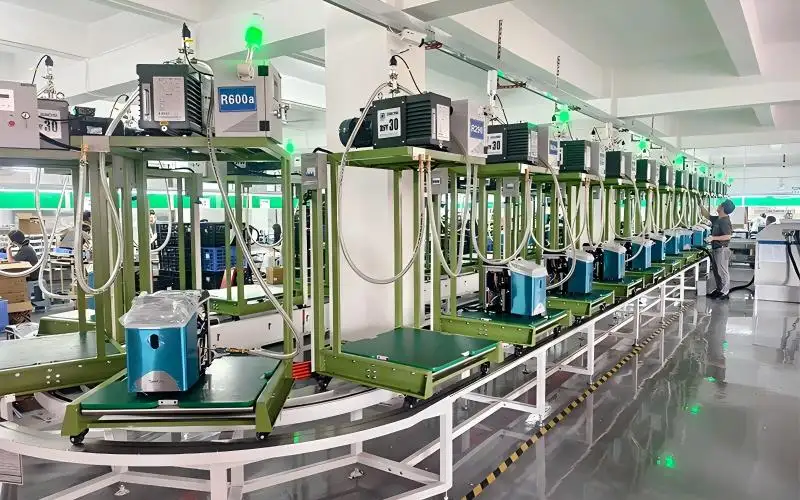
How We Test Every Ice Maker Before Packaging
2026-09-15
BY YUMYTH
A step-by-step look at refrigerant handling, cooling verification, leak detection, corrective action and electrical safety testing For an ice maker, reliable performance is determined long before the carton is sealed. ...
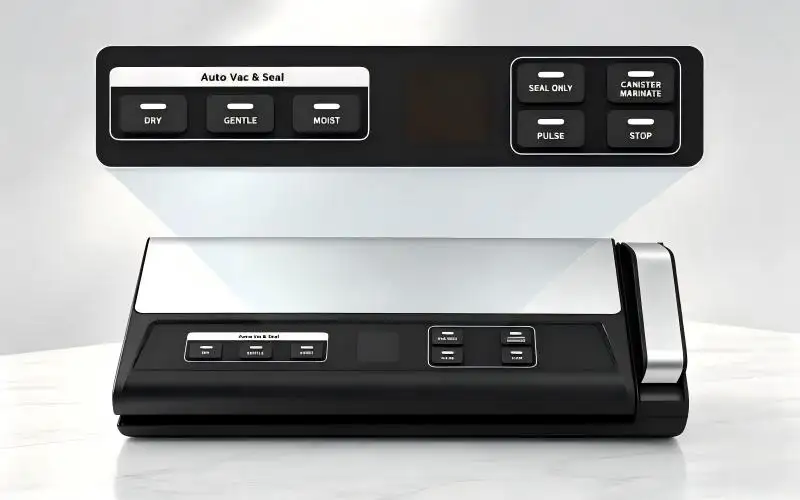
Guide for Brands Looking for a Reliable Vacuum Sealer OEM Supplier
2026-09-14
BY YUMYTH
When you are sourcing kitchen appliances for your retail brand, finding a dependable vacuum sealer OEM supplier is rarely just about getting the lowest unit price. It is about protecting ...
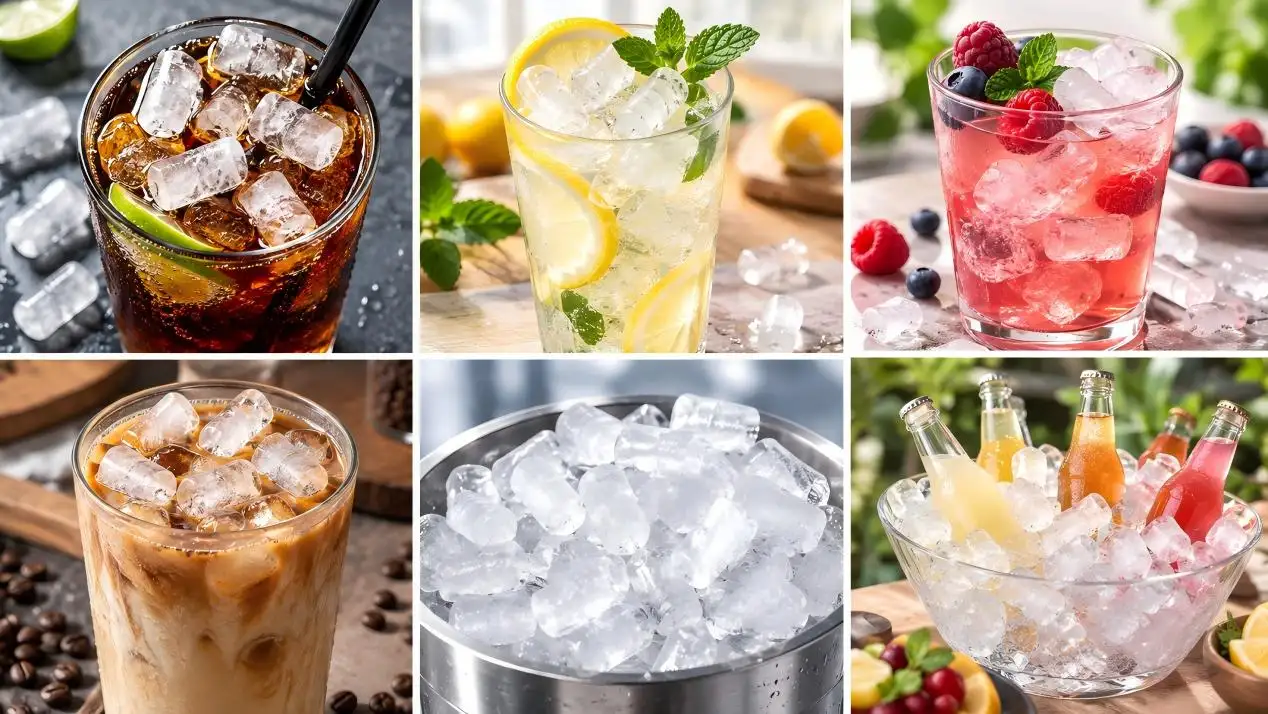
Why Ice Shape Matters: Understanding 10mm × 15mm Cylindrical Nugget Ice
2026-09-14
BY YUMYTH
More Than Ice Production — The Ice Itself Shapes the Consumer Experience When sourcing a nugget ice maker, buyers often focus first on production capacity, water tank size, ice basket ...

Ice Maker Sourcing Guide: How to Find the Right Factory
2026-09-10
BY YUMYTH
Sourcing an ice maker looks straightforward on paper. Find a supplier, agree on a price, place an order. But anyone who has actually done this knows the process is rarely ...