
External Vacuum Sealer: Features, Bag Types, and OEM Options
Share:
-

-

-

-


Copied

Share:
-
-
-
-
Copied
An external vacuum sealer—also called a suction or edge vacuum sealer—removes air through the open end of a bag positioned at the edge of the machine. After the air is extracted, a heated sealing bar closes the bag.
This format is practical for dry foods, moderately moist foods, meal preparation, freezer storage, and sous vide preparation. Most external sealers require embossed or textured bags because their channels keep air moving while the bag is compressed. Free-flowing liquids, smooth chamber pouches, and continuous high-volume operation may require a chamber or heavier-duty system instead.
For product buyers and private-label brands, the decision goes beyond vacuum pressure. Bag compatibility, pump airflow, sealing width, moisture controls, duty cycle, accessories, target-market voltage, and available OEM modifications all affect whether a model fits the intended application.
What Is an External Vacuum Sealer?
The terms external vacuum sealer, suction vacuum sealer, and edge vacuum sealer normally describe the same basic machine format. The food and most of the bag remain outside the machine. Only the bag’s open end is placed across the vacuum channel and sealing area.
This differs from a chamber vacuum sealer, where the complete pouch is placed inside an enclosed chamber. The chamber evacuates air around the package before sealing it. That difference affects the bags each system can use, how it handles liquids, its physical size, and its suitability for repeated operation.
“External vacuum” can also describe an accessory function. Some machines have a port that connects to a hose for vacuuming canisters, bottle stoppers, or compatible valve bags. That accessory port is not the same as the edge-sealing process, even when one machine supports both functions.
How External Vacuum Sealing Works
A normal external vacuum-and-seal cycle follows a short sequence:
-
The bag is positioned. Its clean, open edge is placed flat across the vacuum channel.
-
The lid or handle closes. Gaskets around the channel compress to create a temporary sealed path.
-
The pump removes air. Air travels through the channels in a textured bag toward the machine.
-
The sealing bar heats the bag. Once the selected vacuum level or cycle point is reached, the open end is heat-sealed.
-
The machine releases the package. The seal cools before the bag is removed.
These components depend on one another. A stronger pump cannot correct a wrinkled bag mouth, food residue across the seal area, a worn gasket, or an incompatible smooth pouch. Reliable sealing requires the correct bag, proper positioning, adequate heat, and a clean contact surface.
External Sealing Is Not the Same as Accessory Vacuuming
Edge sealing and accessory vacuuming use different packaging systems.
| Function | Air Path | Typical Packaging |
|---|---|---|
| External edge sealing | Through the open end and textured channels of a flexible bag | Embossed bags and rolls |
| Accessory vacuuming | Through a hose connected to a lid or valve | Compatible canisters, bottle stoppers, or valve bags |
An accessory-capable model may handle both, but the connector, valve, and container must be compatible with that machine. A generic reusable valve bag should not be assumed to work with every accessory hose.
Which Bags Work With an External Vacuum Sealer?
Bag construction is one of the most important external-sealer selection factors. Once suction begins, a completely smooth flexible pouch can collapse around its opening and restrict the airflow path. Embossed channels prevent that early collapse and allow the pump to continue drawing air.
| Packaging Format | Full External Vacuuming | Main Consideration |
| Embossed or textured pre-cut bag | Yes | Confirm width, material, and seal compatibility |
| Textured vacuum roll | Yes | Requires cutting and sealing one end before filling |
| Embossed reusable valve bag | Model-dependent | Requires a compatible valve and accessory connection |
| Rigid vacuum canister | Model-dependent | Requires a matching hose, lid valve, and accessory port |
| Smooth chamber pouch | Usually no | Designed primarily for evacuation inside a chamber |
| Ordinary smooth storage bag | No | May not withstand or support the vacuum-and-seal process |
Some external machines may heat-seal a compatible smooth material using a seal-only function, but that does not mean the machine can fully evacuate the pouch. Vacuum compatibility and heat-sealing capability are separate questions.
Yumyth identifies embossed bags and rolls, embossed zip bags, and compatible canisters among the packaging and accessory options for its vacuum sealer range. Its dual-mode CVS101 documentation also distinguishes the formats directly: textured bags are used for external operation, while chamber operation can support smooth chamber pouches.
Pre-Cut Bags Versus Rolls
Pre-cut bags reduce preparation time because the bottom and sides are already closed. The user fills the bag and seals the remaining open edge. They work well when package dimensions are consistent.
Rolls allow the operator to choose the bag length. This is useful when packaging products of different sizes, but each bag must be cut and sealed at one end before filling.
| Selection Factor | Pre-Cut Bags | Vacuum Rolls |
| Preparation | Faster | Requires cutting and an initial seal |
| Package length | Fixed | Adjustable |
| Equipment features | No cutter required | Cutter and roll storage improve workflow |
| Best fit | Repeated standard portions | Mixed product lengths |
A built-in cutter and roll-storage compartment improve convenience but do not increase vacuum strength. The machine’s maximum working width must still match the roll or bag.
Canisters and Reusable Valve Bags
A canister can be useful for delicate, crushable, or frequently accessed contents. Instead of compressing a flexible bag, the machine extracts air through a valve in the container lid.
Before including canisters or reusable valve bags in a product bundle, confirm:
-
Accessory-port availability
-
Hose and connector design
-
Valve compatibility
-
Container pressure rating
-
Availability of replacement lids, hoses, or seals
Features That Matter on an External Vacuum Sealer
A useful feature should solve a specific packaging problem. More buttons do not automatically mean better performance.
| Feature | What It Changes | Suitable Use |
| Dry mode | Uses a standard sealing program | Dry foods and clean bag openings |
| Moist or extended-seal mode | Adjusts sealing for greater moisture near the bag mouth | Meat, fish, or moderately moist foods |
| Pulse control | Lets the operator stop or control air extraction | Bread, berries, and delicate products |
| Gentle vacuum | Reduces or moderates evacuation intensity | Fragile foods |
| Seal-only function | Closes a bag without a complete vacuum cycle | Making bags from rolls |
| Automatic lid | Closes, cycles, and reopens with less manual handling | Repeated countertop use |
| Handle lock | Provides direct mechanical closure | Simple manual operation |
| Drip tray | Collects limited moisture entering the channel | Easier cleaning after moist-food sealing |
| Cutter and roll storage | Simplify bag preparation | Regular roll users |
| Accessory port | Connects to compatible rigid or valve containers | Canisters and accessory bags |
Yumyth’s external-style models use different combinations of these features. Broader automation, control-panel, and sensing developments are covered in its guide to the modern vacuum sealer.
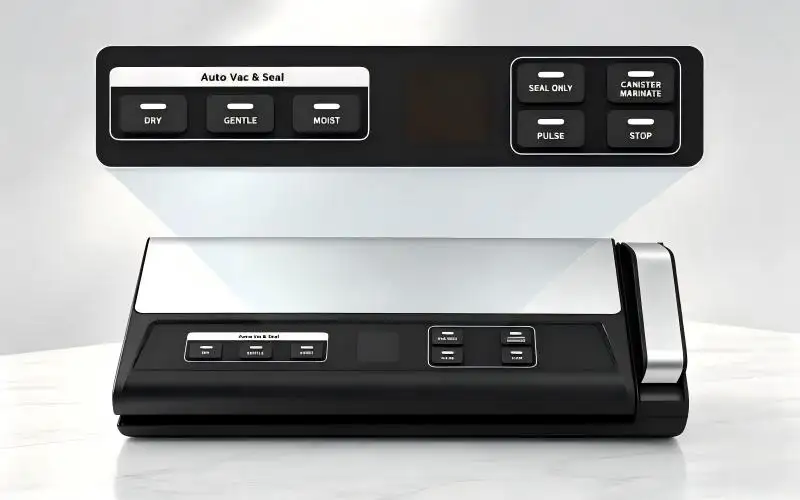
Dry, Moist, Pulse, and Gentle Controls
Dry and moist settings primarily change how the machine completes the sealing stage. A moist mode may provide additional sealing time or a different program for moisture near the bag opening. It should not be treated as permission to draw unrestricted liquid through the vacuum channel.
Pulse and gentle controls affect evacuation. They give the operator more control before soft food is compressed. For example, the cycle can be stopped when enough air has been removed from a bag of bread without flattening the contents.
The detailed relationship between food condition and operating mode is covered on the tabletop vacuum sealer page.
How to Read External Vacuum Sealer Specifications
A vacuum sealer should not be selected by the largest negative-pressure number alone. Pressure, pump flow, sealing dimensions, and duty cycle describe different parts of its operation.
Pressure, Airflow, and Seal Performance Are Different
-
Vacuum pressure, normally shown in kPa, indicates the pressure differential the system is designed to reach under specified conditions.
-
Pump flow, often shown in litres per minute, indicates how quickly the system can move air.
-
Maximum bag width determines the widest package that can be placed across the working area.
-
Seal-line width describes the width of the heated band, not the supported bag size.
-
Duty cycle describes how frequently the machine can operate before cooling is required.
-
Single or double sealing bars describe the sealing configuration, not pump performance.
A machine can have strong published pressure but still perform poorly if airflow is slow, the bag is incorrectly positioned, the seal area is contaminated, or repeated operation causes excess heat. Specifications should be compared using consistent test conditions and the actual packaging intended for the project.
Yumyth’s current product pages show why model-level review matters. The VS6612X and VS6606X list optional −60 or −80 kPa configurations with optional 5 or 8 L/min pumps, a maximum 30 cm working width, and a 3 mm single sealing bar. The VS6680M lists −80 kPa, 8 L/min, a maximum 30 cm width, and a 3 mm single bar. These specifications belong to the named configurations and should not be generalized to every model.
Voltage is another product-selection requirement. Relevant Yumyth pages list 100–120 V and 220–240 V, 50/60 Hz versions, but the final plug, label, documentation, and conformity requirements must be confirmed for the target market.
Buyers planning frequent back-to-back packaging should evaluate cooling requirements and expected daily workload rather than treating a household external unit as a continuous-production machine. Higher-throughput requirements may justify reviewing a commercial vacuum sealer.
Best Uses and Practical Limits of External Sealers
External machines fit applications where compact size, flexible bag length, and straightforward countertop operation matter.
| Application Condition | External-Sealer Fit | Selection Note |
| Dry foods and pantry products | Strong | Use compatible textured bags |
| Portioned meat, fish, or cheese | Strong | Keep the sealing area clean |
| Meal preparation and freezer storage | Strong | Choose bag size for each portion |
| Sous vide preparation | Strong | Use heat-suitable, compatible bags |
| Moderately moist foods | Conditional | Use moist mode and monitor liquid movement |
| Bread, berries, or soft foods | Conditional | Pulse or gentle control may reduce crushing |
| Compatible canisters | Conditional | Requires accessory port and matching valve |
| Free-flowing liquids | Weak | Chamber sealing or pre-freezing is safer for the machine |
| Continuous high-volume packaging | Model-dependent | Check duty cycle and commercial suitability |
| Smooth chamber pouches | Weak | Standard external suction requires airflow channels |
A removable drip tray can help collect small amounts of moisture, but it does not convert an external sealer into a chamber machine. Drawing soup, sauce, marinade, or other free-flowing liquid toward the pump can interrupt evacuation, contaminate the channel, and weaken the seal. The separate guide on vacuum sealing liquids covers that application in greater depth.
Vacuum packaging also does not sterilize food. Perishable products still require suitable refrigeration, freezing, handling, and thawing. The USDA’s food-safety guidance treats vacuum-packed perishable food as temperature-sensitive rather than shelf-stable by default.
Common Reasons Vacuum Bags Fail
| Symptom | Likely Cause | What to Check |
| Pump runs but little air is removed | Smooth or incompatible bag | Confirm embossed channels and correct orientation |
| Machine cannot establish suction | Lid, handle, or gasket not fully closed | Inspect closure and gasket position |
| Bag loses vacuum after sealing | Wrinkle, contamination, or incomplete seal | Clean, flatten, and reseal the bag mouth |
| Air returns gradually | Puncture or sharp product edge | Inspect the film and protect bones or corners |
| Liquid reaches the channel | Food is too wet or positioned too close to the opening | Increase headspace or use a different method |
| Seal appears melted or distorted | Excess heat or repeated cycles | Allow cooling and verify the selected mode |
| Canister does not hold vacuum | Valve or hose mismatch | Check connector, lid gasket, and accessory compatibility |
External or Chamber Vacuum Sealer: Which Format Fits?
Neither format is universally better. Product condition, packaging material, available space, and required throughput determine the suitable system.
| Decision Factor | External Sealer | Chamber Sealer |
| Product position | Outside the machine | Inside the chamber |
| Common pouch type | Textured or embossed | Smooth or textured |
| Liquids | Limited and technique-dependent | Better suited to free-flowing liquids |
| Footprint | Usually smaller | Usually larger |
| Variable bag length | Convenient with rolls | Depends on chamber dimensions |
| Repeated commercial use | Model-dependent | Often better suited to heavier workloads |
| Initial equipment complexity | Generally lower | Generally higher |
Yumyth’s CVS101 demonstrates the difference within one dual-mode platform. Its published specifications separate chamber operation at −98 kPa and 40 L/min from external operation at −80 kPa and 8 L/min. It also lists a maximum 28 cm chamber width and 30 cm external width, showing why chamber and external specifications should not be combined as though they describe the same process.
Choose an external format for textured-bag packaging, compact placement, and everyday dry or moderately moist products. Consider a chamber system when smooth pouches, free-flowing liquids, or heavier repeated use are central requirements.
Yumyth External Vacuum Sealer Options
Yumyth lists several external-style configurations rather than one standard platform. The following comparison uses only differentiating information published on the corresponding product pages.
| Model | Operation and Controls | Bag Handling | Distinctive Features |
| VS6612X | Dry/moist, pulse, vacuum-and-seal, accessory vacuum | Built-in cutter; maximum 30 cm working width | Compact structure; optional −60/−80 kPa and 5/8 L/min configurations |
| VS6606X | Dry/moist/super-moist, normal/gentle, pulse, accessory vacuum | Roll storage and cutter; maximum 30 cm working width | More operating controls for varied food conditions |
| VS6680M | Automatic lid, dry/moist, normal/gentle | Maximum 30 cm working width | Digital scale and removable drip tray |
| VS6685H | Automatic lid, dry/moist, pulse, seal-only, accessory/marinate | Roll storage and cutter; maximum 30 cm working width | Countdown display and removable drip tray |
| VS8001G | Handle lock, dry/moist/super-moist, normal/gentle, pulse, canister, inflate | Roll storage and cutter; maximum 30 cm working width | Published double sealing bar and inflate function |
| CVS101 | Separate chamber and external modes | External width up to 30 cm; chamber width up to 28 cm | One platform for chamber liquid sealing and external textured-bag sealing |
Product pages can change as configurations are updated. A sourcing decision should therefore use the latest model datasheet and a confirmed sample rather than relying only on a category comparison.
OEM Options for an External Vacuum Sealer
External vacuum sealers can be developed from an existing platform through OEM customization or modified more extensively through an ODM project. The practical scope depends on the base model, engineering feasibility, order requirements, and target-market rules.
Yumyth describes customization across the following areas:
-
Exterior color, finish, logo, and printed graphics
-
Control-panel layout, button style, indicators, and language
-
Vacuum programs, sealing modes, pulse behavior, and operating sequence
-
Manual handle or automatic-lid configuration
-
Cutter, roll storage, drip tray, scale, hose, and bundled accessories
-
Voltage, frequency, plug, labels, and user manuals
-
Retail box design and package contents
-
Modification of an existing platform or development of a new concept
These are discussion areas, not a promise that every option can be combined with every model. Changes to pressure, sealing behavior, heating components, safety functions, or internal structure require engineering evaluation and validation. The broader development process is explained in Yumyth’s vacuum sealer OEM manufacturing guide and OEM and ODM service page.
Information to Provide Before Requesting a Quote
A useful OEM inquiry should define:
-
Target country or sales region
-
Intended foods and expected moisture level
-
Required bag type, width, and package dimensions
-
Expected number of cycles or packages per working period
-
Required dry, moist, pulse, gentle, seal-only, or accessory functions
-
Manual or automatic lid preference
-
Cutter, roll storage, drip tray, scale, canister hose, or accessory needs
-
Voltage, frequency, and plug type
-
Logo, color, control-panel language, manual, and packaging requirements
-
Forecast order volume and intended launch schedule
-
Required testing, declarations, or certification scope
Clear application details help the supplier determine whether an existing model is suitable or whether structural and control changes are required.
Documents and Evidence to Request
Worldwide buyers should verify claims at the model and market level. Useful records may include:
-
Current product datasheet and configuration list
-
Functional sample with written acceptance criteria
-
Vacuum-pressure, airflow, sealing, electrical, and repeated-cycle test methods
-
Applicable certificates and declarations tied to the exact model
-
Food-contact documentation for supplied bags, gaskets, or accessories
-
Production inspection criteria
-
Packaging specification and approved artwork
-
Spare-parts and consumables list
-
Written warranty conditions
-
Current MOQ, price, lead time, and payment terms in the quotation
For the US market, food-contact claims should be checked against the FDA food-contact substance framework. Plastic food-contact materials for the EU may require documentation relevant to Regulation (EU) No 10/2011. CE marking should also be evaluated according to the applicable legislation and technical documentation rather than treated as a general quality award, as explained by the European Commission’s CE-marking guidance.
Discuss Your External Vacuum Sealer Requirements
A suitable external sealer starts with the application, not a single pressure figure. Define the food condition, bag format, package width, expected workload, target market, controls, accessories, and branding before choosing the base model.
To evaluate an existing configuration or an OEM project, contact Yumyth with your bag dimensions, intended products, operating requirements, voltage and plug, packaging needs, and required compliance documents. Final specifications, customization feasibility, MOQ, testing, and production terms should be confirmed in the written quotation.
Related Articles
How We Test Every Ice Maker Before Packaging
2026-09-15
BY YUMYTH
A step-by-step look at refrigerant handling, cooling verification, leak detection, corrective action and electrical safety testing For an ice maker, reliable performance is determined long before the carton is sealed. ...
Guide for Brands Looking for a Reliable Vacuum Sealer OEM Supplier
2026-09-14
BY YUMYTH
When you are sourcing kitchen appliances for your retail brand, finding a dependable vacuum sealer OEM supplier is rarely just about getting the lowest unit price. It is about protecting ...

Why Ice Shape Matters: Understanding 10mm × 15mm Cylindrical Nugget Ice
2026-09-14
BY YUMYTH
More Than Ice Production — The Ice Itself Shapes the Consumer Experience When sourcing a nugget ice maker, buyers often focus first on production capacity, water tank size, ice basket ...

Ice Maker Sourcing Guide: How to Find the Right Factory
2026-09-10
BY YUMYTH
Sourcing an ice maker looks straightforward on paper. Find a supplier, agree on a price, place an order. But anyone who has actually done this knows the process is rarely ...