Food Vacuum Sealers: The Ultimate Freshness Guide
Share:
-

-

-

-


Copied
Share:
-
-
-
-
Copied
Every year, households toss out hundreds of dollars' worth of groceries that went bad too soon—slimy produce, freezer-burned meat, leftovers nobody touched. If you buy in bulk, prep meals ahead, or cook sous vide, you already know how much this stings. A food vacuum sealer is the fix most kitchens are missing.
Below, we cover how these machines actually work, how much longer food really lasts, which type suits which kitchen, and the features that separate a workhorse from a headache.
What a Vacuum Sealer Actually Does
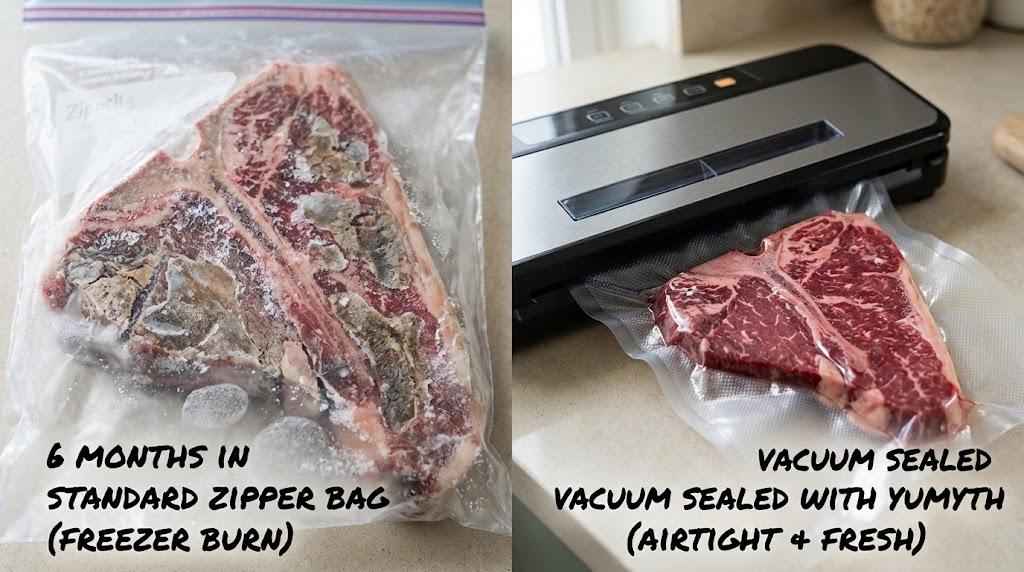
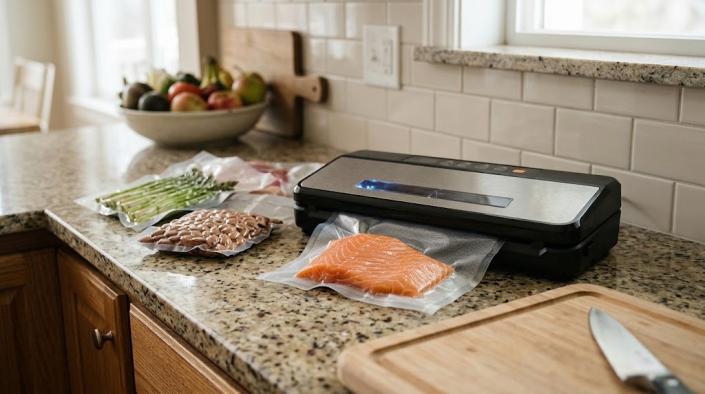
Strip the marketing away and it's simple: the machine pulls air out of a bag, then heat-seals the opening shut. No oxygen means aerobic bacteria, mold, and yeast stop multiplying. No air in the freezer means no ice crystals forming on your steak. Food keeps its flavor, texture, and nutrients three to five times longer than it would in a zipper bag or plastic container.
Leave a steak in a regular freezer bag for a couple of months and you'll find those dry, leathery patches—freezer burn. A vacuum sealer prevents that entirely by wrapping the food in an airtight layer with nothing left to evaporate.
Five Reasons Home Cooks Stick With It
A decent sealer pays for itself faster than most people expect.
- No more freezer burn. Zero air around the meat means no ice crystals, so texture holds up for two to three years.
- Smaller grocery bills. Buy the family pack on sale, split it up, seal it, and stop worrying about waste. Most people cut 30% or more.
- Meal prep gets easier. Flat, stackable pouches take up far less space than plastic tubs—roughly 40% less in our experience.
- Sous vide finally works right. Sealed bags sink evenly and stay put, so heat reaches every part of the food.
- Marinades in 20 minutes. Vacuum pressure opens up the meat's pores, and flavor goes in deep—no overnight wait.
How Long Food Actually Lasts
| Food | Where | Normal Storage | Vacuum Sealed |
| Beef, pork, poultry | Freezer (-18°C / 0°F) | 4–6 months | 2–3 years |
| Fish and seafood | Freezer (-18°C / 0°F) | 3–4 months | 18–24 months |
| Hard and semi-hard cheese | Fridge (4°C) | 1–2 weeks | 4–8 months |
| Berries and fresh produce | Fridge (4°C) | 3–5 days | 1–2 weeks |
| Leftovers and soups | Fridge (4°C) | 3–4 days | 10–14 days |
| Coffee, nuts, grains | Pantry | 3–6 months | 1–2 years |
Three Types of Sealers—Which One Fits Your Kitchen
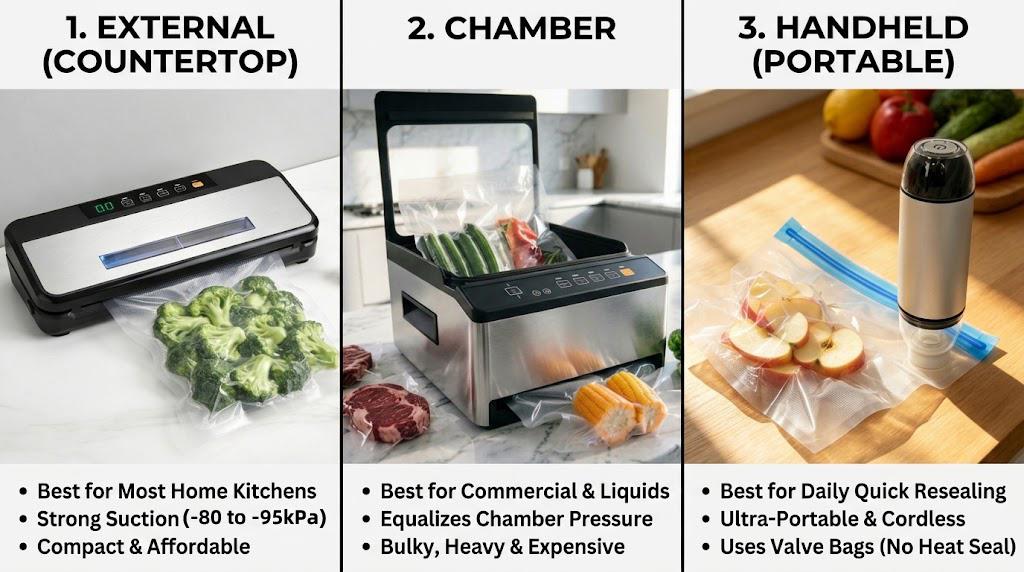
External (countertop) sealers. The most common choice, and for good reason. You lay a textured bag across the heating bar, close the lid, and the pump pulls air out before sealing. Strong suction, small footprint, and you can make bags any size from a roll. This is what most home kitchens should buy.
Chamber sealers. The whole bag goes inside a sealed compartment, and the machine equalizes pressure around it. That design handles liquids beautifully—soups, marinades, stews—without the pre-freezing workaround. The catch: they're heavy, they take up real counter space, and they cost several hundred dollars more.
Handheld cordless sealers. Small rechargeable pumps that pull air through a valve on special zipper bags. Fine for deli meat or a block of cheese you'll eat this week. Not enough suction or heat-sealing power for long-term freezer storage.
Five Features That Separate Good Machines From Frustrating Ones
Cheap sealers tend to fail the same way: moisture creeps onto the heating strip, the seal comes out weak, and air leaks back in overnight. When you compare models, look for these:
- Separate dry and moist modes. Wet meat releases juices under vacuum. A machine that adjusts its sealing time for moisture gives you a weld that actually holds.
- A pulse button. Full suction crushes bread, berries, and chips. Pulse lets you stop the vacuum exactly where you want it.
- Strong suction, around -80 to -90 kPa. Copper-core pumps hit a tighter vacuum in under 10 seconds and can run back-to-back without overheating.
- A wide 3mm heating bar. The standard 1mm wire is a common failure point in freezer conditions. Wider is stronger.
- Built-in roll storage, cutter, and drip tray. Small conveniences, but you'll notice them every single time you use the machine.
Why Our Multi-Mode Sealer Is Built Differently
We designed the YUMYTH Food Vacuum Sealer around the two problems that annoy people most: failed seals on wet food and clunky operation. It runs an industrial-grade -85 kPa pump and a 3mm extra-wide heating bar, sealing in 8 to 12 seconds.
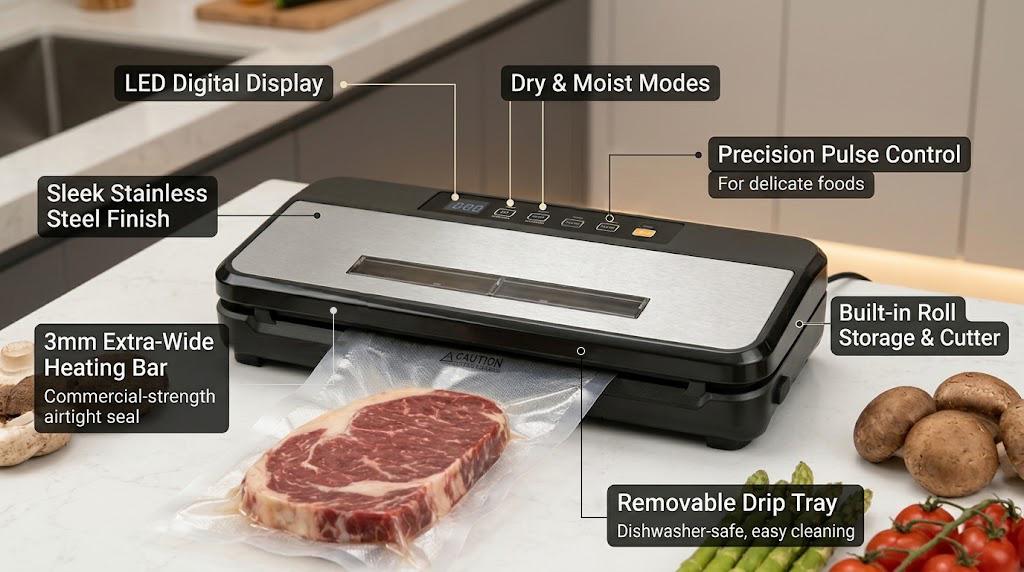
Juicy ribeyes go through the Dry/Moist mode. Soft pastries get the Pulse treatment. Mason jars seal through the external port. Everything sits in a compact body with a built-in bag cutter and a drip tray you can pull out and rinse.
Four Habits That Make Every Seal Better
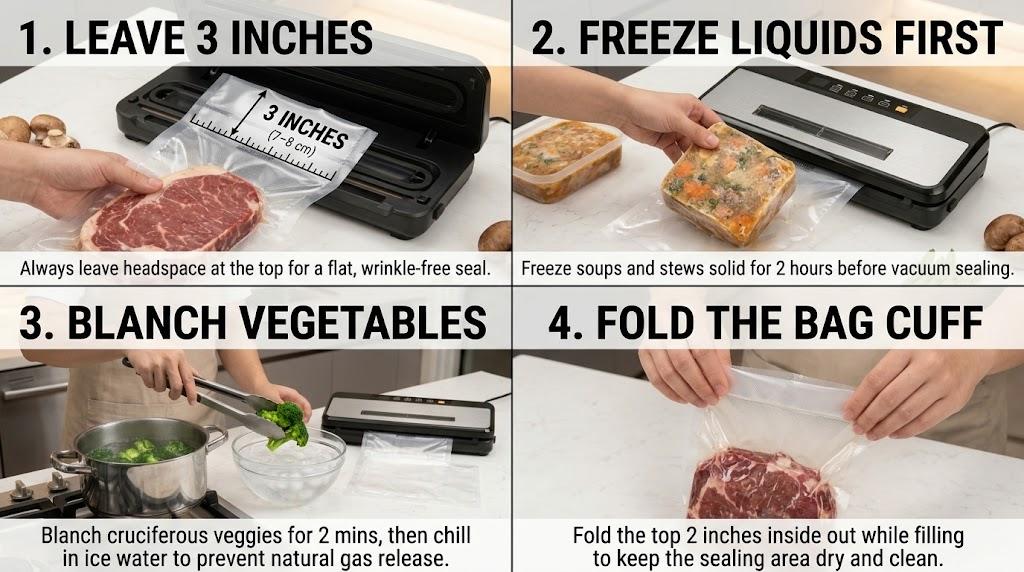
- Leave three inches of headspace. The vacuum channel needs flat plastic to grip. Wrinkles mean weak seals.
- Freeze liquids first. Sealing soup in an external machine? Freeze it solid for two hours, then seal the block.
- Blanch broccoli and cabbage. These vegetables release gas as they sit. Two minutes in boiling water, then an ice bath, stops that.
- Fold the bag cuff outward. Flip the top two inches inside out while filling. Grease stays off the sealing strip, and the seal stays clean.
Common Questions
Can I seal liquids and wet food?
Yes. Use Moist mode or Pulse for things like marinated chicken. For thin liquids like broth in an external sealer, freeze them solid first.
Do I need special bags?
External machines need textured (embossed) bags—the tiny channels are what let air escape. Smooth bags will heat-seal but won't vacuum.
A Final Word
Freezer burn, wasted groceries, mediocre sous vide results—a vacuum sealer solves all three, and it does it without much fuss once you've got the hang of it. If you're ready to stop throwing money in the trash, the YUMYTH Food Vacuum Sealer is a solid place to start.
Related Articles

How Does a Slush Machine Work Without Ice?
2026-10-29
BY arafatshuvo509
Traditional blender's use of crushed ice to mix an ingredient into a thick, cold drink is replaced by today's slush makers which are able to achieve the same result using ...
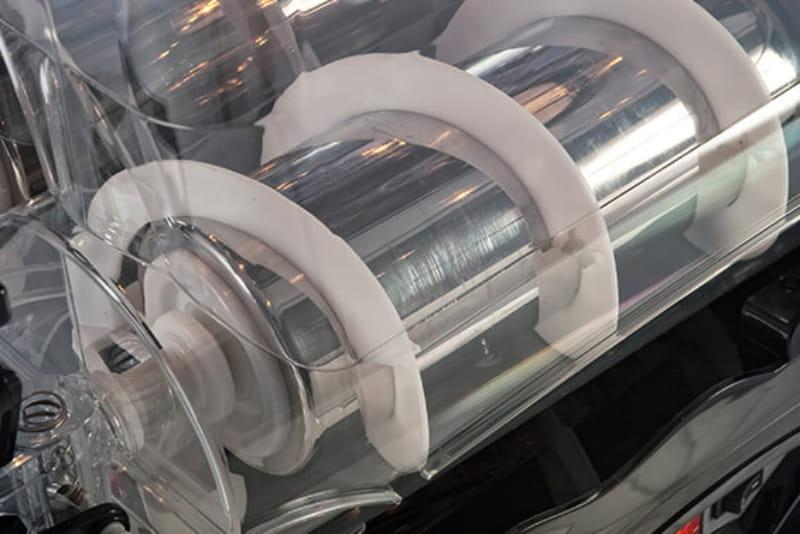
Compressor Slush Machine: Cooling System and Mixing Technology
2026-10-29
BY arafatshuvo509
A compressor slush machine utilizes an integral refrigeration process with continuous mechanical agitation of the refrigerated liquid to produce semi-frozen (slushy) liquids by creating ice crystals directly from the liquid. ...
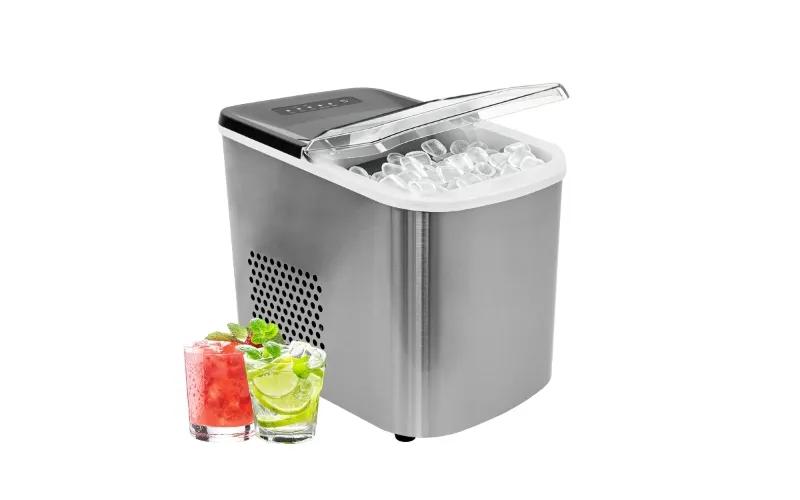
Ice Maker for Small Kitchen: Compact Design for Apartment Living
2026-10-27
BY YUMYTH
An ice maker that fits on an apartment countertop may still be difficult to operate. A wall can obstruct condenser airflow, an overhead cabinet can prevent the lid from opening ...
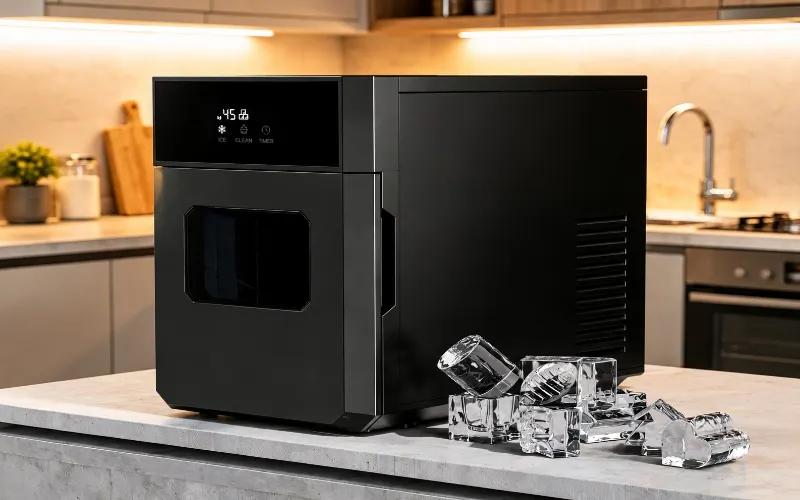
2026 Freestanding Ice Maker Trends: Clear Ice, R290, and Smart Controls
2026-10-27
BY YUMYTH
A freestanding ice maker that can produce 12.6 kg of ice in a day may still not meet expectations. Its ice may turn cloudy because of short freezing cycles, it ...