
Home Frozen Drink Appliance Market Engineering Trends
Share:
-

-

-

-


Copied
Share:
-
-
-
-
Copied
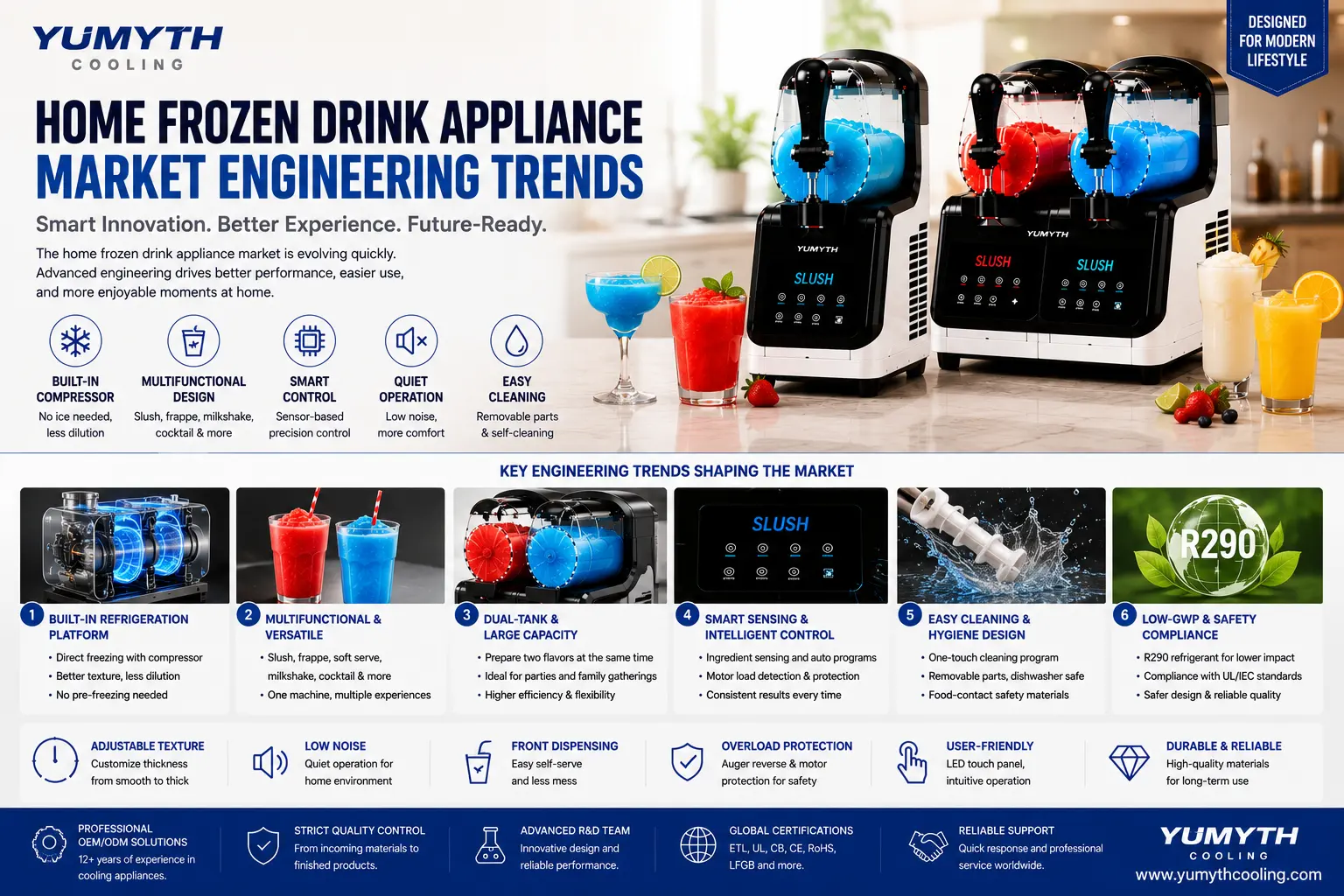
The home frozen drink appliance market is on the move from the simple countertop ice crushing machines and the single drink makers. Nowadays, more and more of the product development is centered around built-in refrigeration, auto texture, multi recipe modes, cleanability, bigger capacity, and safer low-GWP refrigeration platforms.
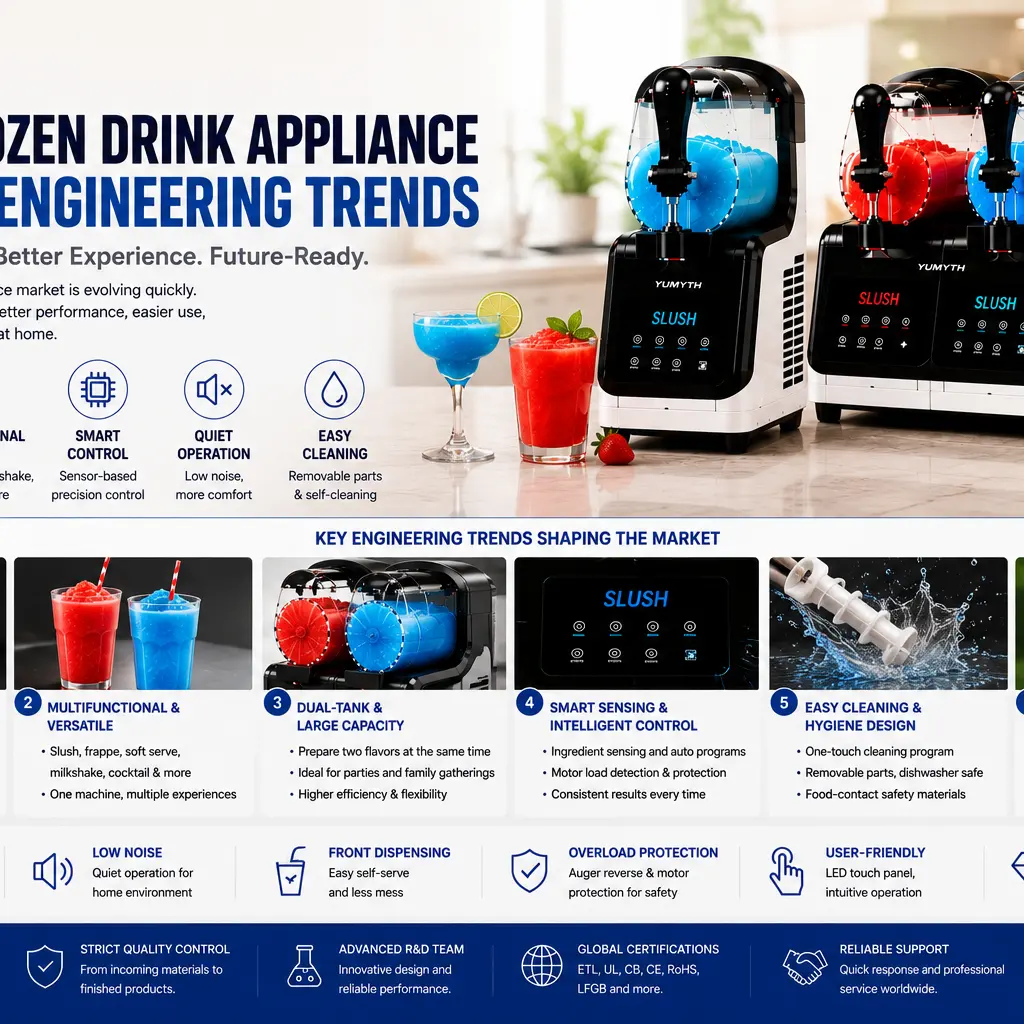
Recent apple products from companies like Ninja, GreenPan and Cuisinart are examples of the progression of a frozen drink company into a more capable kitchen platform. Newer models have slushes, frozen cocktails, frappés, milkshakes, sorbet, soft serve, and ice cream, but have cut down on the number of things the user has to prepare.
These changes bring new engineering possibilities and opportunities to refrigeration design, motor protection, food-contact construction, firmware validation and production quality control for appliance brands and OEM manufacturers.
For example, with built-in apps, the AC is becoming the main platform.For instance, built-in applications are making the AC the main platform.
The obvious engineering trend is the transition from ice preparation to the use of direct freezing by means of an integrated compressor system.
Many traditional frozen drink producers employ crushed ice or a bowl (which has to be held in a freezer prior to use). With a compressor-based appliance, the liquid is cooled directly, while a rotating auger or paddle keeps continually mixing the forming ice crystals.
GreenPan continues to offer a quiet pre-programmable chiller, which does not require any pre-frozen container, whereas Cuisinart's latest multifunctional chiller prepares a number of frozen drink and dessert types automatically using quick-freeze chilling.
There are advantages to direct freezing products:
- * Less evaporation; and
- * Greater consistency of drink consistency;
- * Supplies of ice and snacks are kept in place;
- * Support for repeated batches, with an exception for three runs:
- Holding after preparation (AUTO)
But, the compressor, condenser, evaporator, expansion device, refrigerant charge, insulation, airflow and control software must be a well balanced system. The faster the compressor, the better the results – provided the condenser can remove the extra heat.
The trend of multifunction products replacing single-purpose machines is gaining pace.There is a growing trend towards multifunction products replacing single-purpose machines.
One of the other trends is the integration of frozen drinks and frozen desserts into the same machine.
Cuisinart's 6-in-1 platform is ideal for soft serve, soft sorbet, slushies, frappés, wine and frozen cocktails. For a wider range of product lines, GreenPan provides several different product platforms with a single integrated chiller that include ice cream, gelato, soft serve, milkshakes, slushies and alcoholic frozen beverages.
The multifunction approach has the potential to enhance the value perceived by the end user of a countertop appliance, but poses significant engineering challenges. Slush should be pourable, and ice cream and soft serve should be more compacted and have different mixing loads.
A multifunction appliance can have different settings for:
- * Evaporator temperature;
- * Compressor operation;
- * Paddle angle; and
- * Motor-current limits;
- * Processing time;
- * Holding behavior;
- * Dispensing control.
If additional buttons are added to the interface without any new operating logic then this can lead to inconsistencies. For each advertised mode, use representative formulations and working volumes to validate.
The Dual-Vessel and Party-Scale Designs are spreading.The Dual-Vessel and Party-Scale Designs are growing in popularity.
Serving size is increasingly being used to differentiate products.
With support of ingredient sensing technology, Ninja's SLUSHi Twist creates two drinks at once simultaneously from two separate vessels. The company also launched an XL version of its platform, which promises to offer quicker preparation and larger batches than the original.
Households can cook two flavors or different alcoholic and nonalcoholic recipes in dual-vessel architecture. It also provides themed drinks and party service.
It is very important to monitor carefully the following factors for a dual-vessel product from an engineering point of view:
- * Refrigeration capacity distribution;
- * Independent sensors;
- Loads for motors and augers;
- * Separate control programs;
- * Heat rejection;
- * Power consumption;
- * The size of the cabinet and the air flow in and out of it.
Two tanks could be connected to a single small refrigeration platform, resulting in slow freezing or poor performance. Operating multiple vessels at full load should be considered simultaneously by the engineers, instead of testing them one by one.
The plants are becoming more intelligent.The plants are getting smarter.
Increasingly, frozen drink appliances are employing sensor-driven controls instead of fixed timers.
Ninja's Dual SlushAssist technology is claimed to detect the ingredients and adjust parameters for two drinks. GreenPan appliances offer several setting modes and texture levels and automatically shift to a cooling mode once the desired texture has been achieved.
This means a wider trend towards control systems based on information like:
- * Beverage temperature;
- * Evaporator temperature;
- * Motor current;
- * Auger speed;
- * Processing time;
- * Compressor cycling.
Motor-current monitoring is very useful as the resistance rises, the beverage is becoming too hard. Firmware could disable or reverse the auger, stop refrigeration or warn the user before the gearbox or coupling is damaged.
New platforms may adopt more adaptive algorithms which vary the set point with the change of mechanical load or the ingredient composition.
The use of recipes is evolving from a feature to an engineering feature.The use of recipes is changing from a feature to an engineering feature.
Consumers today desire to enjoy classic slush, non-sugar, milk-based slushes, coffee slushes, mocktails and cocktails all from a single machine. These recipes are not the same when frozen.
For instance, the official guidance on GreenPan's spiked slushie program illustrates that there is a supported alcohol range that must be conservatively managed and not promoted as a general claim to the product.
Freezing point and viscosity is affected by sugar, alcohol, fat, fruit content, and dissolved solids. A low sugar drink may have too soft of an ice formation, and a high alcohol drink may have too few ice crystals.
Engineering teams are therefore focusing more on:
- * Brix testing;
- * Alcohol-range validation;
- * Motor-load protection;
- * Recipe-specific presets;
- * Texture algorithms;
- * Clear user guidance.
Broad recipe compatibility claims should be backed up by controlled testing, not a single demonstration beverage.
Cleaning is gaining competitive importance with the Design.Cleaning gains competitive importance with the Design.
Frozen drink appliances are also more versatile, and can handle tougher residues, such as dairy fat, coffee, fruit pulp, syrup, coloring and alcohol mixtures.
GreenPan emphasizes removable parts that fit into the dishwasher, as well as a cleaning mode. Removable bowls, dispensing parts, augers and lids are also becoming more common in current multifunction products, which decrease the amount of cleaning work performed in an active state.
The engineering emphasis is changing from adding a 'Clean' button to creating a full 'clean zone' for food.
Important features include:
- * Tool-free disassembly;
- * Smooth internal surfaces;
- * Compressible gaskets; and
- * Open drainage paths;
- * Fewer loose components;
- * Clear reassembly guidance;
- * Dishwasher-compatible materials.
Normally an automatic rinse cycle is unable to remove and wash seals, valves, nozzles and other hidden food-contact surfaces.
Noise Reduction is Gaining in Significance
A frozen drink appliance typically runs for longer periods of time than a blender. It can process for longer after the initial recipe is made, so its noise level is a significant aspect of the home experience.
GreenPan features a quiet in-built chiller, and Cuisinart is promoting its fast freeze and dispense features and ultra-quiet motor.
Noise reduction should be achieved for the whole product, and not just one component. Potential sources include:
- * Compressor vibration;
- * Fan blade noise;
- * Refrigerant flow;
- * Auger scraping;
- * Gearbox tones;
- * Cabinet-panel resonance.
The condenser temperature will be higher if the fan speed is reduced, which means that the condenser noise will be lower. Less stiff compressor mounts can decrease vibration, but can cause excessive movement during transporting. The acoustic improvement should, therefore, be tested in conjunction with refrigeration performance and packaging durability.
The use of low-GWP Refrigerants is driving a change in product architecture.Refrigerants with low GWP are reshaping product architecture.
Appliance engineering is also being impacted by environmental needs and the move to refrigerants.
The US EPA's SNAP program assesses the suitability of refrigerant alternatives, including those with a flammability rating, like R290; updated use conditions are based on the latest UL 60335-2-24 safety standard. Household refrigerating appliances, ice-cream appliances and ice makers are covered by IEC 60335-2-24:2025.
Low-GWP compact refrigeration systems can be compatible with R290, but particular engineering and production controls are necessary due to the flammability of R290.
These include:
- * Controlled refrigerant charge;
- * Protected tubing;
- * Leak-risk analysis;
- * Correct use of electrical connectors;
- * Correct ventilation;
- * Refrigerant markings;
- * Factory charging controls;
- * Updated safety testing.
The selection of the refrigerant is thus shifting from late in the purchasing process to a product-platform decision.
The value of modular design and replacement parts is increasing.
The more complex the appliance, the better the serviceability. There is a potential for removable tanks, dispensing assemblies, seals, augers, and accessories to wear, be damaged or lost during ownership.
Cuisinart now offers replacement dispensing and serving parts for its multifunction appliance compatible with the product's current line, which underscores the importance of planning for replacement parts as a product platform.
With modular design, complete-product returns can be minimized and the life of appliances can be prolonged. For OEM projects, the controlled part number should be assigned to high usage parts and verified for compatibility between model versions.
Conclusion
Frozen drinks makers are shifting the focus of home frozen drinks units from basic coolers to multi-function refrigeration units.
Direct compressor freezing, growing drink and dessert menus, dual vessel capacity, sensor-based firmware, recipe-specific control, quieter performance, assisted cleaning, low-GWP refrigeration, and replaceable food-contact parts are the top trends in engineering.
OEM manufacturers and appliance brands will have to do more than just introduce more presets to become more competitive in the future. The refrigeration capability, texture control, motor protection, hygiene, noise, safety, production consistency and ease of operation of successful products all need to be balanced.
Products that incorporate these requirements from the initial product definition phase can create machines which are easier to use, more versatile, safer to fabricate, and better suited to the growing home frozen drink market.
Related Articles
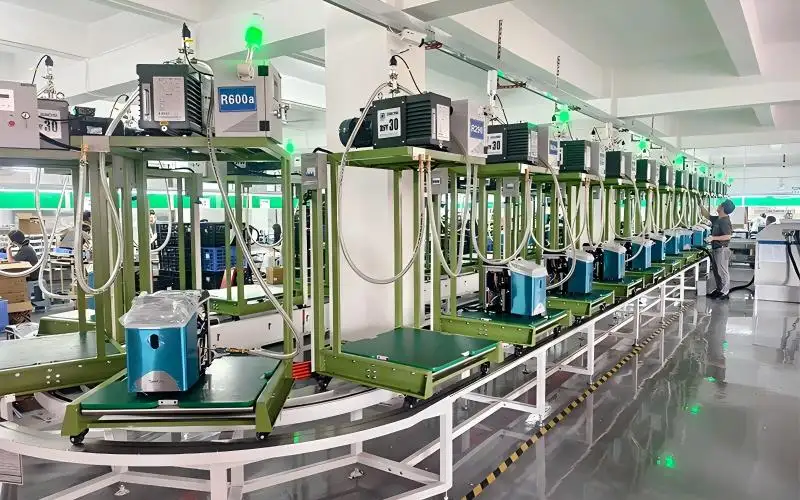
How We Test Every Ice Maker Before Packaging
2026-09-15
BY YUMYTH
A step-by-step look at refrigerant handling, cooling verification, leak detection, corrective action and electrical safety testing For an ice maker, reliable performance is determined long before the carton is sealed. ...
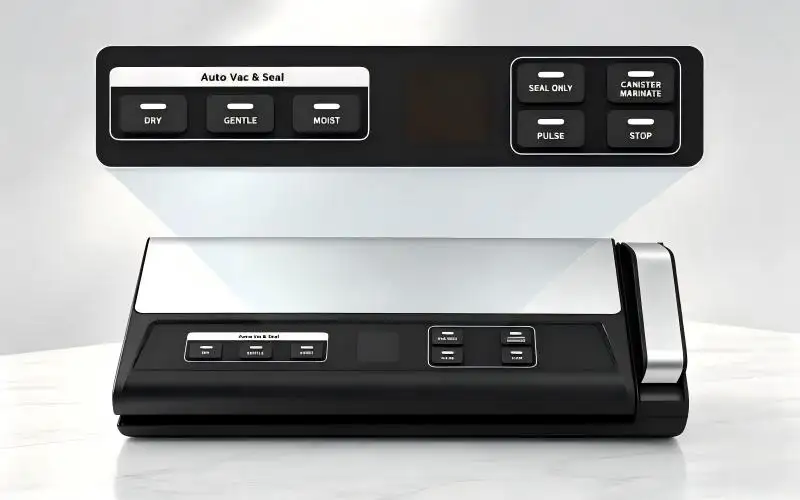
Guide for Brands Looking for a Reliable Vacuum Sealer OEM Supplier
2026-09-14
BY YUMYTH
When you are sourcing kitchen appliances for your retail brand, finding a dependable vacuum sealer OEM supplier is rarely just about getting the lowest unit price. It is about protecting ...
Why Ice Shape Matters: Understanding 10mm × 15mm Cylindrical Nugget Ice
2026-09-14
BY YUMYTH
More Than Ice Production — The Ice Itself Shapes the Consumer Experience When sourcing a nugget ice maker, buyers often focus first on production capacity, water tank size, ice basket ...

Ice Maker Sourcing Guide: How to Find the Right Factory
2026-09-10
BY YUMYTH
Sourcing an ice maker looks straightforward on paper. Find a supplier, agree on a price, place an order. But anyone who has actually done this knows the process is rarely ...