
Common reasons home slush machines jam
Share:
-

-

-

-


Copied

Share:
-
-
-
-
Copied
Here are the top 5 most frequent causes of home slush machines jamming:
Home slush machines are used to mix liquid beverages into a smooth, partially frozen concoction by refrigerating and mixing constantly. These appliances generally do not crush ice with high-speed blades, as you'd find in blenders. Rather, an auger dragging the material to scrape the ice crystals from the cooling surfaces keeps the material moving.
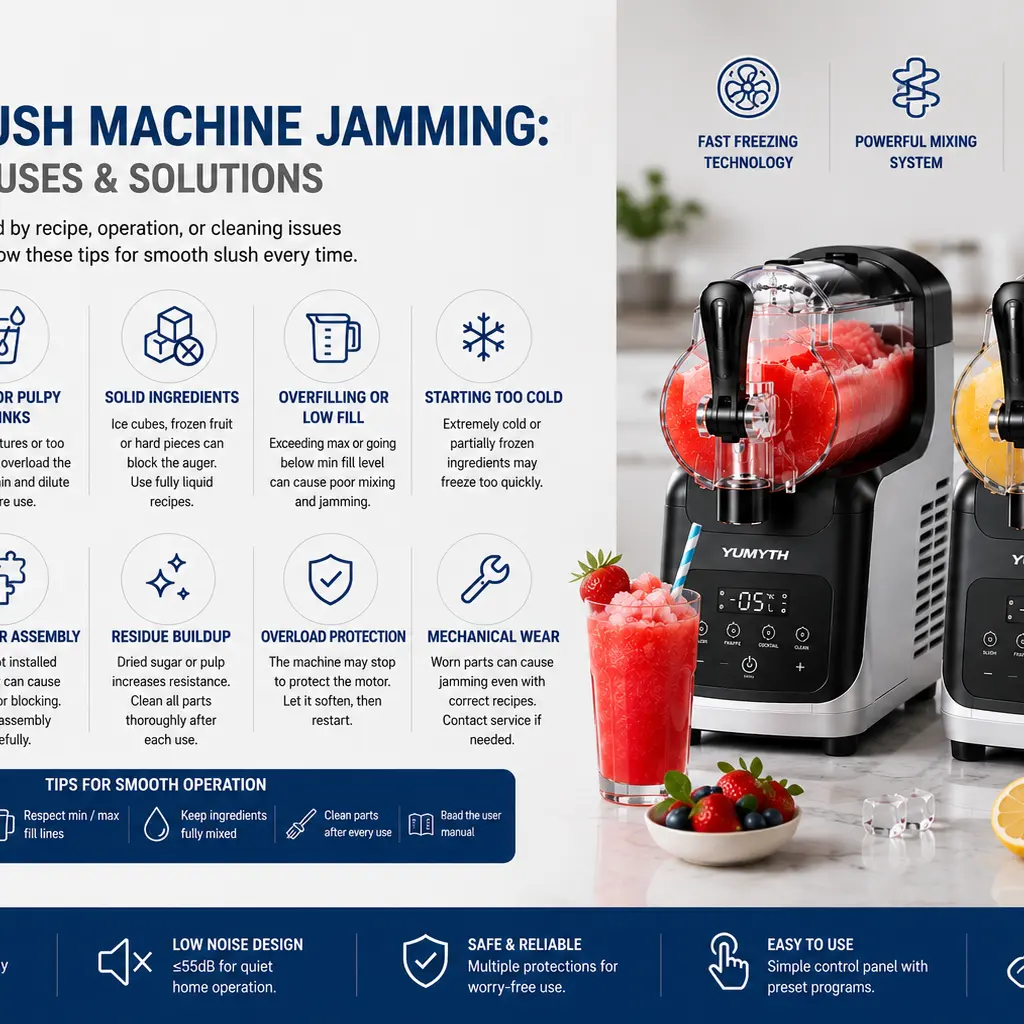
Users have the tendency to think that the motor has failed if the auger stops, rotates slowly, reverses several times, or emits an overload warning. However, in many instances, the machine is encountering too much resistance that is due to the beverage recipe, operating temperature, beverage level, cleanliness, or improper installation of parts.
Knowing why home slush machines tend to jam allows users to create better recipes and appliance manufacturers to design better machines, software and user's manuals.
If the amount of sugar is not enough, the mixture will freeze too hard.
One of the most frequent reasons for a slush machine to jam is due to its low sugar content.
Sugar reduces the freezing point of a drink and it creates a soft drink that has some ice crystals. If sugar is not present in adequate levels, water could freeze into a solid around the evaporator and this could not be a drinkable texture.
The thicker the frozen layer, the more torque is needed to turn the auger. The motor current increases and the control system can stop and/or reverse the auger to protect it.
Thus, unsweetened tea, flavored water, diet soda or zero sugar sports drinks may cause issues if the recipe is not modified. Several other sweeteners can be used to sweeten without causing the same freezing-point effect as regular sugar.
Beverage requirements as given by appliance manufacturer should be followed. Rather than just providing general advice like “do not use sugar-free drinks,” brands should post a validated sugar or Brix range.
Excessive Sugar or Syrup Can Make the Drink Too Thick
If the sugar is too low, the product will hard freeze, and if the sugar is too high it can cause operational issues.
Syrups are often sticky and thick during cold weather when they are concentrated. This can make the mixture softer, but the auger will have to work a little harder to get it through the vessel. Thick syrup may also build up around the seals, the dispensing outlet, around the scraper edges, and around the shaft.
This is a common problem that can happen when the user dumps concentrated flavor syrup into the water without enough water, or when a dessert sauce is used that wasn't formulated for use in frozen drinks.
Any ingredient(s) must be properly diluted and thoroughly mixed before feeding into the machine. Granulated sugar should go into a cold or partially frozen drink and be dissolved rather than poured straight into the drink.
An incorrect Alcohol Content results in Unstable Freezing.
The freezing point of a drink is decreased by alcohol. Too high of an alcohol concentration could cause a cocktail to stay liquid even as the machine cools to its lowest operating temperature.
Recipe jamming can occur with high alcohol mixtures, which typically don't freeze into a solid block. A portion of the water may freeze against the cooling surface while the rest of the alcohol is still liquid in the tank. This results in a non-uniform ice build-up and non-uniform auger resistance.
Additional spirits can then be added to the users after the freezing cycle starts. As the new liquid is added to the beverage mixture, the mixture's composition is altered prior to complete blending, and this may result in an unstable texture.
Frozen cocktails should be kept in the alcohol level recommended for the appliance. All the recipe is mixed thoroughly before the operation begins.
Ingredients that are thick or Pulp-Heavy Overload the Auger
The slush machines at home are normally created for slushes that can be poured. Dessert bases, concentrated coffee mixtures, fruit purées, thick smoothies, yogurt and heavy cream can end up being too thick for the mixing system.
As the temperature decreases the mixture gets even heavier. The resistance in the auger then increases further until the motor protection system is triggered.
The fruit pulp may also be trapped between the scraper and cooling surface. Peel pieces, herbs, seeds and other fibrous material can get trapped around the auger.
Fruit ingredients must be blended and strained before putting into the machine. Prep for dairy products and frozen dessert recipes should not be used unless the manufacturer has tested them for use with this appliance if it is intended only for water-based beverages.
The solid-ingestion mechanism blocks the mixing system.Solid-ingestion mechanism stops the mixing system.
It is important to note that a compressor based slush machine is not a blender.
Ice cubes, frozen fruit, candy, chocolate pieces, nuts, seeds and decorative ingredients can get lodged between the auger and the wall of the vessel. One hard object can prevent rotation, shear the scraper or crush the auger or wear the drive coupling.
Normally garnishes are added after the drink has been dispensed. Any ingredients added to the appliance must be fully liquid or prepared in accordance with the instructions of the product.
This should be clearly differentiated in user manuals and the product content on the web. A lot of jamming problems are the result of consumers putting things into the appliance that it isn't meant to crush.
If a beverage is over-filled, it limits the circulation of the fluid.
Each machine has an upper limit of working capacity. This capacity can be less than the actual physical capacity of the tank.
When a liquid turns into ice, crystals of ice will grow and the liquid will expand. If the dispenser is overfilled, it can push up against the lid, upper auger support, seals, or dispensing parts.
Overfilling also decreases the space for circulation. Close to the evaporator, liquid may freeze quickly and the upper section of the tank is not sufficiently mixed. This creates a hard layer which results in higher mechanical load on the auger.
Users should obey the marked maximum fill line and do not add liquid to the cycle after it has started, unless the manufacturer has stated otherwise.
Jamming Can Also Be Caused by Operating Below the Minimum Fill Level
A supply of insufficient liquid can also be an issue.
If the fill volume is less than minimum, the drink may not cover the desired filling and mixing area. If a thin layer freezes before the auger distributes it through the tank, it will freeze rapidly.
The machine could also be getting inaccurate temperature or load data, as it runs outside the range of its validation.
Manufacturers need to explicitly specify the lowest and highest working volumes. Consumers should not operate the machine with a minimal amount of beverage left over as a means to avoid waste.
Extremely Cold Ingredients Freeze Too Quickly
The initial temperature has a significant influence on the freezing process.
A quick drink of a cold beverage might cut back some time for preparation, but if a partially frozen drink or liquid is served from a very cold refrigerator, hard ice may form around the evaporator and slow down the even flow of liquid.
Unless designed to accept frozen fruit, ice crystals, or partially frozen syrup, they should not be added.
When freezing times are recommended in user guide, the starting temperature should be specified, particularly if freezing times are based on pre-chilled ingredients.
The following mistakes result in too firm of a texture.The next errors lead to a too firm texture.
Some modern frozen drink appliances are equipped with slush, frappé, cocktail or milkshake options and may even have a frozen dessert option. These modes can have different target temperatures, auger behavior and holding logic.
If the program cools the drink too quickly, it may make it too hard. When the ideal texture is attained, if the compressor continues to run, the motor resistance will increase and the auger may stall.
It is important to use a program that fits the recipe and not the coldest as this will mean the faster the results.
This can be minimized with adaptive temperature and torque control. The ideal appliance will sense the increase in motor load and begin to adjust refrigeration before a hard freeze occurs.
Removable Parts May Be Installed Incorrectly
Beverage vessel, auger, seals, lid, dispensing valve and related parts are frequently removable for cleaning. When not installed correctly, rubbing, misalignment, or leakage can occur.
Aside from the mistakes listed below, common assembly errors include:
- The auger is not completely mounted on the drive shaft; and
- The tank is not fixed or secured in place;
- A seal is twisted or placed backwards;
- The lid is put against the auger;
- The dispensing valve protrudes into the mixing line;
- A removable part is assembled in an incorrect order.
When assembled properly, it should be smooth and relatively easy to push. User errors can be reduced by using asymmetrical connections, aligning and feedback sounds.
When dried residue builds up, it hinders crop rotation.
Glass, dairies products, fruit pulp and syrup may dry around the auger shaft, sealing grooves, dispensing outlet, and vessel joints.
A thin layer of hardened residue can even cause enough obstruction to the auger to make it impossible to get the auger to start. Sticky deposits may also prevent parts from seating properly when reassembling.
All food contact parts should be cleaned after every use. Narrow grooves, seals, couplings and behind the dispensing valve should be looked for.
It is important to thoroughly rinse and dry parts before storing them. Cleaning tools that may cause any scratches on the vessel or auger should not be used as it could lead to accumulation of more residues during the subsequent use.
Overload Protection May Be Working Normally
If an auger stops, it does not necessarily mean that the motor is faulty.
Damage is prevented by many machines with motor-current monitoring, thermal protection, automatic reversal or software limits. If too much torque is detected, the system will standstill and may stop the auger or the compressor.
This protective reaction will prevent gearboxes from failing, motors from overheating, broken couplings and damaged auger components.
Users should check the fill level, check that the removable parts are in place and correct the recipe before restarting the machine after the mixture has softened. If you continue to reset the appliance without solving the problem then it can affect the drive system over time.
If mechanical wear is suspected, it may need to be professionally inspected.
When a machine jams while making beverages correctly with correct parts installed, it is possible that there is a defective or worn machine part.
Possible causes include:
- The auger is cracked or damaged;
- An old drive coupling that is worn out;
- * A misaligned shaft;
- * A damaged gearbox;
- * A weak motor;
- A container for drinking or eating that has been bent, misshapen, or warped,
- A defective torque/temp sensor.
If the appliance is making grinding noises, if it is not rotating evenly, if it vibrates too much or if there are repeated errors with the approved recipes, then the appliance may need service.
Opening of the electrical and refrigeration housing should be performed only after adequate training. Product should be checked by the manufacturer or authorised service provider.
Conclusion
The majority of your home slush machine jams aren't caused by your motor failing — they're caused by too much resistance. These are usually due to incorrect sugar or alcohol levels, recipes that are too thick, solid ingredients, over filling, low fill volume, incorrect programs, poor cleaning, or improper assembly.
By preparing full recipes in advance, sticking to the recommended ranges for the ingredients, observing capacity limits, using the appropriate mode and cleaning all detachable parts, users can avoid many issues.
Coordinated refrigeration and mechanical control are important to ensure reliable performance for appliance brands and OEM manufacturers. Effective systems are designed to incorporate accurate temperature sensing, long life auger design, motor current monitoring, automatic reverse, compressor protection and friendly user instructions.
A good frozen drink machine is supposed to make a good frozen drink. It should also be able to identify abnormal resistance, to safeguard critical components, and assist users in solving the problem in a safe way.
Related Articles
How We Test Every Ice Maker Before Packaging
2026-09-15
BY YUMYTH
A step-by-step look at refrigerant handling, cooling verification, leak detection, corrective action and electrical safety testing For an ice maker, reliable performance is determined long before the carton is sealed. ...
Guide for Brands Looking for a Reliable Vacuum Sealer OEM Supplier
2026-09-14
BY YUMYTH
When you are sourcing kitchen appliances for your retail brand, finding a dependable vacuum sealer OEM supplier is rarely just about getting the lowest unit price. It is about protecting ...
Why Ice Shape Matters: Understanding 10mm × 15mm Cylindrical Nugget Ice
2026-09-14
BY YUMYTH
More Than Ice Production — The Ice Itself Shapes the Consumer Experience When sourcing a nugget ice maker, buyers often focus first on production capacity, water tank size, ice basket ...

Ice Maker Sourcing Guide: How to Find the Right Factory
2026-09-10
BY YUMYTH
Sourcing an ice maker looks straightforward on paper. Find a supplier, agree on a price, place an order. But anyone who has actually done this knows the process is rarely ...