
Packaging drop test
Share:
-

-

-

-


Copied

Share:
-
-
-
-
Copied
The Home Slush Machines are packaged for drop testing in accordance with the following procedure:
Packaging drop test is used to determine if a packaged home slush machine can be handled in warehousing, parcel delivery, and final-mile delivery without damage. A package that might seem pretty good for standard storage can be ruined when it is dropped on a corner, edge or flat surface.
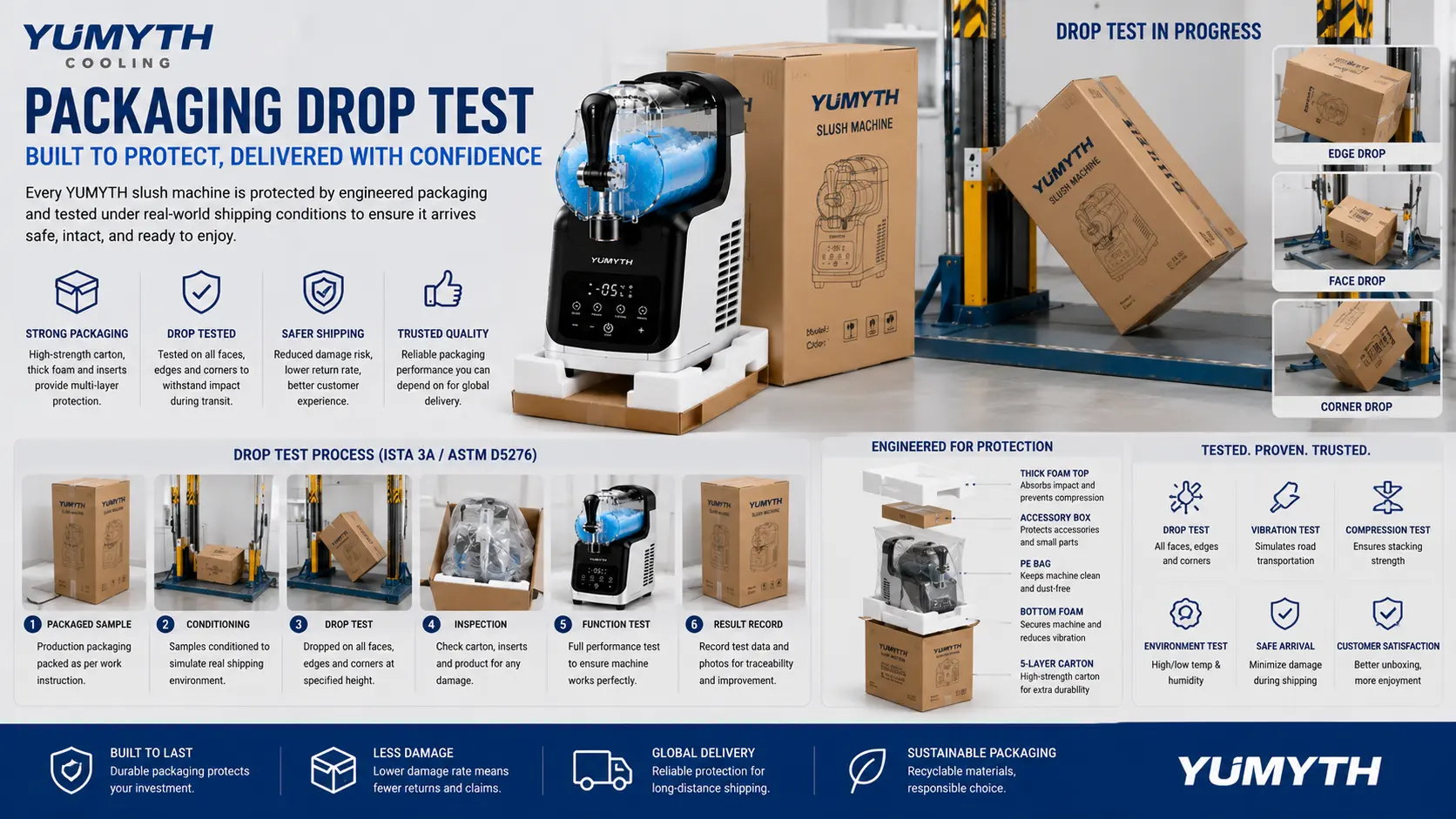
In the case of countertop appliances, a packaging failure may lead to damage to the exterior casing, as well as the appliance itself. Impacts can cause damage to compressor mounts, refrigerant tubing, beverage tank, auger, dispensing handle, control panel, internal wiring or removable accessories. A professional drop test program should therefore test for packaging damage, as well as the condition of the appliance following impact.
Test levels should be chosen before packaging development is complete as it will depend on package weight, form, manner of transport, destination, and package specification as per customer.
You need to choose the suitable test method.
There are several recognised ways of assessing transport packaging.
ASTM D5276 is applicable for free fall drop testing of loaded boxes, cylindrical containers, bags and sacks. It is designed for the purpose of testing the ability of a container and the internal packaging to withstand the impact of a sudden fall. It can also be used to compare the packaging design, and to observe the progressive packaging failure.
A vertical impact test for completely filled transport packages is specified in ISO 2248. The package is lifted above a firm impact surface and dropped in a desired orientation and drop height.
ISTA Procedure 3A usually is recommended for individually packaged products that weigh 150 pounds or less or 70 kilograms or less. It will be used for the distribution of standard, flat, small and elongated packages by parcel systems (ground or air) in general.
The procedure selected must be applicable to the distribution route used. A test plan for a package delivered at the same time on a pallet in a controlled business-to-business network may differ from the test plan for an appliance delivered individually by a parcel delivery network.
Consider Drop Testing to be within Distribution Validation.
A drop test will only assess impact resistance, while actual distribution testing will involve packages being subjected to vibration, compression, temperature fluctuations, humidity, stacking, and repeated handling.
ASTM D4169 establishes a common basis to assess shipping units in a series of expected distribution events. The tests should be conducted as systems, not as individual, isolated events for each hazard.
The full transport-validation program can contain the following:
- * Environmental conditioning;
- * Compression or stacking;
- * Random vibration;
- * Repeated handling impacts;
- * Free-fall drops;
- Final inspection and functional testing.
It may be possible to have a new undisturbed carton drop and still not show weaknesses when vibrated before the final drop sequence. Vibration can cause the separation of accessories, wear of foam surfaces, product position changes and a decrease in the protective function of internal packaging.
Use Production-Representative Samples
The test package should be as close to the desired commercial shipment as possible.
It should use:
- * Final appliance construction;
- * Production carton material;
- * Thick foam or paper packs that are approved and sealed; or
- * Final accessory placement;
- - Making production films and packing film for plastic bags;
- * Enclosed in a protective sleeve; and
- A piece of tape or rope for closing the device.A closure tape or strap (intended).
- Actual retail and shipping labels.
Hand-cut prototype foam can be crafted to fit better than manufactured inserts. Temporary carton can also vary in board strength, moisture content, flute direction, and size.
The product should be packed by following the proposed factory work instruction. This will help to see if operators can place all parts correctly every time and if it is possible that possibly the parts might be placed incorrectly during mass production.
Before testing, condition packages the way you would like them to be.
Paper-packaged products can vary in strength with temperature and moisture. The foam or plastic parts may also react differently in hot or cold weather.
ISO 2233 gives a procedure for pre-conditioning full, loaded transport packages or unit loads before testing. This is the 2000 ISO 2233 edition which was reviewed and confirmed in 2022.
The conditioning program should be tailored to the actual transport conditions and customers' demands. Records of tests should contain:
- * Conditioning temperature;
- * Relative humidity;
- * Conditioning duration;
- * Package starting condition;
- * Time between conditioning and impact testing.
A carton that is dry upon delivery from the manufacturer may behave differently than the one put in a warm delivery truck or a humid warehouse.
Check the Appliance prior to the Test.
A baseline inspection must be carried out to ensure any existing cosmetic and functional issues cannot be attributed to impact damage.
The inspection should make a record of:
- The dimensions and gross weight of carton;
- * Carton condition;
- * Product serial number;
- * Physical, chemical and biological measurements; and
- * Beverage tank condition;
- * Hand tools; and
- Compressor and fan running;
- * Electrical safety condition;
- * Refrigeration performance;
- * Noise and vibration;
- * Accessories and documentation.
Photographs should show all faces, edges and corners of all cartons and problem areas on the appliances. Position of the package to be specified prior to testing.
Explain the concept of Faces, Edges and Corners.
All faces, edges and corners of rectangular packages should be numbered consistently. This helps to avoid the confusion in recording drop orientations.
Impacts commonly include:
- The corner that is the least desirable to play,
- * Edges connected to that corner;
- * Major flat faces;
- Additional orientation(s) needed for the procedure selected.
The most vulnerable orientation should be identified by a risk assessment. Areas susceptible to damage on a slush machine could be the control panel, the dispensing handle, the transparent beverage tank, the compressor base or the side ventilation structure.
Only convenient orientations, where it is easy to position the laboratory, should not be chosen. The test is designed to put the package to a test where it is most likely to damage the appliance.
Handle the Drop Equipment.
The drop tester should be designed to not add rotation or sideways movement or support interference in the package.
The impact surface should be stiff, flat, level and large enough to accommodate the whole package. The height of the fall from the appropriate reference point should be determined by the procedure selected.
The report should document:
- * Test machine identification;
- * Calibration status;
- * Actual drop height;
- * Package orientation;
- * Impact location;
- * Sequence number;
- Include high speed pictures or video if appropriate.
Large variations in orientation and release behavior can be introduced into the system if dropping is done manually. When multiple comparisons of packaging designs are needed, controlled equipment is preferred.
Examine the Package After Every Impact
After every drop, the packages should be checked for damage, not just at the end of the sequence.
The test team should record:
- * Carton crushing;
- * Torn corners;
- * Seam opening;
- * Tape failure;
- * Insert displacement;
- * Foam cracking;
- * Product movement;
- * Accessory migration;
- * Contact between the product and carton;
- Exposure of the appliance.
It is not necessarily possible to open the package after each impact in the selected procedure, as this could interrupt the sequence of impacts. Outside observations should be recorded also and full unpacking should be done at the scheduled inspection point.
Progressive deterioration is important. A carton can take the first few drops, but may drop to the floor and lose strength so it cannot survive the final drop.
Develop Product Acceptance Criteria
The carton should not be rejected if it has a dent in it. The packaging may be expected to be deformed in some way, as the packaging purpose is to absorb impact energy.
Acceptance criteria should be based on the safety, usability and commercial acceptability of the shipment.
Common factors that can be used are:
- * No product exposure;
- No broken beverage tank or detachable part;
- * No cracked or sharp edges in the house;
- * No compressor mount vibration; and
- * No refrigerant leakage;
- * No damaged wiring;
- * No control-panel failure;
- * No dispensing leakage;
- * No special handling instructions required; and
- * Complete accessory retention;
- Normal operation of the appliance following test.
The brand needs to establish what is acceptable for carton damage in retail. The retail package may be very damaged or graphics destroyed and the appliance still meet all requirements, but not commercial requirements.
Complete Functional Retest
It is not possible to determine by visual examination alone whether the appliance survived.
Once the appliance is unpacked, it should be subjected to a well planned functional assessment. This could include:
- Inspection of the power-on and control-panel;
- * Compressor startup;
- * Condenser fan operation;
- * Abnormal-noise inspection;
- * Refrigerant-circuit inspection;
- * Auger operation;
- * Beverage tank installation;
- * Dispensing-valve leakage test;
- * Water quality test; and
- * Representative freezing test.
There should be a check for changes in vibration, cooling time, motor current, leakage, or temperature of the appliance. The damaged compressor mount or bent tube may not be apparent until the refrigeration system is running.
For products that are fit for consumption after a stabilization period, the product should also be examined after that period if applicable, especially if the impact orientation might have influenced the refrigeration system.
Explain the Failure Mechanism
The engineering team should determine how impact energy got to the package.
Common causes include:
- * Insufficient corner protection;
- * Out-of-level floor around the appliance; and
- Cracks that form when load is applied;
- * Product weight coming from a small area;
- * Accessories on fragile surfaces;
- * Weak carton seams;
- * Poor handle protection;
- * Inadequate compressor-base support;
- Foam that is too hard or too soft;
- * Incorrect factory packing.
Increasing the amount of material does not necessarily help. Thicker inserts can be more expensive and larger, but do not adequately control the product's movement.
The design should spread out impact loads in strong structural areas and isolate weak areas.
Discuss Alternative Packaging Designs
The test can be controlled to compare the performance of various materials of inserts, carton strength, product orientation, or the location of accessories.
The same should be used for each design:
- * Appliance model;
- * Gross weight;
- * Conditioning;
- * Drop equipment;
- * Impact sequence;
- * Acceptance criteria.
Damage rate, packaging volume, material cost, assembly time, sustainability, and shipping efficiency should be taken into account in the comparison.
A design that is very robust during extensive testing, but which results in substantial size growth may result in higher freight costs and lower pallet efficiency. Optimisation of packaging must meet the protection needs, but also economic and environmental considerations.
Continue to monitor Packaging Control in Production.Continue monitoring Packaging Control in Production.
Packaging specifications need to be controlled as would components of an appliance.
The bill of materials shall include a definition of:
- * Carton board specification;
- * Dimensions and tolerances;
- * Insert temperature;
- * Protective bag thickness;
- * Safety of tape and its use;
- * Accessory positions;
- * Packing sequence;
- * Label locations.
Even if the carton looks the same, a difference in suppliers can impact the performance of the packaging. It is recommended to be done periodically after changing materials, product weight, new factories, or significant route changes.
The Transit-Tested Mark is being used by states that have implemented the program which requires successful pre-shipment testing and review based on ISTA's program conditions.
Write the Final Test Report.Organize the Final Test Report.
The report from a professional packaging drop-test will include:
- Identifying products and packaging;
- * Sample quantity;
- * Carbon monoxide regulations; and
- * Applicable test method;
- * Conditioning conditions;
- * Bifocal lenses; and
- * Actual drop heights;
- * Equipment information;
- * Record observations of the package after each impact;
- * Product inspection results;
- * Functional retest results;
- * Map of the site; and
- * Failure analysis;
- * Corrective actions;
- * Final conclusion.
Any reported “pass” should be associated with a defined criteria and not based on a vague visual evaluation.
Conclusion
Packaging drop testing is an effective method to help appliance brands know if a domestic slush machine can endure real-world drops without compromising safety, functionality, or marketability.
A good program employs production representative samples, controlled conditioning, defined orientations, calibrated equipment and complete post-test functional inspection. Drop testing should also be combined with vibration, compression and environmental validation to simulate the entire distribution pathway when the objective is to simulate the entire distribution pathway.
Good packaging validation for OEM manufacturers can minimise damage in transit, product returns, replacement shipments and customer complaints. Thickest or most expensive design is not necessarily the best package. It is a controlled system which allows the protection of vulnerable components and supports efficient production, transportation and final delivery.
Related Articles
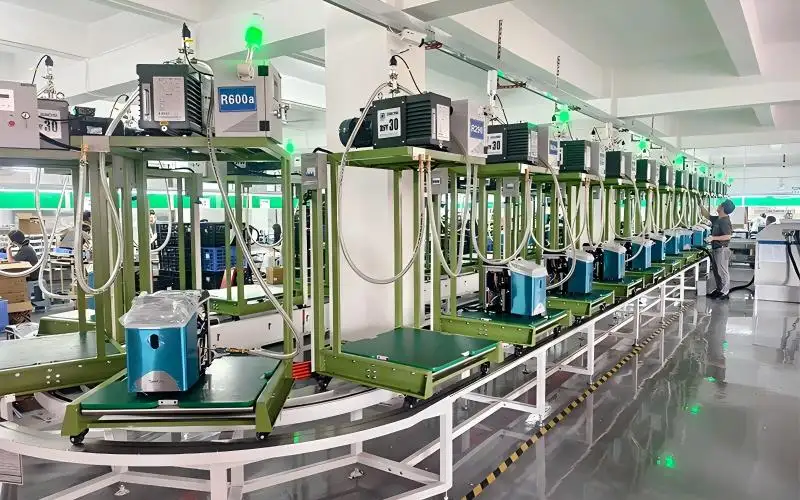
How We Test Every Ice Maker Before Packaging
2026-09-15
BY YUMYTH
A step-by-step look at refrigerant handling, cooling verification, leak detection, corrective action and electrical safety testing For an ice maker, reliable performance is determined long before the carton is sealed. ...
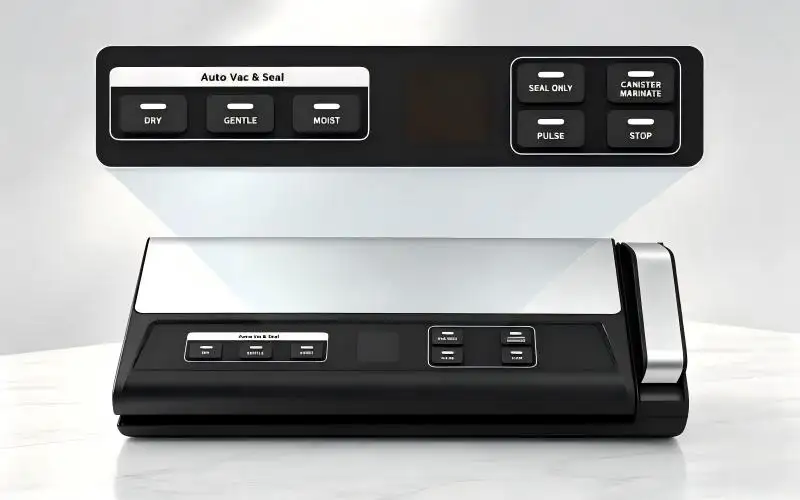
Guide for Brands Looking for a Reliable Vacuum Sealer OEM Supplier
2026-09-14
BY YUMYTH
When you are sourcing kitchen appliances for your retail brand, finding a dependable vacuum sealer OEM supplier is rarely just about getting the lowest unit price. It is about protecting ...

Why Ice Shape Matters: Understanding 10mm × 15mm Cylindrical Nugget Ice
2026-09-14
BY YUMYTH
More Than Ice Production — The Ice Itself Shapes the Consumer Experience When sourcing a nugget ice maker, buyers often focus first on production capacity, water tank size, ice basket ...

Ice Maker Sourcing Guide: How to Find the Right Factory
2026-09-10
BY YUMYTH
Sourcing an ice maker looks straightforward on paper. Find a supplier, agree on a price, place an order. But anyone who has actually done this knows the process is rarely ...