
What Refrigerant Is Used in Home Slush Machines?
Share:
-

-

-

-


Copied
Share:
-
-
-
-
Copied
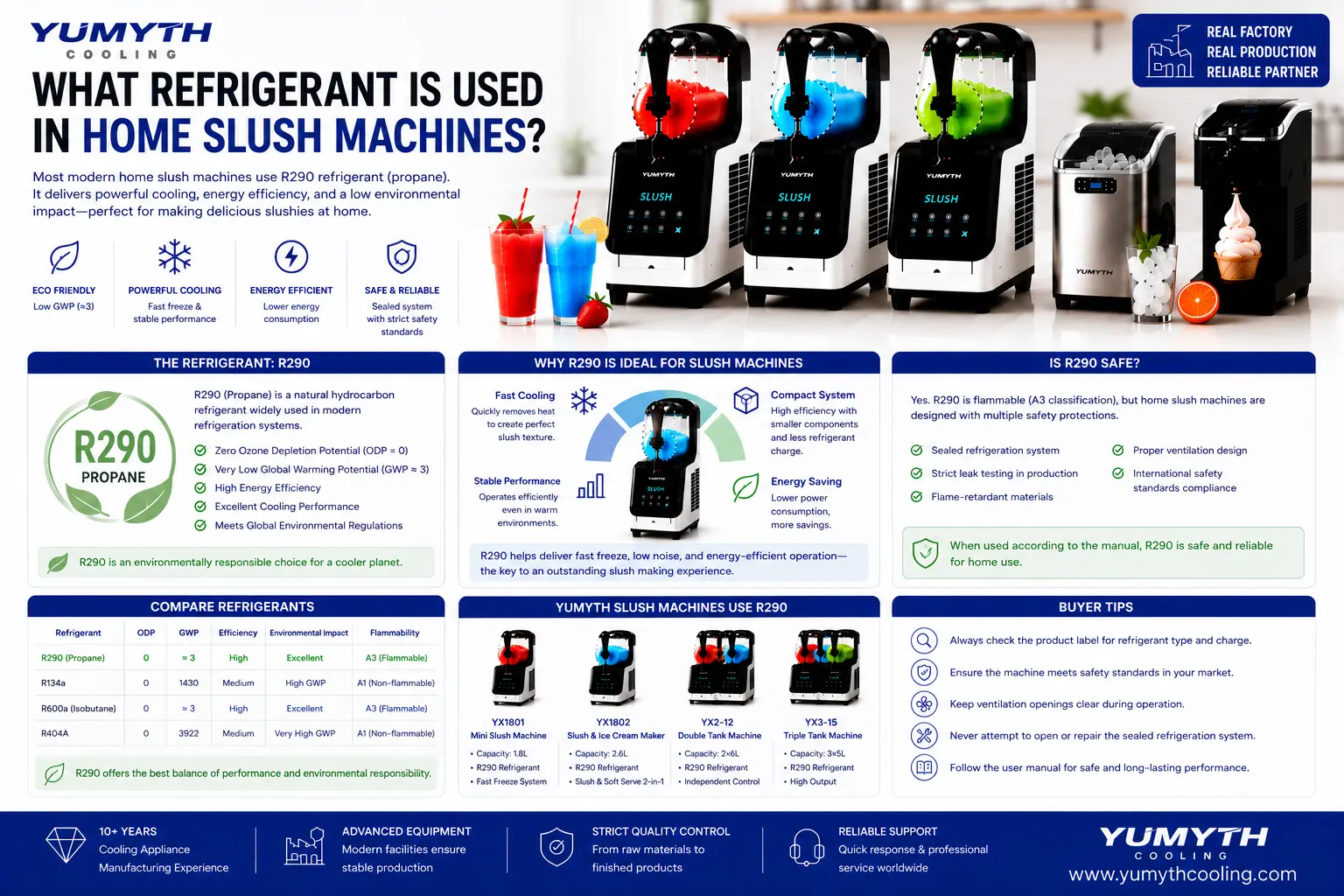
The majority of contemporary compressor-based home slush machines have R290 refrigerant ( propylene or propane). R290 is contained within a closed refrigeration system to extract heat from the beverage and allow the rotating auger to form a fine and smooth blend of liquid and fine ice crystals.
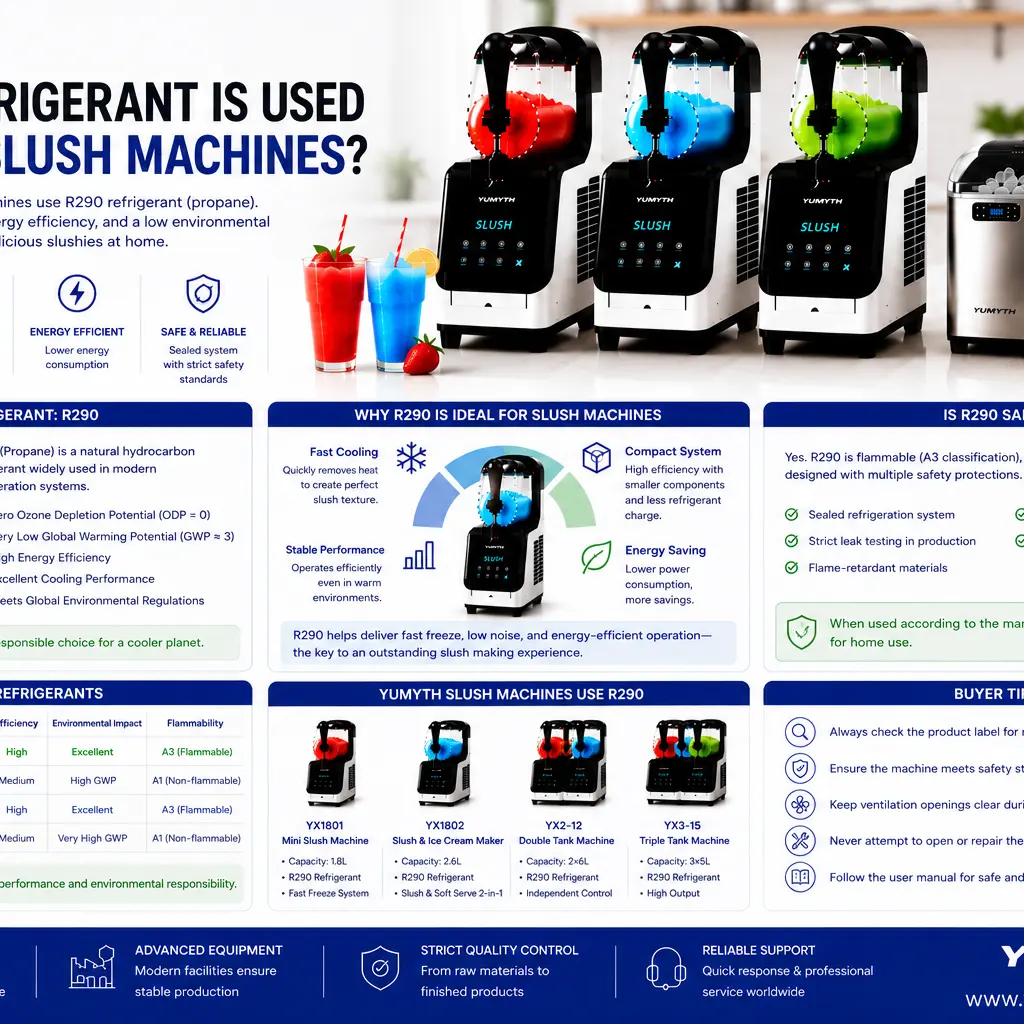
The YUMYTH YX1801 Mini Slush Machine and YX1802 Slush and Ice Cream Maker list R290 as the coolant used. These models employ small-sized compressor systems for direct freezing without the extra ice.
But, consumers or appliance purchasers should not rely on the fact that all slush machines use the same refrigerant. The refrigerant type used will be specified on the product rating label, technical specification, safety documentation, or instruction manual.
What Is R290 Refrigerant?
R290 is the refrigeration designation for propane. It is a hydrocarbon refrigerant that can absorb and release heat efficiently as it changes pressure and state inside a refrigeration circuit.
In a home slush machine, the refrigerant remains inside a closed system consisting of components such as:
- A compressor;
- A condenser;
- A capillary tube or expansion device;
- An evaporator;
- Refrigerant tubing.
The compressor increases the refrigerant's pressure and pushes it through the refrigerant system. The condenser gives up heat to the ambient air and the expansion device lowers the pressure of the refrigerant before it flows into the evaporator.
The refrigerant inside evaporator takes the heat from the beverage. The auger constantly scrapes and spreads the ice crystals as they form, ensuring the drink doesn't freeze solid.
Why Do Manufacturers Use R290?
The major benefit of R290 is that it has a very low environmental impact compared to many of the older hydrofluorocarbons (HFCs) refrigerants.
The materials of the United Nations Environment Programme (UNEP) indicate that R290 is a natural refrigerant with a global-warming potential around three and with zero ozone-depletion potential. The European Union has a current regulation on fluorinated greenhouse gasses, which gives R134a a GWP of 1430.
R290 is also a good thermodynamically for compact refrigeration systems. If the compressor, condenser, evaporator tube, capillary tube, airflow and refrigerant charge are properly matched, the compressor can deliver:
- Effective cooling capacity;
- Relatively low refrigerant charge;
- Good energy efficiency;
- Compact compressor-system design;
- Stable low-temperature performance.
The existing European F-gas Regulation is gradually phasing out the use of high-GWP F-gases. R290 is a hydrocarbon and not a fluorinated greenhouse gas, which is why manufacturers considering the development of long term appliance platforms are increasingly interested in this option.
Is R290 Common in Home Slush Machines?
R290 is the refrigerant used in growing numbers in home frozen drink applications with compressors. Several small refrigerant charges of R290 are listed in user documentation for other recent countertop frozen drink machines, and YUMYTH has currently installed R290 in their household models.
In addition, the broader refrigeration-component industry is also backing R290 in slushy machine applications. In the compressor families supported with R290 in Embraco's official compressor catalog, slushy machines can be found together with the other refrigerants supported in various compressor designs.
This is not to say that R290 is the only possible refrigerant. Different existing or older equipment might be using other refrigerants, such as R134a, R404A family, R513A or alternative refrigerants depending on capacity, product age, target market, and refrigeration architecture.
However, R290 is becoming a popular choice for existing domestic applications, where compact cooling performance, along with very low GWP, is required.
Is R290 Flammable?
Yes. R290 is an A3 refrigerant, which is less toxic but highly flammable, according to ASHRAE classification system. ASHRAE calls R290 propane and defines it as an A3 refrigerant.
It is not a statement of a slush machine that is unsafe to use when operated under normal conditions, but rather that it may not be suitable for the specific purpose for which it is intended. The refrigerant is contained in a small circuit provided in the factory and the product should be engineered to minimise the risk of leakage and ignition.
R290 is flammable, so the design of the appliance needs to be given special attention for:
- Maximum refrigerant charge;
- Refrigerant-tube protection;
- Brazing quality;
- Leak testing;
- Electrical component placement;
- Ventilation openings;
- Warning labels;
- Transportation protection;
- Disposal instructions.
IEC 60335-2-24:2025 covers household refrigerating appliances, household ice-cream appliances, and compression-type appliances using flammable refrigerants. It deals with the common dangers of this type of equipment.
The EPA also uses conditions of use for R290 and other flammable refrigerants in certain household refrigeration applications in the U.S. The regulatory and product-safety path for a slush machine depends on the classification of the appliance, which standard the certification body applies and the result.
How Should Consumers Use an R290 Slush Machine Safely?
Consumers do not normally need to interact with the refrigerant. They operate the beverage tank, auger, control panel, dispensing handle, and removable cleaning parts while the refrigeration circuit remains sealed.
Users should follow several basic precautions:
- Do not drill, puncture, bend, or damage the refrigeration tubing.
- Do not place the appliance near open flames or strong ignition sources.
- Keep the ventilation openings clear.
- Do not use sharp tools to remove ice from the evaporator.
- Do not attempt to accelerate defrosting with unapproved heating equipment.
- Allow the machine to stand upright after transport before switching it on.
- Arrange professional inspection if the refrigeration circuit appears damaged.
When it is suspected that the refrigerant circuit is damaged, the appliance should be unplugged, placed away from flames and switching sparks and transported only following the manufacturer's safety recommendations.
It is important to remember that no consumers should be refilling or replacing the R290 themselves. The tools, training, leak control and flammable-refrigerant safety information required for refrigeration-system work.
Why Is the Refrigerant Charge Important?
The mass of refrigerants should be correct in a refrigeration system.
If the amount of refrigerant is too low, it will decrease cooling capacity, extend freezing time and cause fluctuating evaporator temperatures. Excess refrigerant can create system pressures, performance issues in the compressors, and/or safety concerns.
The correct charge is determined in the engineering development and it is to be controlled during the factory production. The operation of sound or pressure should never be used to estimate the charge because calibrated equipment should be used.
The OEM customer should see the same type and charge of refrigerant in:
- The technical specification;
- Rating label;
- Safety test report;
- Refrigeration drawing;
- Production work instruction;
- Bill of materials;
- Final inspection records.
Changing the compressor, evaporator, condenser, capillary tube, or internal volume may require the charge to be re-optimized.
Can R290 Be Replaced With Another Refrigerant?
R290 should not be replaced casually with R134a, R600a, or another refrigerant.
Different refrigerants have different pressures, densities, compressor-oil requirements, flow characteristics, cooling capacities, and safety classifications. The compressor and capillary tube designed for one refrigerant may not operate correctly with another.
A refrigerant change can affect:
- Freeze time;
- Beverage texture;
- Compressor temperature;
- Energy consumption;
- Noise;
- Refrigerant pressure;
- Electrical safety;
- Product certification.
Changing the refrigerant in an OEM project is not a purchasing substitution, it is a full engineering change. It may need new compressors, system elements, risk assessments, prototypes, performance testing, labels, manuals, and evaluation of certification.
How Can Buyers Identify the Refrigerant?
The most reliable source is the machine’s rating label. The label should identify the refrigerant designation and may also show the refrigerant charge in grams or ounces.
Buyers can also check:
- The product specification sheet;
- Instruction manual;
- Safety certificate;
- Complete laboratory test report;
- Refrigeration-system drawing;
- Compressor model;
- Packaging and transport documents.
A website statement should be confirmed against the actual production version. One model may be available in several voltage or regional configurations, and the final compliance documents should match the exact machine being ordered.
What Should OEM Buyers Check?
Brands developing a private-label home slush machine should confirm:
- The exact refrigerant and charge;
- The compressor model and approved voltage;
- The applicable appliance-safety standard;
- Leak-testing and charging procedures;
- Production-area controls for flammable refrigerants;
- Warning labels and manual instructions;
- Transport and packaging requirements;
- Certification coverage for the final configuration;
- Traceability of compressors and refrigerant batches;
- Disposal and after-sales procedures.
The buyer should also inspect the factory’s refrigerant storage, ventilation, leak-detection equipment, charging stations, calibration records, operator training, and emergency procedures.
Conclusion
R290 propane is the refrigerant used most for the existing compressor based home slush machine platforms. YUMYTH's YX1801 and YX1802 feature R290 as their coolant, and provide both compact compressor cooling and direct no-ice drink freezing.
R290 has an extremely low global-warming potential, zero ozone-depletion potential and effective refrigeration performance. The primary engineering consideration is its susceptibility to fire; the key points are to keep the amount of refrigerant controlled, ensure safe tubing and electrical construction, perform leak tests, ensure adequate ventilation, label all the containers and evaluate all the materials involved according to standards.
The refrigeration circuit must never be opened for any reason, nor can it be repaired by a consumer. It is essential for OEM buyers to confirm the actual refrigerant used, charge, compressor, safety standard, test/papers, and manufacturing controls for the actual production model.
An R290 refrigeration system is an efficient and environmentally-conscious platform for contemporary household slush machines, if engineered and manufactured properly.
Related Articles
How We Test Every Ice Maker Before Packaging
2026-09-15
BY YUMYTH
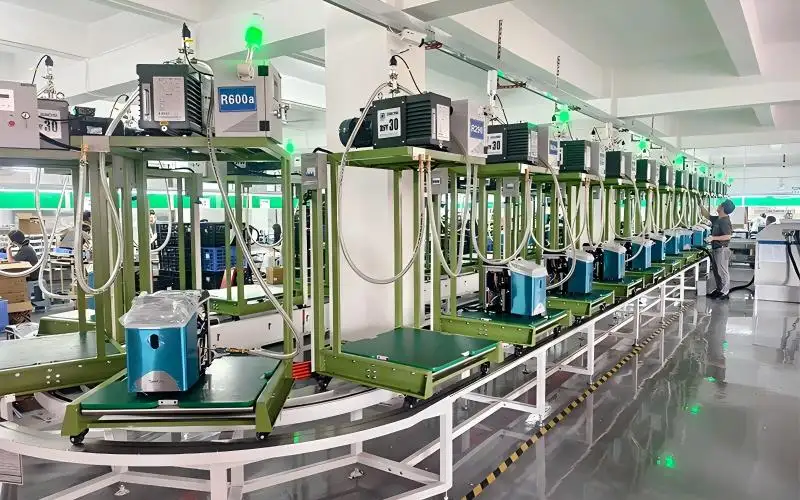
A step-by-step look at refrigerant handling, cooling verification, leak detection, corrective action and electrical safety testing For an ice maker, reliable performance is determined long before the carton is sealed. ...
Guide for Brands Looking for a Reliable Vacuum Sealer OEM Supplier
2026-09-14
BY YUMYTH
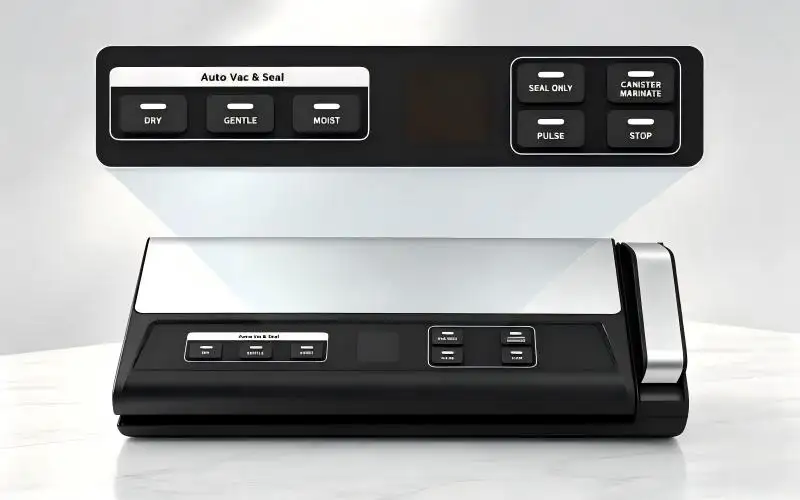
When you are sourcing kitchen appliances for your retail brand, finding a dependable vacuum sealer OEM supplier is rarely just about getting the lowest unit price. It is about protecting ...

Why Ice Shape Matters: Understanding 10mm × 15mm Cylindrical Nugget Ice
2026-09-14
BY YUMYTH
More Than Ice Production — The Ice Itself Shapes the Consumer Experience When sourcing a nugget ice maker, buyers often focus first on production capacity, water tank size, ice basket ...

Ice Maker Sourcing Guide: How to Find the Right Factory
2026-09-10
BY YUMYTH
Sourcing an ice maker looks straightforward on paper. Find a supplier, agree on a price, place an order. But anyone who has actually done this knows the process is rarely ...