
Home Vacuum Sealer: Features for Everyday Food Storage
Share:
-

-

-

-


Copied

Share:
-
-
-
-
Copied
A home vacuum sealer should do more than remove air from a bag. For everyday food storage, the most useful machine combines consistent sealing, suitable controls for different food conditions, compatible bags, manageable cleanup, and a size that fits the kitchen.
Maximum vacuum pressure matters, but it does not determine performance on its own. Bag design, seal quality, moisture control, gasket condition, and repeated-use capacity all affect the result. The right choice depends on what you store, how often you seal food, and how much control you need.
What Makes a Vacuum Sealer Suitable for Home Use?
A household machine must balance performance with convenience. It should be easy to place on a counter, simple to operate, and practical to clean after handling meat, leftovers, or moist ingredients.
Three main formats are relevant to home buyers.
| Machine format | Best suited to | Main limitation |
|---|---|---|
| External vacuum sealer | Routine freezer storage, dry foods, meat portions, meal preparation, and sous vide bags | Free-flowing liquids can move toward the pump |
| Chamber vacuum sealer | Frequent liquid packaging, marinades, and larger sealing workloads | Usually requires more space and a higher investment |
| Handheld vacuum sealer | Light use, reusable valve bags, and compact storage | Less suitable for making and sealing standard bags from rolls |
An external tabletop vacuum sealer is the most familiar household format. The open edge of a compatible bag is placed inside the machine, air is extracted, and a heat-seal bar closes the package.
A chamber model operates differently because the complete package sits inside a controlled chamber. That format can be more practical for regular liquid packaging, but it may be unnecessary for a household that mainly seals meat, dry foods, vegetables, or occasional leftovers.
Handheld systems take up less space and may work well with compatible containers or reusable valve bags. They are less suitable when the user needs custom-length bags, wider packages, or repeated freezer-meal preparation.
Essential Features That Affect Everyday Sealing
The most useful features should solve a real storage problem. A longer mode list does not automatically make a machine more suitable for home use.
| Feature | Priority for most households | Why it matters |
| Consistent heat sealing | Essential | Keeps the package closed after air extraction |
| Dry and moist controls | Essential | Adjusts operation for different food conditions |
| Pulse or manual control | Essential for delicate or moist foods | Gives the user more control over air removal |
| Compatible bags and rolls | Essential | Affects air extraction, seal formation, and ongoing cost |
| Removable drip tray | Highly useful | Simplifies cleanup when moisture reaches the machine |
| Built-in cutter | Useful | Makes custom-length bags easier to prepare |
| Roll storage | Useful for frequent sealing | Keeps bag material ready inside the machine |
| Double seal | Useful for demanding packages | Adds a second closure line |
| Accessory port | Optional | Supports compatible canisters or containers |
| Extra automatic programs | Optional | Valuable only when they match actual household use |
Vacuum Strength and Seal Quality Must Be Evaluated Together
Vacuum pressure describes how much pressure the pump can remove from the package environment. It can help buyers compare machines, but it is only one part of performance.
A strong pump cannot compensate for:
-
An incompatible or poorly textured bag
-
A dirty or damaged gasket
-
Moisture across the bag opening
-
Wrinkles under the heat-seal bar
-
Insufficient sealing control
-
A puncture caused by a sharp food edge
The heat-seal bar creates the final closure. If that seal is incomplete, the bag may gradually lose vacuum even when the pump initially removed air effectively.
Seal width and consistency are therefore more meaningful when considered with pressure. A double seal can add a second closure line, which may be useful for moist foods or packages that will receive more handling. It is not necessary for every dry-food package, and it should not be treated as a substitute for a clean, flat bag opening.
Readers who need a deeper explanation of this feature can review Yumyth’s dedicated page on the double seal bar vacuum sealer.
Dry, Moist, and Pulse Controls Match Different Food Conditions
A useful control panel should help the user manage food condition rather than add unnecessary complexity.
Dry mode is intended for foods with little or no surface moisture, such as dry pantry ingredients, firm cheese, or fully dried snacks.
Moist mode changes the sealing cycle for foods that contain more surface moisture. It may be useful for fresh meat or damp ingredients, but it does not mean an external machine can freely draw soups, sauces, or other liquids through the bag.
Pulse or manual control lets the user stop or limit air extraction. This is especially useful for bread, berries, soft baked goods, and other foods that may be crushed during a fully automatic cycle. It can also help slow liquid movement toward the machine.
A modern vacuum sealer may offer several automatic functions, but the practical question is whether those controls match the foods the household actually stores.
Bag Width, Roll Storage, and Cutter Design Affect Daily Convenience
Maximum bag width determines the largest open bag edge the machine can accept. A narrow sealing channel may be sufficient for individual portions, while wider bags are more practical for larger cuts of meat, family-size portions, or several items sealed together.
Bag rolls allow the user to create custom lengths. This reduces wasted material when package sizes vary. A built-in cutter helps produce a straighter edge, while integrated roll storage keeps the material ready for frequent use.
External vacuum sealers commonly rely on textured or embossed bags. Channels inside the bag allow air to move toward the pump before the seal is formed. A smooth bag designed for a chamber machine may not extract air correctly in an external model.
Long-term bag availability matters as much as the included starter supply. Before buying, check:
-
Supported bag width
-
Whether rolls and pre-cut bags are accepted
-
Required bag texture
-
Heat-sealing compatibility
-
Availability in the destination market
-
Food-contact documentation where needed
Cleanup, Gaskets, and Batch Use Affect Long-Term Practicality
Moisture, oil, crumbs, and food particles can interfere with both air extraction and sealing. A removable drip tray makes cleanup easier when liquid reaches the machine.
The gasket also plays an important role. It helps create the closed air path needed for effective vacuum extraction. A dirty, compressed, misaligned, or damaged gasket can reduce vacuum consistency even when the pump is functioning.
Frequent users should also consider duty cycle or refractory time. These terms refer to how quickly the machine can repeat sealing cycles before it needs to cool or recover. A machine that works well for two or three bags may feel slow during a large freezer-preparation session if it requires long pauses.
Useful ownership questions include:
-
Can the drip tray be removed?
-
Are the sealing area and gaskets easy to clean?
-
Does the machine indicate overheating?
-
How many bags are normally sealed in one session?
-
Are replacement gaskets or trays available?
-
Does the manufacturer publish a repeated-use limitation?
Match Home Vacuum Sealer Features to the Way You Store Food
Household needs differ. The same feature can be essential for one user and unnecessary for another.
| Storage use | Features to prioritize | Main trade-off |
| Occasional leftovers | Automatic operation, compact size, easy cleaning | Roll storage and advanced controls may be unnecessary |
| Bulk meat and freezer storage | Wide bag support, consistent seal, roll cutter, repeated-use capacity | Larger machines need more counter space |
| Weekly meal preparation | Fast bag preparation, roll storage, multiple food modes, reliable batch sealing | More frequent use increases consumable demand |
| Delicate foods | Pulse or manual vacuum control | Full automatic extraction may crush the food |
| Moist foods and marinades | Moist setting, pulse control, drip tray, secure seal | External machines still have limits with free liquid |
| Dry pantry foods | Dry mode, compatible bags, custom roll length | Strong liquid-handling features may add little value |
| Occasional sous vide preparation | Suitable heat-sealed bags, consistent closure, appropriate package size | The sealer does not control cooking temperature |
| Large family portions | Wider bag capacity, roll storage, cutter, batch capability | Wider machines may be harder to store |
Meal-prep users should focus on workflow rather than mode count. Bag preparation speed, repeat sealing, portion size, and freezer organization usually matter more than rarely used programs.
Limitations and Common Causes of Poor Seals
External home sealers are practical, but they do not handle every package equally well.
Free-flowing liquid can travel toward the vacuum channel before the machine reaches the sealing stage. Excess moisture may also prevent the bag opening from heating evenly. A specialized vacuum sealer for liquids may offer more appropriate guidance or equipment options for liquid-heavy use.
Common causes of poor results include:
| Problem | Likely cause | Practical response |
| Air remains inside the bag | Incompatible bag, blocked channels, or incorrect placement | Confirm bag type and reposition the open edge |
| Bag loses vacuum later | Incomplete seal, puncture, food debris, or wrinkles | Inspect the seal and package surface |
| Liquid reaches the machine | Excess free liquid or extraction that is too aggressive | Use pulse control or choose a more suitable format |
| Soft food becomes crushed | Automatic cycle removes too much air | Stop extraction manually or use pulse mode |
| Seal line is uneven | Moisture, oil, folds, or debris across the opening | Clean, flatten, and dry the sealing area |
| Vacuum performance becomes inconsistent | Dirty, compressed, or damaged gasket | Clean and inspect the gasket |
| Machine slows during a large session | Heat buildup or required recovery time | Allow the machine to cool according to its instructions |
Sharp bones, shells, or hard food edges can also puncture a package. Protective wrapping or a different package arrangement may reduce this risk, but the final package should still be inspected before storage.
When an External Home Sealer Is Not the Best Format
A different format may be more suitable when the household regularly needs to package:
-
Soups, sauces, or free-flowing liquids
-
Large quantities in one session
-
Packages wider than the machine supports
-
Products requiring chamber-style bags
-
Food in specialized containers
-
Workloads that exceed the machine’s repeated-use capacity
Yumyth lists several machine formats in its wider vacuum sealer range, allowing buyers to compare home-use, compact, automatic, and chamber options.
Vacuum Sealing Does Not Replace Refrigeration or Freezing
Vacuum packaging removes much of the air surrounding food, but it does not sterilize the product. It also does not automatically make perishable food safe at room temperature.
Reduced-oxygen packaging may slow some quality changes, yet the same low-oxygen environment can create risks if certain foods are stored at unsafe temperatures. Guidance from Utah State University Extension and Oregon State University Extension stresses that vacuum packaging must be combined with appropriate refrigeration, freezing, sanitation, and food-handling practices.
For household refrigeration, the USDA Food Safety and Inspection Service recommends keeping the refrigerator at 40°F, or approximately 4.4°C, or below.
A vacuum-sealed package should therefore be treated as packaging, not as a pathogen-control process. Perishable meat, seafood, cooked food, and other temperature-sensitive items still require proper cold storage.
Home Vacuum Sealer Buying Checklist
Before selecting a machine, define the storage routine first.
Food and package requirements
-
Which foods will be sealed most often?
-
Are they dry, moist, delicate, or liquid-rich?
-
What is the largest package width needed?
-
Are custom-length bags necessary?
-
Will the machine be used for sous vide bags?
-
How many packages are prepared in one session?
Machine requirements
-
Is pulse or manual vacuum control needed?
-
Are dry and moist settings available?
-
Is a double seal useful for the expected packages?
-
Can the drip tray be removed?
-
Are the gaskets accessible for cleaning?
-
Does the machine provide overheating protection?
-
Will it fit the available counter and storage space?
Consumable and ownership requirements
-
Are compatible textured bags available locally?
-
Can the machine use both rolls and pre-cut bags?
-
What bag width does it support?
-
Are replacement gaskets, trays, or other wear parts available?
-
What accessories are included?
-
What support or warranty information can the supplier provide?
Worldwide Buyers Should Confirm Electrical and Food-Contact Requirements
International buyers should confirm the exact electrical configuration before ordering. Voltage, frequency, and plug type must match the destination market. A plug adapter changes the connector shape; it does not necessarily correct a voltage mismatch.
Buyers should verify:
-
Supplied voltage range
-
Power frequency
-
Plug configuration
-
Product labeling and manual language
-
Food-contact documentation for bags and accessories
-
Included accessories and replacement-part support
For the European market, the European Commission’s food-contact materials guidance explains that materials intended to contact food must not transfer substances at harmful levels or unacceptably change the food. Compliance should be supported by documentation relevant to the actual bag material and destination market.
How Yumyth’s VS8001G Fits Typical Household Requirements
Yumyth positions the VS8001G as a vacuum sealer machine for home use. Its published features address several of the selection factors discussed above.
| Published VS8001G feature | Household relevance |
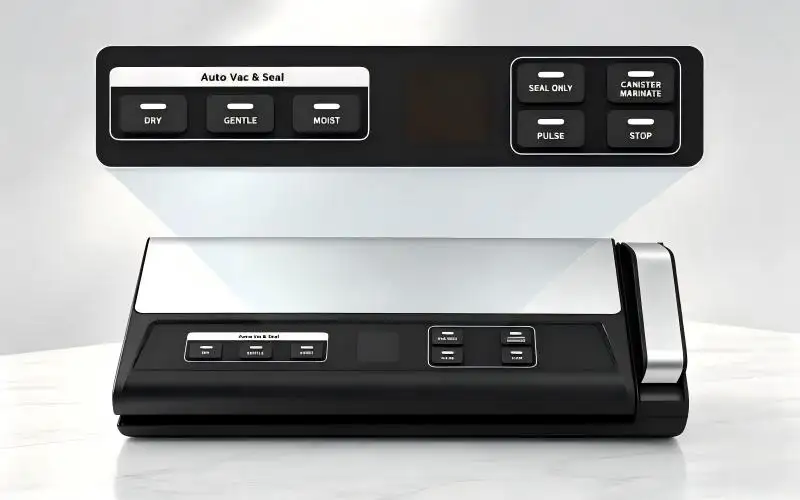
| Dry, moist, and moist-plus functions | Supports different surface-moisture conditions |
| Pulse function | Gives the user more control over delicate or moist foods |
| Inflate, canister/accessory, and marinate functions | Extends use beyond standard automatic bag sealing |
| Easy-lock handle | Supports routine opening and closing |
| Built-in roll storage and cutter | Simplifies custom bag preparation |
| Removable drip tray | Supports easier moisture cleanup |
| Silicone gaskets | Form part of the vacuum-extraction path |
| Maximum bag width of 30 cm | Supports a range of household package sizes |
| Stored roll size up to 28 cm × 600 cm | Allows custom-length bag preparation |
| Optional single or double heat seal | Provides different closure configurations |
| Published maximum vacuum level of −95 kPa | Provides a manufacturer-stated pressure specification |
| 100–120 V or 220–240 V, 50–60 Hz options | Supports different electrical markets when correctly configured |
| Rated power of 125 W | Provides an electrical specification for configuration checks |
| NTC overheating protection, thermal fuse, and lid-open heating interruption | Adds published thermal and operating protection features |
These specifications suggest that the model is designed for varied household food conditions and routine bag preparation. The pressure figure should still be evaluated alongside seal consistency, bag compatibility, moisture control, and actual repeated-use requirements.
Buyers should confirm the supplied voltage, plug, accessories, bag availability, documentation, and support before ordering. The complete manufacturer-published details are available on the VS8001G home vacuum sealer page.
When to Consider Another Yumyth Vacuum Sealer Format
Another format may be more appropriate when the application involves frequent liquids, unusually wide packages, heavier repeated use, or a need for chamber operation.
The correct choice should follow the package and workload requirements rather than the number of functions printed on the control panel.
Choose the Features Before Choosing the Machine
Start with five questions: what foods will be stored, how moist they are, how large the packages will be, how many bags will be sealed at once, and where the machine will be kept.
From there, compare seal consistency, control modes, bag supply, cleaning access, repeated-use capacity, and electrical configuration. Pressure should support that evaluation, not replace it.
Household buyers can review the VS8001G product configuration against these requirements. Distributors and private-label buyers can contact Yumyth to discuss product options, destination-market configuration, documentation, packaging, or OEM/ODM requirements.
Related Articles
How We Test Every Ice Maker Before Packaging
2026-09-15
BY YUMYTH
A step-by-step look at refrigerant handling, cooling verification, leak detection, corrective action and electrical safety testing For an ice maker, reliable performance is determined long before the carton is sealed. ...
Guide for Brands Looking for a Reliable Vacuum Sealer OEM Supplier
2026-09-14
BY YUMYTH
When you are sourcing kitchen appliances for your retail brand, finding a dependable vacuum sealer OEM supplier is rarely just about getting the lowest unit price. It is about protecting ...

Why Ice Shape Matters: Understanding 10mm × 15mm Cylindrical Nugget Ice
2026-09-14
BY YUMYTH
More Than Ice Production — The Ice Itself Shapes the Consumer Experience When sourcing a nugget ice maker, buyers often focus first on production capacity, water tank size, ice basket ...

Ice Maker Sourcing Guide: How to Find the Right Factory
2026-09-10
BY YUMYTH
Sourcing an ice maker looks straightforward on paper. Find a supplier, agree on a price, place an order. But anyone who has actually done this knows the process is rarely ...