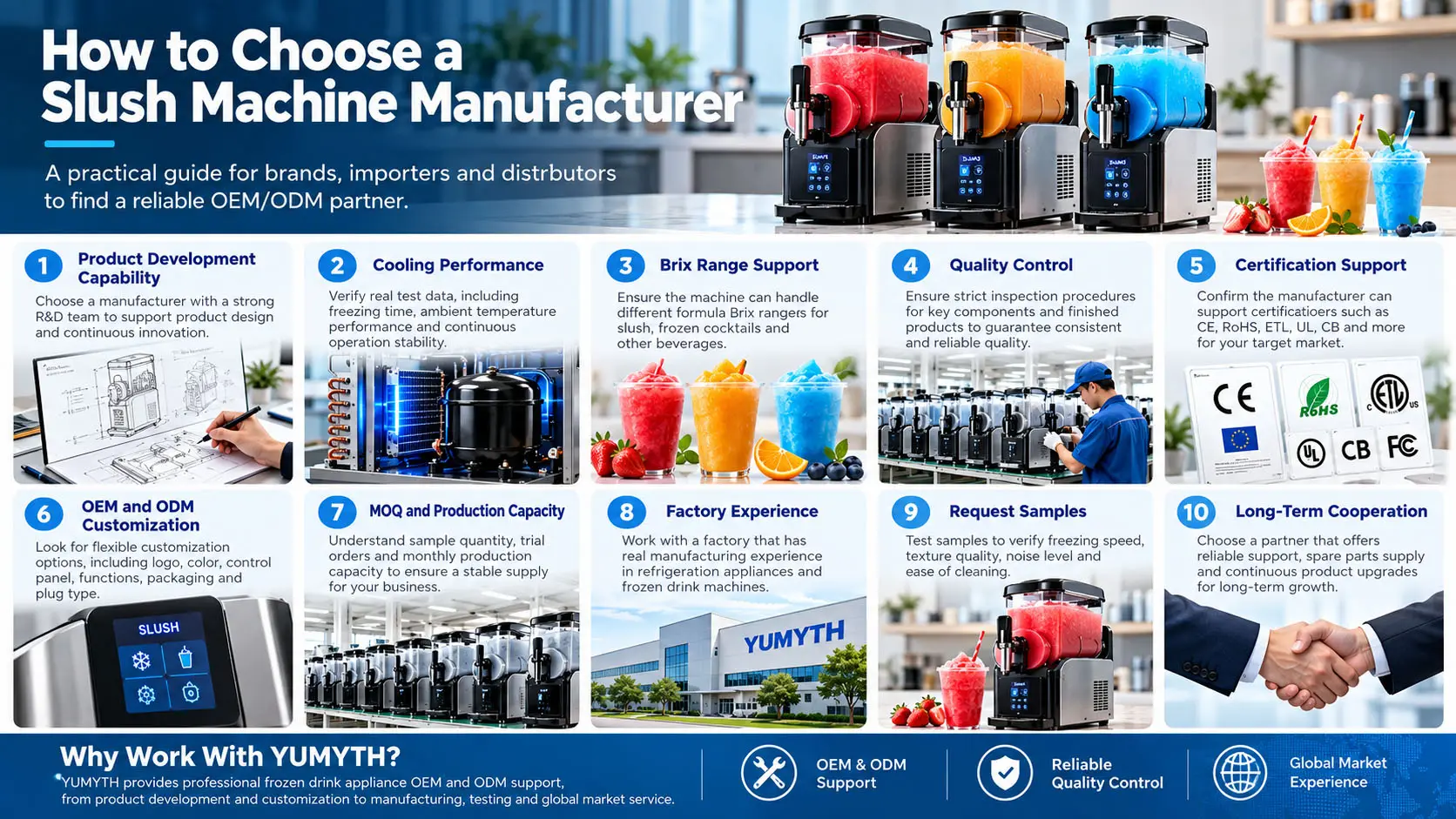
Choosing a slush machine manufacturer is a long-term decision for beverage brands, distributors, convenience stores, cafés, and foodservice operators. The machine affects product quality, customer experience, energy bills, and day-to-day operations.
This guide explains how to select a manufacturer that fits your technical, commercial, and brand needs. The same principles apply whether you buy for a global brand or a regional distributor.
01
PART
Why the manufacturer matters
BUSINESS IMPACT
Commercial frozen drink machines work hard: long operating hours, high ambient temperatures, strict hygiene requirements, and pressure to keep the drink consistent. The manufacturer has to support that reality for the entire life of the machine.
A good manufacturer helps you keep product quality stable and protect your brand; reduce breakdowns, service calls, and spare part costs; cut energy use and improve margins; scale with reliable supply and technical support; and meet local standards and regulatory rules.
The wrong partner can turn peak demand into lost sales.
Pick the wrong partner and you risk texture problems, frequent failures, high repair bills, and lost sales at peak times.
02
PART
Understand your own needs first
START WITH FIT
Before comparing suppliers, define what you actually need. This makes it easier to separate solid options from generic marketing.
Key questions
1
Operating environment: indoor or outdoor, typical and peak ambient temperatures, and daily run time.
2
Application: convenience stores and petrol stations; QSR chains and cafés; cinemas, stadiums, leisure venues; or brand activations and seasonal setups.
3
Capacity and configuration: single, double, or triple tanks; tank volume such as 12 L or 20 L per tank; peak demand; and refill frequency.
4
Energy and cost: power supply limits, target energy consumption, and the balance between purchase price and total cost of ownership.
5
Brand and design: custom branding, color, exterior design, and fit with your existing store image and merchandising.
Once this is clear, you can judge manufacturers against your actual profile instead of broad claims.
03
PART
Core criteria for evaluating manufacturers
EVALUATION FRAMEWORK
Focus on engineering strength, reliability, cooling performance, energy efficiency, customization, support, and compliance.
1. Engineering and technical expertise
Good slush machines come from good refrigeration engineering. Look for frozen beverage experience, in-house engineering and R&D, and clear competence in compressors, evaporators, condensers, and control systems.
Ask how the cooling system affects freeze-down time, texture, and energy use. Strong engineering support often includes advice on recipes, settings, and store conditions, not just the hardware.
2. Reliability and build quality
Downtime in hot weather or busy periods is extremely expensive. Check commercial-grade stainless steel, robust casing, solid frames, and the quality and source of compressors, motors, gearmotors, and control boards.
Machines should hold a consistent texture and temperature during long shifts and repeated serving. Ask about factory testing, inspection steps, defect rates, and test documents. The way a supplier answers detailed technical questions often reveals more than the brochure.
3. Cooling performance and product quality
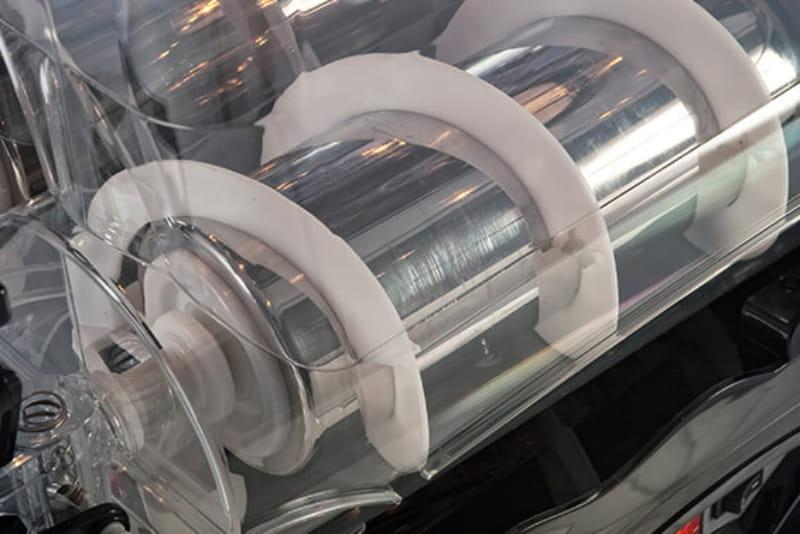
Consider freeze-down time, temperature control, agitation and mixing, and recipe flexibility. Overfreezing creates solid ice; undercooling produces a thin, watery drink. The stirrer design affects how evenly sweetness and texture remain mixed.
Ask whether the machine can handle different sugar levels, syrups, concentrates, and pre-mixes. Where possible, test machines with your own products in a trial location.
04
PART
Energy efficiency and environmental considerations
COST OF OWNERSHIP
For multi-site operators or long daily shifts, energy use becomes a major operating cost.
Check refrigeration design, control strategy, insulation, tank design, and realistic consumption data. Ask for energy numbers based on typical operating conditions rather than laboratory values.
Also review refrigerant type, electrical safety, environmental standards, and the total operating cost. Combine energy use, expected lifespan, and maintenance into a cost-per-serving calculation. The cheapest purchase price is rarely the cheapest long term.
05
PART
Customization, branding, and OEM/ODM options
BRAND FIT
For brands, distributors, and chains, the machine is part of the customer-facing image.
Ask about OEM/ODM experience, colored panels, branded graphics, lighting, artwork areas, tank counts, height, footprint, and marketing features such as improved product visibility.
Treat customization as a core capability, not a one-off favor.
06
PART
Service, warranty, and after-sales support
FIELD SUPPORT
Even the most reliable machine will need maintenance. Review manuals, installation instructions, cleaning guides, operator and technician training, support channels, local service partners, spare-part stocking, lead times, and warranty coverage and exclusions.
Ask for typical support response times and examples of how the manufacturer handles field issues.
07
PART
Compliance, certification, and safety
RISK CONTROL
Food and electrical safety requirements differ by region, and non-compliance can block your project. Check electrical and safety approvals such as CE, UL, or local marks; approved food-contact materials for tanks, taps, seals, and product-contact parts; and guards, interlocks, and stable construction.
A manufacturer that understands your target-market standards reduces risk and delays.
08
PART
How to compare and shortlist manufacturers
SHORTLISTING
Once you know what you need, set up a simple comparison framework.
1
Collect specifications and product ranges: model types, tank sizes, dimensions, energy data, and refrigeration concepts.
2
Check customer fit through references or case studies with customers similar to you.
3
Review customization options, examples, and lead times.
4
Assess how clearly and promptly each supplier answers technical and commercial questions.
5
Run pilots in real locations with your recipes and staff.
6
Calculate total cost of ownership, including machine cost, shipping, energy, maintenance, and likely downtime.
This helps you move from gut feeling to evidence-based selection.
09
PART
Why specialized cooling manufacturers matter
SPECIALIZATION
Some companies sell slush machines as part of a large catalogue. Others specialise in beverage cooling. Specialised cooling manufacturers often offer better understanding of frozen beverage behaviour, more stable performance during long operating hours, closer alignment with beverage brand quality standards, and focused R&D on cooling, energy use, and drink experience.
If frozen beverages are central to your offer, a cooling specialist is usually the safer long-term choice.
10
PART
Practical checklist for supplier conversations
QUESTIONS TO ASK
Use these questions when talking to potential suppliers.
Product and performance: Which models and tank configurations are available? What is the typical freeze-down time under standard conditions? How stable is texture during continuous serving?
Technical and cooling system: How is the refrigeration system designed? Which compressors and key components do you use? What steps reduce energy consumption?
Customization and branding: Do you offer OEM/ODM services? Can you customize exterior design and branding? What options exist for colors, panels, and graphics?
Quality and reliability: What quality-control processes do you follow? What are typical defect or return rates? What is the usual service life?
Service and support: What does the warranty cover? How do you handle technical support and parts supply? Do you provide training or documentation?
Compliance and safety: Which standards and regulations do your machines meet? What materials are used in product-contact parts? What safety features are built in?
Clear, specific answers are a good sign.
11
PART
Match manufacturer strengths to your business
CUSTOMER FIT
Beverage brands and concentrate suppliers
Need repeatable quality across many locations, often require OEM machines and custom branding, and benefit from manufacturers experienced in long-run beverage cooling and joint development.
Distributors and importers
Need reliable, ready-to-sell machines, continuous supply, responsive support, flexible branding, and a range of models.
Retail chains and convenience stores
Focus on uptime, ease of use, energy cost, long operating hours, and proven performance in similar retail setups.
Choosing a manufacturer whose customer base looks like you reduces the risk of surprises later.
12
PART
Visual and store integration
IN-STORE EXPERIENCE
Slush machines are visible and can either add to or detract from your store image. Consider design and finish, product visibility, clear tanks, lighting, simple controls, accessible parts, ease of use, cleaning, training, and hygienic operation.
The best machine balances technical performance with visual impact.
13
PART
Long-term partnership and strategic value
PARTNERSHIP
The ideal manufacturer is more than a vendor. Over time, a good partner can help fine-tune machine settings and recipes, co-develop models for specific markets, resolve issues faster through established contacts, and align equipment development with your brand roadmap.
Evaluate how suppliers approach collaboration as well as the machines they sell.
///
LAST
Conclusion
SUMMARY
Choosing a slush machine manufacturer is ultimately about securing a reliable, efficient, and brand-fit partner for your frozen beverage business.
To decide with confidence: clarify your operating, capacity, and branding requirements; compare engineering capability, reliability, cooling performance, energy use, customization, service, and compliance; use structured comparisons and pilot tests; and give extra weight to manufacturers specialising in beverage cooling and long-term relationships.
A careful selection process will help you secure stable product quality, a consistent brand image, and a sustainable business case for your frozen drinks program.
FAQs
What is the most important factor when choosing a slush machine manufacturer?
Reliability under real operating conditions. Without consistent performance, advantages in price or design quickly disappear.
How can I compare energy efficiency between manufacturers?
Ask for energy consumption measured under comparable conditions and details on refrigeration design, insulation, and control strategy. Compare numbers side by side and factor them into total cost of ownership.
Do I need a manufacturer with OEM/ODM services?
If you are a brand owner, distributor, or chain that needs custom branding or specifications, yes. OEM/ODM capability is closely tied to how well the machine supports your marketing and store image.
How many tanks should my slush machine have?
Base the decision on your flavor range, daily traffic, and counter space. Single-tank units suit smaller locations, while two or three tanks suit broader menus and higher peaks.
Should I test machines before large orders?
Yes. Pilot units running in real stores with your staff and recipes are one of the most reliable ways to validate performance before large-scale deployment.