
Ice Cream vs Slush Machines
Share:
-

-

-

-


Copied

Share:
-
-
-
-
Copied
Cooling and continuous mixing are the two methods by which ice cream and slush machines produce a frozen drink; however, there are many differences in the texture, recipes, and equipment used to serve these frozen treats.
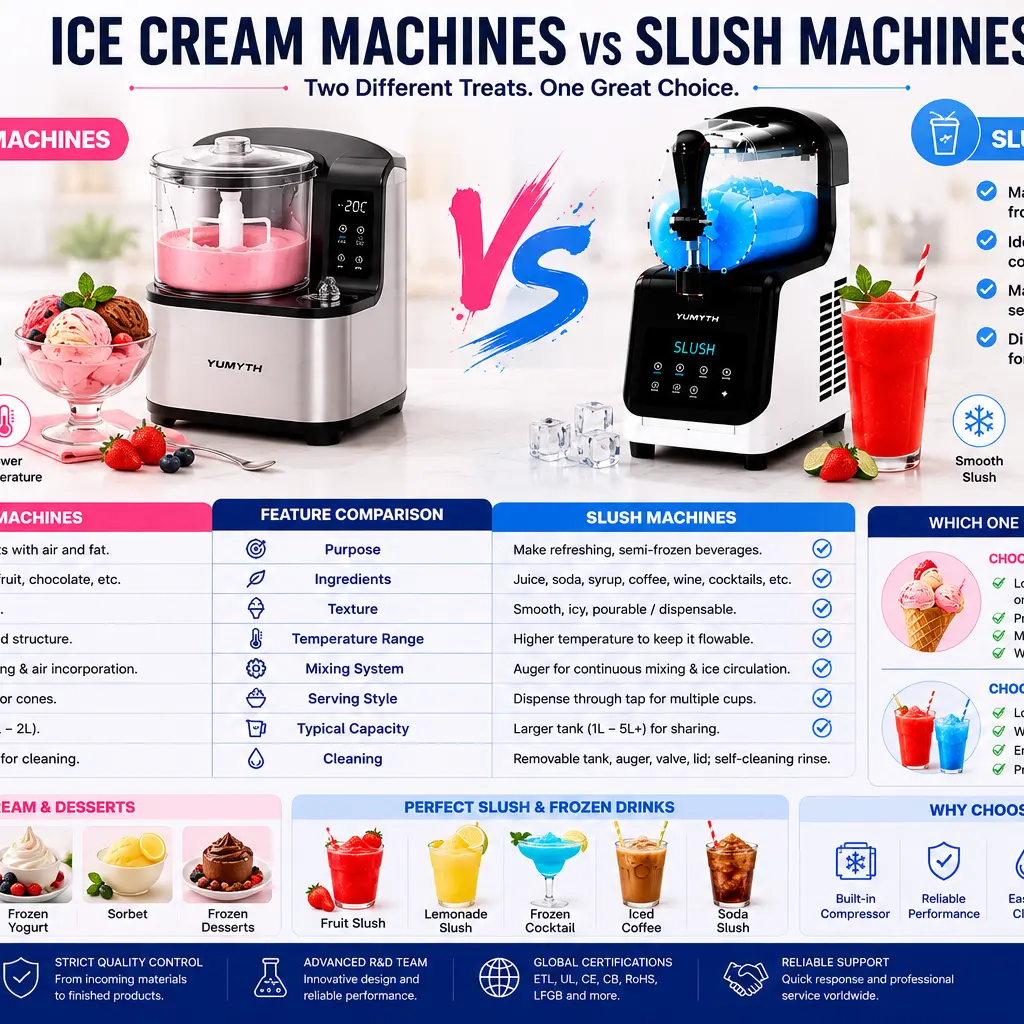
In an ice cream machine, there is a creamy, dense ice cream with lots of air, fat, sugar, and very small ice crystals. A slush machine is used to mix liquid and frozen ice crystals into a slush that is either pourable or dispensible.
While the modern countertop appliances may be able to make both, there are technical differences between the two that should be understood before purchasing a machine. The refrigeration system, mixing structure, temperature range, ingredients, cleaning requirements, and control programs should all be compatible with the product that is being produced.
What’s an Ice Cream Machine Anyway?
An ice cream machine is a machine that freezes the mixture into ice cream while it is churning continuously.
Typical ingredients:
- * Milk or cream;
- * Sugar;
- * Flavoring;
- * Stabilizers;
- * Fruit or chocolate;
- Ingredients for eggs in certain recipes.
When the machine is running, heat is removed as the mixture is pushed against the cold surface by a paddle or dasher. The continuous churning prevents the formation of large ice crystals, and also adds air to the dessert.
The final texture of the products is determined by the ingredient composition, freezing temperatures, churning speed, incorporation of air, and processing time.
Other machines also produce soft ice cream which can be eaten straight out of the machine. Others make a partially frozen dessert which needs to be finished in a domestic freezer after production.
What is a Slush Machine?
The slush machine is used primarily to make liquid beverages.
Typical recipes include:
- * Fruit juice;
- * Lemonade;
- * Soda;
- * Flavored syrup drinks;
- * Frozen coffee;
- * Mocktails;
- * Wine slush;
- * Frozen cocktails.
A slush machine uses a compressor to chill the drink directly in the slush machine's chilled beverage tank. A rotating auger removes the ice that is formed on the evaporator and moves it around the vessel.
Don't freeze all the liquid. It keeps a balance of small ice crystals and liquids, which produce a smooth texture that can flow through a dispensing valve.
The slush machine used with a compressor generally does not need extra ice, as the machine does not need to be cooled by the ice.A slush machine with a compressor typically does not require additional ice, as the ice does not have to cool the machine.
By the time you are finished the texture will be totally different.
The difference between the two types of appliances is most obvious in terms of texture.
Ice cream should be:
- * Creamy;
- * Compact (not porous);
- * Spoonable;
- Not likely to collapse or cave in under pressure;
- Smooth - no noticeable ice crystals.
Slush should be:
- * Pourable or dispensable;
- * Wet and refreshing;
- Composed of tiny ice crystals that can be seen;
- * May be moved by the auger at all times;
- Not too stiff to come out of the outlet.
A too early stop in an ice cream machine can result in the production of liquid ice cream. If the slush machine freezes the mixture too quickly, it can cause it to become a solid block and clog the auger.
The control system needs to therefore achieve a different balance between frozen and unfrozen material.
No two ingredient formulations are the same.
Typical ice cream recipes include stabilizing ingredients, dairy fats, proteins and sugar. The combination of these ingredients affects creaminess, freezing, air incorporation, and melting.
Most slush recipes are water-based and rely on the sugar that is dissolved in the water to manage ice formation.
If the slush drink is too low in sugar, the water can freeze too solid around the evaporator. If the mixture is too sweet or alcoholic, it may not freeze properly, or the ice may not grow.
Do not necessarily use an ordinary slush machine for ice cream mixtures. Thick dairy recipes may add to motor load, get stuck around seals, become stuck in the dispensing valve and be outside of the range of viscosity that the appliance was designed for.
For example, an ice cream machine may not be suitable for maintaining a slush that is drinkable due to its paddle, bowl, temperature range and serving format optimized for dense ice creams.
The functions of mixing systems vary.
The purpose of an ice cream dasher is to remove ice from the freezing surface, blend a thickened dessert and add a measured amount of air.
The significance of air incorporation is that it influences the volume, softness, density, and mouthfeel of ice cream. Less air can result in an unusually heavy dessert, more can result in a weak, foamy dessert.
A slush machine auger is more focused on ice removal, liquid circulation and a continuous dispensing system. It should only run at a relatively controlled speed and should not allow hard ice to build up around the cooling surface.
The auger also needs to remain in constant motion after the drink is prepared, to ensure a consistent texture during the holding time.
The motor current, texture, noise level, freezing time, and product stability may be impacted by changing the design of the auger or the paddle. These ingredients should thus be developed within the category of the recipe.
Operating Temperatures Differ
The temperature of service for ice cream is typically lower than that of slush and the density of the frozen state is higher than that of slush.
A slush machine needs to have a certain amount of liquid that isn't frozen so it can flow and be dispensed. The optimal size of the steamer varies depending on the sugar content, alcohol level, recipe formulation, and desired thickness.
Ice cream needs to be frozen with a lower temperature to build a stable dessert structure. But the specific target also relies on fat, sugar, and air content, as well as the type of product that is going to be served as is or be hardened later.
A multifunction machine should not set a single freezing temperature, but rather rely on separate sets of control programs. May require different auger speed, motor limits, sensor thresholds, processing times and compressor cycling modes for slush and ice cream.
Slush Machines Are Better for Continuous Dispensing:
A typical slush machine is a machine used to make multiple servings of slush and store it in the machine.
The user can draw the dispensing handle and dispense drinks at any party, family gathering or long duration holding period.
The auger keeps moving and the compressor cycles to keep the desired texture.
The typical home ice cream maker employs a detachable container or bowl. The dessert is usually removed by being scooped from a container, rather than being ejected continuously through a valve.
Some commercial machines that offer continuous softs are more complicated to run, sanitize, maintain and contain as compared to traditional home ice cream dispensers.
The capacity should be equal to the product.
Slush machines tend to be bigger in order to serve frozen drinks in cups and in the preparation of drinks may be served for several people.
It's possible the size of the bowls on ice cream machines is smaller, since the cream resulting from their production is dense, and is usually eaten in smaller quantities.
The greater the capacity the more heat the refrigeration system will have to remove. It may require:
- * A stronger compressor;
- * More condenser area;
- * A larger evaporator;
- * A larger fuel tank; and
- * Longer preparation time;
- * More countertop space.
The working capacity of the container, not just the container volume, should be compared when purchasing. All machines have minimum and maximum fill levels for optimal mixing and freezing.
Cleaning Requirements are Different
A typical slush machine would be used to make sugary, alcoholic, colored, and acidic drinks. Residue can accumulate around the tank, auger, dispensing valve, seals, nozzle and drip tray.
Some helpful cleaning capabilities are:
- * Removable tanks;
- * Detachable augers;
- * Removable valves;
- * One-touch rinse programs;
- * Smooth internal surfaces;
- * Dishwasher-compatible parts.
Ice cream machines are used to make dairy, fat, protein, sugar, fruit and thick dessert combinations. The dairy residue needs particularly careful and timely cleaning.
Care must be taken to wash paddles, bowls, lids, seals and dispensing parts. Dairy-based food contact parts typically require a more thorough cleaning.
The thick residue of the dessert should be fully removed from a multifunction appliance. Use real ice cream recipes, not just water or fruit slush to evaluate the cleaning system.
Noise and Motor Load may vary.
Both of these appliances have moving parts and are capable of using compressor refrigeration.
Slush machines may run for more hours due to holding while mixing. They can make a sound such as compressor hum, condenser fan, auger motion, refrigerant flow, and cabinet vibration.
As ice cream mixtures freeze they become increasingly viscous. This can lead to increased mechanical resistance at the end of the cycle.
Excessive load should be detected and motor, gearbox, paddle or auger should be protected. Some useful protection functions are:
- * Current monitoring;
- * Thermal protection;
- * Automatic shutdown;
- * Compressor interruption;
- * Clear error messages.
A multifunction machine needs to be able to discriminate between the resistance of a normal thick ice cream and a mechanical jam.
Which machine should you use in your home?
For most families who primarily need:
- * Fruit slushies;
- * Frozen soda;
- * Frozen lemonade;
- * Mocktails;
- * Frozen cocktails;
- * Multiple servings;
- * Front dispensing;
- * No-ice preparation.
Typically, an ice cream machine is preferable when:
- * Traditional ice cream;
- * Gelato-style desserts;
- * Sorbet;
- * Frozen yogurt;
- * Dense dairy recipes;
- * Scoopable desserts;
- * Recipe experimentation.
If a family eats snacks such as slushes and ice cream often, a multifunction slush and ice cream maker is a good idea. But they need to ensure that the appliance has a separate validated program and a mixing system that is able to accommodate both liquid slush and thicker frozen desserts.
For OEM brands, consider the following:
Plans should be carefully developed for brands developing a combined appliance.
Important questions include:
- Which ice cream and slush recipes do they need to back up?
- Will the machine give scoopable or soft-servings?
- What is the maximum viscosity of the mixture?
- Do you need a dispensing valve?
- Which parts can be taken off?
- How will the dairy waste be treated?
- Do separated augers or paddles need to be used?
- Which temperature sensors do you need?
- What will happen if the computer is overloaded?
- Which Certificate Markets are proposed?
It is hardly possible to create a combined machine simply by putting an “Ice Cream” button on top of basic slush software. The refrigeration capacity, mixing structure, food-contact design, control logic and durability should be able to accommodate both operating conditions.
Conclusion
Ice cream machines and slush machines both freeze and mix, but they're intended for different purposes.
The ice cream machines make use of deeper freezing, controlled churning and air incorporation to make denser and creamy spoonable desserts. Slush machines are used for frozen drinks and continuous slushes that have a liquid to small ice ratio.
Which appliance works for the individual will depend on their recipe preferences, how they plan to eat, how much they plan to eat, how they plan to clean it, and how much countertop space they have.
If brands are creating a line of multifunction products, they need to have a separate program, a validated recipe, appropriate mix components, proper temperature control, overload protection and a hygienic removable part in order to perform with success.
Related Articles
How We Test Every Ice Maker Before Packaging
2026-09-15
BY YUMYTH
A step-by-step look at refrigerant handling, cooling verification, leak detection, corrective action and electrical safety testing For an ice maker, reliable performance is determined long before the carton is sealed. ...
Guide for Brands Looking for a Reliable Vacuum Sealer OEM Supplier
2026-09-14
BY YUMYTH
When you are sourcing kitchen appliances for your retail brand, finding a dependable vacuum sealer OEM supplier is rarely just about getting the lowest unit price. It is about protecting ...
Why Ice Shape Matters: Understanding 10mm × 15mm Cylindrical Nugget Ice
2026-09-14
BY YUMYTH
More Than Ice Production — The Ice Itself Shapes the Consumer Experience When sourcing a nugget ice maker, buyers often focus first on production capacity, water tank size, ice basket ...

Ice Maker Sourcing Guide: How to Find the Right Factory
2026-09-10
BY YUMYTH
Sourcing an ice maker looks straightforward on paper. Find a supplier, agree on a price, place an order. But anyone who has actually done this knows the process is rarely ...