
When is a new injection mold required?
Share:
-

-

-

-


Copied

Share:
-
-
-
-
Copied
One of the most significant manufacturing processes of home slush machines or other countertop appliances is injection molding. The beverage tanks, beverage lids, augers, control panel housings, dispensing parts, drip trays, air grilles, internal brackets or decorative covers can all rely on dedicated molds.
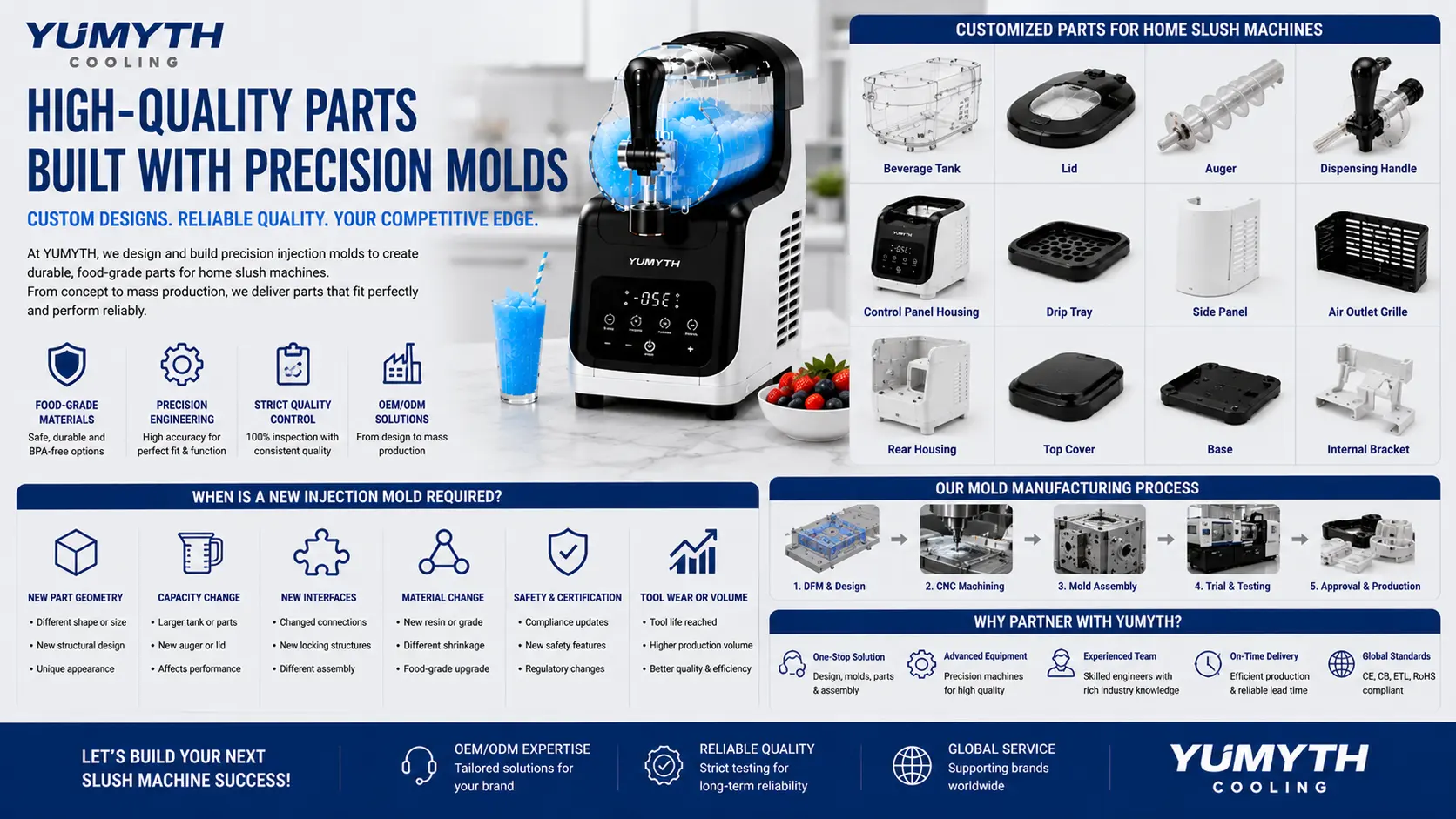
The choice of the extend of the existing mold, adapting an existing tool or creating a brand new mold significantly impacts product cost, MOQ, development time, product appearance and performance, and IP protection.
Not all customizations need a new injection mold. Some changes in the tooling can be avoided when the logo printing, packaging changes, software updates and some color changes can be done. When a requested change involves part geometry, function, material behavior, assembly, safety, production quality, etc., however, new tooling may be required.
A completely new Part Geometry is required.
The most obvious reason for making a new mould is the need to make a new part, in a different shape or size.
A home slush machine can be used for the following purposes:
- * Water heater with a bigger capacity; and
- * A redesigned lid;
- * A new 1 liter bottle of Naloxone; and
- * A different feed rate; and
- * A deep or long tray; and
- A new housing for the control panel;
- * A new configuration and packaging system for the appliance; and
- Different air-inlet or outlet grille.
The injection mold is made according to the exact shape of the component. If the design changes can't be made by modifying an insert that can be replaced, or by machining a small section of the mold, a new mold is usually needed.
Whether it's a minor aesthetic refinement, internal ribs, screw bosses, draft angles, wall thickness, locking tabs, or sealing surfaces, it can all be affected by even a minor change. When considering the need for new tooling the engineering team should look at the full 3D model and not just the outside appearance.
Product Capacity Changes
Beverage tank, auger, lid, evaporator interface and appliance housing are typically affected by an increase in working capacity of a slush machine.
If the clear tank is bigger, then it may need:
- * New tank tooling;
- An auger that is longer or wider than usual;
- A more powerful locking system;
- * A revised lid;
- A modified dispensing position;
- * Improved insulation for the rear surface of the cabinet; and
- * Additional internal support.
Other changes in capacity can also impact refrigeration load, motor torque, product dimensions and cleaning performance. Thus, the project should not be viewed as a change of just the plastic part of the vessel.
If the growth is small, it can achieve the additional capacity by minor changes of tools on an existing platform. If changes are larger, they will typically need multiple coordinated molds and further performance validation.
Current Tooling Cannot be Modified Safely: In some circumstances, it may not be possible to modify existing tooling safely.
There are molds that can be modified by using different inserts, by local machining of areas or by the replacement of areas of the mold. This can be quicker and less costly than creating a totally new tool.
Modification of tools may be feasible for:
- * Adding or removing text; and
- * A change to a minor element of a surface;
- A local rib that has been revised;
- * Changing a snap's position;
- * Enlarging an opening;
- Modifying a replaceable insert.
But mold modification has its bounds. It is generally easier to remove steel than add it back. A modification that calls for lessening a plastic feature could cause an increase in the amount of metal in the mold cavity that may be difficult, less durable or cosmetically unappealing.
The new mold is safer if the modification would weaken the tool, affect cooling channels, interfere with the ejector pins or damage textured surfaces or result in an unstable molding process.
A NEW industrial design is needed.
Brands typically desire a product which is obviously unique from the current models on the market. The new industrial design can be a different silhouette, a different front panel, a different top cover, a different handle, a different shape of the tank or a different decorative structure.
Printing, labels, color and packaging alone may be sufficient for differentiating the product if the objective is only brand identification. It is often necessary to create new exterior molds for the brand if they wish for a distinctive appliance look.
A custom-built house can require multiple tools for:
- * Front enclosure;
- * Rear enclosure;
- * Side panels;
- * Top cover;
- * Control-panel frame;
- * Ventilation grilles;
- * Decorative trims;
- * Base components.
The brand needs to determine the amount of visual differentiation that is commercially required. Making many new cosmetic parts can result in higher tooling costs, but no better cooling, texture, cleaning or reliability.
Functional Interfaces Change
If there is a change in the interface between two components, then a new mold may be required.
Examples include:
- *A new tank locking system;
- * An updated engine cover; and
- * A different tubing system; and
- * A new two-switch power control; and
- A new seal groove;
- A new mounting structure for the control panel; and
- An altered compressor or motor bracket.
It is important that interfaces are dimensionally controlled. Leakage, vibration, assembly force or safety to the user can be affected by small changes.
For instance, a seal groove has to impart the correct compression to the approved gasket. It is unlikely that the existing mold will be sufficiently precise or have the required surface quality for rework. A new insert or full mold might thus be necessary.
The requirements for the materials vary greatly.
Plastics have different properties when being injected molded. They might need other shrinkage allowance, mold temperatures, gate designs, cooling systems, surface finishes and wall thickness.
One material cast should not be used with another resin without a mold being made for the new resin.
A material change can be requested for the purpose of:
- * Better transparency;
- * Greater impact resistance;
- * BPA-free construction;
- * Higher dishwasher resistance;
- * Improved chemical resistance;
- * Lower odor absorption;
- * Better temperature performance;
- * Reduced material cost.
If the new material has significantly different shrinkage or flow properties, it could result in inaccuracies in the dimensions of the parts being made, sink marks, warping, poor surface finish, or weak weld lines.
Before making the decision of reusing a mold, the engineering team should perform material-flow and tolerance analysis.
Tooling Has Reached the End of Its Service Life
Injection molds wear out with time. Slides, ejector pins, gates, parting lines, textured surfaces and cavity dimensions can become compromised after a number of production runs.
Worn tooling can be detected by:
- * Increasing molding flash;
- * Unstable part dimensions;
- * Poor surface finish;
- * Difficult ejection;
- * Damaged texture;
- * Frequent mold repairs;
- * Increased rejection rates;
- Dimensional variation leakage.
The mold supplier may be able to repair or refurbish the mold. If significant structural elements are deteriorating or repeated repair work is no longer cost-effective, however, it may be more cost effective to use a replacement mold.
Brands should request records of mold maintenance, expected life, production volume & ownership from the OEM supplier.
Production Volume: Must use a Higher-Grade Tool
For engineering samples and small initial orders, a prototype or low volume mold can be used but it is not suitable for mass production.
Lower volume tools can be made of less hard steel, have less cavities, simpler cooling, or manual inserts. When the volume of forecast is increased, a more durable production mold may be needed for the project.
A new high volume tool can offer:
- * Hardened tool steel;
- * Improved cooling channels;
- * Faster cycle time;
- * Better dimensional stability;
- * Automated slides;
- * Multiple cavities;
- * Longer service life;
- Smoother surface.
The tooling strategy should thus take into account both the first order and the number of pieces that can be produced during the expected life of the tooling.
Higher Cycle Time or Quality must be achieved
An existing mould can create acceptable parts, but it could be inefficient.
Problems may include:
- * Long cooling time;
- * Uneven temperature;
- * Frequent warping;
- * High scrap rate;
- * Difficult ejection;
- * Excessive manual trimming;
- * Unstable dimensions;
- * Visible weld lines.
An optimized mold design that features optimized gates, runners, cooling channels, venting and ejection can help enhance production speed and quality.
In some cases, when annual volume is high, it may be worth the investment to purchase a new tool to reduce cycle time. This should take into account savings in labour, reduction in scrap, increased production capacity and quality improvement costs, against the cost of tooling.
The certification or Safety Requirements are applicable to the Plastic Structure.
Plastic enclosures, ventilation openings, barriers, distances in which parts can move, mounts for parts, or access to moving parts may be affected by changes that must be made during safety testing.
For instance, a certification review could involve:
- * Shielding for electrical components; and
- * Revised ventilation openings;
- * Power on protection of the refrigerant tubing;
- * Stronger internal supports;
- Increased ability to withstand high temperatures or burning;
- * New warning-label areas;
- Improved user access protection.
If these requirements can't be added reliably by modifying the tool, then a new mold might be needed.
Planning for certification should start prior to releasing the tools. One of the most costly causes of the redevelopment of mold is late compliance changes.
Reuse is not possible for the existing mold owners.
A factory can produce a product leveraging another customer's tooling. It is important to note that the supplier may not legally possess the right to use or modify that mold for a new brand even if the part looks like it would work for that brand.
Prior to starting a project, the brand needs to verify:
- Who can claim the property of the mold;
- * If the equipment is exclusive, how many people will require it; and
- * If it can be used by several customers;
- Who is responsible for maintenance costs;
- * If the mold can be transferred, what are the risks involved with this transfer; and
- What's the deal when co-operation fails;
- The duration of the storage period of the tool.
A new mold might be needed to safeguard the original customer's rights and the new brand's product identity.
Intellectual Property and Market Differentiation
A brand can select new tooling even if a platform is technically capable of achieving a target.
These special castings can be used with:
- A one-of-a-kind product appearance;
- * Exclusive component geometry;
- * Distinctive user experience;
- * Better control of spare parts;
- * Emedication of competition; and
- Greater IP strength.
But just because a new mould is developed does not mean that an IP asset can be protected. Brands need to carry out a design and patent search prior to investing in a structure that could be in conflict with others.
If a new mold isn't necessary, a mold inspection may not be needed.
For the following parts, it is often not necessary to use new injection tooling:
- * Logo printing;
- * Rating labels;
- * Packaging graphics;
- * User manuals;
- * Firmware changes;
- * Preset-program changes;
- * Color changes in standard plastic;
- * Minor surface printing;
- * Market-specific plugs;
- * Accessory combinations.
Depending on the color change, a new color masterbatch might be sufficient, but production quantities and colour control requirements remain.
It can also accommodate small, brand-specific details with the use of a replaceable mold insert, without the need to replace the entire tool.
Carefully review the Decision Using a Tooling Review.
New tooling should be reviewed prior to approval by the appliance brand and OEM supplier to include:
- The requested change of design;
- * Existing mold construction;
- * Modification feasibility;
- * Material requirements;
- * Expected production volume;
- * Tool-life target;
- * Part quality requirements;
- * Certification impact;
- * Project schedule;
- * Tool ownership;
- * Total cost.
It is best for the supplier to offer a tooling quote, mold specification, development timeline, anticipated cycle time, sample plan, and criteria for acceptance.
Pre-production molded parts must be checked with mold before mass production for dimensions, appearance, assembly, leakage, cleaning and functional performance.
Conclusion
If the product change cannot be accomplished safely, accurately, legally and economically using existing tooling, then a new injection mold must be made.
Most often, new molds are required if the part geometry changes, production capacity is increased, functional interfaces are changed, significant changes in material are required, the industrial design is unique, the number of parts to be produced is high, the tooling that has been used is worn, certification corrections are needed, or if the mold is needed for exclusive brand ownership.
For the appliance brands, the most judicious choice isn't necessarily without tooling cost. Using the wrong mold means that dimensions won't be consistent, the assembly may be incorrect, it can leak, cause cosmetic issues, and cause delays in production.
A structured tooling review is used to establish if a current mold should be used, insert(s) should be adapted, or a new tool should be developed. New tooling can help achieve meaningful differentiation and reliable mass production when it is based on an engineering need, market strategy, production volume, and long-term cost.
Related Articles
How We Test Every Ice Maker Before Packaging
2026-09-15
BY YUMYTH
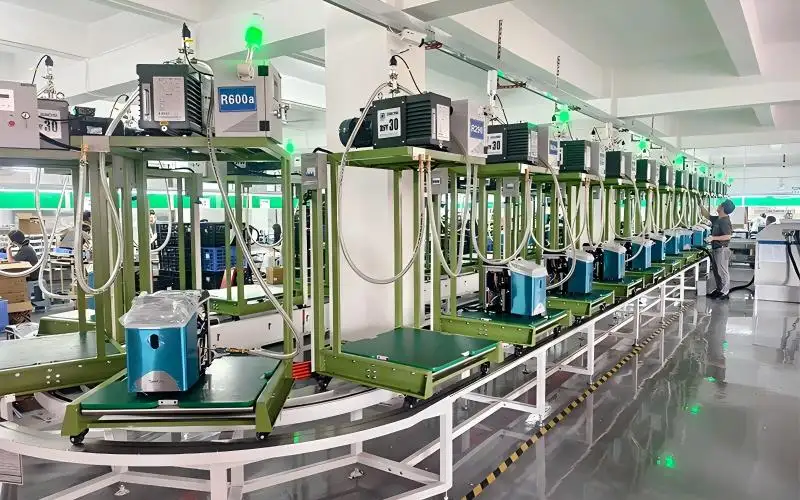
A step-by-step look at refrigerant handling, cooling verification, leak detection, corrective action and electrical safety testing For an ice maker, reliable performance is determined long before the carton is sealed. ...
Guide for Brands Looking for a Reliable Vacuum Sealer OEM Supplier
2026-09-14
BY YUMYTH
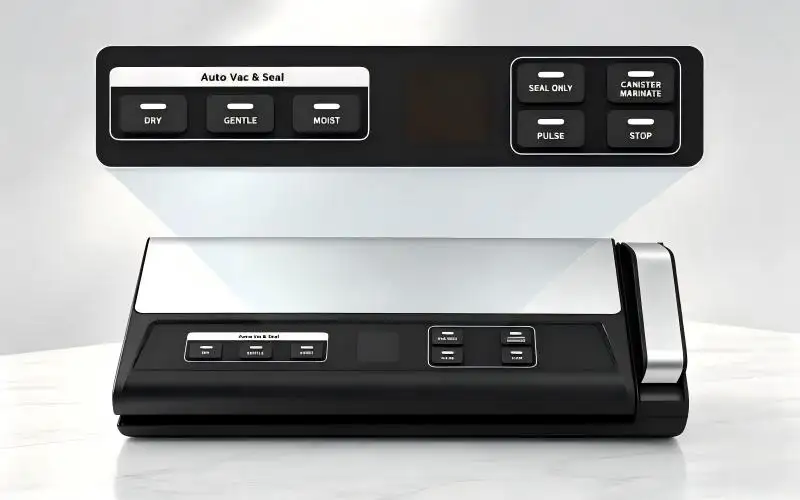
When you are sourcing kitchen appliances for your retail brand, finding a dependable vacuum sealer OEM supplier is rarely just about getting the lowest unit price. It is about protecting ...

Why Ice Shape Matters: Understanding 10mm × 15mm Cylindrical Nugget Ice
2026-09-14
BY YUMYTH
More Than Ice Production — The Ice Itself Shapes the Consumer Experience When sourcing a nugget ice maker, buyers often focus first on production capacity, water tank size, ice basket ...

Ice Maker Sourcing Guide: How to Find the Right Factory
2026-09-10
BY YUMYTH
Sourcing an ice maker looks straightforward on paper. Find a supplier, agree on a price, place an order. But anyone who has actually done this knows the process is rarely ...