Nugget Ice for Cocktails: Why Soft Ice Makes a Difference
Share:
-

-

-

-


Copied
Share:
-
-
-
-
Copied
A Mint Julep served over soft nugget ice can feel noticeably different from one prepared with conventional crushed ice. Both may reach a similar serving temperature, yet the nuggets' texture, surface moisture, and packing density change how the drink cools, dilutes, and feels in the mouth.
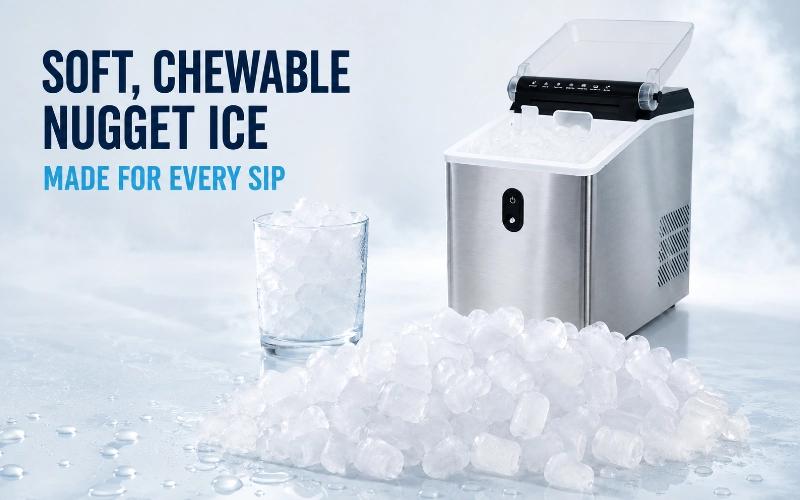
When choosing beverage equipment, buyers tend to analyze more than just chewability. Nugget ice for cocktails needs to be able to quickly chill a drink, and disperse adequately throughout the beverage to achieve the characteristic flavor and mouthfeel of crushed ice.
At YUMYTH, we take a different approach with our nugget ice, ensuring practicality by incorporating texture and consistency to help you achieve the right experience with your drinks.
What Makes Nugget Ice Softer than Conventional Cubes?
The difference starts with the freezing process.
Most conventional ice cube trays, freeze water to a relatively solid shape. Alternatively, most nugget ice systems, form very thin layers of ice on a surface which is kept at a refrigerated temperature, and mechanically remove them from the surface to form flakes. The flakes are then compacted to form the nuggets.
A block of ice contains one single interface. Compared to a single, large, solid block of ice, nugget ice contains a large number of small, discrete, weak interfaces. When force is applied to a pellet, the small interfaces fracture, resulting in a soft, and chewable, texture.
The mechanics of the compacting process also influence the texture and consistency of the nuggets. Loosely compacted nuggets break apart when scooped, while more densely compacted nuggets maintain their shape, and tend to feel harder, compared to less compacted nuggets.
Moisture on the surface of the nuggets prior to their discharge from the machine also influences how the pellets stick together. Pellets discharged from the machine with surface moisture tend to stick together in the collection basket. After the moisture evaporates, the pellets may fuse together, resulting in larger masses.
For buyers comparing different machines, pellet size and appearance should be examined along with how easily the pellets crush and stick together. These characteristics cannot be determined by the production capacity of the machine.
How Does Soft Ice Affect Cooling and Cocktail Dilution?
Compared to an equivalent mass of ice, pellets take longer to absorb the latent heat of fusion. The main difference between an ice cube and a mass of pellets is how quickly the heat can dissipate into the pellets.
Pellets can provide a large surface area for heat transfer compared to a single large cube. If pellets are packed closely enough, then the liquid in the drink can circulate through the empty spaces and provide additional paths for heat transfer.
Faster cooling can occur if liquid first gains contact with the pellets rather than ice. This is referred to as the pre-cooling effect. If the pellets are at 0°C, they don't have the same capacity to absorb the additional latent heat of the cocktail like ice. During service, three conditions are of particular importance:
Ice mass: Because different pellet sizes can be compacted into a given volume, pellets of the same size can have different weights. As a result, scooping the same volume of pellets may not result in the same mass of ice being scooped.
What happens when you throw a big clump of ice into your drink?
This "wet ice" effect brings extra water into the drink before additional melting occurs.
The serving duration of small pellets may also be less as they may melt more quickly when in contact with a warmer drink for a longer period of time.
For more accurate recipes, it is best to use weight when measuring the ice charge rather than using an uncalibrated scoop.
What Cocktails Actually Benefit From Nugget Ice?
Mint Juleps, as well as other cocktails traditionally built using crushed ice, may also benefit from nugget ice.
Swizzles and certain Tiki cocktails, which are built using a lengthy process of blending and shaking with ample ice contact and a high level of dilution, also may benefit from a bed of nugget ice.
Mojitos and less acidic fruit-based mocktails may also benefit, depending on the level of sweetness and the temperature at which they are served.
The trade-off becomes clearer with spirit-forward cocktails.
An Old Fashioned is generally intended for slower consumption with gradual dilution. A large solid cube is usually better suited to that requirement than numerous small nuggets.
Soft ice should therefore be selected according to the drink's intended dilution profile, not simply its visual appearance.
Can a Countertop Nugget Ice Maker Support Cocktail Service?
Daily production figures help compare equipment, but don't describe a machine's short term dispensing capacity.
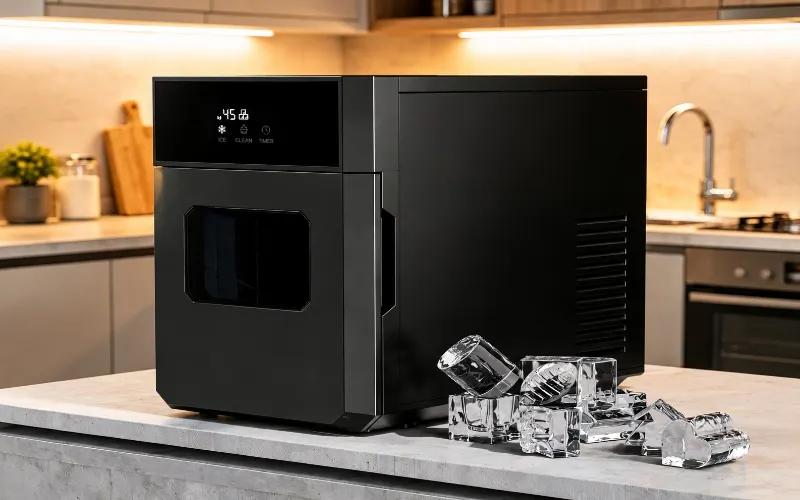
The YUMYTH Countertop Chewable Nugget Ice Maker has a production figure of up to 20 kg in 24 hours, with first ice in about 6 minutes at 25°C.
Its ice basket can hold 1.4 to 1.9 kg of ice, and the water tank can hold 2.1 liters.
Let's say there's a beverage station making ten cocktails each requiring 150 g of ice. The total ice charge would be 1.5 kg, which is the capacity of the ice basket, and therefore, would not be enough to make all ten cocktails.
This shows why nominal daily production is inadequate to measure peak demand. The buyer has to consider how quickly the machine replenishes ice after it's dispensed.
YUMYTH has incorporated a rotating anti-jam mechanism to reduce ice blockage. This is relevant to our discussion because compressed pellets can build up along the discharge passages and obstruct the opening, especially if it's combined with melting and mechanical compaction.
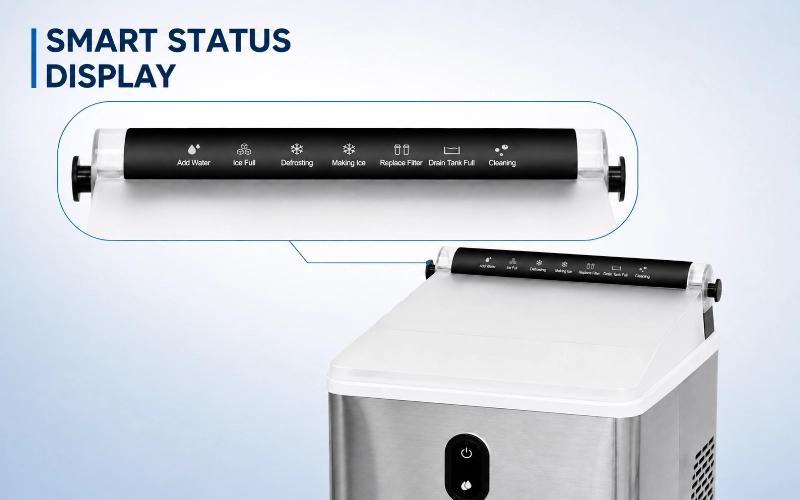
The machine has an automatic cleaning cycle and a filter replacement reminder. These simplify routine maintenance, but do not replace the need for a thorough inspection and sanitation by the user.
The dimensions of the unit are 402 × 240 × 402 mm and it requires 150 W of power. Other considerations when placing the unit should be the accessibility of water, wastewater and electricity.
How Else can Buyers Evaluate Ice Quality?
Both the quality of the beverages and the performance of the equipment should be tested.
For beverage performance, make identical cocktails and use the same amount of nugget and crushed ice to each. Keep the initial temperature of the drink, the temperature of the ice, the process used to mix the drink, and the time it takes to serve the drink constant.
Immediately after preparation, record the temperature of the drink, and at defined intervals, afterward. Estimate how much the ice has melted by separating and weighing the used ice. Uncertainty is introduced by liquid remaining on the ice.
Taste testing can help determine if the dilution of the drink by the ice is acceptable.
Equipment verification requires a different approach.
Record how much usable ice was collected in a defined operating period. Factors to be collected include ambient temperature, water inlet temperature, how often the machine was refilled, and reasons for an interruption in use (full basket, low water).
After collection, nuggets can be evaluated for integrity. It is possible that how a pellet behaves during initial dispensing can change with storage.
Hard water can negatively impact an ice machine. Mineral deposits from the hard water can buildup and reduce water flow. Restricted water flow can change how water is distributed and effect the ice machine's performance over time.
In order to verify the ice machine meets the electrical and market requirements for use in different countries, prior to bulk purchase, verify with the manufacturer.
YUMYTH's Countertop Chewable Nugget Ice Maker is a compact ice maker to produce nugget ice to be used in beverage service. For more information about the machine and how it may be used in your application, contact YUMYTH.
FAQs
Q1: What type of ice does YUMYTH's countertop ice maker produce?
YUMYTH's countertop ice maker produces soft, chewable nugget ice with a compact pellet-like structure, suitable for cocktails, mocktails, iced coffee, and other chilled beverages.
Q2: Why is nugget ice suitable for cocktails?
Its small pellets provide extensive liquid contact for rapid cooling. The soft texture also enhances mouthfeel, although dilution must be controlled.
Q3: Which cocktails work best with YUMYTH nugget ice?
Mint Juleps, swizzles, Tiki cocktails, Mojitos, and fruit-based mocktails are suitable applications. Large solid cubes are generally preferable for slow-sipping, spirit-forward drinks.
Q4: How quickly can YUMYTH's nugget ice maker produce ice?
YUMYTH specifies first ice production in as little as 6 minutes at 25°C ambient temperature. This does not indicate the time required to fill the entire basket.
Q5: How much nugget ice can YUMYTH's machine produce daily?
The production capacity is up to 20 kg per 24 hours. Actual output depends on operating conditions, including ambient temperature and water supply.
Related Articles

How Does a Slush Machine Work Without Ice?
2026-10-29
BY arafatshuvo509
Traditional blender's use of crushed ice to mix an ingredient into a thick, cold drink is replaced by today's slush makers which are able to achieve the same result using ...
Compressor Slush Machine: Cooling System and Mixing Technology
2026-10-29
BY arafatshuvo509
A compressor slush machine utilizes an integral refrigeration process with continuous mechanical agitation of the refrigerated liquid to produce semi-frozen (slushy) liquids by creating ice crystals directly from the liquid. ...
Ice Maker for Small Kitchen: Compact Design for Apartment Living
2026-10-27
BY YUMYTH
An ice maker that fits on an apartment countertop may still be difficult to operate. A wall can obstruct condenser airflow, an overhead cabinet can prevent the lid from opening ...
2026 Freestanding Ice Maker Trends: Clear Ice, R290, and Smart Controls
2026-10-27
BY YUMYTH
A freestanding ice maker that can produce 12.6 kg of ice in a day may still not meet expectations. Its ice may turn cloudy because of short freezing cycles, it ...