
OEM development timeline
Share:
-

-

-

-


Copied
Share:
-
-
-
-
Copied
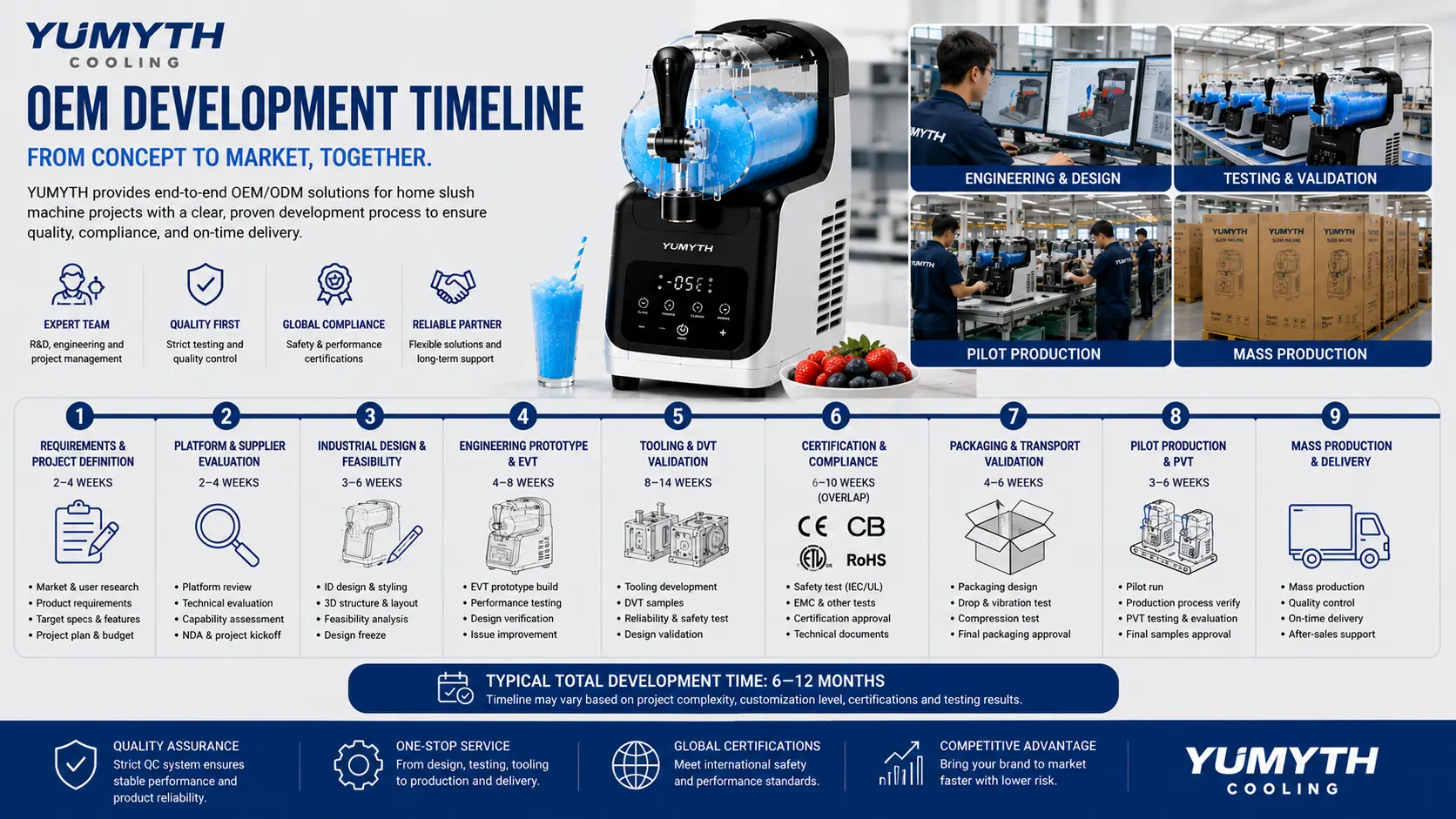
The following is an OEM Development Timeline to help you better understand how the components of a Home Slush Machine Project develop.
Creating a home slush machine with an OEM or ODM supplier isn't just a matter of picking the right machine and putting on a brand name. A compressor-based frozen drink appliance combines refrigeration, mechanical mixing, electronic control, food contact parts, dispensing parts, cleaning systems, safety protection, packaging and market-specific compliance.
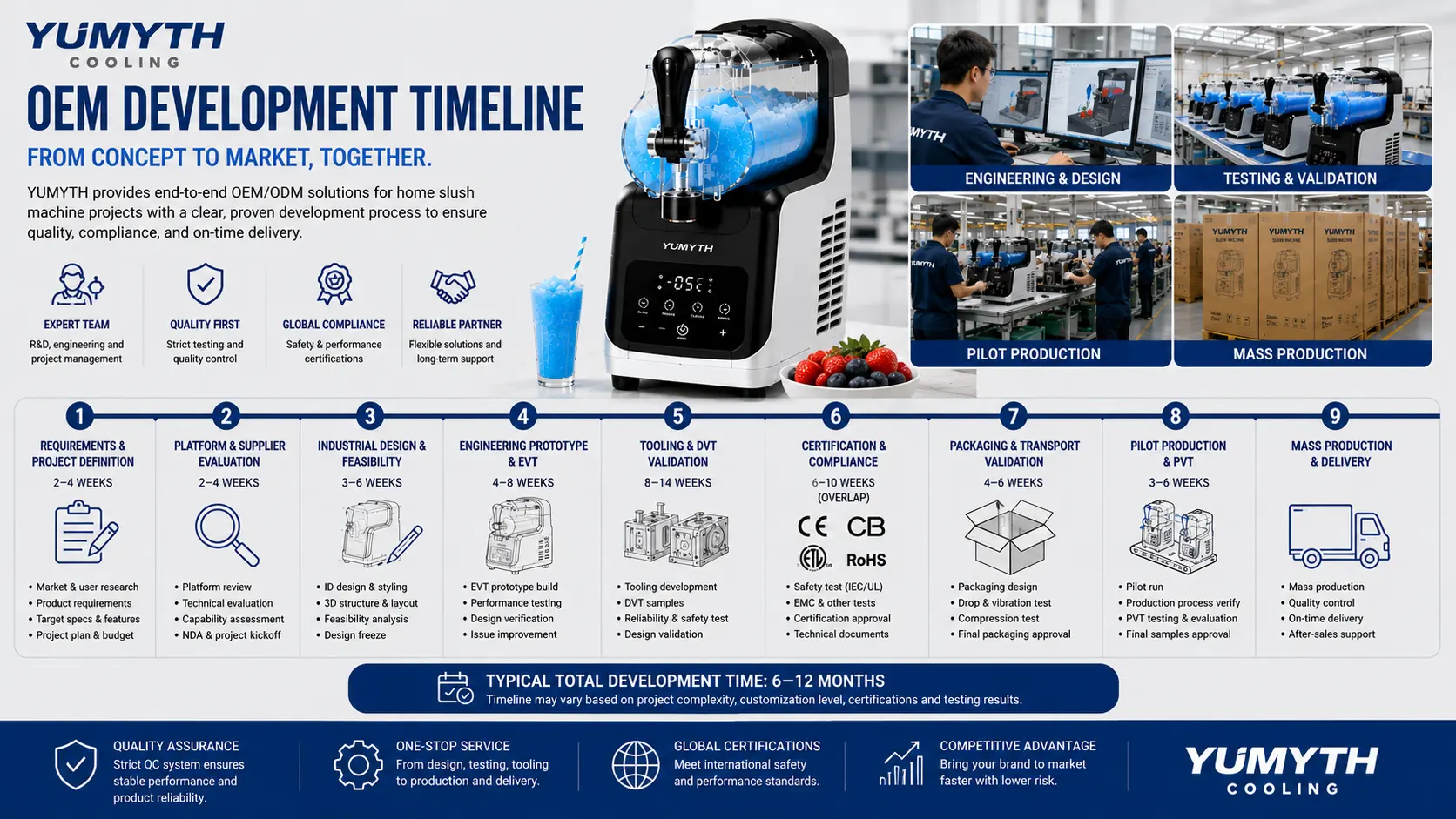
Product definition, engineering design, prototype, performance validation, certification, tooling, pilot production, and manufacturing readiness are all items in a realistic development timeline. Failure to perform at least one of these stages could result in premature certification, poor performance, packaging issues or quality concerns after the launch.
This will vary depending on the project. Depending on the type of private label model, which may be based on an existing certified platform, or a new structural design with custom tooling and multiple market certifications, it can take quite awhile.
Phase 1 involves defining the product requirements and the project.Phase 1 is the product requirements and project definition.
The first stage sets the expectations for the brand on what the supplier needs to create.
The product requirement specification should outline:
- Incorporate target market and user group;
- * Feeding and pooping; and
- * Illustrated the various frozen drink categories; and
- * Target preparation time;
- * Noise target;
- Rated current and current capacity; and
- * Refrigerant preference;
- * Preset programs;
- * Food-contact materials;
- * Cleaning requirements;
- * PETC; and
- * Packaging expectations;
- * Forecast order volume;
- * Target retail price.
Test conditions must be included in the performance requirements. A target freeze time, for instance, can't be complete without the beverage volume, starting temperature, ambient temperature, Brix level, operating program and definition of slush ready.
This phase can additionally entail competitor analysis and a comparison of suppliers' platforms. This depends on the type of project, either a privatelabel adaptation, functional customization or a complete new product development.
Having a clear brief decreases the likelihood of changes after. If the needs of a product are constantly evolving after tools have started production, the development cost and lead time can rise drastically.
Phase 2: Platform and Supplier Evaluation.
The next phase is to see if the OEM supplier has an appropriate product platform ready.
It is the brand's responsibility to review:
- The designed models and engineering samples; and
- * Refrigeration-system architecture;
- * Airflow capacity;
- * Equipping, mounting, and installation of augers; and
- * Electronic control capability;
- * Current certifications;
- * Food-contact material reports;
- * Factory production capacity;
- * Reliability-testing facilities;
- * Quality-management procedures.
The principles of ISO 9001 define the framework in which an organisation can design, develop and continually enhance a quality-management system. Brands should, however, conduct an audit on how the supplier practices its procedures when collecting their parts, in refrigeration assembly, testing, traceability and corrective action.
The specifications of an existing platform must be confirmed but can reduce development time. The supplier needs to furnish controlled drawings, a bill of materials, test records, certification files, and proof that the proposed production model matches the sample.
The third phase consists of Industrial Design and Engineering Feasibility.Phase 3: Industrial Design and Engineering Feasibility.
Once the platform has been agreed, the teams start to develop the product brief into an engineering concept.
This phase can involve any or all of the following:
- * Exterior styling;
- * Product dimensions;
- * Tank and auger configuration;
- * Control-panel layout;
- * Quality and performance; and
- * Dispensing structure;
- * Air sealing; and
- * Component arrangement;
- * Removable-part design;
- * Packaging size targets.
Feasibility studies should be completed by the engineering team prior to detailed engineering of tools. A narrow house with a roof can limit the condenser ventilation. Larger tank can add refrigeration loads and auger torque. Leakage or cleaning could be an issue with a new dispensing handle.
The supplier should identify the changes that impact the tooling, certification, refrigeration performance, software, and critical component.
The product architecture and major dimensions, appearance direction and technical specification should be approved by the brand at the end of this phase.
Phase 4: Engineering Prototype and EVT
Engineering Validation Testing is also known as EVT; it is used to determine if the technical concept is viable.
Initial models can be CNC-made parts, 3D printed housing or a modified platform part, or soft tooling. These units are not intended to be a final cosmetic quality. They are used to test the principal systems.
Here are examples of EVT activities that may take place:
- * Refrigeration-capacity testing;
- * Freeze-time testing;
- * Sugar/Brix testing;
- * High-ambient testing;
- * Auger load measurement;
- * Jam-protection testing;
- * Task analysis; and
- * Dispensing evaluation;
- * Leakage testing;
- * Cleaning assessment;
- Preliminary Electrical Safety Review.
The IEC 60335 series is a typical specification for the safety development of household appliances. In accordance with the final appliance functions and intended use, the applicable Part 2 for the specific product must be confirmed with regard to the type of appliance, IEC 60335-1 outlines general safety requirements for household and similar electrical appliances.
If problems are discovered in EVT then they should be corrected prior to the creation of costly production tooling. Common modifications include condenser airflow, auger geometry, sensor positioning, seal compression, motor protection, firmware logic or component layout.
In this phase, tooling is developed and implemented, along with design validation.
After engineering risks have been addressed, the project enters into Production Tooling and Design Validation Testing (DVT).
Use parts that are a lot closer to the proposed production design for the DVT samples. They can be injection molded homes, final tanks, production-representative augers, approved seals, final PCBs and target compressors.
Validation should include the entire declared operating range. These important tests include:
- * Minimum and maximum fill heights; and
- * Different beverage recipes;
- * Shake and stir before use; and
- Spreading of alcoholic drinks with support;
- * Different ambient temperatures;
- * Extended holding;
- * Repeated batches;
- * Noise testing;
- * Component durability;
- * Cleaning cycles;
- * Packaging validation;
- * Foreseeable abnormal use.
UL Solutions says reliability and durability testing is a method of determining the performance of products when they are used under normal and abnormal conditions and to uncover design flaws before they're released to market.
DVT should conclude with a controlled specification, approved materials, final software, test reports, and a list of open issues that need to be addressed prior to certification/pilot production.
A phase dedicated to the safety and market certification of the product.
Testing is generally done as a formal test and is usually done on samples that are representative of the final production construction, and should be planned from the outset.
Brands can partner with a qualified Nationally Recognized Testing Laboratory to meet the appliance standards and certification mark requirements for the United States. UL Solutions offers testing and certification for household and small appliances based on appropriate UL- and IEC-based requirements.
For the European Union, the CE marking is the manufacturer's statement that the product meets all the relevant EU requirements. It's not just a test lab certificate.
The EU manufacturer has to have technical documentation on hand before putting the product on the market, and is required to hold it for 10 years, unless relevant legislation dictates otherwise.
The following are examples of work that can be certified:
- * Product safety;
- * Electromagnetic compatibility;
- * Contact with the sun;
- * Food-contact materials;
- * Refrigerant-related evaluation;
- * RoHS compliance;
- * Labels and warnings;
- * User instructions;
- For example, market-specific plugs and electrical ratings.
Failure of certification can impact molds, wiring, ventilation, control boards, critical components and software. This risk can be mitigated by testing prior to compliance (EVT/DVT).
Phase 7: Packaging Development and Transport Testing;
The design of packaging should be done with the appliance in mind, not as an after-thought.
The packaging team is responsible for safeguarding:
- A clear drink tank;
- * Dispensing handle;
- * Control panel;
- * Compressor mounts;
- * Refrigerant tubing;
- * Removable components;
- * Accessories.
Drop, vibration, compression and environmental conditioning can all be a part of packaging validation. End-of-test samples should be cartons, inserts, accessories, labels, manuals and packed product weight that represent the production.
The failure of the packaging may cause damage to the refrigeration parts even if the packaging looks good on the outside. Units should be subjected to electrical, leakage, noise and representative freezing tests after transport.
Phase 8 – Pilot Production and PVT – The design is completed and a sample production is undertaken.
Production Validation Testing (PVT) ensures that the factory is able to consistently produce the product with the end process.
The pilot run is to be performed with:
- * Final tooling;
- * Approved component suppliers;
- * Production operators;
- * Intended assembly lines;
- * Calibrated test equipment;
- * Final firmware;
- * Approved packaging;
- * Production inspection procedures.
The brand and factory are responsible for reviewing the inspection, charging in the refrigerator, brazing, leak testing, electrical safety, functional testing, appearance inspection, serial number traceability, and packaging.
Pilot samples to be compared with approved golden sample and DVT results. If the differences in the amount of time required for each freeze is not negligible, that means the process is not yet stable, as might be the differences in noise, leakage, or control behavior or appearance.
PVT is also to confirm production capability, test-station throughput, operator training, work instructions and repair procedures.
Phase 9: Mass Production Approval
Mass production should start after open issues of pilot production have been solved.
It should contain the following as part of the release package:
- * Final SOP; and
- * Approved drawings;
- * Golden sample;
- * Firmware version;
- * Critical component list;
- * Certification files;
- * Inspection criteria;
- * Packaging specification;
- * Work instructions;
- * Traceability requirements;
- * Engineering-change procedure.
Never replace any approved compressor, motor, seals, PCB, plastics, thermal protector, or refrigeration component without proper evaluation and customer approval by the factory.
Quality control needs to be maintained after launch by conducting batch audits, analysing complaints, investigating any failures, monitoring suppliers and taking corrective actions.
An Illustrative OEM Schedule
The process of creating a logo, preparing colors, packaging, reviewing samples, and preparing for production can be rather swift for a platform-based private label project.
A moderately customized project might follow an illustrative schedule like:
- * Start of delivery: 2–4 weeks after requirements are confirmed; and
- Design and feasibility 3-6 weeks;
- EVT prototypes and corrections: 4 – 8 weeks;
- * Design: 12 weeks; and
- Partially performed in parallel: Certification and packaging validation;
- * full production: 10–12 weeks; and
- Initial mass production: once all release conditions have been closed.
These ranges are indicative, not guaranteed, timetables. The schedule can be extended by new molds, structural redesigns, test failures, changes in certification, or late specification changes, etc.Schedule extensions may occur due to new molds, structural redesigns, test failures, changes in certification, component shortages, or late specification changes.
Conclusion
The important thing to remember about a successful OEM development time line is not that it contains calendar dates, but decision gates.
The project should transition from product definition to feasibility, EVT, DVT, certification, packaging validation, pilot production, and mass production approval. For each stage, there should be documented evidence that the product is ready for the next stage of investment.
For appliance brands, the best solution to speed up development is not to eliminate testing. It's about setting requirements in the beginning, finding a competent supplier, keeping engineering and compliance in parallel, approving changes in a timely fashion, and keeping a check on the specifications throughout the project.
A structured timeline minimizes the risks associated with a launch and can help get the final slush machine to be safe, reliable, manufacturable, compliant and ready to be consistently produced.
Related Articles
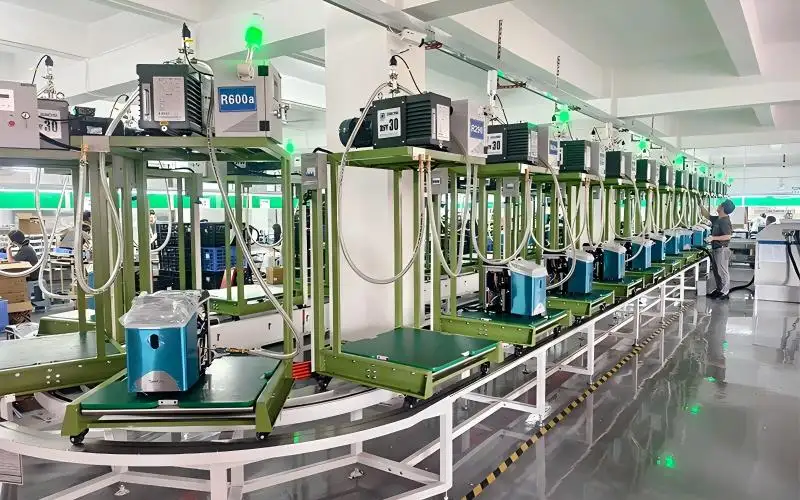
How We Test Every Ice Maker Before Packaging
2026-09-15
BY YUMYTH
A step-by-step look at refrigerant handling, cooling verification, leak detection, corrective action and electrical safety testing For an ice maker, reliable performance is determined long before the carton is sealed. ...
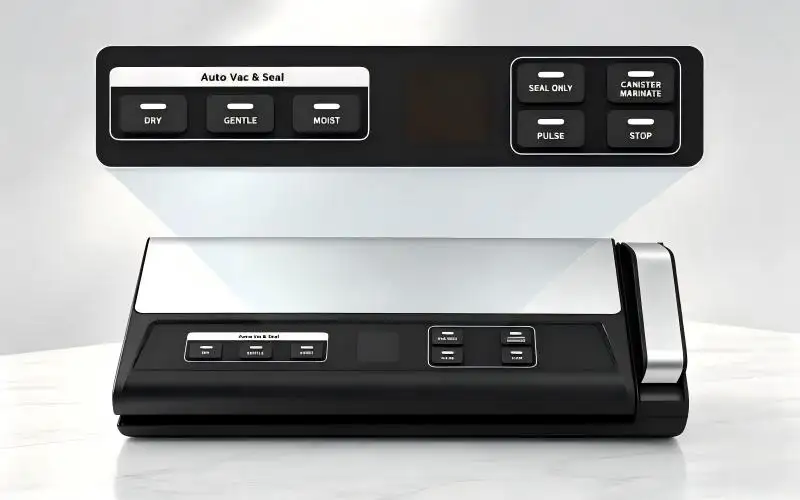
Guide for Brands Looking for a Reliable Vacuum Sealer OEM Supplier
2026-09-14
BY YUMYTH
When you are sourcing kitchen appliances for your retail brand, finding a dependable vacuum sealer OEM supplier is rarely just about getting the lowest unit price. It is about protecting ...

Why Ice Shape Matters: Understanding 10mm × 15mm Cylindrical Nugget Ice
2026-09-14
BY YUMYTH
More Than Ice Production — The Ice Itself Shapes the Consumer Experience When sourcing a nugget ice maker, buyers often focus first on production capacity, water tank size, ice basket ...

Ice Maker Sourcing Guide: How to Find the Right Factory
2026-09-10
BY YUMYTH
Sourcing an ice maker looks straightforward on paper. Find a supplier, agree on a price, place an order. But anyone who has actually done this knows the process is rarely ...