How Brands Can Select Top-Tier OEM Vacuum Sealer Suppliers: From Verifying Production Capacity to Vetting Core Technology
Share:
-

-

-

-


Copied
Share:
-
-
-
-
Copied
In the cross-border e-commerce and home appliance markets, finding a reliable contract manufacturer for vacuum sealers involves far more than simply comparing quotes on B2B platforms. When you place your brand logo on a device, you assume full responsibility for quality. If a machine loses suction power or its sealing strip melts after just a month of use, consumers will direct their negative feedback at your brand.
For brands looking to expand their kitchen appliance product lines, understanding how a high-quality vacuum food sealer is manufactured—and knowing how to avoid factories that churn out cheap, shoddy assemblies—is essential for achieving high profit margins.
Four Key Criteria for Evaluating Vacuum Sealer Suppliers
Many trading companies market themselves as original manufacturers. Before placing bulk orders, you must look past the sales pitch and assess the supplier's actual engineering capabilities. Here are several core evaluation metrics that cannot be faked:
1. Actual Vacuum Pump Negative Pressure and Continuous Operation Capability
The vacuum pump is the heart of the sealer. Cheap machines on the market often achieve only -40 kPa or -50kPa of suction, and their motors tend to overheat and shut down after just a dozen or so consecutive operations. And there is no thermal fuse in the machine. The high temperature may cause the plastic body melt.
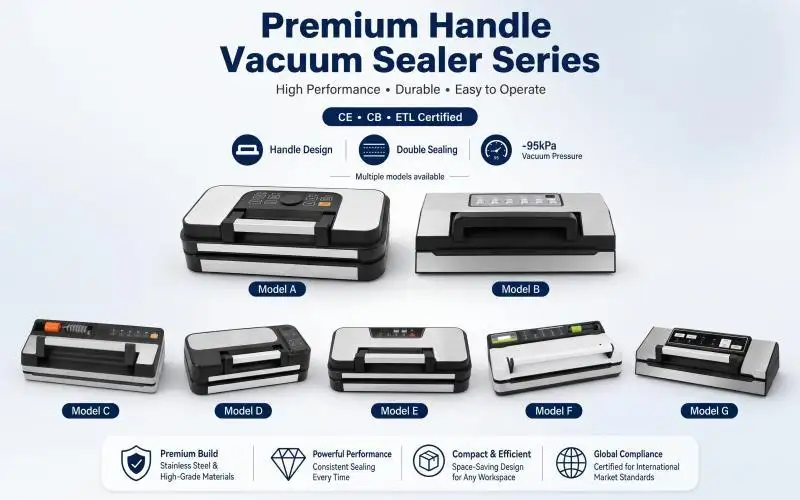
Top-tier contract manufacturers use high-performance pure copper motors in their OEM vacuum sealer projects, ensuring stable vacuum levels of -60 kPa or even -80 kPa. When requesting samples, insist on seeing a "Continuous Sealing Test" report; a qualified commercial-grade or high-end home unit should be capable of performing at least 30–40 consecutive seals without needing a cooling-off period.
2. Heating Wire Assembly and Leak-Proof Design
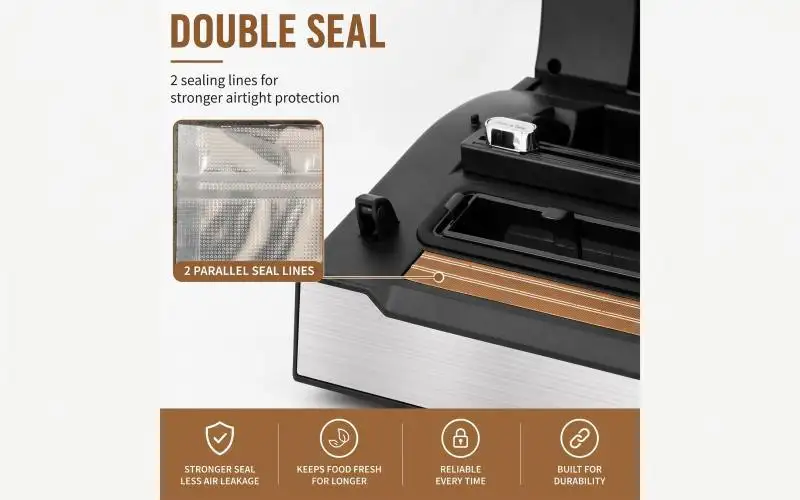
One of the most common customer complaints is air leakage caused by an imperfect seal. Inferior products often rely on a single, extremely thin heating wire.
When communicating with the factory, explicitly ask to see the specifications for the heating assembly. Top-tier suppliers utilize double heating wires that are at least 3mm wide, complemented by high-temperature resistant Teflon tape and high-density EVA foam pressure strips or silicone strip. Additionally, the machine must feature a removable drip tray to prevent liquids from flowing back and damaging the motherboard when vacuum-sealing moist ingredients.
3. Proprietary Tooling and Custom R&D Capabilities (ODM Strength)
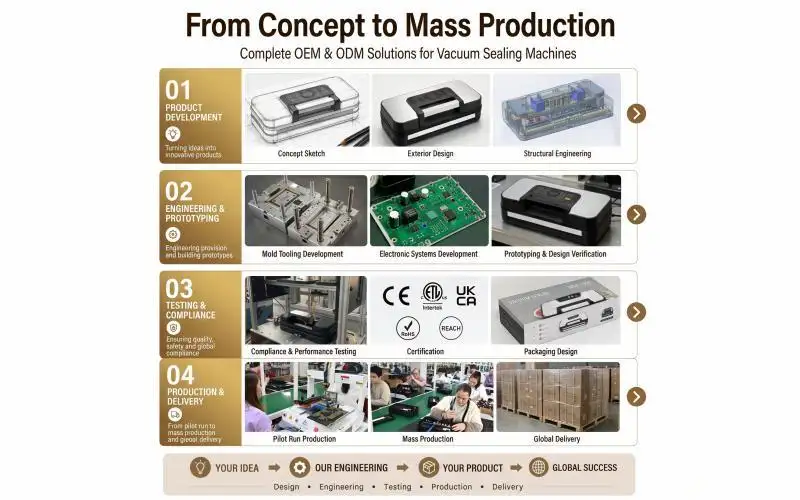
To stand out in a fiercely competitive market, you cannot simply sell generic, off-the-shelf products. When evaluating a supplier's ODM capabilities, look for in-house mold workshops and injection molding production lines. Can they create new molds based on your industrial design blueprints within 30 to 45 days? This ability to execute hardware prototyping from scratch—taking a concept from zero to one—is the key differentiator between top-tier manufacturers and small, low-end workshops.
Embracing New Trends: The Rise of Portable Vacuum Sealers
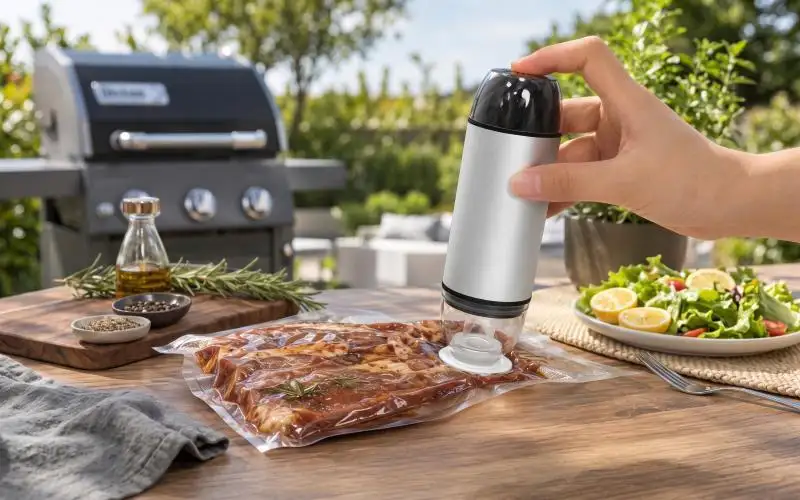
As modern kitchen spaces shrink and "glamping" (glamorous camping) culture gains popularity, bulky traditional countertop sealers are no longer the only option. Demand from overseas buyers for portable vacuum sealers is surging.
Why Should Brands Add Portable Models to Their Product Line?
Unlike large, plug-in units, portable sealers typically feature built-in lithium batteries and USB-C charging; they are compact enough to be held in one hand.
For consumers: They save significant drawer space and are ideal for resealing snacks, prepping food for sous-vide cooking, or even compressing clothing for outdoor travel.
For brands: These products have a moderate price point and low risk for market testing. They are also perfect for "seeding" marketing campaigns via short-form videos on TikTok and Instagram, making them excellent "traffic builders."
Look for experienced contract manufacturers with proven expertise in battery safety certifications (such as UN38.3 and UL) and noise-reduction technology for micro air pumps.
A Guide to Avoiding Pitfalls in B2B Procurement
When sending inquiries to overseas suppliers, be sure to clarify the following details upfront to avoid disputes during the contract signing stage. Don't be misled by "MOQ: 1 unit" claims on a webpage.
For true deep customization—such as screen-printing your logo, or designing custom color boxes—the standard MOQ for OEM vacuum sealers usually ranges from 500 to 1,000 units. If you want to altering the casing color, the MOQ usually need over 2000 units. If your initial budget is limited, try negotiating with the factory to purchase off-the-shelf "public mold" units screen-printed with your brand first to test market response, before investing in proprietary "private mold" development later.
Market Access Certifications
No matter how impressive the factory's machinery looks, if it fails to meet the electrical safety and food-contact certification standards of your target market, you risk total financial loss should the goods be seized by customs.
North American market: Require the factory to provide ETL or UL certification.
European market: CE-LVD and CE-EMC certifications, as well as RoHS compliance, are required.
Food-contact components (such as vacuum bags and internal suction nozzles): Must have FDA or LFGB material compliance reports.
Conclusion: Partnering with an Engineering-Minded Manufacturer
Finding the perfect vacuum sealer supplier isn't just about driving down procurement costs; it’s about finding a manufacturing partner capable of sharing after-sales risks and maintaining continuous R&D capabilities.
Whether you are dealing with high-power countertop units or trend-setting portable machines, you need a factory with technical expertise and rigorous quality control backing you up. Review your shortlist of potential suppliers now and use these rigorous standards to test their professionalism.
Related Articles

How Does a Slush Machine Work Without Ice?
2026-10-29
BY arafatshuvo509
Traditional blender's use of crushed ice to mix an ingredient into a thick, cold drink is replaced by today's slush makers which are able to achieve the same result using ...
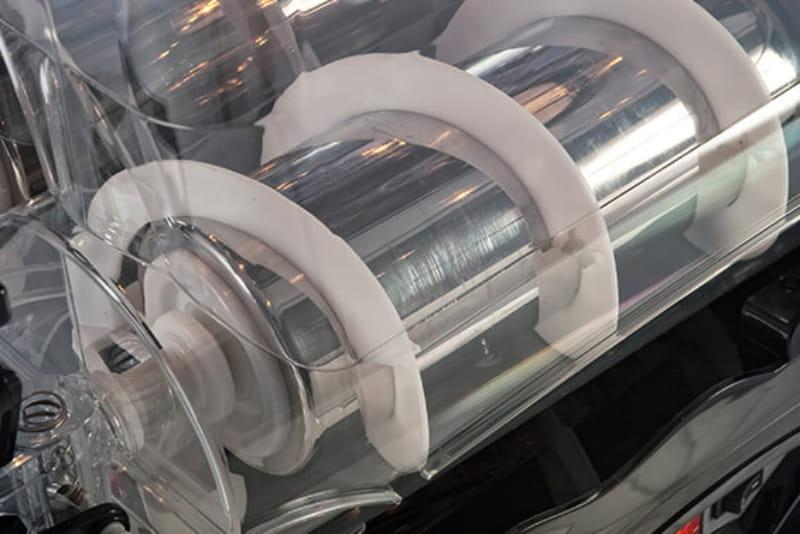
Compressor Slush Machine: Cooling System and Mixing Technology
2026-10-29
BY arafatshuvo509
A compressor slush machine utilizes an integral refrigeration process with continuous mechanical agitation of the refrigerated liquid to produce semi-frozen (slushy) liquids by creating ice crystals directly from the liquid. ...
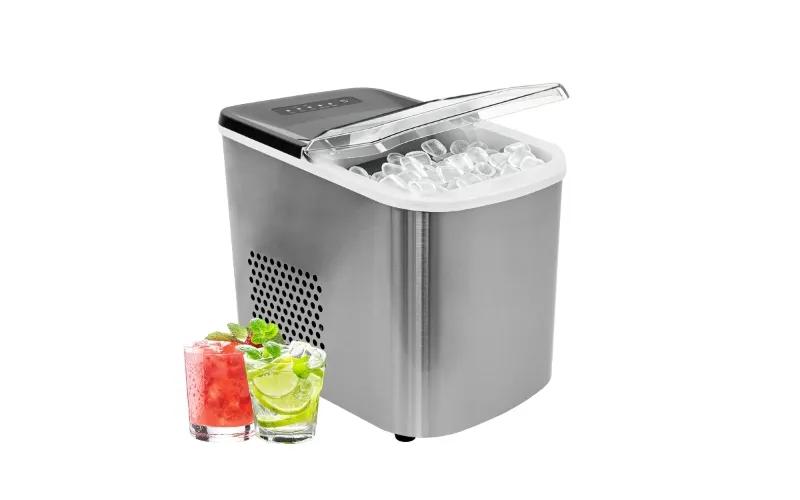
Ice Maker for Small Kitchen: Compact Design for Apartment Living
2026-10-27
BY YUMYTH
An ice maker that fits on an apartment countertop may still be difficult to operate. A wall can obstruct condenser airflow, an overhead cabinet can prevent the lid from opening ...
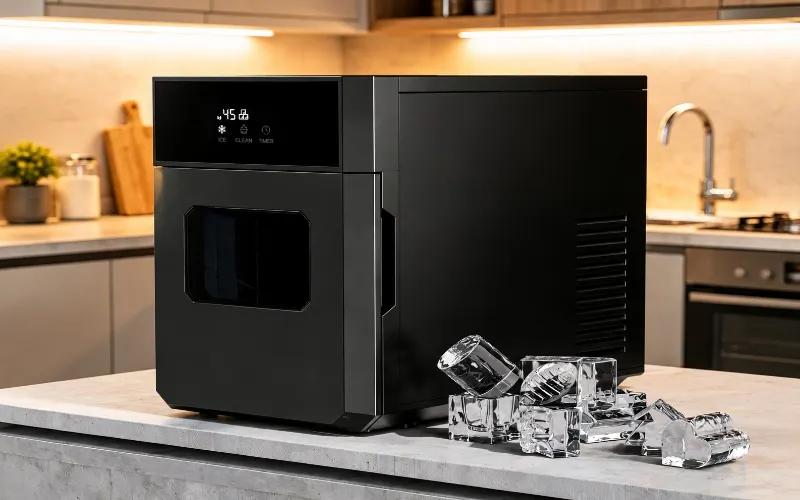
2026 Freestanding Ice Maker Trends: Clear Ice, R290, and Smart Controls
2026-10-27
BY YUMYTH
A freestanding ice maker that can produce 12.6 kg of ice in a day may still not meet expectations. Its ice may turn cloudy because of short freezing cycles, it ...