Private Label Slush Machine Development: From Concept to Mass Production
Share:
-

-

-

-


Copied
Share:
-
-
-
-
Copied
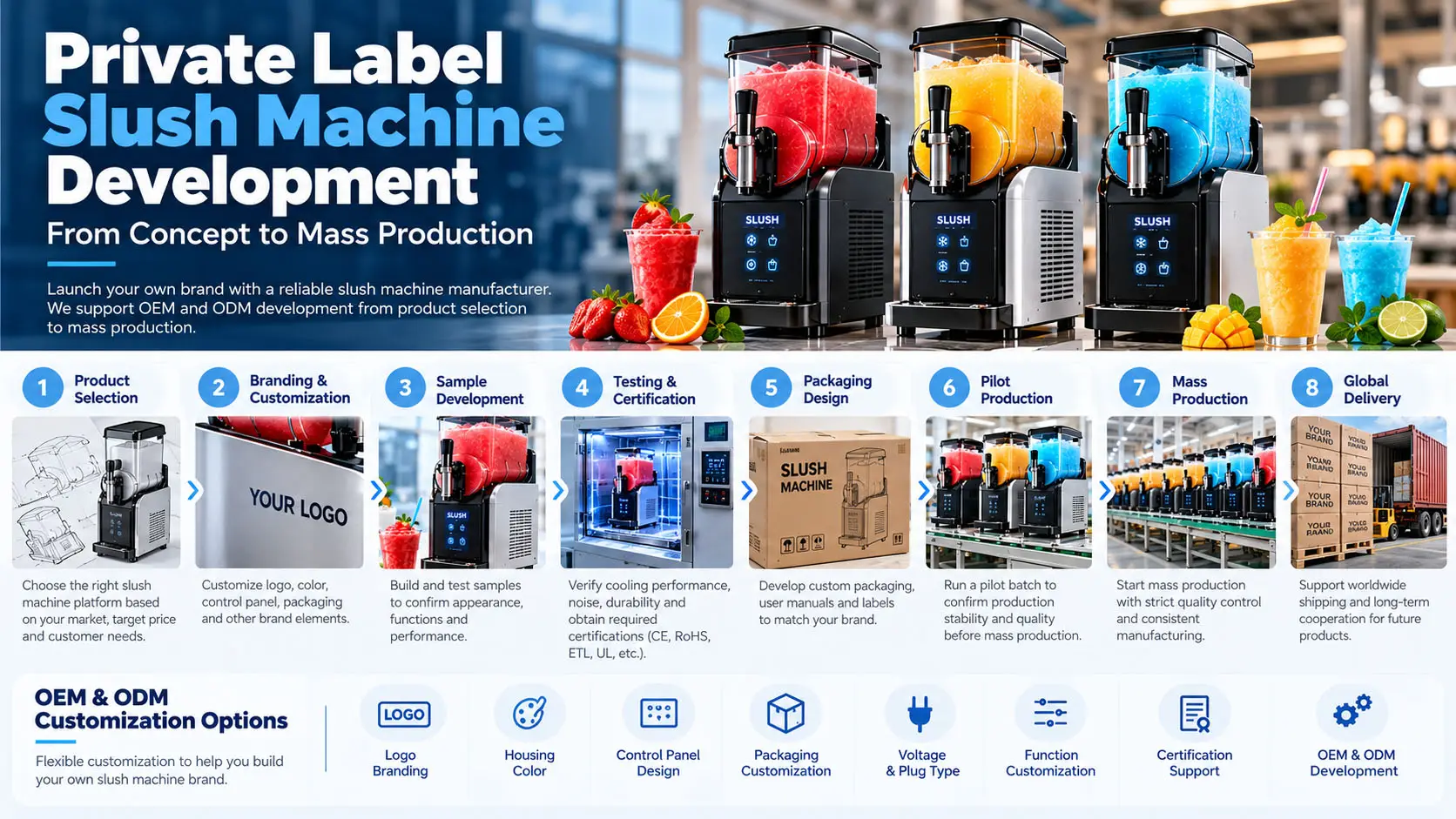
Launching a private label slush machine can be an effective way for appliance brands, importers, and distributors to enter the frozen drink market without building a product from scratch.
However, private-label development involves more than adding a logo to an existing machine. Buyers must consider product selection, branding, functions, voltage, packaging, certification, quality control, testing, and production planning.
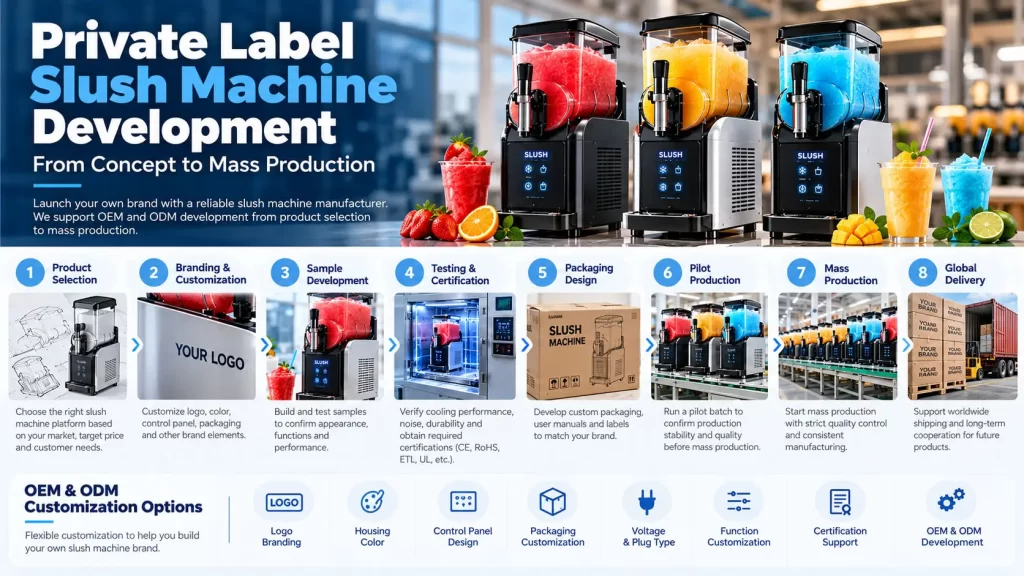
This guide explains how a private label slush machine project typically moves from initial concept to mass production.
What Is a Private Label Slush Machine?
A private label slush machine is manufactured by a factory but sold under the buyer’s own brand.
Depending on the project, customization may include:
- Brand logo
- Product color
- Control panel graphics
- Packaging
- Instruction manual
- Rating label
- Voltage
- Plug type
- Accessories
- Preset programs
- Product appearance
Private labeling allows brands to launch products faster than developing a completely new machine from the ground up.
Private Label vs. OEM vs. ODM
These terms are often used together, but they are not exactly the same.
| Model | Typical Scope |
|---|---|
| Private Label | Existing product with branding and packaging changes |
| OEM | Existing platform with selected functional or appearance customization |
| ODM | Deeper product development, including structure, tooling, software, or new functions |
For a new brand, private labeling is usually the fastest and lowest-risk starting point.
For established brands with specific market requirements, OEM or ODM development may provide greater differentiation.
Start With the Right Product Platform
The first step is choosing a suitable existing slush machine platform.
Buyers should compare:
- Capacity
- Cooling performance
- Freezing time
- Noise level
- Product size
- Control interface
- Cleaning method
- Beverage compatibility
- Power consumption
- Target retail price
The best platform is not always the model with the most features.
It should match the intended customer, price point, market, and sales channel.
Define Your Target Market
Before customization begins, clearly define where the product will be sold.
Important questions include:
- Which country or region is the target market?
- Is the product for home or commercial use?
- What voltage is required?
- Which plug type is needed?
- What certifications are required?
- What retail price range are you targeting?
- Will the machine be sold online, through retail stores, or through distributors?
These factors affect product configuration and certification decisions.
Customize the Brand Identity
Branding is one of the most important elements of a private-label project.
Common options include:
- Logo printing
- Laser marking
- Custom housing color
- Branded display graphics
- Custom control panel
- Product labels
- Private-label cartons
- User manuals
- Warranty cards
The appearance should match your brand identity while remaining practical for manufacturing.
For smaller first orders, using a standard housing color with custom branding may help reduce MOQ and cost.
Evaluate Functional Customization
Some private-label projects require more than visual branding.
Possible functional changes include:
- Different preset programs
- Adjustable texture levels
- Custom interface icons
- Modified temperature settings
- Different cleaning programs
- Language options
- Child lock
- Memory functions
- Different operating modes
More advanced functional changes may require software development or engineering evaluation.
These changes should be confirmed before sample production.
Confirm Cooling Performance
A private label slush machine must perform consistently under real operating conditions.
Important test items include:
- Initial freezing time
- Slush texture
- Beverage temperature
- Ambient temperature
- Brix range
- Continuous operation
- Compressor stability
- Noise
- Motor performance
If the target market includes hot climates, higher ambient temperature testing is especially important.
Check Beverage Compatibility
Different beverages freeze differently.
A reliable manufacturer should understand how formulation affects slush performance.
Common test liquids may include:
- Juice
- Soda
- Coffee
- Milk-based drinks
- Cocktails
- Wine
- Syrup-based drinks
Sugar concentration, alcohol content, and solids can all affect freezing behavior.
Before mass production, buyers should test representative beverage formulas.
Plan Voltage and Plug Configurations
Slush machines may require different electrical configurations for different markets.
Common examples include:
- 110–120V / 60Hz
- 220–240V / 50Hz
- US plug
- EU plug
- UK plug
- AU plug
If one project covers multiple regions, confirm whether each voltage and plug combination requires a separate MOQ.
Electrical configuration may also affect certification.
Review Certification Requirements Early
Certification should be discussed before finalizing the product.
Depending on the market, requirements may include:
- CE
- RoHS
- CB
- ETL
- UL
- EMC
- LVD
- Food-contact compliance
Using an existing certified platform can reduce development time and cost.
However, major structural or electrical changes may require additional testing.
Develop Custom Packaging
Packaging is part of both branding and product protection.
Private-label packaging may include:
- Custom color box
- Shipping carton
- Foam or molded pulp inserts
- User manual
- Accessories
- Barcode labels
- Retail labels
- Compliance markings
Packaging should be tested for transport durability, especially for compressor-based appliances.
Confirm MOQ and Development Cost
Private label MOQ depends on the level of customization.
A simple logo project usually requires less volume than a project involving:
- Custom colors
- New packaging
- Modified control panels
- Software changes
- New molds
- Structural changes
Buyers should ask about:
- Sample quantity
- Trial order MOQ
- Mass-production MOQ
- Tooling fees
- Engineering fees
- Packaging MOQ
- Lead time
This helps avoid unexpected costs later.
Build and Test Samples
Sample testing is one of the most important stages.
The sample should confirm:
- Branding
- Color
- Functions
- Cooling performance
- Noise
- Slush consistency
- Packaging
- Labels
- Voltage
- Accessories
If changes are needed, they should be completed before mass production.
For more complex ODM projects, multiple prototype rounds may be required.
Run a Pilot Production
Before a large order, a pilot run can help confirm production stability.
A pilot batch allows the buyer and manufacturer to review:
- Assembly quality
- Product consistency
- Packaging
- Functional performance
- Labeling
- Inspection process
- Shipping preparation
Pilot production helps reduce risk before scaling up.
Establish Quality Control Standards
Quality requirements should be defined clearly before mass production.
Inspection items may include:
- Appearance
- Cooling
- Compressor function
- Auger operation
- Noise
- Electrical safety
- Leakage
- Control panel
- Packaging
- Accessories
Buyers may also request third-party inspection before shipment.
Prepare for Mass Production
Once samples and pilot production are approved, the manufacturer can begin mass production.
Before production starts, both sides should confirm:
- Final specification
- BOM
- Packaging artwork
- Labels
- Manuals
- Quantity
- Delivery schedule
- Inspection standard
- Shipping requirements
Clear documentation helps avoid production errors.
After-Sales and Spare Parts Support
A private-label appliance program should also include long-term support.
Ask whether the manufacturer can provide:
- Spare parts
- Technical troubleshooting
- Replacement components
- Product updates
- Packaging revisions
- Certification support
- Future model development
This is particularly important for brands planning long-term sales.
Why Work With YUMYTH?
YUMYTH supports private-label, OEM, and ODM projects for frozen drink appliances.
Our development process can include:
- Product selection
- Branding
- Packaging
- Voltage configuration
- Functional customization
- Sample evaluation
- Testing
- Quality control
- Mass production
We work with appliance brands, importers, and distributors to develop products for different markets and sales channels.
If you are planning a new private-label slush machine project, our team can support you from initial product selection through production.
Frequently Asked Questions
What is a private label slush machine?
It is a slush machine manufactured by a factory and sold under the buyer’s own brand, usually with customized logo, packaging, labels, and selected product configurations.
How long does private-label development take?
The timeline depends on the level of customization. Simple branding projects are faster, while structural, tooling, or software changes require more development and testing.
Can I customize the color and logo?
Yes. Housing color, logo, packaging, control panel graphics, and labels can usually be customized depending on MOQ.
Do I need a new mold for private-label production?
Not always. If you use an existing product platform, a new mold may not be necessary. New tooling is mainly required for structural or appearance changes.
Can the manufacturer support multiple voltages?
Yes. Many slush machines can be configured for 110–120V or 220–240V markets, depending on the model and project requirements.
Should I test samples before mass production?
Yes. Sample testing is strongly recommended to verify cooling performance, appearance, branding, packaging, and product functions before bulk production.
Related Articles

How Does a Slush Machine Work Without Ice?
2026-10-29
BY arafatshuvo509
Traditional blender's use of crushed ice to mix an ingredient into a thick, cold drink is replaced by today's slush makers which are able to achieve the same result using ...
Compressor Slush Machine: Cooling System and Mixing Technology
2026-10-29
BY arafatshuvo509
A compressor slush machine utilizes an integral refrigeration process with continuous mechanical agitation of the refrigerated liquid to produce semi-frozen (slushy) liquids by creating ice crystals directly from the liquid. ...
Ice Maker for Small Kitchen: Compact Design for Apartment Living
2026-10-27
BY YUMYTH
An ice maker that fits on an apartment countertop may still be difficult to operate. A wall can obstruct condenser airflow, an overhead cabinet can prevent the lid from opening ...
2026 Freestanding Ice Maker Trends: Clear Ice, R290, and Smart Controls
2026-10-27
BY YUMYTH
A freestanding ice maker that can produce 12.6 kg of ice in a day may still not meet expectations. Its ice may turn cloudy because of short freezing cycles, it ...