
Production QC checklist
Share:
-

-

-

-


Copied
Share:
-
-
-
-
Copied
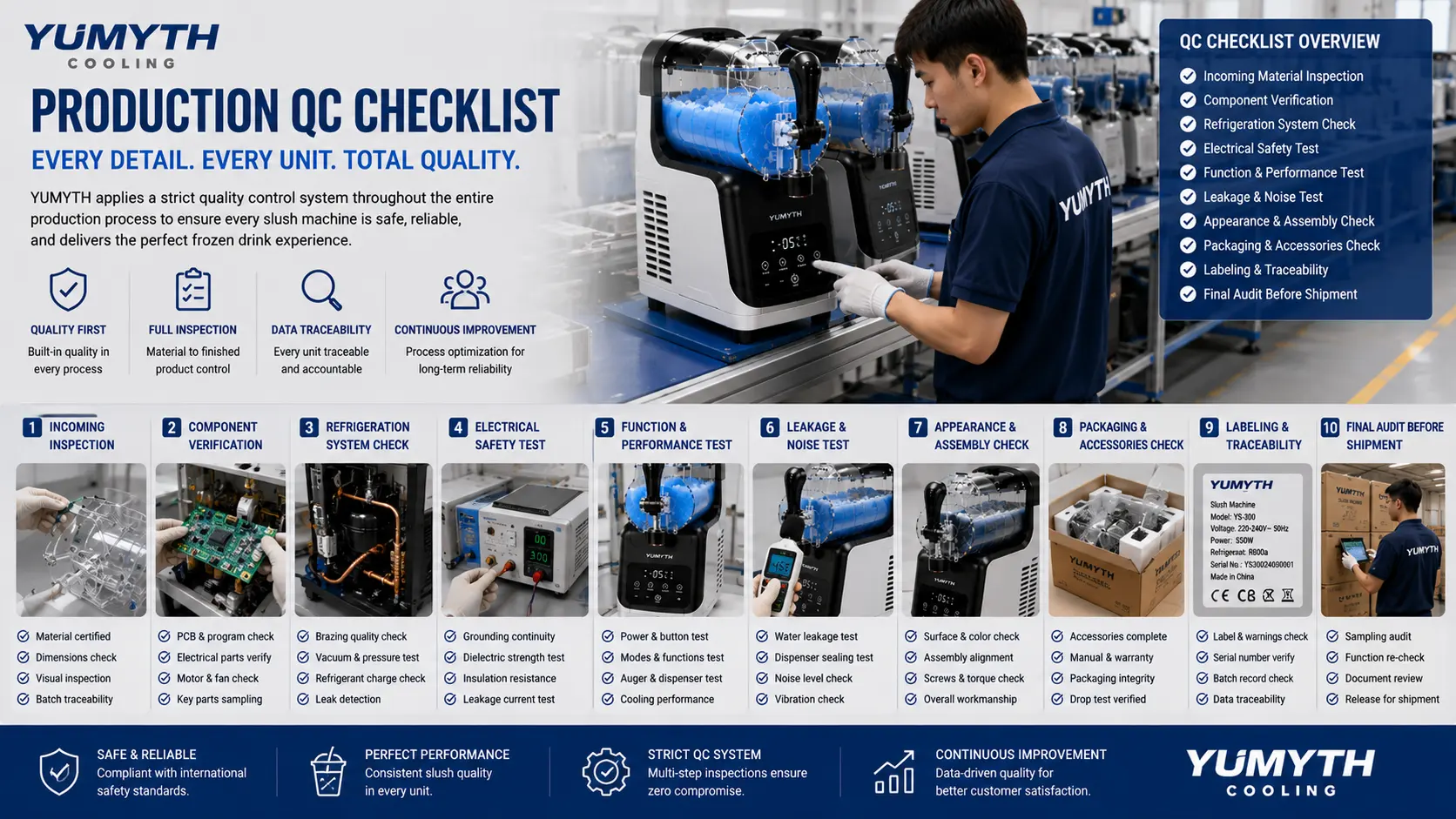
Production QC check list for home slush machines.
There is more to a good home slush machine than an approved prototype. Production batches need to be consistently reproduced from the approved design and refrigeration, food contact materials, electrical safety, mechanical assembly, software, appearance, and packaging must be controlled by the factory.
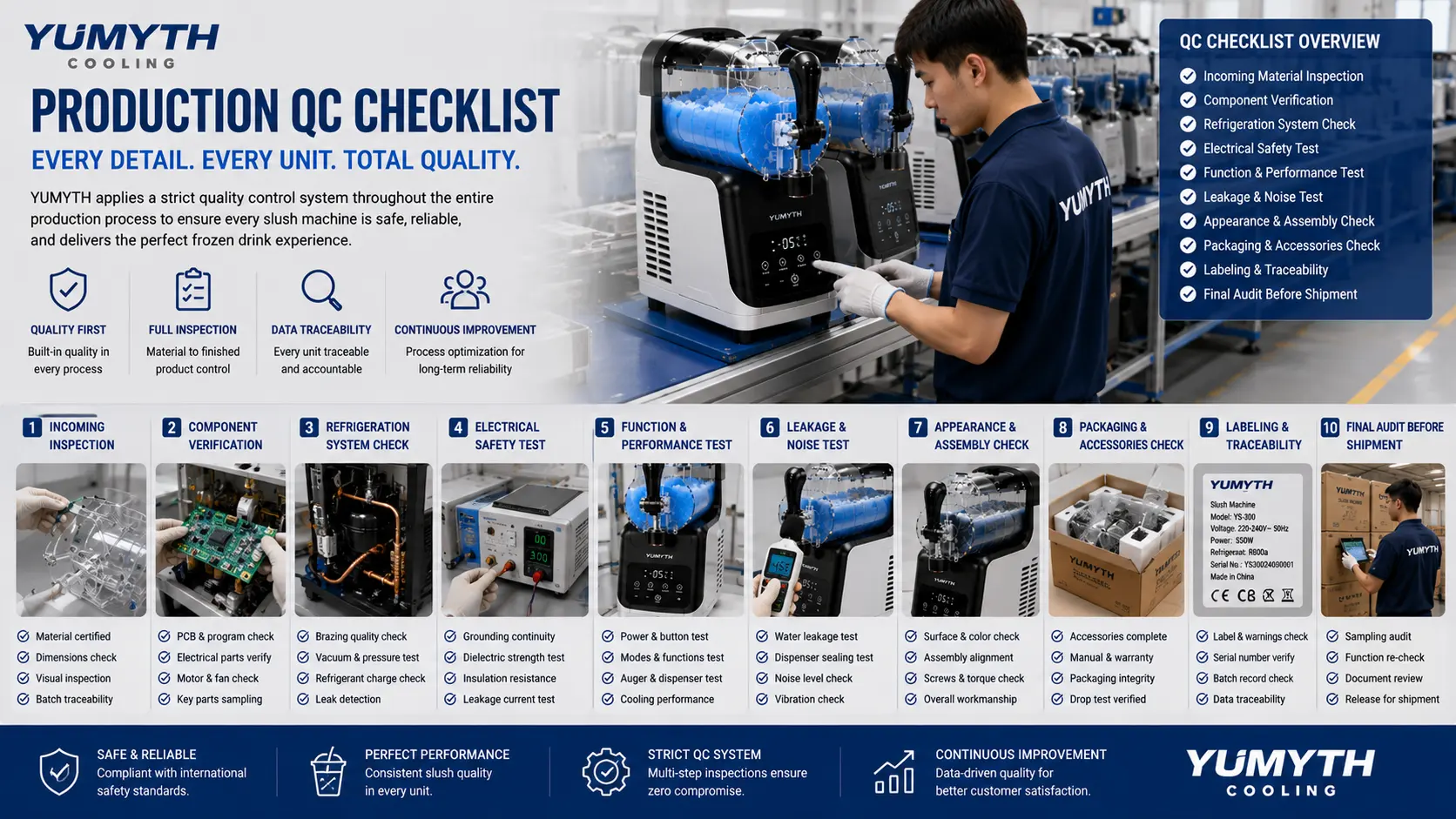
Using a production quality control checklist, appliance brands and OEM manufacturers can determine issues before the products go out. It also provides a record of the use of components, inspections performed and how nonconforming units were disposed of.
ISO 9001 is a well-established quality-management system to help organizations to establish processes, responsibilities, documentation, corrective actions and continuous improvement. But certification does not always imply product quality. Manufacturing slush machines requires translation of the control system into measurable procedures for each stage in the manufacturing process.
Confirm the Approved Product Specification
A controlled specification package should be used for production to start, not just a physical sample.
The following should be included in the approved documents:
- * Product model and version;
- * Bill of materials;
- * Mechanical drawings;
- * Refrigeration-circuit drawing;
- * Wiring diagram;
- Version of the PCB and firmware;
- * Food-contact material specifications;
- * Appropriate art techniques, processes, and products; and
- * Rating-label artwork;
- * Packaging structure;
- * Inspection requirements;
- * Approved golden sample.
All controlled components should have a supplier name, part number, technical specification, and approval status. Not replacing a component due to another that appears similar and/or cheaper.
Any compressor, fan, motor, relay, thermal protector, refrigerant tubing, PCB, food contact resin, seals, wiring or firmware changes must be formally reviewed before being put into production.
Inspect Incoming Components
Incoming quality control (IQC) is used to check for critical components prior to them entering assembly.
Inspection should focus on those components that relate to safety, refrigeration efficiency, food contact, noise, leakage and service life.
Some important checks to perform for incoming checks are:
- * Electrical rating; and
- * Engine torque and gearbox torque; and
- * Condenser-fan size and direction of air flow;
- * Type of transformer; and
- Power cord, plug, switch, and connector ratings;
- * Electric fuses; and
- * Type of water to be stored; and
- * type of augers;
- * Seal sensitivity to temperature; and
- * Dispensing-valve fit;
- * Refrigeration tubing dimensions;
- Include carton and insert specifications.
Food contact materials must correspond to statements and test reports from the approved supplier. NSF food-equipment certification principles focus on interconnected controls – material safety, hygienic construction, cleanability, product performance and factory auditing – rather than on claims of certification.
Inspectors should note batch numbers and supplier details in case a field problem arises so that a component can be traced.
Control Plastic and Food-Contact Parts
The dimensional and visual inspection of transparent tanks, lids, augers, seals, valves and nozzles are required to be strictly managed.
Inspectors will be looking for:
- Cracks and stress whitening;
- * Sharp edges or molding flash;
- * Weather conditions; and
- * Warping;
- * Incorrect color;
- * Surface clouding;
- * Poor transparency;
- * Incomplete molding;
- * Odor;
- * Incorrect fit;
- * Rough food-contact surfaces.
Defects or damaged surfaces that may hold beverage residue in food zones shall not be present. NSF food-equipment standards define standards for sanitation requirements for materials, design, construction, cleanability and performance for various types of food equipment. The applicable standard will depend on the actual intended use and classification of the product.
Critical dimensions should be measured using calibrated gauges. Leakage characteristics and mixing performance are directly related to tank alignment, auger clearance, seal-groove dimensions, and valve interfaces.
Monitor Refrigeration-Circuit Assembly
One of the most sensitive production areas is the refrigeration circuit. Freeze time, temperature stability, noise and compressor life can be influenced by small levels of difference in the condition, brazing, evacuation, refrigerant charge or airflow of the tubes.
The process checklist should be able to be controlled by:
- * Correct compressor installation;
- * Refrigerant tubing routing;
- Tube protection against sharp edges;
- * Brazed-joint appearance;
- Where specified, Nitrogen procedures were used;
- * Filter-drier installation;
- * Evacuation time and vacuum level;
- * Refrigerant type;
- * Refrigerant charge;
- * Leak-test result;
- * Compressor-mount installation;
- * Position of condenser and fan.
Calibrate and maintain charging equipment, scales, gauges and leak test instruments. The cylinders should be clearly marked to avoid the possibility of mixing or charging with the wrong refrigerant.
IEC 60335-2-24:2025 addresses specific safety requirements for refrigerating appliances, ice-cream appliances and ice makers. The appliance to be used for the production must be consistent with the construction assessed in the relevant certification program.
Verify Mechanical Assembly
All components should be properly secured without excessive stress or interference as verified by mechanical inspection.
Key checkpoints include:
- * Hooker and torque of the drive coupling; and
- * Gearbox alignment;
- * Motor fastener torque;
- * Tank locking;
- * Lid fit;
- * Seal orientation;
- * Dispensing-valve movement;
- * Drip-tray installation;
- * Fan clearance;
- * Cable routing;
- * Screw torque;
- * Cabinet-panel alignment.
Under normal operation conditions, the auger should be spinning without scraping into the vessel. Removable parts must slide in and out easily and should not be overly difficult.
Inspectors should also make sure that the important parts can not easily be installed in an unsafe position. The alignment arrows, keyed couplings, locking feedback and interlocks should operate as intended.
Check Electrical Safety
Inspecting electrical equipment and systems should be carried out with appropriate equipment and methods in compliance with regulation. IEC 60335-1 is a general safety standard for household and similar electrical appliances, which includes electrical, mechanical, thermal, fire, and other reasonably foreseeable hazards.
According to the approved safety plan, the following may be part of the production tests:
- * Ground continuity;
- * Dielectric strength;
- * Leakage current;
- * Power input;
- * Insulation condition;
- * Polarity;
- * Wiring connection;
- Properly checking the fuse and protector;
- * Control-panel operation;
- - unusual noises or smells.
The approved product specification and certification file is the source for test limits. Do not make up limits based on experience or upon copying values from an unrelated appliance.
Immediately isolate failed units. Once repaired, the entire battery safety test run must be repeated, not the single point that was repaired.
Perform Functional Testing
All completed appliances should be subjected to a controlled functional test prior to packaging.
The checklist should verify:
- * Power-on behavior;
- Display and button operation;
- * Preset programs;
- * Auger rotation;
- * Automatic reversal;
- * Compressor startup;
- * Condenser-fan operation;
- * Temperature-sensor response;
- * Error messages;
- * Cleaning mode;
- * Dispensing operation;
- * Leakage protection.
The machine must be subjected to a factory test medium, water or otherwise, by a standard testing method. If conducting full freezing tests is only done on a sample of the units, a sufficient amount of functional testing should be performed on each unit to ensure that it is not wired incorrectly, has a blocked fan, a defective motor, sensor failure, or abnormal refrigerant-system failure.
Validate Cooling Performance
A representative freezing test should be performed for sampled units from each production batch.
The test should regulate:
- * Ambient temperature;
- * Starting liquid temperature;
- *×C is the amount of sugar in the drink;
- * Fill volume;
- * Selected program;
- * Ventilation clearance;
- * Supply voltage;
- * Texture endpoint.
Time in freezer, temperature of beverages, compressors, auger action, noise, leakage, and final texture need to be recorded by inspectors.
A machine that is cold is not necessarily acceptable. The drink should be soft, smooth and be easily dispensed without auger overload, compressor cycling or any abnormal temperature.
The results must be compared to the accepted performance limits but not the result obtained from one ideal prototype.
Check any noise or vibration issues.Check any noise and vibration problems.
The abnormal noises can point out the wrong assembly before the component fails.
There are some sounds that operators need to pay attention to:
- * Auger scraping;
- * Gearbox knocking;
- * Fan contact;
- * Compressor impact;
- * Loose panel vibration;
- * Refrigerant-line contact;
- * Relay chatter;
- * Drive-coupling noise.
The background noise should be controlled in the inspection environment. A reference sample may be useful for operators to differentiate between normal compressor and refrigerant noises and defects.
Acoustic testing should be performed using instruments when the product has a specified noise level. If production changes are made to the fan, compressor, motor, mounts, or panels or the refrigerant charge, there should be more verification.
Run Dispensing and Conduct Leakages
After the removable parts have been attached to the food system, the system should be tested.
Inspectors should check:
- * Tank-to-base leakage;
- * Seal-ring leakage;
- * Dispensing-valve leakage;
- * Value leaking after it has been shut;
- * Tank cracks;
- * Incorrect seal installation;
- * Valve-return operation;
- * Nozzle alignment.
A specific volume of liquid and period of observation should be used for testing. Slow leakage can not always be seen at the moment the tank is being filled.
The dispensing handle should move smoothly when opened and closed and the valve itself should return to its original position of sealing without manual adjustment.
Check how the plants look and label them.
The final quality control should be a comparison with the approved appearance standard.
The inspection should be concerned with:
- * Housing color;
- * Surface scratches;
- * Gaps and steps;
- * Printing alignment;
- * Logo position;
- * Display condition;
- * Fingerprints and residue;
- * Tank clarity;
- * Ventilation grilles;
- * Rating label;
- * Warning labels;
- * Serial number.
Product rating, refrigerant information, certification mark, model number, electrical data and manufacturer information should be identical to the approved market version.
Care should be taken to keep country and voltage markings apart to avoid potential misapplications.
Check the accessories and packaging.
Inspectors should verify that all necessary accessories and paperwork are in place prior to sealing of the carton.
The following items could be contained within the checklist:
- * Appliance;
- * Feed hopper; and
- * Lid;
- * Dispensing components;
- * Drip tray;
- * Cleaning brush;
- * Recipe guide;
- * User manual;
- * Warranty information;
- Power cord accessories or plug,
- * Protective films.
The packing sequence must be approved and follow the orientation sequence. The product should not slip too much in the carton and accessories should not come into contact with the transparent tank, control panel or other fragile surfaces.
All cartons, foam, pulp inserts, bags, tape and labels should correspond with the packaging specification previously tested to meet transporting requirements.
Implement Traceability and Nonconforming Control
All complete appliances should be coupled with an identifiable serial or batch number to significant production data.
Traceability records can include:
- * Production date;
- * Assembly line;
- * Operator or station;
- * Compressor batch;
- * Motor batch;
- * PCB version;
- * Firmware version;
- * Refrigerant charge record;
- * Electrical test result;
- * Final inspection status.
Any nonconforming units should be identified and physically segregated from accepted units. The factory must log the defect, cause of the defect, repair action, who is responsible, and the retest result.
If there is repeated defect, corrective action should be taken instead of repeat repair. The goal is to eliminate the process cause, not just the individual units.
Audit Finished Batches
Quality staff should conduct an audit of the sampled cartons from the batch before shipping.
The audit needs to confirm the function, look, labeling, add-ons, packaging, quantity, and shipping documentation for the products. Samples should be taken from various locations within the carton rather than just the most easily accessible location within the carton.
If the defect is serious or is repeated, then expanded inspection or production review or shipment hold should be initiated as per the agreed quality plan.
Conclusion
A production QC checklist is a set of approved slush machine designs which are put in a controlled manufacturing process.
The quality control process starts with the specification setting process of the product, continues with the refrigeration assembly, mechanical installation, electrical safety, functional test, cooling performance, leakage test, appearance inspection, packaging process, and tracing process.
The checklist should be backed by trained operators, calibrated equipment, documented acceptance criteria, controlled changes, and corrective-action procedures, for appliance brands and OEM manufacturers.
The objective is not just to check for the presence of defects at the end of the production line. It is to eliminate variation at all stages in order to ensure safe operation, consistent performance of frozen drinks, ease of cleaning and long life for every machine shipped.
Related Articles
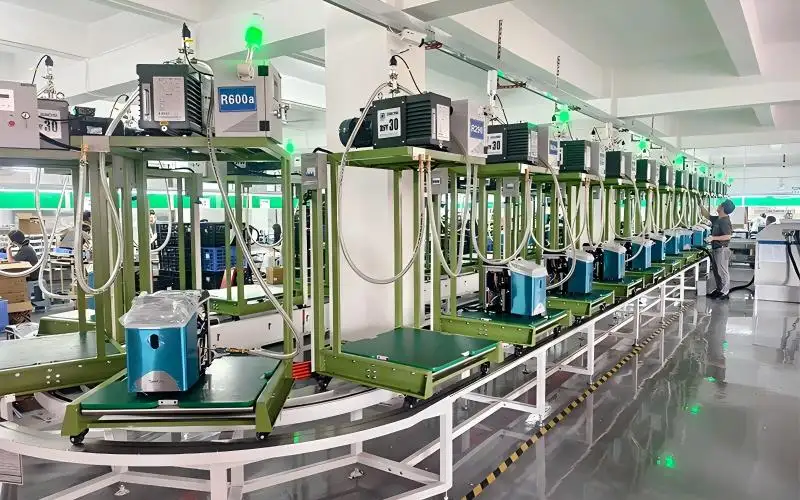
How We Test Every Ice Maker Before Packaging
2026-09-15
BY YUMYTH
A step-by-step look at refrigerant handling, cooling verification, leak detection, corrective action and electrical safety testing For an ice maker, reliable performance is determined long before the carton is sealed. ...
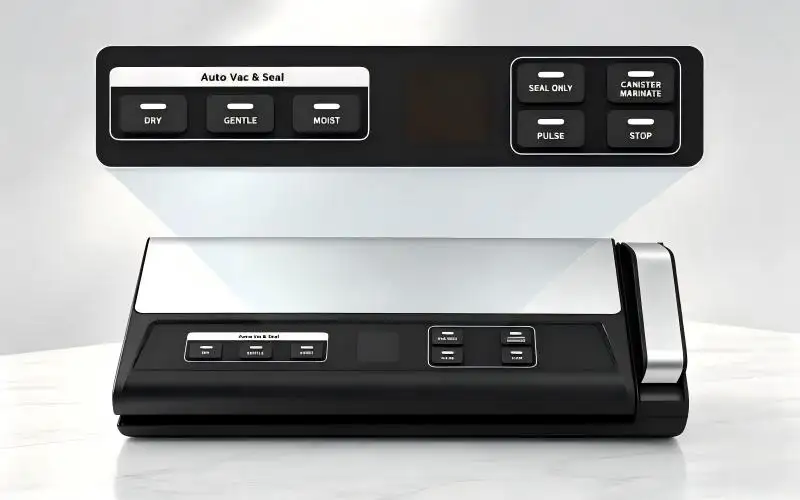
Guide for Brands Looking for a Reliable Vacuum Sealer OEM Supplier
2026-09-14
BY YUMYTH
When you are sourcing kitchen appliances for your retail brand, finding a dependable vacuum sealer OEM supplier is rarely just about getting the lowest unit price. It is about protecting ...

Why Ice Shape Matters: Understanding 10mm × 15mm Cylindrical Nugget Ice
2026-09-14
BY YUMYTH
More Than Ice Production — The Ice Itself Shapes the Consumer Experience When sourcing a nugget ice maker, buyers often focus first on production capacity, water tank size, ice basket ...

Ice Maker Sourcing Guide: How to Find the Right Factory
2026-09-10
BY YUMYTH
Sourcing an ice maker looks straightforward on paper. Find a supplier, agree on a price, place an order. But anyone who has actually done this knows the process is rarely ...