
Is R290 Suitable for Countertop Slush Machines?
Share:
-

-

-

-


Copied

Share:
-
-
-
-
Copied
Yes, R290 can be used in countertop slush machines where the refrigeration machine has been designed, made, tested and certified for this flammable refrigerant.
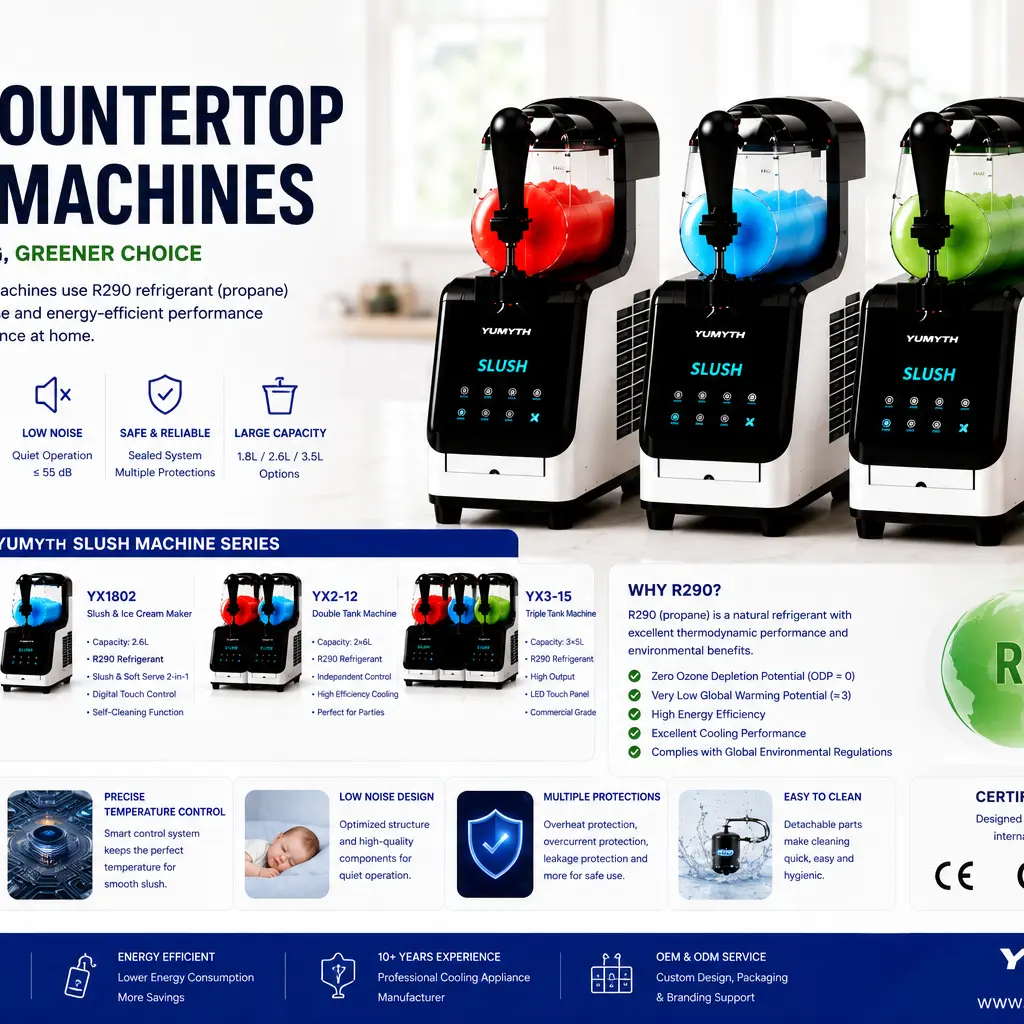
Propane or R290 has the potential of offering efficient cooling capacity in a compact sealed refrigeration circuit. It offers good thermal efficiency, minimal environmental footprint, and can be used with various types of small compressor systems, making it an ideal choice for modern no-ice slush machines.
Currently, YUMYTH's coolant for the YX1801 Mini Slush Machine and the YX1802 Slush and Ice Cream Maker is R290. The products illustrate the compatibility of R290 with the size of the household frozen drinks machine that integrates compressor cooling, continuous auger mixing and has space-saving countertop dimensions.
R290 is a high-flammability refrigerant that is an A3 refrigerant. Therefore its suitability will not be determined by its refrigeration efficiency alone. These are all necessary items that must be covered: refrigerant charge, tubing protection, component placement, leak prevention, ventilation, labeling, factory controls and product certification.
What Is R290?
Propane is the standardised refrigerant designated R290. ASHRAE classifies refrigerants by toxicity and flammability properties, and refers to propane as refrigerant #290. R290 is normally given the designation A3 for low toxicity and high flammability.
Inside a countertop slush machine, R290 should remain sealed within a circuit containing:
- A compressor;
- A condenser;
- A capillary tube or expansion device;
- An evaporator;
- Refrigerant tubing.
The compressor pumps refrigerant to circulate it around the system. The heat is taken up at the evaporator and is released at the condenser. At the same time, the auger will take the ice crystals off of the cold surface and spread them around within the beverage.
Consumers do not normally handle or refill the refrigerant during ordinary operation.
Why R290 Works Well in a Compact Appliance
The condenser, compressor, fan, evaporator, motor, insulation, control board and beverage tank have a limited amount of space in a countertop machine.
If all the components of a refrigeration system are properly matched, R290 can be used effectively in small hermetic refrigeration systems. European Commission project data states that R290 is a refrigerant with near zero GWP for small hermetic refrigeration systems—and compressor manufacturers provide R290 solutions for frozen beverage and slushy-machine applications.
Its compact-system advantages can include:
- Strong cooling performance;
- Relatively small refrigerant quantities;
- Efficient heat transfer;
- Reduced environmental impact;
- Compatibility with no-ice freezing systems.
But R290 cannot automatically be used to make an efficient machine. All the components of the compressor, condenser area, fan airflow, capillary tube, evaporator, insulation and the refrigerant charge must be developed in a balanced manner.
A poorly designed R290 circuit has the potential to yield slow freezing, high compressor temperature, excessive noise, and/or an unstable beverage texture.
R290 Has a Very Low Environmental Impact
R290 is a natural refrigerant that does not contain any fluoride. According to the European Commission guidance, it has a GWP of about three, under the commonly used reference values, and is much lower than many of the legacy HFC refrigerants. It is also classified in safety group A3.
This low GWP is significant because markets are ongoing shifting away from high GWP fluorinated gases.
For appliance manufacturers, the choice of R290 can help to ensure a longer term refrigeration platform by minimising reliance on refrigerants which could become more strictly regulated or less available.
The overall environmental performance remains subject to the whole appliance. Other factors include energy use, product longevity, minimizing leaks, repairability, packaging and end-of-life management.
Is R290 Safe in a Countertop Slush Machine?
R290 can be used safely in a compliant countertop appliance, but its flammability must be treated as a central engineering requirement.
IEC 60335-2-24:2025 covers the safety of household refrigerating appliances and household ice-cream appliances. It also addresses compression-type household and similar appliances using flammable refrigerants.
A safe design may require:
- A controlled refrigerant charge;
- A sealed and mechanically protected circuit;
- Reliable brazed connections;
- Suitable leak testing;
- Careful electrical component placement;
- Protection against tubing damage;
- Appropriate ventilation openings;
- Refrigerant warnings and service instructions;
- Safe transport and packaging design.
The product should also be designed to take account of reasonably foreseeable misuse. Users can relocate the machine, clean removable components, set up the machine next to other kitchen appliances, or run the machine in a small kitchen. The design should minimize the risks of a leak reaching to an ignition source or to a dangerous concentration.
Refrigerant Charge Must Be Precisely Controlled
The correct refrigerant charge is essential for both performance and safety.
Too little R290 may result in:
- Reduced cooling capacity;
- Longer freezing times;
- Incomplete evaporator cooling;
- Unstable texture;
- Higher compressor operating temperatures.
Excess refrigerant can cause high refrigerant pressure, imbalance in the system, loss in system efficiency and refrigerant release in the event of a sealed circuit failure.
The optimal charging method for all production machines is by weight and with calibrated equipment. The approved quantity of refrigerant must be listed in the technical specification, safety file, rating label, work instructions and production records.
The Safe Use of Flammable-Refrigerants rules outlined by US EPA in paragraph 79.5072 of the rules for R290 (R.5663) make it clear that use conditions and charge limits are linked to the type of equipment and include safety standards. Those refrigerator household rules don't necessarily apply to a slush machine but they show the importance of manufacturers complying with the requirements for the specific intended use.
Factory Controls Are Especially Important
A factory producing R290 appliances needs appropriate refrigeration-process controls.
Important production capabilities include:
- Ventilated charging areas;
- Controlled refrigerant storage;
- Ignition-source management;
- Trained refrigeration operators;
- Calibrated charging scales;
- Vacuum and pressure equipment;
- Leak detectors suitable for hydrocarbons;
- Brazing-process controls;
- Emergency procedures;
- Batch traceability.
All sealed systems should be checked at the factory prior to final assembly and shipment. The tests that can be conducted include vacuum performance, refrigerant charge, circuit leakage, compressor operation, freezing performance, electrical safety, noise, and abnormal-operation protection.
The processes that can be used safely for the production of R290 may not be available on a supplier that has only been involved in the production of non-refrigerated kitchen appliances.
R290 Can Support Fast and Stable Slush Formation
The refrigerant influences how effectively the evaporator removes heat, but the final drink texture depends on the entire appliance and recipe.
A well-developed R290 system can support:
- Direct beverage freezing;
- No added ice;
- Stable evaporator temperatures;
- Controlled ice-crystal formation;
- Compact countertop construction;
- Efficient holding after the drink is ready.
YUMYTH's R290 countertop platforms feature compressor cooling, preset programs, texture adjustment, auger control and removable food contact parts. The published YX1801 platform is provided with a 1.8-liter “tank”, while the YX1802 provides the frozen dessert option.
This is because R290 is not the answer to the wrong drink. Too much alcohol can result in inadequate freezing and too little can lead to hard ice and auger overload. Recipe validation and refrigeration engineering are essential to go together.
What Consumers Should Know
Under normal use, the consumer should not need to interact with the refrigerant system.
Users should:
- Keep ventilation openings clear;
- Operate the appliance on a stable surface;
- Keep it away from flames and high-heat sources;
- Avoid puncturing or bending the refrigeration tubing;
- Avoid using sharp tools near the evaporator;
- Follow upright-standing instructions after transportation;
- Use qualified service support for refrigeration problems.
Do not routinely open the compressor compartment for cleaning. The removable beverage tank, auger, seals, dispensing parts, lid and drip tray are the only items for which the user manual applies.
The appliance will not run if it is seen to be damaged after delivery, smells strange or has damage to tubing.
What OEM Buyers Should Verify
Before approving an R290 countertop slush machine, an appliance brand should request:
- The exact refrigerant charge;
- Compressor and refrigeration-component specifications;
- The applicable safety standard;
- A complete safety test report;
- The critical component list;
- Refrigerant leakage and abnormal-operation tests;
- Rating-label and warning artwork;
- Factory charging and leak-testing procedures;
- Production-line safety controls;
- Certification coverage for the final customized model.
Buyers should verify that the documents match the approved production sample. A certificate for a related refrigerator, ice maker, or earlier slush machine does not automatically cover a modified product.
Changes to the compressor, refrigerant charge, tubing, evaporator, PCB, motor, housing, ventilation, or firmware may require certification-body review.
When Might R290 Not Be the Right Choice?
R290 should not be used if the manufacturer is inexperienced with flammable refrigerants, the charge cannot be controlled accurately at the factory, the design cannot protect the refrigeration circuit or the proposed charge configuration does not meet the requirements of the proposed market.
It may also be inappropriate if a project demands field service by the hydrocarbons technicians who are not trained and equipped to work with hydrocarbon refrigerants.
The choice should be made based on product type, regulations in the target country, product safety standards, production factory capacity, certification strategy, and long term service planning, not just the refrigerant price.
Conclusion
R290 is very well suited for use in a well designed, low-charge, enclosed refrigeration system in slush machines used for counter tops.
It offers excellent cooling capacity, system flexibility for compatibility with compact systems, and significantly reduced global warming potential compared to many other conventional HFC refrigerants. The current YUMYTH models of the countertop type illustrate the application in home slush and frozen dessert appliances.
The main drawback is its flammability. Manufacturers need to manage the refrigerant charge, circuit integrity, component layout, ventilation, labeling, manufacturing, testing, and certification.
However, for the OEM buyer the right answer to the "safe or unsafe" question is not just that R290 is safe or unsafe. It should be used where the particular machine, the factory process, the technical file and the approval by the target market have been designed from the outset around R290.
Related Articles
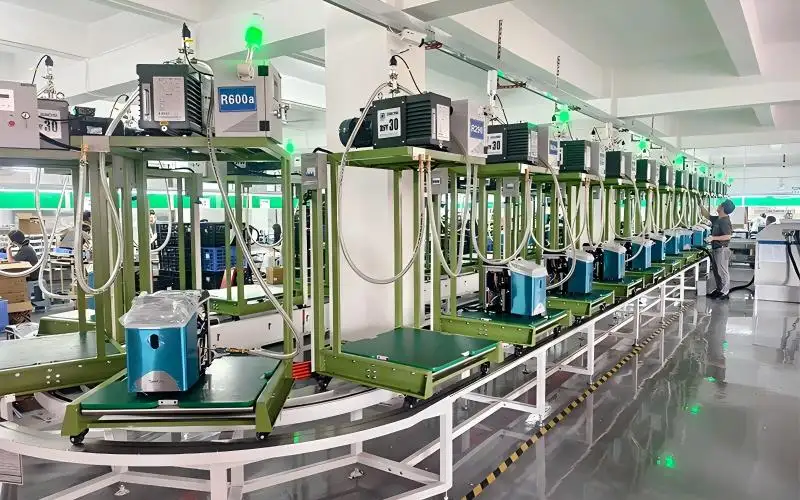
How We Test Every Ice Maker Before Packaging
2026-09-15
BY YUMYTH
A step-by-step look at refrigerant handling, cooling verification, leak detection, corrective action and electrical safety testing For an ice maker, reliable performance is determined long before the carton is sealed. ...
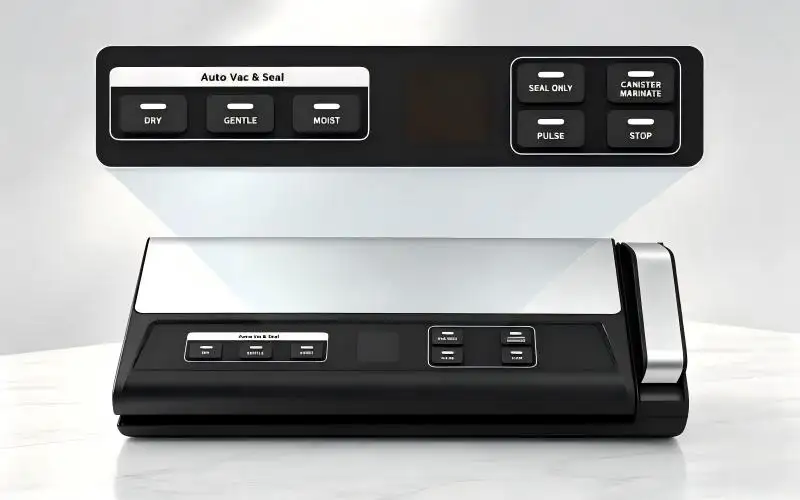
Guide for Brands Looking for a Reliable Vacuum Sealer OEM Supplier
2026-09-14
BY YUMYTH
When you are sourcing kitchen appliances for your retail brand, finding a dependable vacuum sealer OEM supplier is rarely just about getting the lowest unit price. It is about protecting ...

Why Ice Shape Matters: Understanding 10mm × 15mm Cylindrical Nugget Ice
2026-09-14
BY YUMYTH
More Than Ice Production — The Ice Itself Shapes the Consumer Experience When sourcing a nugget ice maker, buyers often focus first on production capacity, water tank size, ice basket ...

Ice Maker Sourcing Guide: How to Find the Right Factory
2026-09-10
BY YUMYTH
Sourcing an ice maker looks straightforward on paper. Find a supplier, agree on a price, place an order. But anyone who has actually done this knows the process is rarely ...