
Designing removable food-contact components
Share:
-

-

-

-


Copied
Share:
-
-
-
-
Copied
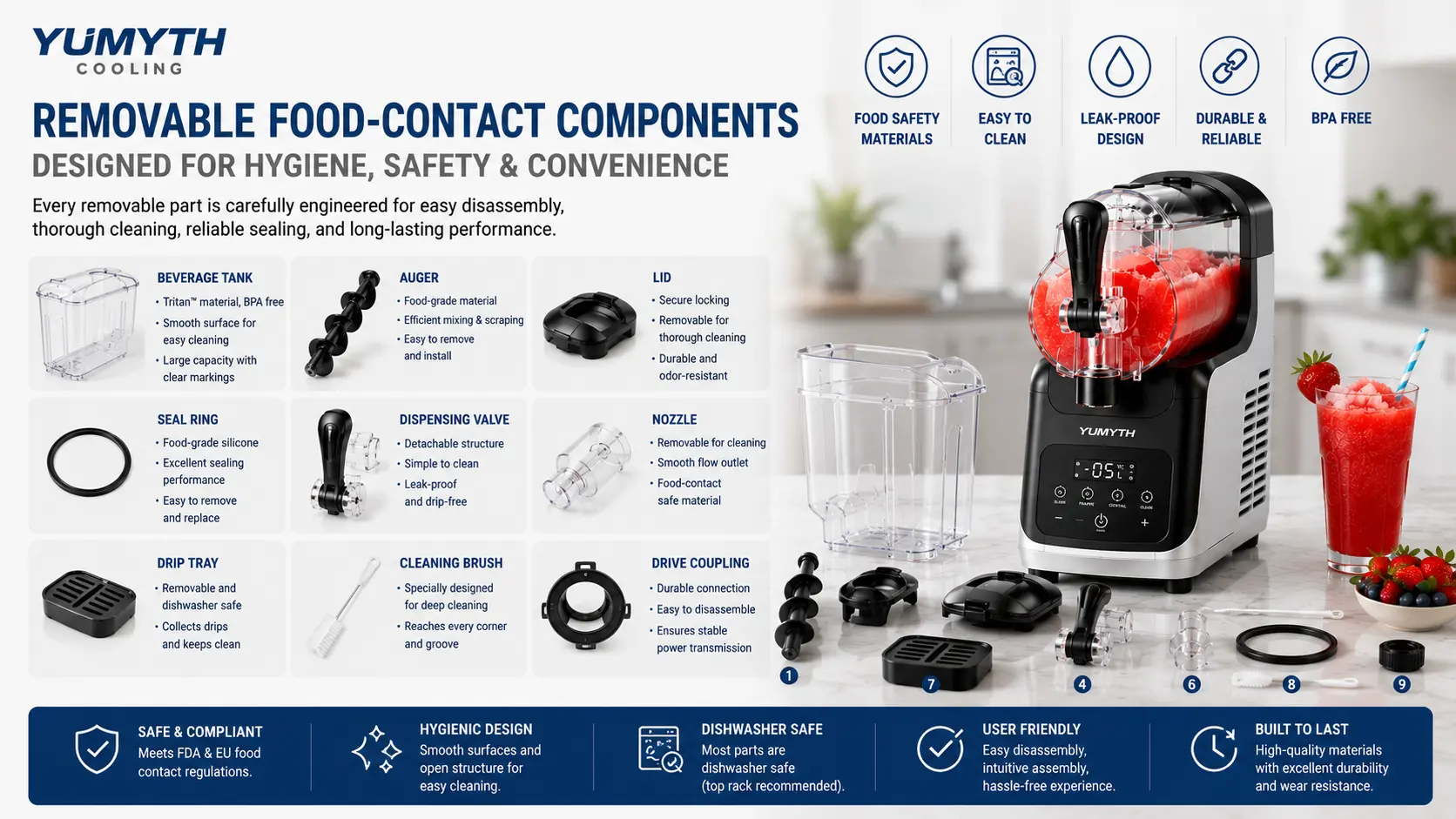
The service life, reliability, usability and hygiene of counter top food appliances are greatly affected by removable food contact parts. Users may clean the beverage tank, auger, lid, seals, dispensing valve, nozzle and drip tray frequently in a home slush machine, frozen drink maker, ice cream appliance, beverage dispenser or other similar type product.
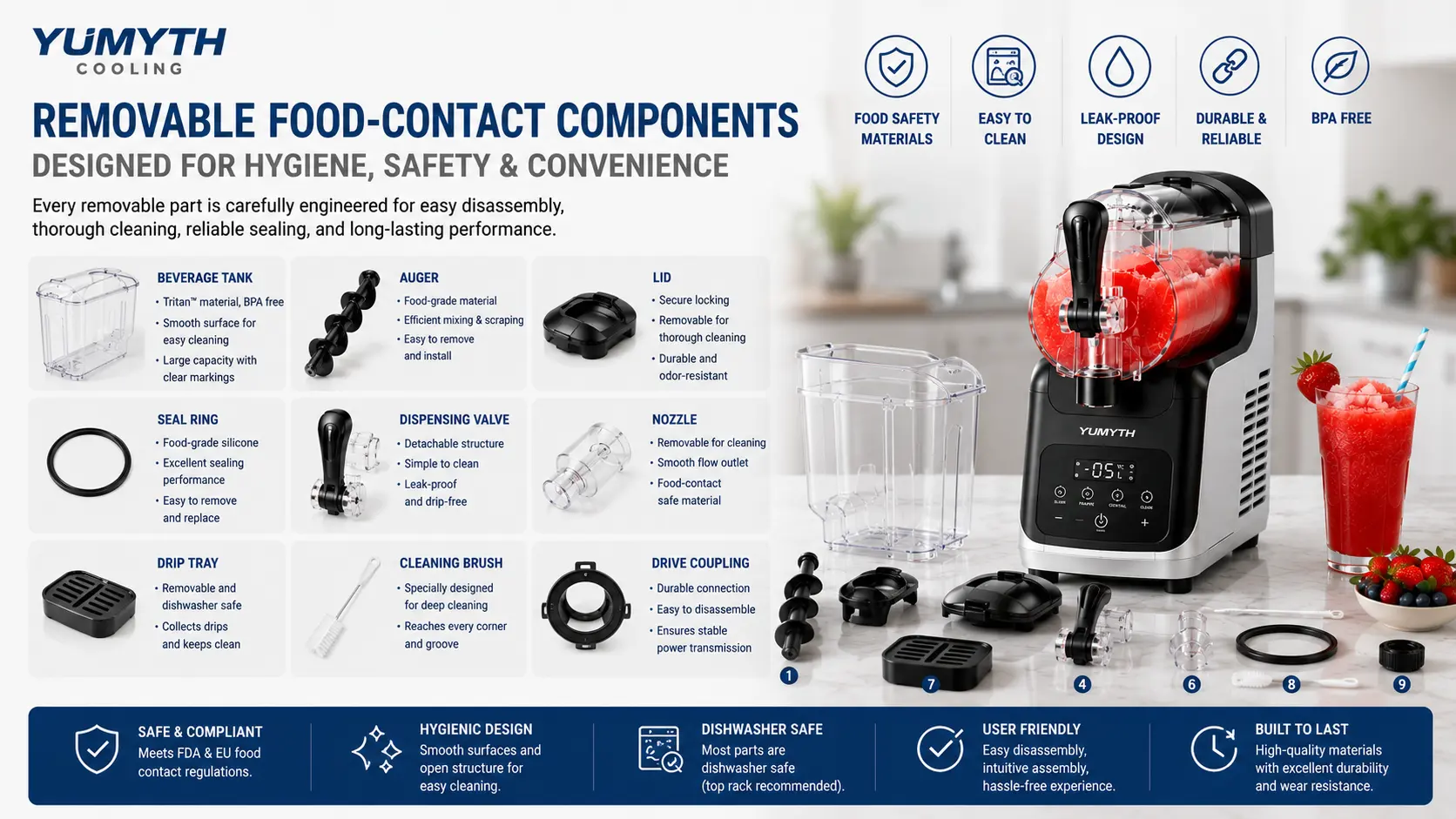
Parts that are looking somewhat simple mechanically are actually subject to a complex design that involves choosing the appropriate materials, designing a hygienic structure, its sealing, maintaining dimensional stability, validation of its cleanability, guidance for assembly, and testing for durability. A component that is hard to clean and/or easy to install incorrectly can be a cause of leakage, residue buildup, unusual odors, auger jamming, and customer complaints.
Explain the Complete Food-Contact Zone.
The first step in the design process is to determine all surfaces that come in contact with drinks directly or indirectly.
Examples of direct-contact parts are:
- * Beverage vessels;
- * Shovels and rakes; and
- * Scrapers;
- * Dispensing valves;
- * Nozzles;
- * Lids;
- * Seals and gaskets;
- * Measuring accessories.
Indirect-contact surfaces can be contaminated with condensation, splashes, foam, drips or residue, which can then be re-contaminated with the beverage. These include the underside of a lid, the area where the vessel is held, the dispensing housing and surfaces around the drip outlet.
The term "food-contact substance" as defined by FDA encompasses food-processing equipment, food-preparation surfaces, cookware, packaging materials, adhesives, colorants, and other substances that are likely to come in contact with food. This means that engineers should consider the entire piece—its main plastic or metal part—and not just the plastic or metal body.
A practical design review should start with the beverage being filled, then cooled, mixed, held, dispensed, disassembled, cleaned, and reassembled.
Choose the materials to be used in the appropriate situations
“Food grade” is not sufficient to ensure a material is appropriate for an appliance.
The performance of the materials will depend on:
- * Beverage composition;
- * Contact temperature;
- * Contact duration;
- * Alcohol concentration;
- * Acidity;
- * Fat content;
- * Cleaning chemicals;
- * Dishwasher temperature;
- * Repeated-use conditions.
The FDA provides a definition for the regulatory status of a food-contact article based on the status of the substances making up the article and the conditions under which it is used. Therefore, the consideration of resins, colorants, additives, coatings and adhesives and processing aids must all be taken together.
The Regulation (EC) No 1935/2004 is a general framework for food contact materials safety and inertness for the European markets. Materials should not release or transfer quantities that pose a health risk or are not acceptable to change the composition of food or its odor or taste. Plastics and other material categories may also have material specific requirements.
Slush machine material evaluation can require fruit acids, sugar syrup, dairy mixtures, coffee, alcohol, food colourings and multiple cold exposure.
The elements of design that are smooth, open and inspectable surfaces.Smooth, open and inspectable surfaces as elements of design.
Food residue is a common occurrence in sharp corners, deep grooves, blind holes, exposed threads, overlapping walls and narrow passages.
All internal food-contact surfaces must be smooth and easily accessible for cleaning using water, a sponge or the recommended brush. The rounded corners typically are easier to clean than the narrow, right-angle transitions.
Engineers should minimize:
- * any exposed parts of the boiler, such as pressure parts, that are not covered; and
- * Stops ignition; and
- * Decorative textures inside the food zone;
- * Unsealed joints;
- * Deep fastener recesses;
- * Water supply from narrow channels, with or without drainage;
- Hidden areas which are not accessible for visual inspection.
NSF food-equipment standards cover sanitation criteria related to materials, design, construction and performance standards for equipment. NSF also suggests that a hygienic design should be integrated as part of the concept development process, and not just done after the tooling is finished.
The surface quality should also be under control during production. Even with hygienic original designs, some residue may be left behind by scratches, molding defects, rough welds, flash or damaged coatings.
Minimize the number of unnecessary parts.
Each removable clip/ seal, screw, insert, cover and adapter create another surface requiring cleaning and re-attachment by the user.
Less parts mean less risk of small part loss and better cleaning. But part consolidation doesn't always make the most sense. High-wear parts must also be replaceable, and the replacement part should not be pricey, or else the customer will have to spend a lot of money to replace the main assembly.
For instance, the dispensing seal should be replaceable without replacing the whole beverage vessel if the seal is worn. A valve assembly can also be made up of a removable valve block which can be completely disassembled for thorough cleaning and replaced as needed.
The appropriate design balances:
- * Cleaning access;
- * Assembly simplicity;
- * Tooling cost;
- * Component durability;
- * Replacement cost;
- * Production efficiency.
Prevent Incorrect Reassembly
Removable components are often serviced by user who has no technical training. In that case, the appliance should make incorrect installation difficult.
Helpful elements of design:
- * Asymmetrical interfaces;
- * Alignment arrows;
- * Matching symbols;
- * Color-coded seals;
- * Keyed drive couplings;
- * Audible locking feedback;
- * Tactile stop positions;
- * Limited assembly directions.
A gasket can be circular shaped and look the same on both sides, but still have an orientation requirement. Although the seal is not faulty, if the user can quickly install it in reverse, the appliance is likely to leak.
The auger should have an easy fit with the drive shaft and not need a lot of effort. The tank must also have a good lock prior to use. The machine could be stopped from running if crucial components are not properly installed because of a position sensor or a mechanical interlock.
Seals For Repeated Handling (SRH) represents an engineer's solution to repeated handling.
Seals need to be compressed and also should withstand low temperatures, cleaning chemicals, multiple extraction, and variations in adjacent parts' dimensions.
The most common reasons for seal failure:
- * Excessive compression;
- * Insufficient compression;
- * Twisting during assembly;
- * Stretching during removal;
- * Sharp housing edges;
- * Incorrect groove dimensions;
- * Chemical incompatibility;
- * Permanent compression set.
Seal grooves should be used so as to maintain gasket position and prevent it rolling away from its intended seat. Rounded lead-in surfaces help to minimize cutting or pinching during installation.
Production representative seals should be tested after multiple sealing/unsealing and cleaning cycles. A good design that is not leaky at the start of use might leak after hundreds of cycles.
Take into account Thermal Expansion and Manufacturing Tolerances
A frozen drink machine can chill removable parts from room temperature to close to freezing temperature then bring them into the warm cleaning water or dishwasher cycles.
Materials expand and contract at different rates, such as plastic, stainless steel, silicone and more. These dimensional changes may impact sealing, auger clearance, vessel locking and dispensing valve alignment.
Too small of auger clearance may cause the auger to rub on the vessel when the parts get cold. Excessive clearance may cause reduced mixing and scraping efficiency.
To be tolerant, analyze:
- * Material shrinkage;
- * Tooling variation;
- * Production temperature;
- * Operating temperature;
- * Part wear;
- * Assembly variation.
Tests should be conducted on complete thermal cycles and not just at room temperature dimension.
Validate Manual and Dishwasher Cleaning
If the component is removable, do not state that it's dishwasher safe unless it's validated by repeated cycles.
May be caused by: dishwasher heat, dishwasher detergent, water pressure, and drying conditions.
- * Warping;
- * Cracking;
- * Surface clouding;
- * Color fading;
- * Seal deformation;
- * Printed marking damage;
- * Reduced mechanical strength.
Validation of manual cleaning should be used to determine if all important surfaces could be cleaned by ordinary cleaning tools. If some sort of special brush is needed for dispensing channel or seal groove, it should be included with the product or be made specific.
The type of soil, surface material, cleaning agents, water temperature, contact time, and mechanical action are all important factors in cleaning and sanitizing programs. NSF guidelines focus on defined procedures with respect to food-contact surfaces, not just rinsing.
The components also need to be drained and dried out. Water that cannot be moved can cause odour, residue or storage hygiene problems.
Create Washable Zone and Appliance Base separation.
The user can remove the tank or valve when there's any beverage residue in the tank. The product should help to move drips away from the motor, control board, electrical connectors, sensors and refrigeration system.
Separating the food area from the appliance base can be accomplished through raised edges, drip barriers, drainage channels, sealed interfaces, and removable trays.
Engineers are to consider real-world non-compliance, such as:
- Removing a partially filled vessel;
- * Installing wet components;
- * Overfilling;
- * Spilling during dispensing;
- * Disconnecting the power cord; and
- Reinstalling parts before dry.
The appliance must stay stable when significant removable parts are removed; electrical areas which are cleanable normally must be protected from splash.
Test Long-Term Durability
Removable parts are subjected to greater than normal operating loads. They can be put in the sink, twisted when being removed, washed at high temperatures, or pushed into a wrong location.
The following is a list of factors that should be taken into account when developing a durability program:
- * Lease period; and
- * Locking-tab fatigue;
- * Handle-load testing;
- * Dispensing-valve cycles;
- * Seal-compression cycles;
- * Dishwasher exposure;
- * Chemical resistance;
- * Low-temperature impact;
- * Auger-coupling wear;
- * Drop testing.
Use of final materials, production tooling, actual surface treatments and approved suppliers should be used in testing. Prototype parts are not necessarily representative of mass produced parts.
It is important for engineers to document the progressive damage (stress whitening, looseness, scratches, loss of locking feedback, minor leakages, etc.) and not just total component failure.
Schedule for Replacement Parts in Advance
Even the most tough and hardy items can get stained, scratched, lost, or damaged over time. Brands of appliances should have a replacement option for high-use parts like:
- * Beverage tanks;
- * Augers;
- * Seals;
- * Lids;
- * Dispensing valves;
- * Nozzles;
- * Drip trays;
- * Cleaning tools.
Each part number, material specification, compatible model list and installation instructions should be controlled for each component.
Appliance life is increased, unnecessary complete product returns are minimized and after-sales service is improved.
Conclusion
Creating something that can be removed from the food must be more than just making it detachable. Components must be made of suitable materials, withstand the desired ingredients/cleaning conditions, prevent build-up of residues and be easily assembled correctly.
Strong designs for slush machines and other countertop appliances feature smooth surfaces and accessible geometry, protected seals, tight tolerances, easily marked alignment marks, good drainage and, in the case of slush machines, replaceable high-wear parts.
From the outset, hygienic design can enhance food safety, cleaning facility, mechanical performance, customer satisfaction, and product value.
Related Articles
How We Test Every Ice Maker Before Packaging
2026-09-15
BY YUMYTH
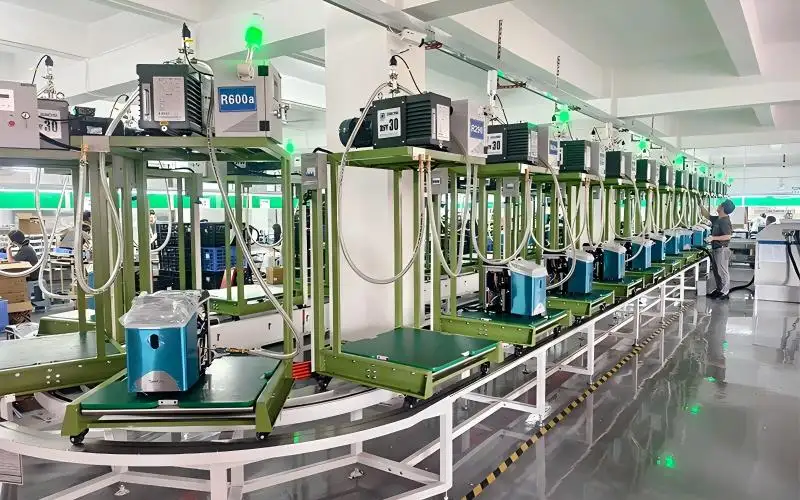
A step-by-step look at refrigerant handling, cooling verification, leak detection, corrective action and electrical safety testing For an ice maker, reliable performance is determined long before the carton is sealed. ...
Guide for Brands Looking for a Reliable Vacuum Sealer OEM Supplier
2026-09-14
BY YUMYTH
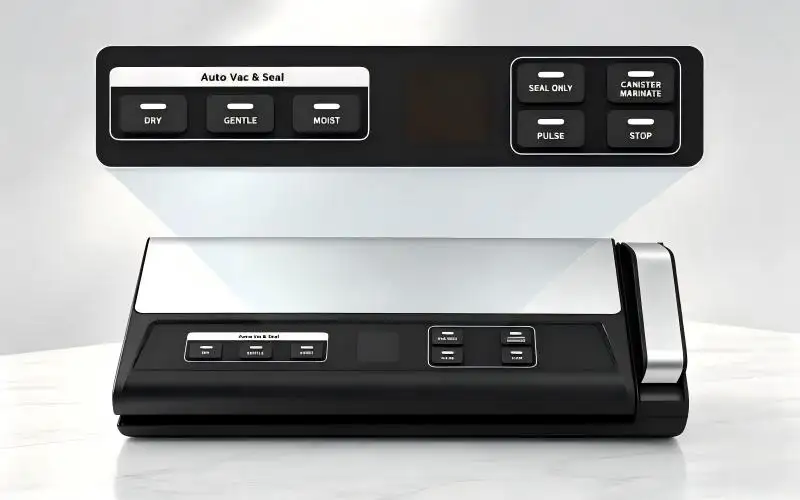
When you are sourcing kitchen appliances for your retail brand, finding a dependable vacuum sealer OEM supplier is rarely just about getting the lowest unit price. It is about protecting ...
Why Ice Shape Matters: Understanding 10mm × 15mm Cylindrical Nugget Ice
2026-09-14
BY YUMYTH
More Than Ice Production — The Ice Itself Shapes the Consumer Experience When sourcing a nugget ice maker, buyers often focus first on production capacity, water tank size, ice basket ...

Ice Maker Sourcing Guide: How to Find the Right Factory
2026-09-10
BY YUMYTH
Sourcing an ice maker looks straightforward on paper. Find a supplier, agree on a price, place an order. But anyone who has actually done this knows the process is rarely ...