
Self Cleaning Slushie Machine
Share:
-

-

-

-


Copied
Share:
-
-
-
-
Copied
The slushie machine is named self-cleaning because it is engineered to make frozen cocktails without having to clean the residue from the auger, dispensing valve, and food contact surfaces of the tank.
You don't have to add ice to make smooth frozen drinks with compressor-based slushie machines; they can create smooth frozen coffee, mocktails, drinks, and cocktails from a variety of juices and sodas. Sugar, fruit pulp, dairy ingredients, coloring and syrup may, however, stay in the machine after dispensing. This residue can dry, lead to odors or cause problems in moving parts or complicate the next cleaning cycle if not removed in a timely fashion.
A self-cleaning or automatic rinse program is used to help loosen and remove all the residue prior to washing the removable parts. It may minimize active cleaning time and add convenience, but consumers need to be aware that self cleaning typically works in conjunction with manual cleaning.
What is a self-cleaning "slushie" machine?
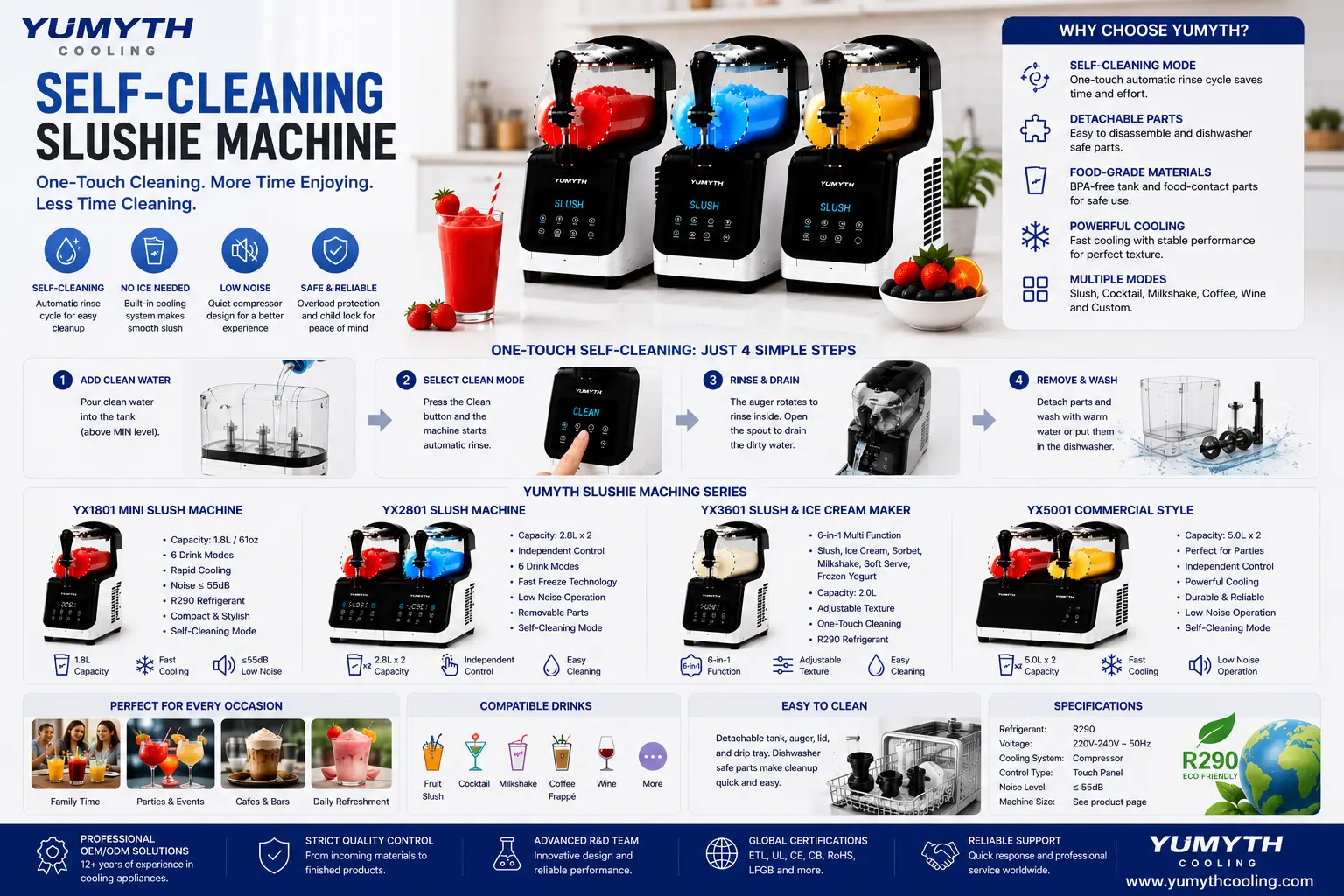
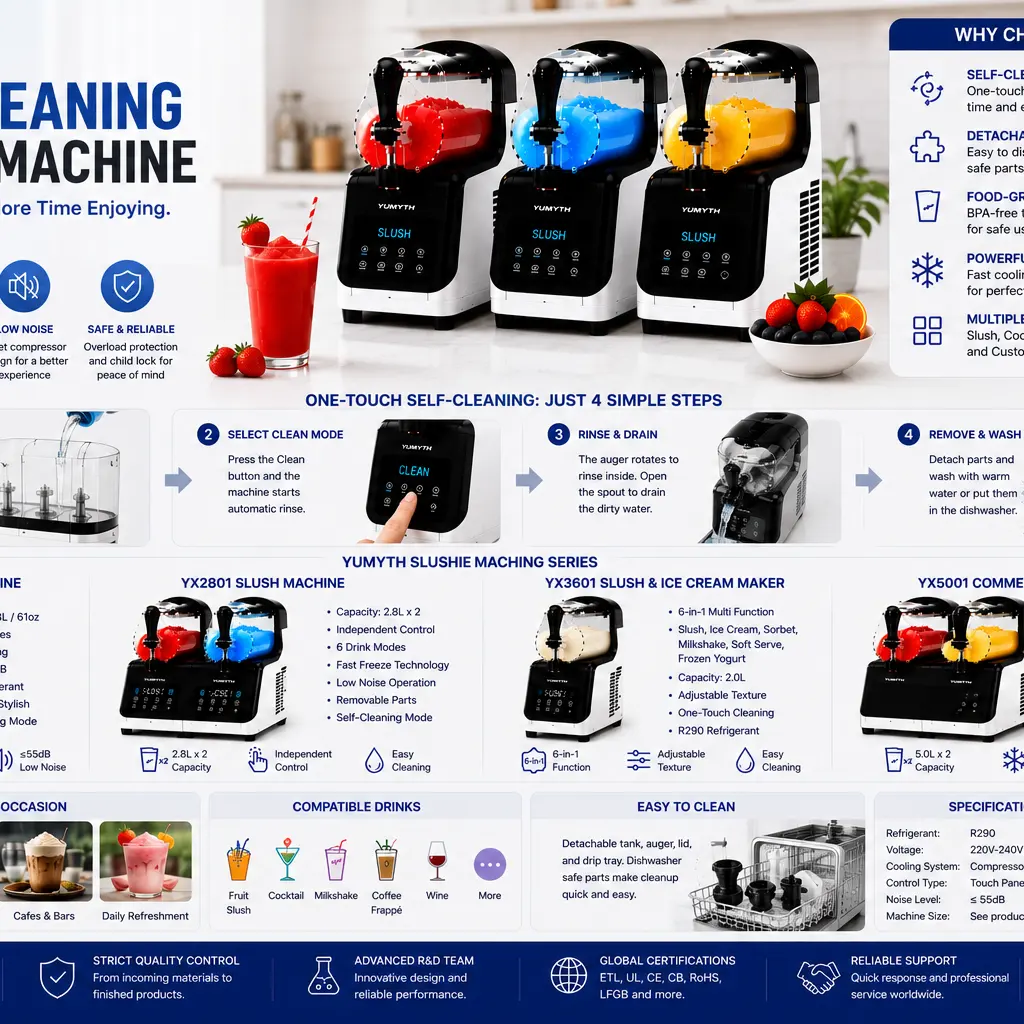
A self cleaning slushie machine typically has a separate program that spins the auger while water is being pumped through the beverage tank and dispenser.
This process normally consists of:
- 1. Dispensing or draining the last of the frozen drink;
- 2. Filling the tank with fresh water;
- 3. Choosing the cleaning programme;
- 4) letting the auger turn while it washes the food-contact area;
- 5. Dispensing the rinse water;
- 6. Discharging washable components for the last cleaning.
Some machines might have a short rinse cycle, while others offer timed cleaning programs that alert to the completion of the auger and provide automatic movement of the auger.
To stop the loose sugar, syrup, fruit, coffee or dairy residue from drying out. This means it will be easier and quicker to disassemble and wash later.
The Automatic Cleaning Cycle - how it works.
In cleaning, the auger is quite important. Under normal conditions, it will mix the drink and remove the ice crystals from the skin of the drinker. When the system is in cleaning mode, the same rotating structure circulates water throughout the tank and the tank areas that may still have beverage residue.
The firmware can control, depending on the design:
- * Auger speed;
- * Rotation direction;
- * Cleaning duration;
- * Pause intervals;
- * Completion alerts;
- * Dispensing instructions.
If splashing is a problem, try reducing the speed, or adjusting the direction of motion may help to rinse the blades of the auger on both sides of the blades. Some designs can also help to prevent the refrigeration system from running while the evaporator is being cleaned to prevent water from freezing on the evaporator.
This process should be easy to understand on the control panel. The amount of water to add, duration of program, and when the tank should be drained should not be left to the user's guess.
Self-Cleaning does not mean fully automatic.
The term, "self-cleaning", can set expectations that are difficult to meet. Automatic cleaning programs typically don't clean and sanitize every removable part of the appliance in most household appliances without assistance.
A rinse cycle can clear the actual main tank and dislodge any build-up around the auger, but it won't necessarily get there:
- * Seal grooves;
- * Dispensing-valve channels;
- * Nozzle interiors;
- * Tank locking interfaces;
- The bottom part of the cover;
- * Drip trays;
- * Drive couplings.
Manual washing may be necessary for sticky syrup, fruit pulp, dairy residue and dried ingredients.
Therefore, a more precise product description might be “automatic rinse mode,” “one-touch cleaning” or “assisted cleaning. Brands of appliances should make it clear what part of the process is automated and what part is not.
Why is fast cleaning so important?The reasons of fast cleaning
A slushie machine can be used for parties, family gatherings, summer drinks, frozen coffee and cocktails. Fewer steps required in cleaning is more likely to encourage consumers to use the appliance several times a week.
A properly designed cleaning system can decrease:
- * Periods of brushing with dried syrup;
- * Beverage odor;
- * Residue buildup;
- * Seal contamination;
- * Dispensing blockage;
- * Auger startup resistance;
- * Cross-flavor transfer.
This is a handy feature when users want to switch between different recipes. The machine can first make a fruit slush and it can also make frozen coffee. Most of the flavor can be washed off before the next flavor is added.
Users should also undergo a full cleaning between allergen-sensitive recipes, as well as between dairy/non-dairy drinks and alcoholic/children's drinks.
Removable Parts Continue to Be Essential
The most convenient self-cleaning machines are those that can rinse automatically, and that have removable food-contact parts.
Some removable components that are important are:
- * Beverage tank;
- * Auger;
- * Lid;
- * Dispensing mechanism with handle and valve; and
- * Nozzle;
- * Seal rings;
- * Drip tray.
All components should be easily removed without tools. The process can be made more intuitive with larger grip areas, clear alignment marks, keyed connections and having a limited number of loose parts.
The cleaning program will not prove to be as valuable if the user continues to have problems getting the tank out or putting the seals in. The most powerful designs are those that take cleaning into account from the start, not the last minute addition of a rinse button to a hard-to-clean mechanical design.
Smooth surfaces are more efficient in cleaning.Smooth surfaces are more efficient at cleaning.
The cleaning time is highly dependent on the geometry of the components.
Smooth internal surfaces help to carry the residue to the rinse water dispensing outlet. Round corners are easier to clean than narrow right angle corners. Open channels are more easily accessible than closed channels.
Good hygienic design should minimize:
- * Deep grooves;
- * Blind holes;
- * Exposed internal threads;
- * Rough molded surfaces;
- * Durable, sturdy, and comfortable materials; and
- * All plumbing connections; and
- Decoration of textures in the food zone.
These clear tanks can also be used to check if there is residue left in the tank after the rinse cycle. If an area cannot be seen or reached, it may be difficult to verify that it is clean.
You can save energy when using a dishwasher with dishwasher-safe parts.
Certain removable parts may be dishwasher safe. This can limit the amount of active labor, particularly following a thick or dairy recipe.
Users are advised to check before putting parts into a dishwasher that:
- * Approved components are determined; and
- * If so, what is its purpose?* If yes, what is it used for when?
- * The length of time for heated drying; and
- * How to use the correct detergent; and
- Whether separate washing of seals should be allowed.
Some plastics will warp, cloud, crack and/or be inaccurate in dimensional size when heated by dishwasher. Repeated cycles might also cause different aging of printed markings and silicone parts.
The claim dishwasher safe should be based on repeated durability testing – not on just one wash.
Cleaning a variety of drinks
Not every frozen beverage poses the same cleaning problem.
Sugar-based slushies: These tend to come off readily when washed at the time of use, but dried sugar syrup can get sticky and difficult to wash off.
Fruit drinks: Pulp, seeds, and fibers can clog the valve or auger.
Frozen coffee: Odor or discoloration can be caused by coffee oils and the dairy ingredients.
Milkshakes and dairy drinks: Food may need to be washed more carefully and protein/fat should not be left in warm appliance parts.
Frozen cocktails: Alcohol can easily rinse off, but fruit syrup, sugar and coloring can stay.
Specific instructions for the machine should inform the cook if certain recipes need to be cleaned at once or can be cleaned with a quick rinse.
Don't let the residue dry.
The optimum time to clean a slushie machine is right after dispensing the beverage.
Sugar can harden around moving interfaces and seals if left in the tank for several hours. Dairy ingredients can produce odour and fruit particles can clog small passages.
Most residue can be avoided from drying by a quick rinse right after use. This could substantially decrease brushing and soaking during the last wash.
Users should also not run the machine without dispensing for extended periods of time after dispensing. Some frost may remain and harden around the cooling surface and auger.
Cleaning the Appliance Base
Water should not be used to cover the refrigeration and electrical base.
The exterior should be cleaned using a soft damp cloth and according to the manufacturers' instructions around:
- * Control panel;
- * Ventilation grilles;
- * Tank mounting area;
- * Dispensing outlet;
- * Drive connection.
The compressor compartment, fan opening, electrical connectors and control board should be protected from water intrusion.
The product system should isolate the washable food section from the refrigeration and electrical systems. Do not have liquid drain into the appliance base when removing the tank.
Cleaning Programs require Safety Controls.
The automatic cleaning mode should include appropriate control logic.
Helpful safeguards may include:
- * Tank-installation detection;
- * Lid detection;
- * Limited auger speed;
- * Defined program duration;
- * Compressor deactivation;
- * Motor overload protection;
- * Completion alerts.
When a cleaning brush, utensil or hand gets into the tank during the auger operation, there could be a risk of injury or damage to components. The instructions should include the following: Do not reach into the tank while it is running.
The cleaning program should also cease safely if a component isn't installed properly.
The following are some points to consider when purchasing a file scanner.
When considering self-cleaning slushie machines, consumers need to look at more than just a “Clean” button.
Important questions include:
- 1. Does the program clean out the entire tank and auger space?
- 2) May the rinse water be delivered via the valve?
- 3. Can auger, valve, lid, seals and tank be removed?
- 4. Do the surfaces have a smooth texture and are they easy to see?
- 5. Is there anything that is dishwasher safe?
- 6. Does the cleaning brush come with it?
- 7. How many loose parts need to be washed?
- 8. Is it easy to put in seals?
- 9. Is full cleaning explained in the manual?
- 10. Is replacement of seals, valves available?
Any cleaning design that comes to life must minimize effort but without overpromising.
Self Cleaning for OEM Projects.
For appliance manufacturers who want to create an OEM slushie machine, they can tailor the cleaning process both mechanically and via the firmware.
Possible options include:
- * One-touch rinse programs;
- * Adjustable cleaning duration;
- * Automatic auger reversal;
- * Cleaning reminders;
- * Removable valve modules;
- * Color-coded seals;
- * Tool-free tank removal;
- * Dishwasher-compatible materials;
- * Included cleaning accessories.
Changes should be tested with real beverage residue. Clean water tests will not necessarily account for the machine's ability to process syrup, dairy, coffee or fruit pulp.
When it comes to cleaning times, you should be able to break it down into the following four categories: automatic rinse time, amount of manual work, dishwasher time, and overall elapsed time.
Conclusion
To facilitate preparation of frozen drinks, a self-cleaning slushie machine can help loosen up residue and rinse the main food contact surface automatically.
The best designs include one touch cleaning and removable tanks, augers, valves, seals and lids and drip trays. Smooth surfaces, easy to reach channels, clear instructions and dishwasher-friendly components can also minimize cleanup time.
It is important consumers note that automatic rinse is typically not a full substitute for washing, but rather the initial step in cleaning. The Food-contact Parts remain to be inspected and washed, rinsed and dried following the manufacturer's instructions.
A slushie machine can easily be maintained with technology and hygienic mechanical design.Technology and hygienic mechanical design makes it easier to maintain a slushie machine, more pleasant to use, and more suitable for regular frozen drink preparation at home.
Related Articles
How We Test Every Ice Maker Before Packaging
2026-09-15
BY YUMYTH
A step-by-step look at refrigerant handling, cooling verification, leak detection, corrective action and electrical safety testing For an ice maker, reliable performance is determined long before the carton is sealed. ...
Guide for Brands Looking for a Reliable Vacuum Sealer OEM Supplier
2026-09-14
BY YUMYTH
When you are sourcing kitchen appliances for your retail brand, finding a dependable vacuum sealer OEM supplier is rarely just about getting the lowest unit price. It is about protecting ...
Why Ice Shape Matters: Understanding 10mm × 15mm Cylindrical Nugget Ice
2026-09-14
BY YUMYTH
More Than Ice Production — The Ice Itself Shapes the Consumer Experience When sourcing a nugget ice maker, buyers often focus first on production capacity, water tank size, ice basket ...

Ice Maker Sourcing Guide: How to Find the Right Factory
2026-09-10
BY YUMYTH
Sourcing an ice maker looks straightforward on paper. Find a supplier, agree on a price, place an order. But anyone who has actually done this knows the process is rarely ...