
Semi-Automatic Vacuum Sealer: Controls, Workflow, and Use Cases
Share:
-

-

-

-


Copied

Share:
-
-
-
-
Copied
A semi-automatic vacuum sealer usually requires an operator to load and position the pouch, close or lock the lid, and start the cycle. The machine then performs the programmed evacuation and heat-sealing steps. After the cycle finishes, the operator removes and checks the package.
That definition is useful, but it is not universal. Some suppliers use “semi-automatic” for operator-loaded chamber machines, while others apply it to external sealers that automate the vacuum-and-seal cycle. Buyers should therefore evaluate the exact operating sequence instead of relying on the category name alone.
The appropriate setup depends on the product, pouch type, required controls, operator availability, and repeated-use workload.
What Makes a Vacuum Sealer Semi-Automatic?
A vacuum sealer is semi-automatic when part of the packaging sequence still depends on an operator while the machine completes other steps automatically.
The operator commonly handles:
-
Filling the pouch
-
Positioning the open end
-
Closing or locking the lid
-
Selecting a program
-
Starting the cycle
-
Removing and inspecting the finished package
The machine commonly handles:
-
Air evacuation
-
Vacuum timing or pressure control
-
Heat sealing
-
Seal cooling
-
Chamber venting or lid release
The exact division varies. A machine may have an automatic lid but still require manual loading and unloading. Another machine may use a manual handle lock but automatically control evacuation and sealing.
This is why automation should be evaluated step by step. A modern vacuum sealer may include digital controls, preset programs, sensors, or automatic lid movement without becoming a fully automated packaging line.
Manual, Assisted, and Automatic Steps
| Process step | Possible operating format | Buyer question |
|---|---|---|
| Product loading | Usually manual | How many pouches can one operator prepare consistently? |
| Pouch positioning | Usually manual | Can the operator keep the seal area flat and clean? |
| Lid closing | Manual, assisted, or automatic | Is the lid heavy or repetitive to operate? |
| Cycle initiation | Button, foot control, or automatic trigger | Can the operator start the cycle without disturbing the pouch? |
| Evacuation | Timed, sensor-controlled, or pulse-controlled | How is the vacuum endpoint determined? |
| Heat sealing | Usually automatic after evacuation | Can seal time or heat be adjusted? |
| Cooling | Usually timed automatically | Is enough cooling allowed before pressure returns? |
| Lid opening | Manual, spring-assisted, or automatic | Does opening reduce operator effort? |
| Unloading | Usually manual | Does unloading become the production bottleneck? |
Automation Level Is Not Machine Architecture
“Semi-automatic” describes operator involvement. It does not identify the physical vacuum system.
An external machine removes air through the open mouth of the pouch. A chamber machine evacuates the space around the complete pouch before sealing it. Either format can involve manual loading and an automatic vacuum-and-seal cycle.
Other labels describe different characteristics:
-
Tabletop usually refers to machine size or placement.
-
Commercial refers to intended workload and operating requirements.
-
Single chamber and double chamber describe chamber arrangement.
-
Fully automatic normally means that more handling steps—such as feeding, conveying, lid movement, or unloading—are automated.
How the Semi-Automatic Vacuum-Sealing Workflow Operates
A reliable workflow starts before the vacuum cycle. Product preparation, pouch condition, and operator positioning can affect the finished seal as much as the control settings.
A typical sequence is:
-
Select a pouch compatible with the machine.
-
Fill it without contaminating the open end.
-
Leave enough empty material for positioning and sealing.
-
Flatten the pouch mouth and remove wrinkles.
-
Place it in the suction channel or across the chamber sealing bar.
-
Close or lock the lid.
-
Choose the vacuum and sealing settings.
-
Start the cycle.
-
Allow evacuation, sealing, cooling, and venting to finish.
-
Remove the package and inspect the seal.
External or Tabletop Workflow
An external sealer pulls air through the pouch opening. Many models require textured or embossed bags because their internal channels allow air to move while the lid compresses the pouch mouth.
The operator must position the bag carefully. A folded edge, food particle, oil, or moisture across the seal area can create a leak path. Free liquid may also be drawn toward the suction channel before the seal forms.
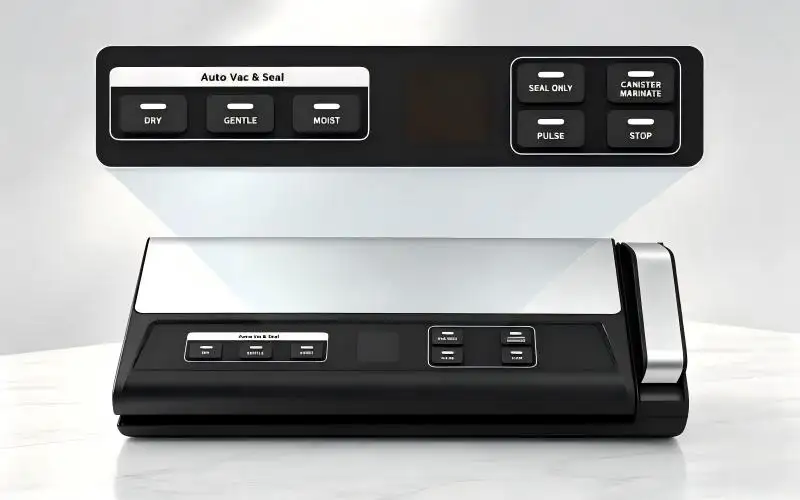
Pulse or gentle controls can help the operator stop evacuation before a delicate product is crushed or liquid reaches the sealing area. Detailed dry, moist, and pulse-control selection belongs in the broader tabletop vacuum sealer guide.
Chamber Workflow
In a chamber machine, the full pouch is placed inside the chamber with its open end across the sealing bar. The chamber and pouch are evacuated together. The machine seals the pouch before atmospheric pressure returns.
This arrangement is generally more suitable for soups, sauces, marinades, and other products containing free liquid because the pressure inside and outside the pouch changes together during evacuation. The actual liquid-handling limit still depends on pouch placement, chamber depth, settings, and product condition.
Yumyth’s CVS101 chamber vacuum sealer is presented as a combined chamber and external system. It illustrates why machine architecture and automation level should be treated as separate selection decisions.
A double-chamber design changes the production pattern further. While one chamber runs its vacuum cycle, the operator may prepare or load the other side. This can reduce waiting time, but it does not eliminate manual handling.
Controls That Affect Vacuum, Seal Quality, and Operator Control
A long control list is not automatically useful. Buyers need to understand which settings influence evacuation, product condition, and seal formation.
| Control | What it changes | Main buyer concern |
| Vacuum time | How long the pump evacuates | Is a fixed time repeatable across different loads? |
| Vacuum sensor or endpoint | Pressure level at which evacuation stops | Is pressure measured directly or estimated by time? |
| Pump flow | Speed at which air can be removed | How does it perform with the actual chamber and load? |
| Pulse control | Operator-controlled evacuation | Can delicate or moist products be monitored manually? |
| Gentle mode | Less aggressive evacuation behaviour | Does it reduce crushing for the intended product? |
| Moisture mode | Model-specific cycle adjustment | What does the mode actually change? |
| Seal time or heat level | Energy applied to the pouch | Is it suitable for the film structure and thickness? |
| Cooling time | Time allowed for the seal to stabilize | Is the package stressed before the seal sets? |
| Single or double seal | Number of seal lines | Does the application require added redundancy? |
| Program memory | Stored operating recipes | Can settings be repeated during product changeovers? |
Vacuum Controls
Vacuum time and vacuum pressure are not the same measurement.
A time-controlled machine runs the pump for a set period. A sensor-controlled system stops at a measured pressure endpoint. Time control may be sufficient for stable, repeatable loads, but changes in package volume, chamber loading, product shape, or air trapped in the food can affect the result.
Pump flow describes how quickly the pump can move air. Vacuum endpoint describes how low the pressure can become. A high flow rate does not automatically mean a deeper final vacuum, and a strong pressure specification does not reveal how quickly the machine reaches it.
Negative gauge-pressure figures should not be presented as equivalent oxygen-removal percentages. Residual oxygen depends on the package, food structure, gas release, pressure-measurement method, and operating conditions.
Sealing and Cooling Controls
The vacuum level cannot compensate for a weak seal.
Seal time or heat must suit the pouch material. Too little heat may leave an incomplete bond, while excessive heat can deform or weaken the seal area. Moisture, oil, product particles, folds, and wrinkles can also create channels.
Cooling is part of the sealing process. The seal needs time to stabilize before the package is moved or atmospheric pressure applies stress to it.
Yumyth publishes model-specific control combinations rather than one universal format. For example:
-
The VS6612X page lists pulse and dry/moist controls.
-
The VS6606X page lists dry, moist, super-moist, normal, gentle, and pulse options.
-
The VS8001G page lists handle locking, pulse control, moisture modes, and single- or double-seal choices.
These features should remain tied to the relevant model. They do not establish that every Yumyth machine has the same controls or belongs to a formal semi-automatic product category.
Use Cases Suited to Semi-Automatic Operation
Semi-automatic operation is useful when the business needs repeatable machine-controlled vacuum and sealing but still benefits from manual loading, inspection, or product changeovers.
| Product or operation | Suitable approach | Main control or workflow issue |
| Dry foods and routine portions | External or chamber, depending on pouch and volume | Stable positioning and repeatable presets |
| Moist or marinated food | Moisture control or chamber operation | Liquid movement and seal contamination |
| Delicate products | Pulse, gentle, or lower vacuum endpoint | Compression and shape damage |
| Soups and sauces | Usually chamber operation | Free liquid and pouch positioning |
| Meat, seafood, or cheese | Depends on volume and package format | Product shape, moisture, seal cleanliness |
| Mixed short production runs | Adjustable or programmable controls | Fast changeovers between products |
| Restaurants and test kitchens | Compact operator-loaded systems | Flexible batches and limited space |
| Medium-volume processing | Chamber or double-chamber configuration | Operator loading speed and duty cycle |
A semi-automatic configuration may be less suitable when the operation requires continuous feeding, conveying, fixed high-volume output, minimal operator contact, or integration with upstream and downstream machinery.
Vacuum packaging also does not make perishable food shelf-stable. Temperature control and safe handling remain necessary. The USDA’s guidance on vacuum-packed perishable foods reinforces that packaging does not replace refrigeration or freezing.
Advantages, Limitations, and Automation Trade-Offs
Semi-automatic machines can offer more operator control than an integrated automatic line. That can be valuable when products vary in size, moisture, delicacy, or pouch placement.
Potential advantages include:
-
Easier product changeovers
-
Manual intervention for delicate or moist products
-
Visual inspection before each cycle
-
Lower system complexity than automated feeding and conveying
-
Practical operation for variable batches
The same operator involvement creates limitations:
-
Output depends on loading and unloading speed
-
Positioning may vary between operators
-
Wrinkles or contamination may reduce seal integrity
-
Repetitive lid handling may affect ergonomics
-
Training influences package consistency
-
The machine may not integrate easily into a continuous line
-
Repeated-use capacity may be lower than the buyer assumes
| Criterion | Manual or basic operator-controlled | Semi-automatic | Fully automatic |
| Loading | Manual | Usually manual | May be automated |
| Lid operation | Manual | Manual, assisted, or automatic | Usually automated |
| Vacuum and sealing | May require more operator control | Programmed cycle | Programmed and integrated |
| Unloading | Manual | Usually manual | May be automated |
| Changeover flexibility | High | High to moderate | Depends on line design |
| Operator dependence | High | Moderate to high | Lower for repetitive handling |
| Line integration | Limited | Limited to moderate | High |
| Best fit | Small or irregular batches | Variable commercial batches | Stable, high-volume production |
No automation level is universally better. The correct choice depends on product variation, labor availability, required consistency, space, sanitation, and production targets.
Yumyth’s VS6685H automatic vacuum sealer provides a useful contrast. Its page describes automatic lid closing, vacuuming, sealing, and reopening, while still including a pulse override. That shows how automation and operator control can coexist within one machine.
How Workload and Duty Cycle Affect Real Output
A published machine-cycle time does not equal completed packages per hour.
Real output includes:
Product preparation + pouch loading + positioning + machine cycle + unloading + inspection
A fast pump cannot compensate for slow loading. A large chamber does not guarantee high output if the operator cannot arrange packages efficiently. A short cycle may also be unsustainable if the sealing system needs recovery time or activates thermal protection during repeated operation.
Buyers should ask suppliers to disclose the conditions behind output claims:
-
Product and pouch dimensions
-
Number of pouches per chamber
-
Target vacuum
-
Seal and cooling settings
-
Operator count
-
Loading and unloading method
-
Test duration
-
Break or recovery periods
Automation level and workload classification should be evaluated separately. A machine can have a semi-automatic cycle without being designed for extended commercial production. A broader commercial vacuum sealer evaluation should therefore include sanitation, serviceability, sustained workload, and spare-parts support—not only the control panel.
How to Select the Right Semi-Automatic Configuration
Start with the application rather than the product label.
Choose by Product and Pouch
Confirm:
-
Product dimensions and shape
-
Presence of free liquid
-
Surface moisture or marinade
-
Compression sensitivity
-
Pouch width and length
-
Pouch material and thickness
-
Required seal width
-
External or chamber-bag compatibility
The package opening must fit the sealing bar. The complete package must fit inside the chamber where chamber operation is required. External systems may need textured material, while chamber machines commonly use different pouch structures.
Choose by Workflow and Workload
Define the exact process:
-
Who fills the pouches?
-
Who positions them?
-
Should the lid be manual or automatic?
-
Is foot-control initiation useful?
-
How often do products change?
-
How many operators are available?
-
Is one chamber sufficient?
-
Would alternating double-chamber loading reduce waiting?
-
How long must the machine operate without interruption?
-
Is future line integration expected?
Also confirm voltage, frequency, cleaning access, gasket and sealing-wire replacement, pump maintenance, spare-parts availability, and technical documentation.
Yumyth’s vacuum sealer range includes several control and architecture formats. The available model should still be assessed against the actual product and operating schedule rather than selected from a feature list alone.
Validate the Machine with Your Actual Product and Pouch
Supplier testing is more useful when it reproduces the intended process.
Provide representative samples, including the most difficult conditions:
-
The wettest product
-
The most delicate product
-
The largest package
-
The smallest routine package
-
The intended pouch material
-
The expected repeated-cycle workload
During testing, record the vacuum, seal, and cooling settings. Check package compression, liquid movement, wrinkles, seal contamination, and finished appearance.
Visual inspection is useful but may not be enough for applications requiring documented package validation. ASTM F88/F88M provides a recognized method for measuring flexible-package seal strength. ASTM D3078 covers gross-leak detection in flexible packaging using bubble emission. Using these standards does not prove that a machine or package complies automatically; the correct method and acceptance criteria must be defined for the application.
Buyers should also request:
-
Model-specific electrical information
-
Applicable certificate copies
-
Test conditions behind throughput claims
-
Recommended consumables
-
Spare-parts lists
-
Maintenance requirements
-
Operating manuals
-
Sample-test records
Company-wide certification statements should not be assumed to cover every model or destination market.
Yumyth Options for Adjustable and Automated Vacuum-Sealing Workflows
Yumyth’s website lists compact external machines, handle-lock models, automatic models, and a combined chamber/external machine. Published controls vary by model and include pulse operation, moisture modes, gentle or normal pressure settings, seal options, displays, and automatic cycles.
Yumyth also states that vacuum strength, operating modes, sealing parameters, control-panel layout, voltage, appearance, packaging, and accessories may be customized through its vacuum sealer OEM/ODM service.
These verified capabilities do not confirm that Yumyth currently markets a standard model under the exact “semi-automatic vacuum sealer” category. Buyers should confirm whether the required workflow matches an existing machine or needs a custom configuration.
Prepare a Useful Supplier Inquiry
A useful inquiry should include:
-
Product type and physical condition
-
Package dimensions
-
Pouch material and thickness
-
Free-liquid or moisture level
-
Delicate-product concerns
-
Required manual and automatic steps
-
Expected batch pattern and operating schedule
-
Destination voltage and frequency
-
Required testing or documentation
-
Branding and customization requirements
Provide these details when you contact Yumyth to discuss configuration options, sample testing, or a quotation. The clearest recommendation will come from matching the machine to the actual product, pouch, operator workflow, and sustained workload.
Related Articles
How We Test Every Ice Maker Before Packaging
2026-09-15
BY YUMYTH
A step-by-step look at refrigerant handling, cooling verification, leak detection, corrective action and electrical safety testing For an ice maker, reliable performance is determined long before the carton is sealed. ...
Guide for Brands Looking for a Reliable Vacuum Sealer OEM Supplier
2026-09-14
BY YUMYTH
When you are sourcing kitchen appliances for your retail brand, finding a dependable vacuum sealer OEM supplier is rarely just about getting the lowest unit price. It is about protecting ...

Why Ice Shape Matters: Understanding 10mm × 15mm Cylindrical Nugget Ice
2026-09-14
BY YUMYTH
More Than Ice Production — The Ice Itself Shapes the Consumer Experience When sourcing a nugget ice maker, buyers often focus first on production capacity, water tank size, ice basket ...

Ice Maker Sourcing Guide: How to Find the Right Factory
2026-09-10
BY YUMYTH
Sourcing an ice maker looks straightforward on paper. Find a supplier, agree on a price, place an order. But anyone who has actually done this knows the process is rarely ...