
What Materials Are Used for Food-Contact Parts in Slush Machines?
Share:
-

-

-

-


Copied

Share:
-
-
-
-
Copied
Food-contact materials are a critical part of slush machine safety, cleaning performance, durability, and beverage quality. The beverage tank, auger, evaporator surface, seals, lid, dispensing valve, and nozzle may remain in contact with sugary, acidic, alcoholic, dairy-based, or fruit-containing drinks for extended periods.
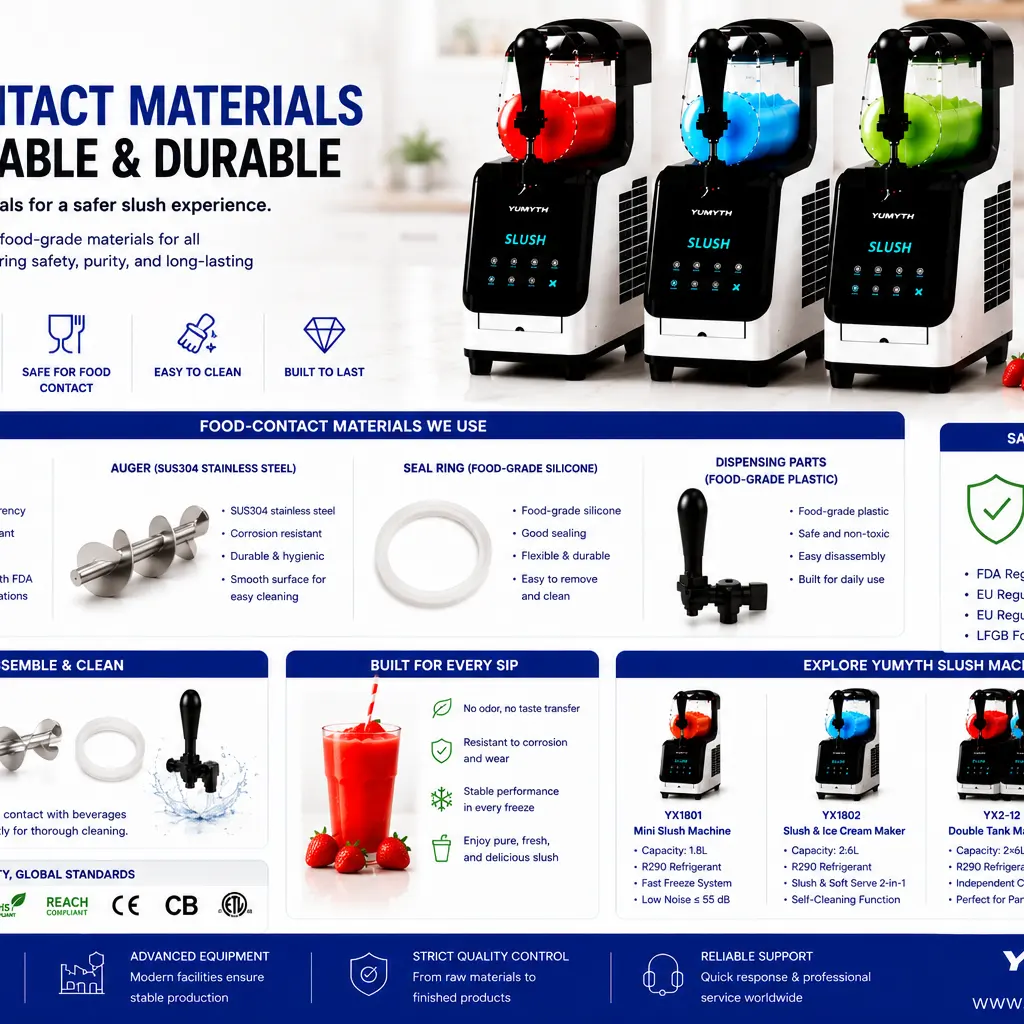
Manufacturers therefore need to select materials that are suitable for the intended beverages, operating temperatures, cleaning methods, and target-market regulations.
Modern home slush machines commonly combine food-contact plastics, stainless steel, and silicone elastomers. YUMYTH’s current YX1801 Mini Slush Machine and YX1802 Slush and Ice Cream Maker list ABS, silicone, and SUS304 stainless steel in their published material specifications. The exact material used for each component should still be confirmed through the controlled bill of materials and food-contact documentation for the production model.
Which Parts Come Into Contact With the Beverage?
Food-contact parts normally include any component that touches the drink during preparation, holding, or dispensing.
Depending on the machine design, these parts may include:
- Beverage tank;
- Auger or mixing paddle;
- Evaporator surface;
- Tank-rim seal;
- Lid interior;
- Dispensing valve;
- Outlet nozzle;
- Internal gaskets;
- Drip-related components exposed to the beverage.
In the U.S. Food and Drug Administration's definition, a food-contact substance is anything that comes into contact with food during processing, on processing surfaces, in cookware, or food packaging and includes any other article that comes into contact with food but is not intended to provide a technical function.
The outside casing is not necessary a food-contact part. A manufacturer should thus differentiate between a material for the appliance body and the material in the beverage path.
Food-Grade Plastics
Food-contact plastics are widely used because they can provide low weight, impact resistance, design flexibility, and relatively simple cleaning.
Depending on the product, plastic may be used for:
- Beverage tanks;
- Lids;
- Augers;
- Dispensing handles;
- Valve bodies;
- Drip trays;
- Internal guides.
Common plastics used in commonly used appliances include ABS, polypropylene, copolyester, SAN or any of the specially selected resins. But, commercial name of a plastic is not sufficient to demonstrate food-contact suitability.
Compliance is influenced by the grade of the material, the additives, colorants, manufacturing method, type of beverage, beverage temperature, and contact time.
All food-contact materials in the European Union have to comply with the general safety and inertness criteria of Regulation (EC) No 1935/2004. In addition to the requirements of Regulation (EU) No 10/2011, plastic materials and articles also have to comply with the specific requirements of this regulation, such as those on authorised substances, restrictions, migration limits and documentation requirements.
ABS Plastic
ABS is widely used in the structures of appliances because of its impact resistance, dimensional stability and surface appearance.
YUMYTH has ABS on its home slush machine platform for food grade use. It is equipped with published food safety information and food grade silicone seals and SUS304 stainless steel interior components.
But it is not a rule to say that all ABS formulations will be directly drinkable.
A supplier should identify:
- Resin manufacturer;
- Exact material grade;
- Color masterbatch;
- Intended contact conditions;
- Applicable food-contact declaration;
- Migration test report.
A housing-grade ABS resin may not have the same compliance documentation as a resin selected for food-contact use.
Transparent Beverage Tanks
The beverage tank is one of the most demanding components because it must normally provide:
- Visual clarity;
- Impact resistance;
- Dimensional accuracy;
- Stable sealing surfaces;
- Resistance to cracking;
- Compatibility with sugary and acidic drinks;
- Repeated cleaning durability.
Transparent tanks may use different plastic families depending on the appliance design. The selected material should be evaluated with the actual beverages and cleaning conditions.
Alcoholic cocktails, acidic fruit drinks, food coloring, coffee, dairy ingredients, and repeated dishwasher exposure can create different material stresses.
The tank should be checked for:
- Clouding;
- Stress cracking;
- Odor transfer;
- Color absorption;
- Warping;
- Scratches;
- Seal-surface deformation.
A vague claim such as “BPA-free” is not a complete material specification. Buyers should request the exact resin grade and supporting regulatory documentation.
SUS304 Stainless Steel
SUS304 stainless steel is commonly selected for metallic food-contact parts because it provides useful corrosion resistance, strength, cleanability, and durability.
In a slush machine, stainless steel may be used for:
- Evaporator surfaces;
- Internal shafts;
- Auger components;
- Fasteners;
- Beverage-contact structural parts.
YUMYTH has determined that SUS304 is one of the key materials for the YX1801 and YX1802 platforms. Depending on the model description, its present countertop product information mentions a SUS304 stainless steel auger or stainless steel internal contact structure.
The actual stainless steel grade must be confirmed by the supplier in the form of material certificates, or positive material identification, as appropriate.
The surface condition is also crucial. Even if the base metal is adequate, rough welds, sharp edges, corrosion marks, exposed residues or joints that are difficult to clean can cause hygiene issues.
Silicone Seals and Gaskets
Silicone is widely used for flexible seals because it can maintain elasticity, create compression around removable tanks, and tolerate repeated washing.
Typical silicone components include:
- Tank-rim seals;
- Valve gaskets;
- Lid seals;
- Nozzle seals;
- Internal O-rings.
YUMYTH's published design features a removable food-grade silicone seal ring, which is designed for easier inspection and washing.
Silicones are not all the same. Odor, migration, hardness and durability may vary due to pigments, curing agents, fillers and processing conditions.
According to the German Federal Institute for Risk Assessment, silicone and rubber are but a few of the many categories of materials used in the manufacture of food contact articles, and any migration from the article to the food should be low enough to not endanger human health or cause unacceptable changes to the food.
Seals should be evaluated for:
- Odor and taste transfer;
- Compression set;
- Tearing;
- Swelling;
- Discoloration;
- Dishwasher resistance;
- Repeated installation.
A seal may pass an initial leakage test but gradually lose elasticity after repeated cleaning cycles.
Dispensing Valves and Nozzles
The dispensing system can contain several materials, including rigid plastic, silicone seals, springs, shafts, and stainless steel fasteners.
These components require special attention because syrup, fruit residue, coffee, dairy ingredients, and food coloring may remain inside narrow valve channels.
A good dispensing design should provide:
- Tool-free disassembly;
- Smooth internal passages;
- Accessible seals;
- Minimal hidden cavities;
- Reliable closure;
- Easy reassembly.
Every component inside the beverage flow path should be included in the food-contact review. Testing only the main beverage tank is not enough.
Material Safety Depends on Intended Use
A material may be suitable for one application but unsuitable for another.
Food-contact testing should consider:
- Beverage acidity;
- Alcohol concentration;
- Fat content;
- Contact duration;
- Operating temperature;
- Cleaning temperature;
- Repeated-use cycles.
The EU food-contact framework specifies that materials should not release substances into food at levels that could pose a risk to health, lead to an unacceptable alteration of the composition of food or affect the organoleptic properties (taste, odor, appearance, etc.).
Reports based on water contact will not necessarily reflect long-term exposure to acidic lemonade, wine based slush, creamy coffee or colored syrup.
FDA and European Documentation
Buyers for the US market should ask for documentation of suitability of each material for the food-contact application and condition of use as required by the applicable FDA food-contact provisions.
The FDA has inventories and regulatory pathways for substances considered food-contact substances such as substances included in Title 21 of the Code of Federal Regulations and Food Contact Notifications.
For the European market, documentation may include:
- Declaration of Compliance;
- Overall migration results;
- Specific migration results;
- Supporting material declarations;
- Test conditions and food simulants;
- Traceability information.
The European Commission explains that substances used in plastic food-contact materials must comply with the authorized Union List and any applicable restrictions or specifications.
What OEM Buyers Should Check
Before approving a slush machine, buyers should request:
- A complete food-contact component list;
- Exact resin, silicone, and metal grades;
- Supplier names and material codes;
- FDA or EU compliance declarations;
- LFGB or relevant migration reports;
- Test conditions matching intended beverages;
- Dishwasher and repeated-use test results;
- Production traceability procedures;
- Engineering-change controls;
- Confirmation that production materials match the approved sample.
The material documents should be linked to the final bill of materials. Changing the tank supplier, silicone formulation, pigment, coating, or stainless steel grade may require a new compliance review.
Cleaning Design Is Part of Material Safety
Even a compliant material can become unsuitable in practice when the part is difficult to clean.
Food-contact components should avoid rough surfaces, deep grooves, inaccessible cavities, molding flash, sharp edges, and areas that trap liquid.
Removable parts should withstand repeated washing without cracking, warping, swelling, or losing sealing performance.
Material selection and hygienic design must therefore be evaluated together.
Conclusion
The types of plastics, SUS304 stainless steel, and food-grade silicone are commonly used in purpose-selected materials for food-contact parts in slush machines.
According to published specifications of YUMYTH's home slush machine, the machine's main material combination is ABS, silicone, and SUS304.
But names of material is not the only thing. The supplier should be checked for the exact grades, suppliers, colourants, test conditions, migration reports, beverages intended, cleaning method, and production traceability.
A well-documented food contact system should be safe, clean, odor-free, dimensionally stable and durable after repeated freezing, dispensing, washing and reassembling cycles.
Related Articles
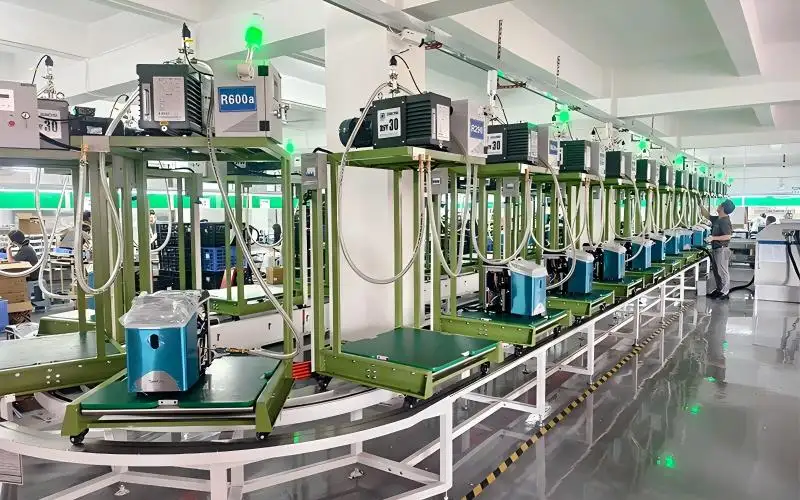
How We Test Every Ice Maker Before Packaging
2026-09-15
BY YUMYTH
A step-by-step look at refrigerant handling, cooling verification, leak detection, corrective action and electrical safety testing For an ice maker, reliable performance is determined long before the carton is sealed. ...
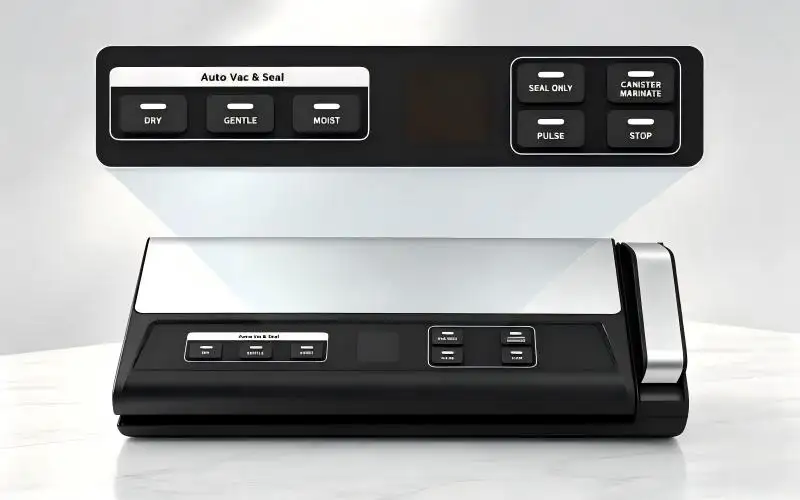
Guide for Brands Looking for a Reliable Vacuum Sealer OEM Supplier
2026-09-14
BY YUMYTH
When you are sourcing kitchen appliances for your retail brand, finding a dependable vacuum sealer OEM supplier is rarely just about getting the lowest unit price. It is about protecting ...
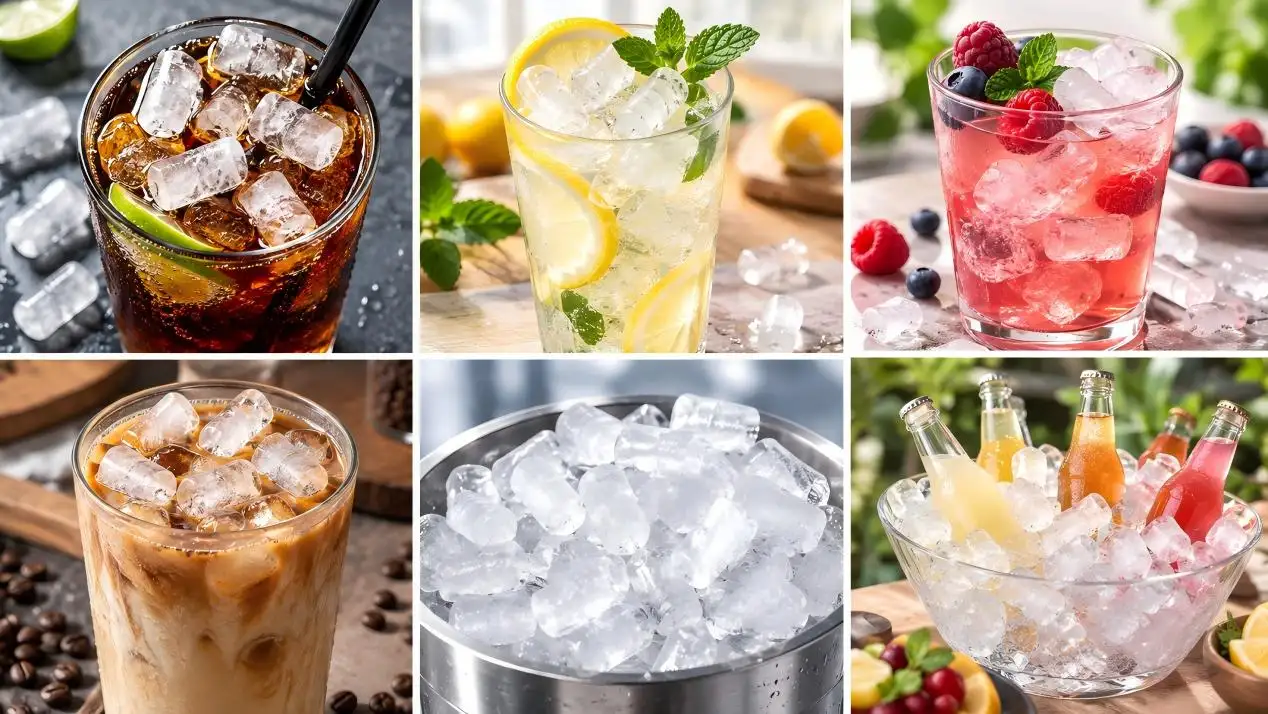
Why Ice Shape Matters: Understanding 10mm × 15mm Cylindrical Nugget Ice
2026-09-14
BY YUMYTH
More Than Ice Production — The Ice Itself Shapes the Consumer Experience When sourcing a nugget ice maker, buyers often focus first on production capacity, water tank size, ice basket ...

Ice Maker Sourcing Guide: How to Find the Right Factory
2026-09-10
BY YUMYTH
Sourcing an ice maker looks straightforward on paper. Find a supplier, agree on a price, place an order. But anyone who has actually done this knows the process is rarely ...