
Freeze-time test under different ambient temperatures
Share:
-

-

-

-


Copied
Share:
-
-
-
-
Copied
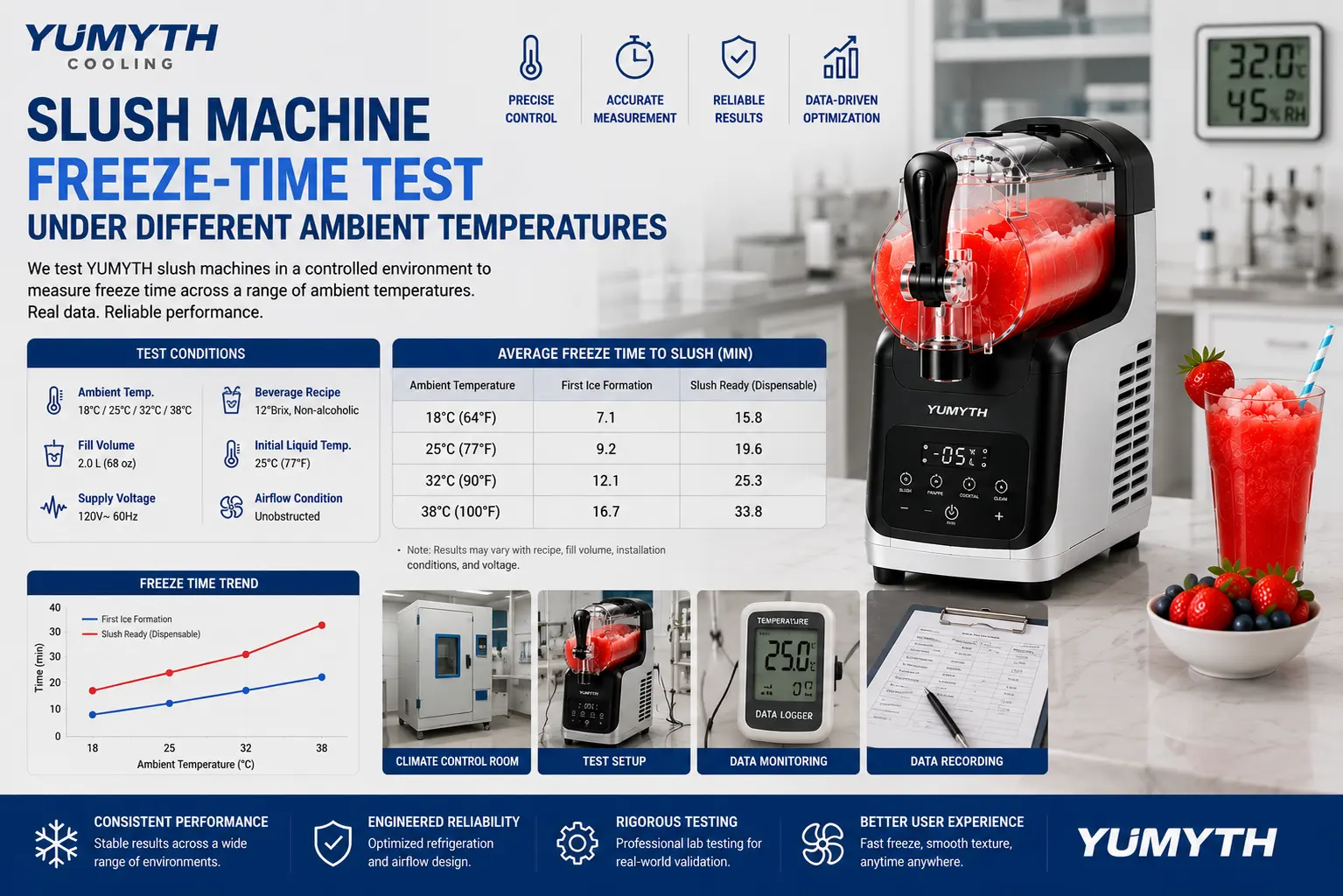
Freeze-Time Testing at various Ambient Temperatures
One of the most apparent indicators of a home slush machine's performance is the amount of time it takes to freeze. Consumers want to know how fast a liquid beverage can be turned into a smooth, dispensable frozen beverage, and appliance brand must establish that its product will produce a consistent flavor, regardless of the kitchen, the season and climate.
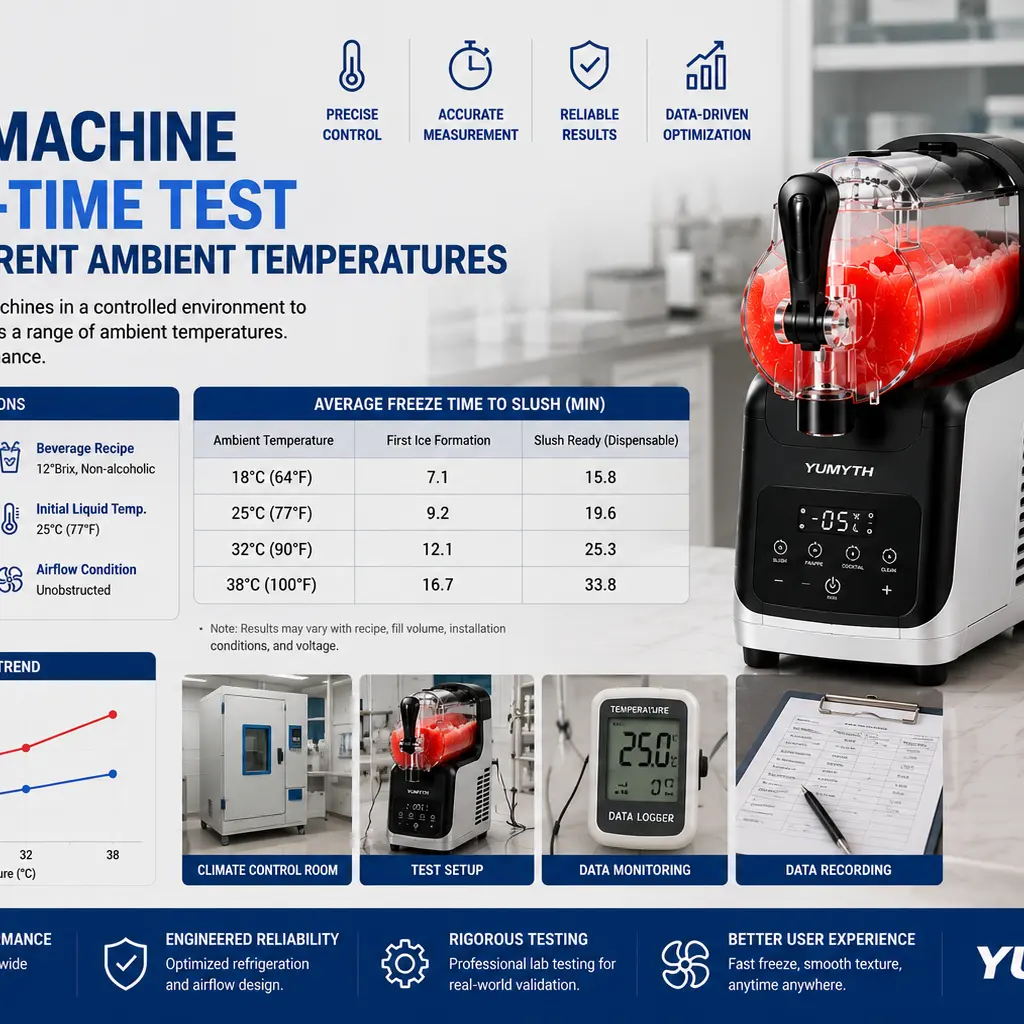
The word “slush ready in 15 minutes” is not sufficient technical information. Freeze time is affected by ambient temperature, beverage volume, initial liquid temperature, sugar concentration, alcohol percentage, programme selected, airflow clearance, charge of the refrigerant, and the definition of the final texture.
These variables should be controlled by a professional freeze-time test and the effects of room temperature changes on refrigeration performance explained.
Ambient temperature has an impact on the amount of time it takes for food to freeze.
A slush machine is a machine that removes heat from the beverage by using an evaporator. The refrigerant in turn conveys this heat to the condenser where it is transferred to the ambient air.
Ambient temperature is defined by ASHRAE as the temperature of the medium surrounding an object, or the temperature of the medium to which heat is dissipated for a refrigeration system. This is typically the room air in the condenser inlet area of an air-cooled countertop appliance.
If the air around the condenser is warmer, the condenser will have to reject heat to a higher temperature source. This usually makes the refrigeration system operation more difficult and can cause the compressor discharge temperature, condensing pressure, power consumption, and beverage preparation time to rise.
Airflow is also crucial. ASHRAE says one of the most important considerations in the unit's ability to provide the desired cooling is its ability to have unrestricted air flow through the condenser.
The performance of a machine operating under free air flow and at 25°C can therefore be different when operated at 32°C near a wall in the kitchen.
Explain why you are conducting this test.
Before sample preparation the goal of the test should be determined.
Freeze-time testing could be used to:
- – Compare two compressor systems;
- Review alternatives to condensers or fans;
- * Optimize refrigerant charge;
- Confirm a product specification:
- Compare software control strategies;
- * Develop guidelines for consumers;
- * Validate production consistency;
- Explore customers' complaints from hot climates.
Comparative engineering data might be used in an early prototype test. For a final product claim, a set of controlled conditions, representative production samples, calibrated instruments and a well defined endpoint are needed.
The test should not be constructed in such a way as to simply generate the shortest possible test time. It should also verify stable texture, acceptable component heat, normal motor load and reliable extended operation.
Create an Ambient-Temperature Test Matrix
The selected temperatures should be typical of those to which the product will be subjected.
Examples of illustrative engineering matrix include:
- * 18°C for a cool indoor environment;
- Temperature of 25°C for a normal laboratory or domestic environment;
- * 32°C for a warm kitchen or summer condition;
- Increased declared limit as needed by target market.
The temperatures listed are guidelines and not universal requirements. The final test points should be determined by the appliance's rated operating range, product specification, intended countries and laboratory recommendations.
The temperature around the appliance should be stabilized prior to the test. Immediately putting a room temp machine into a hot chamber and measuring the thermal transition of the machine is not necessarily measuring the ambient performance of the machine.
Ambient temperature (not before startup) should be recorded in the laboratory throughout the entire cycle.
Maintain the humidity and test-room conditions.
The most important variable is ambient temperature; relative humidity must be recorded as well. When humidity is high it can lead to condensation on tanks, pipe, dispensing parts and cabinet surfaces.
The report of the test should include:
- * Test-room type;
- * Ambient-temperature tolerance;
- * Relative humidity;
- * Air movement;
- * Background heat sources;
- * Appliance position;
- * Wall clearances;
- * Countertop material;
- Provide voltage and frequency of supply.
Conductor inlet and outlet of the machine should not be obstructed. The distance from walls should be the same as the instructions provided to the user or the wall environment being tested.
All other installation conditions should be the same when comparing different ambient temperatures.
Institute a standard Beverage Recipe.Establish a standard Beverage Recipe.
Change in the recipe influences the freeze time significantly. Adding sugar decreases the freezing point and adding alcohol decreases it even more. Viscosities and heat transfer properties may also be altered by dairy ingredients, pulp, syrups and dissolved solids.
The reference beverage should then be made by weight, not by approximation, of course. The report should include the following:
- * Water quantity;
- * Sugar quantity;
- * Measured Brix;
- * Flavor ingredients;
- * Alcohol content (percentage) (if applicable);
- * Total beverage mass;
- * Starting temperature;
- * Mixing procedure.
If possible use the same batch of ingredients. If multiple batches are needed, they should be checked for Brix and starting temperature.
The test conducted using a chilled drink from the refrigerator cannot be directly compared to the test conducted using a room temperature drink.
Control the Starting Beverage Temperature
The initial temperature of the drink will affect the overall amount of heat that the appliance will need to extract before ice crystals are created.
The two results may be correct, but they are for different conditions of use; a machine starting liquid at 5°C can produce slush much sooner than the same machine starting liquid at 25°C.
If comparative ambient testing is to be carried out, the initial temperature of the liquid should be the same at all ambient locations.
There are two helpful test strategies:
Same starting temp: All drinks come out at the same temperature. This helps to provide the room temperature effect is separated from the appliance.
Ambient-equilibrated drink: The drink is kept at the same temperature as the room temperature. This is a practical environment where machine and ingredients are impacted by the environment.
The approach chosen needs to be explicitly described. These two methods are not allowed to be combined in the same comparison table.
When setting up a volume and program, use the same one.
The time of freezing depends on the mass of the beverage. A small amount of heat will be less in the tank and can be rapidly cooled, and a full tank will need a greater potential to remove heat, and may add more load on the auger.
The test should be conducted with a fixed working volume of for instance:
- * Minimum rated fill;
- The volume at which the household is serving the food, in units;
- Rated for maximum fill: *
Testing a small amount can yield a nice look that may not be reflective of normal use.
All four program, target temperature, texture level, auger setting and holding function need to be the same for all ambient conditions. If software adjustments are automatically made, they should be documented as they are a response to temperature adjustments.
Explain what the word “Frozen” means.
For a freeze time test, an endpoint must be repeatable. If based solely on visual judgment, the results can vary from operator to operator.
Possible endpoints include:
- * First sight of ice crystals;
- * Serving temperature of beverage; and
- * Mixture that has a specific consistency;
- A machine that displays when the cycle has been completed;
- To make a product dispensable over time (continuously);
- The texture that passes an internal flow test or spoon test.
The point of uniform, stable and dispensable slush is a useful endpoint for consumer relevance.
Even if this is not the final declared result, the report should include the time to first ice formation. By examining the initial freezing time versus the final serving time, engineers can determine whether delay is due to refrigeration capacity or due to the delay in the texture-control logic.
Takes time measurements to compare to Freeze Time.Measures and compares Freeze Time.
Technically useful report should monitor entire system.
Recommended measurements include:
- * Ambient temperature;
- * Beverage temperature;
- * Evaporator temperature;
- * Condenser inlet and outlet pressure; and
- * Compressor shell temperature;
- * Discharge-line temperature;
- * Auger motor current;
- * Appliance power;
- * Compressor cycling;
- * Final beverage texture;
- * Freeze time.
When the ambient temperature is high, a machine can eventually attain an acceptable temperature at the beverage outlet, but then with an excessive temperature of the compressor or electronic components.
Thermal safety and reliability must therefore be taken into account in the final decision, along with preparation speed. IEC 60335-2-24:2025 focuses on the safety requirements of refrigerating appliances, ice-cream appliances and ice makers, as well as any abnormal operating conditions applicable to such products.
Repeat tests with multiple samples.Repeat testing: multiple samples.
Normal product variations can't be represented by one machine and one cycle.
The testing shall be performed on a number of appliances that are representative of production use and several cycles shall be repeated for each of the ambient conditions. The units should be returned to a known initial state for the next cycle.
The report should include the following:
- * Individual results;
- * Average freeze time;
- * Minimum and maximum;
- * Variation between cycles;
- * Variation between samples;
- All stopped and incomplete cycles.
If there's considerable difference, it's likely that the refrigerant is not being charged evenly, the sensor is not positioned correctly, the sensors are not in good thermal contact with the evaporator, the fans are not working properly, the compressor output is inconsistent, or the charge calibration is incorrect.
It is more important to have repeatable results rather than one really fast one.
Investigate Hot-Ambient Performance
The engineering team should examine the full heat rejection system if there is a significant rise in freeze time at higher temperatures.
Potential causes include:
- * Insufficient condenser area;
- * Restricted grille openings;
- airflow is below the specification;
- * Hot-air recirculation;
- * Excessive refrigerant charge;
- * Incorrect capillary-tube selection;
- * Poor insulation;
- * High compressor temperature;
- * Early thermal protection;
- Control logic that is not adapted to ambient conditions.
It may need better air flow, a different fan, a better condenser, a change in refrigerant optimization, better insulation or software changes in the appliance.
Adding compressors alone may not always be the optimal answer. If the airflow is inadequate, a larger compressor could get noisier, hotter, heavier, and heavier on the electrical meter.
Compare and contrast Extended Holding and Repeated Batches.
The first batch is not an exhaustive list of use cases.
After a long period of use, a machine can become over-heated. Heat can build up around condiser, compressor, electronics and cabinet particularly during high ambient temperatures.
The following should be part of the test program:
- A single freeze cycle;
- Need a minimum of a 12-month holding period; and
- * Dispensing and refilling;
- A second batch of successive numbers;
- * MAXIMUM declared operating time.
When using a second batch, engineers need to determine if it is slower and if there is any change in beverage texture during holding.
The Final Test Report should be organized as follows:
The professional report on the event should include the following:
- Product model, serial number;
- * type of test;
- * Sample quantity;
- * Ambient-temperature points;
- * Relative humidity;
- * Power from the grid; and
- * Appliance installation;
- * Recipe and Brix;
- * Fill volume;
- * Starting liquid temperature;
- * Selected program;
- * Endpoint definition;
- * Instrument information;
- * Complete results;
- * Thermal expansion of materials; and
- * Abnormal observations;
- Photographs of the set up;
- * Engineering conclusion.
The conditions of the validated report should be used in the marketing claims. If a statement like “ready in about 20 minutes,” is used, then the reference volume, recipe, starting temperature, and ambient condition should be provided.
Conclusion
A laboratory demonstration is not a true representation of the ability of the slush machine to operate under various ambient conditions as it can be tested in the freezing time.
An increase in ambient temperature may increase the difficulty of condenser heat rejection, lengthen preparation time and cause greater thermal stress. But, recipe, fill volume, starting liquid temperature, installation, operating mode and endpoint definition must be carefully controlled to achieve meaningful results.
The objective for appliance brands and OEM manufacturers is not only to get the fastest isolated result but also to get the best overall result. The aim is to provide consistent freezing, desirable texture, reasonable temperatures and consistent performance within the appliance's advertised operating range.
A clear and documented test report helps justify product claims, improve engineering choices, increase product uniformity, and better performance in the home.
Related Articles
How We Test Every Ice Maker Before Packaging
2026-09-15
BY YUMYTH
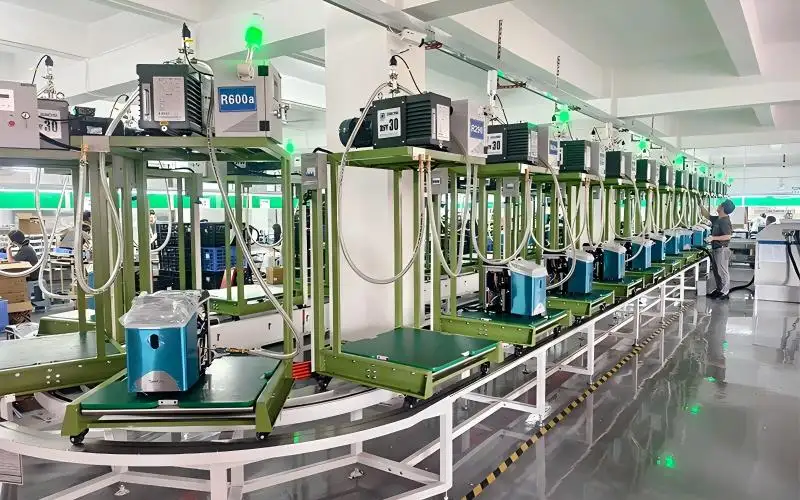
A step-by-step look at refrigerant handling, cooling verification, leak detection, corrective action and electrical safety testing For an ice maker, reliable performance is determined long before the carton is sealed. ...
Guide for Brands Looking for a Reliable Vacuum Sealer OEM Supplier
2026-09-14
BY YUMYTH
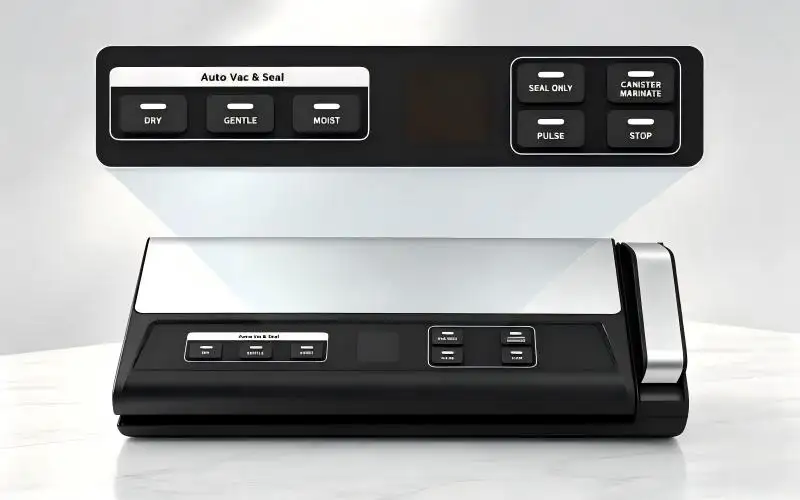
When you are sourcing kitchen appliances for your retail brand, finding a dependable vacuum sealer OEM supplier is rarely just about getting the lowest unit price. It is about protecting ...

Why Ice Shape Matters: Understanding 10mm × 15mm Cylindrical Nugget Ice
2026-09-14
BY YUMYTH
More Than Ice Production — The Ice Itself Shapes the Consumer Experience When sourcing a nugget ice maker, buyers often focus first on production capacity, water tank size, ice basket ...

Ice Maker Sourcing Guide: How to Find the Right Factory
2026-09-10
BY YUMYTH
Sourcing an ice maker looks straightforward on paper. Find a supplier, agree on a price, place an order. But anyone who has actually done this knows the process is rarely ...