
What affects slush machine freezing time?
Share:
-

-

-

-


Copied
Share:
-
-
-
-
Copied
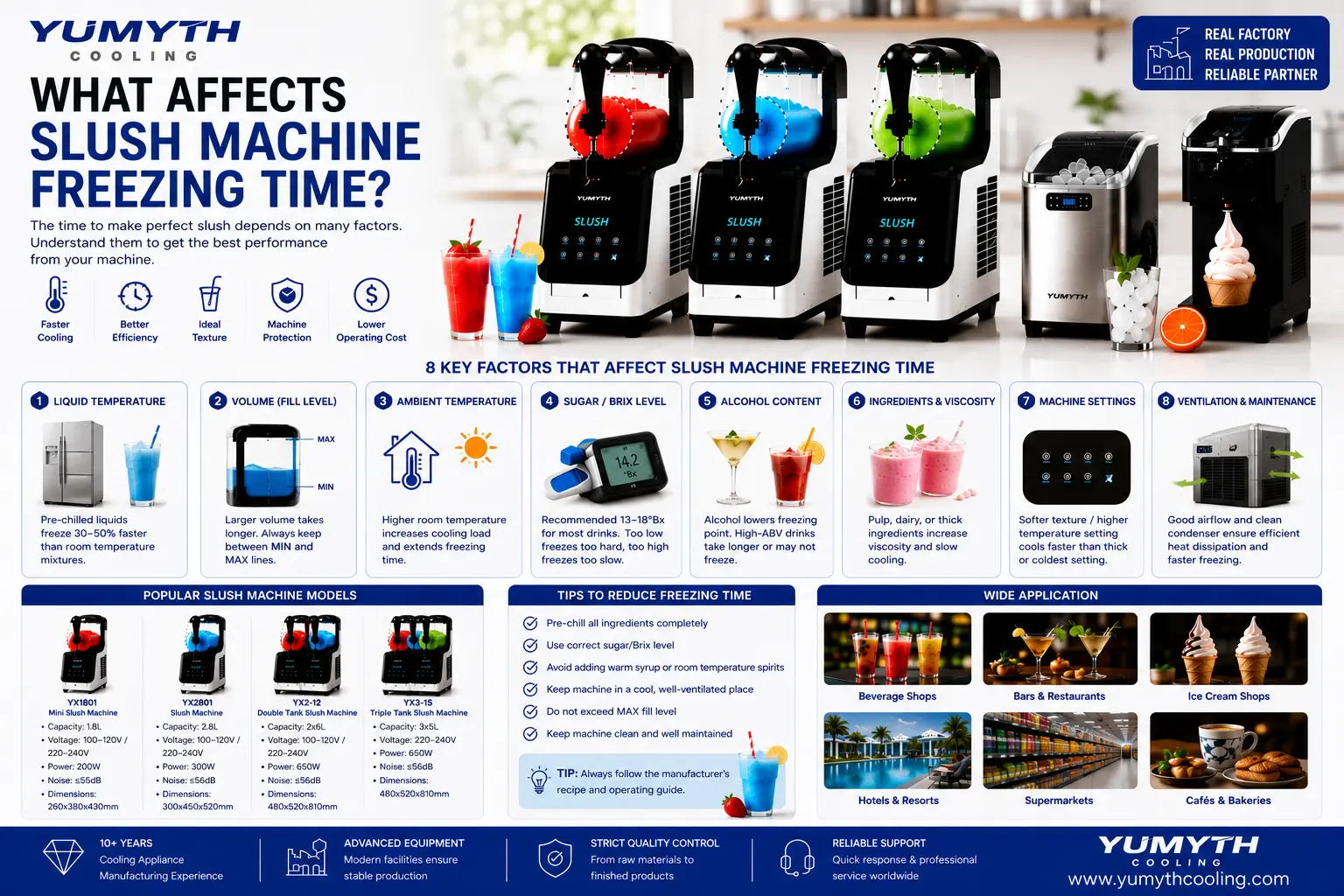
Besides rated compressor power, the freezing time of a slush machine depends on other factors. The speed of the beverage becoming a smooth dispensable slush is determined by the temperature and volume of the drink, the amount of sugar added to the drink, the amount of alcohol added to the drink, ambient temperature, ventilation, the type of texture selected and refrigeration system design.
The average cycle to make a slush mixture is about 20-45 minutes, depending on the amount of beverage, the room temperature, sugar level, and starting liquid temperature. These are values for reference and not guaranteed for all recipes.
The variables listed below are known and can help home users prepare their beverages more quickly and help OEM drink buyers compare machine performance in controlled conditions.
Starting Liquid Temperature
The temperature of the beverage at the beginning of freezing is typically among the most significant factors affecting the freezing time.
A machine that has liquid which is very cold in the refrigerator has less heat to take out than a machine that has a mixture of liquid which is at room temperature. The refrigeration system should first reduce the temperature of the entire beverage towards the freezing range, before ice crystals could be formed.
When YUMYTH performs compressor-machine tests, the time for some pre-chilled mixtures is about 18 to 25 minutes, while for similar room-temperature mixtures, the time is about 28 to 40 minutes. The outcome will vary with recipe and appliance, but the results show the importance of chilling the entire drink prior to consumption.
For faster preparation:
- Combine all the ingredients ahead of time;
- Leave it in the refrigerator for several hours;
- Do not partially freeze unless the manufacturer says it is okay to do so;
- Do not prepare with warm syrup or spirits just before use.
Before the beverage goes into the machine, all the ingredients should be evenly mixed.
Beverage Volume
The bigger the batch, the more heat will remain and the longer it will take to cool.
The compressor is responsible for removing heat from all parts of the beverage, and the auger pumps warmer beverage to the evaporator. It can take a longer cycle for a full batch to reach the desired temperature, while a small batch may reach the desired temperature sooner.
But not all the time is less liquid the better. Each machine has a minimum operating level. If the fill level is too low, it may not circulate properly or heat to the desired cooling and mixing area. This can lead to fast localized freezing instead of a uniform "slush".
Never fill the machine below the minimum or above the maximum. When comparing models, try the claimed freezing time with the same beverage volume. The 15-minute result obtained from a small batch should not be directly compared to a 30-minute result from a full tank.
Ambient Room Temperature
Both the amount of heat that enters the beverage and the heat that the machine returns to the atmosphere are influenced by the room temperature.
The refrigeration system will have to overcome a higher temperature difference in a warm kitchen, outdoors bar or a poorly ventilated room. The condenser also needs to dump waste heat to the surrounding warmer air.
The refrigeration system's condensing unit, says Danfoss, supplies cooling capacity and rejects heat, and it also has large condenser sizes designed for high ambient temperatures. It shows the importance of the cooler environment in improving the cooling efficiency or longer cooling time to attain the desired texture.
To ensure repeatable performance, run the machine in the manufacturer's recommended ambient-temperature range, and avoid direct sunlight, ovens, grills, or other appliances that generate heat.
Ventilation and Countertop Clearance
The compressor machine should be able to have adequate air flow in the condenser and vent openings.
If the inlet or outlet is obstructed, it can cause hot air to accumulate around the condenser or to return into the machine. This raises the temperature inside and reduces heat rejection.
Common problems of airflow are:
- * Mounting the machine on the wall;
- Install side or rear ventilation grilles;
- * Storing things next to the fan outlet;
- * Minimize exposure to dirt; and
- Leaving dust to accumulate on reachable grills.
Install with wall clearance as indicated and place on a level, stable work surface. This will not make the machine more powerful but will put the refrigeration system closer to its intended operation.
Sugar and Brix Level:
Sugar affects the freezing point of the liquid and contributes to the amount of unfrozen liquid.
If the evaporator evaporator is a mixture with a small amount of sugar, it may freeze violently around the evaporator. This can result in hard ice, higher auger resistance and may even cause the machine to reverse or stop before a uniform texture is achieved.
The freezing point of a mixture is lower if there is too much sugar. Ice crystals may not form quickly enough and the product may be soft or runny.
Spaceman USA suggests the use of around 13 – 18°Bx for most of its commercial frozen beverages and does not recommend use of newer viscosity controlled models below 12°Bx. The explanation provided in its guidance says that, if the Brix is not changed by changing the machine setting, it may result either in soft product or freeze-up.
The correct range is dependent on the machine and the manufacturer's recipe guidance should be followed. A calibrated refractometer can assist consistency to be maintained between batches.
Alcohol Content
The freezing point of a drink is lowered by the alcohol. The higher the level of alcohol, the cooler the refrigeration system will need to be before it can create enough ice crystals.
A cocktail recipe that is more mild can slush fairly easily, and a cocktail recipe that contains more spirits can take much longer or not slush at all. YUMYTH points out that high-ABV mixtures require more time to reach slush consistency and may not reach the slush stage at the normal freezing temperature of a household freezer.
Make alcoholic recipes in full, don't add extra alcohol while the freezing is in progress. The volume and sugar level in the machine must be within the machine's capacity and the final alcohol concentration must be within the machine's range.
The ingredients used and their viscosity.Type and viscosity of the ingredients used.
Two drinks that have the same Brix can freeze differently.
Fruit pulp, Dairy ingredients, Coffee solids, Gums, Stabilizers, Protein powders and concentrated syrups can alter viscosity and heat transfer. With a thick mixture, the circulation can be slower, decreasing the amount of warm liquid touching the evaporator.
The load of augers can also be increased due to heavy pulp or unsupported solids that may produce inconsistent freezing. Although the refrigeration system is operating properly, the machine can still start to reverse several times.
Don't use thick drinks like dairy beverages, ice cream or fruit drinks unless the model is designed for them.Do not use smooth pourable recipes unless the model is made for thick drinks such as dairy beverages, ice cream or fruit drinks. Conventional auger-type slush tanks should not be used for seeds, frozen fruit, ice cubes or solid garnishes.
A selected program or Texture Level.A selected program or Texture Level.
The soft slush is usually ready to drink sooner than the thick slush, because less heat needs to be extracted from the drink by the machine.
Temperature or texture affects:
- * Compressor operating time;
- * Target beverage temperature;
- * Auger load;
- * Holding behavior;
- * Final ice concentration.
Ninja recommends waiting after adjusting the temperature for the drink to "adjust its texture," which shows that changing the texture of a beverage takes time to refrigerate the drink to get it to the desired consistency.
If you're in a hurry, start with a standard or less pure texture, and not the coldest setting right away. Too much cooling may also result in hard freezing if the recipe is low in dissolved solids.
The design of a compressor and a refrigeration system.Design of compressor and refrigeration system.
Power rating of the compressor is not the only factor related to freezing speed.
The whole refrigeration system will affect the performance of the refrigerator, such as:
- * Compressor capacity;
- * Refrigerant;
- * Evaporator area;
- * Condenser size;
- Advanced: Capillary tube or expansion device;
- * Refrigerant charge;
- * Fan airflow;
- * Insulation.
If the condenser is undersized, airflow is restricted or the charge of refrigerant is incorrect, the larger compressor may have a large capacity but not be very efficient.
That is why it is important for OEM buyers to ask for test data using the full production configuration and not only wattage.
The condition of the machine and the cleanliness.
Mechanical resistance will increase and circulation will decrease due to residue around auger, evaporator, seals or motor coupling.
Ventilation openings can also be reduced by dusting on the openings. A poorly fitted tank or auger can cause scrapping, frictional problems or inadequate heat transfer.
After each use:
- 2. Complete the approved rinse cycle; or
- 2. Collect and clean food-contacting surfaces;
- 3. Check seals and dispensing valve;
- 4) Dry and re-install parts properly;
- 5. Maintain clean ventilation areas.
Consistent freezing performance across many batches will be more likely to be achieved with a well-maintained machine.
How manufacturers should report freezing time.Reporting freezing time--how manufacturers should do it.
Freezing-Time claims must specify the test conditions.
A good report should contain:
- * Communicate and develop a working vocabulary; and
- * Ambient temperature;
- * Starting beverage temperature;
- * Beverage volume;
- * Brix;
- * Alcohol concentration;
- * Selected program;
- * Texture endpoint;
- * Ventilation clearance.
Some compressor based products are marketed by GreenPan as being able to make frozen treats in as little as 15 minutes and YUMYTH publishes a wider range of compressor products based on liquid and operating conditions. These claims do not necessarily contradict, since the size of a batch and the definition of “ready” can vary, along with the machines.
The best way to compare the performance of the machines is to test each one with the same controlled recipe.
Conclusion
The factors of slush machine freezing time include starting liquid temperature, amount of beverage, ambient temperature, ventilation, Brix, alcohol concentration, ingredient viscosity, texture setting, refrigeration design and machine condition.
The most common solution to decreasing the preparation time is to pre-chill the entire drink. The user must also adhere to the fill limits, ensure proper air circulation, make sure that the amount of sugar and alcohol used is within the limits set by the recipe, and choose the right texture for the recipe.
Freezing performance should be verified in OEMs' case by documented testing and not just one marketing claim. If all test conditions are controlled, the results of the freeze-test are more repeatable, comparable, and helpful for product development.
Related Articles
How We Test Every Ice Maker Before Packaging
2026-09-15
BY YUMYTH
A step-by-step look at refrigerant handling, cooling verification, leak detection, corrective action and electrical safety testing For an ice maker, reliable performance is determined long before the carton is sealed. ...
Guide for Brands Looking for a Reliable Vacuum Sealer OEM Supplier
2026-09-14
BY YUMYTH
When you are sourcing kitchen appliances for your retail brand, finding a dependable vacuum sealer OEM supplier is rarely just about getting the lowest unit price. It is about protecting ...
Why Ice Shape Matters: Understanding 10mm × 15mm Cylindrical Nugget Ice
2026-09-14
BY YUMYTH
More Than Ice Production — The Ice Itself Shapes the Consumer Experience When sourcing a nugget ice maker, buyers often focus first on production capacity, water tank size, ice basket ...

Ice Maker Sourcing Guide: How to Find the Right Factory
2026-09-10
BY YUMYTH
Sourcing an ice maker looks straightforward on paper. Find a supplier, agree on a price, place an order. But anyone who has actually done this knows the process is rarely ...