
Slush machine noise test report
Share:
-

-

-

-


Copied
Share:
-
-
-
-
Copied
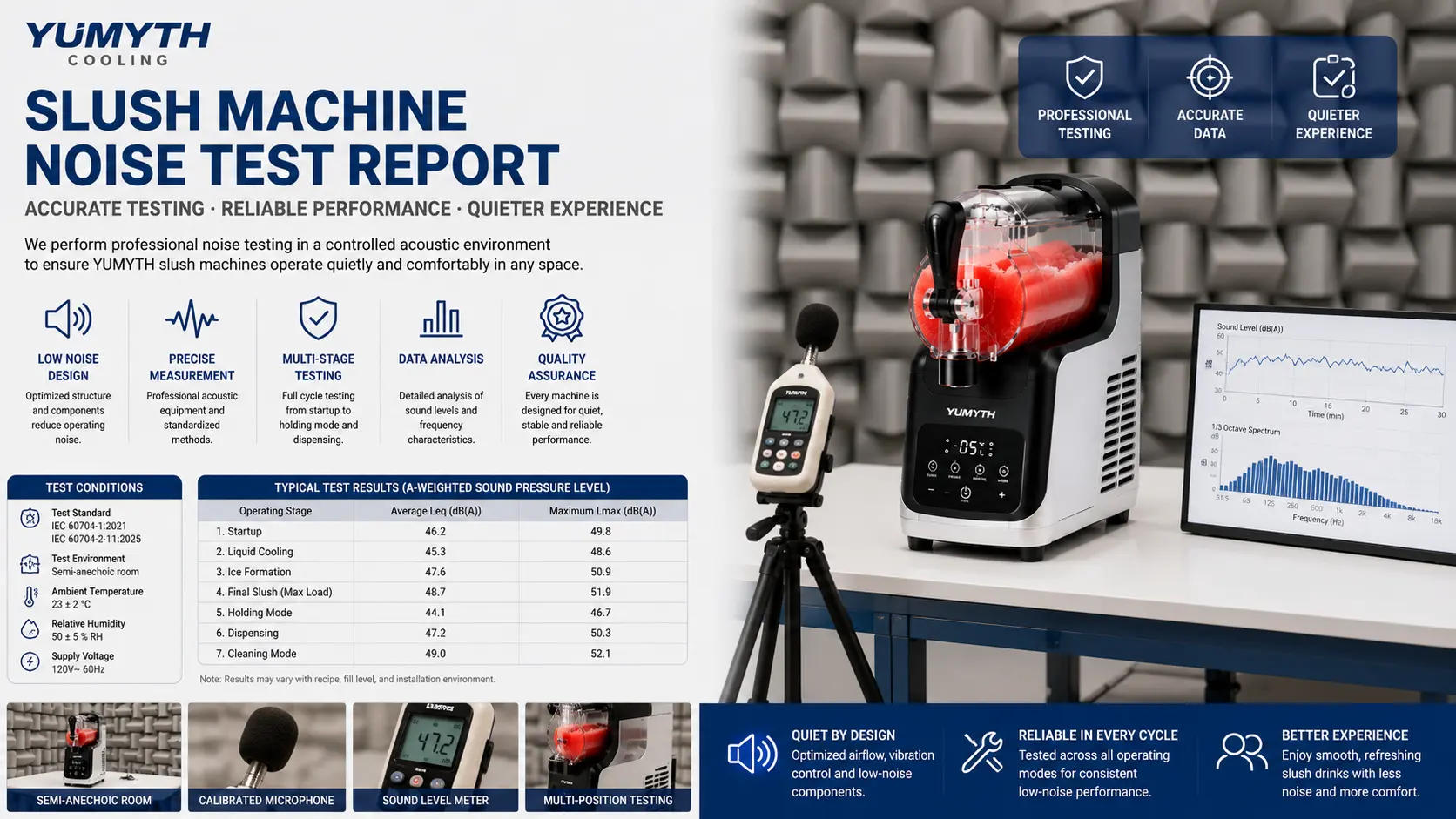
Home slush machines produce a lot of noise since they often run for a lot longer than blenders or food processors. The machine can provide a long preparation time to cool and mix the drink before a holding period ensures a stable frozen product.
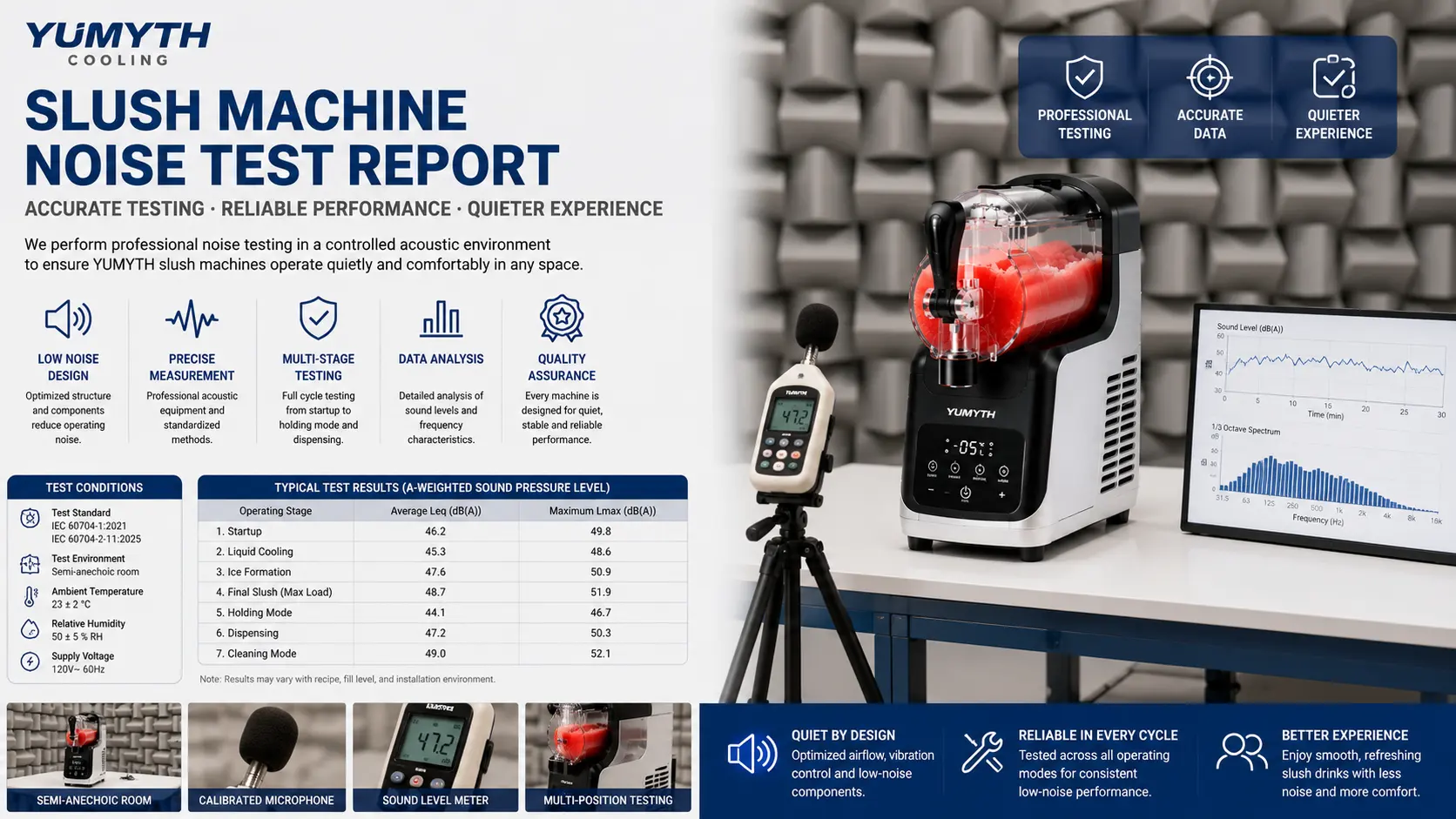
The compressor, condenser fan, auger motor, gearbox, refrigerant circuit and cabinet panels can all make sound during this period. It is, therefore, recommended that a noise test be conducted by a professional with a test report that measures more than one operating moment. It needs to describe the test environment, beverage load, operating program, measuring equipment, sound metric and the entire refrigeration cycle.
If these are omitted from the statement, it is not possible to make reliable comparisons between different products when the statements are read as “low noise” or “less than 55 dB”.
Outline the objective of the noise test.
The manufacturer should determine the purpose of the measurement prior to testing.
A noise test can be used to:
- * Compare engineering prototypes;
- * Identify the pros and cons of a particular marketing claim;
- * Determine the noisiest stage running;
- Test a new compressor or fan;
- Compare the different types of cabinets;
- * Monitor mass-production consistency;
- Provide a stand-alone laboratory report.
The required method and level of accuracy in measurement depends on the purpose of the test. An internal engineering comparison may be based on differences between two prototypes, or a declared product specification may need to be a more controlled and repeatable process.
IEC 60704-1:2021 lays out the general requirements for the measurement of airborne acoustical noise from household and similar electrical appliances. It covers household appliances powered by the mains or batteries, and contains conditions pertaining to climatic conditions, test environments and ambient noise.
Verify that the Applicable Product Standard is correct
Home slush machines serve two purposes: cooling and food preparation. The specific classification of the appliance for the acoustic test should thus be checked with the help of a competent laboratory according to the appliance's construction and intended use.
It is applicable for electrically operated food-preparation appliances designed for use on counters, tables, worktops, sinks or for built-in applications to IEC 60704-2-11:2025. It is designed to be used together with IEC 60704-1:2021.
Refrigerator, Frozen food storage cabinets and Food freezers are covered under IEC 60704-2-14. It is intended to set up the conditions for the measurement which give a sufficient degree of accuracy and enable the results of the measurement to be compared under conditions which closely mimic practice.
A slush machine might not neatly fit into either of the above categories. The laboratory should therefore decide on the procedure to be used and record any adaptations which are justified.
Differentiate between Sound Power and Sound Pressure.
For a professional report, it is important to determine if it is presenting sound power level or sound pressure level.
The acoustic pressure measured at a certain microphone position is called sound pressure. It may vary based on the distance between the measured object, room reflections, surrounding walls, counter top material, and the location of the microphone.
A sound power indicates the overall acoustic energy output of the appliance and is less affected by the listening position. ISO 3744:2025 gives an engineering approach to estimate the sound power from a measured sound-pressure on a surface around a noise source in an environment that approximates a free field over one or more reflecting planes.
These two values cannot be interchanged. If a report contains only the specification of "48 dB", then it is incomplete without also specifying:
- * The acoustic quantity;
- * The frequency weighting;
- * The microphone distance;
- * The operating condition;
- * The test environment;
- * The averaging period.
Set up a Controlled Test Environment.
The noise level of the appliance should be sufficiently below the noise level of the background to not affect the result. Air-conditioning systems, nearby equipment, outdoor traffic, conversations and building vibration should be avoided or recorded.
Testing can be carried out in an acoustic room, a hemi-anechoic chamber or any other environment which complies with the selected test procedure. ISO 3744 acknowledges environments that are close to a free acoustic field over a reflecting plane, and provides guidelines for the assessment and improvement of less-than-ideal environments.
The slush machine should be set up in a pre-established location on a representative rigid countertop. The test person should document:
- * Distance from walls;
- * Type of sink; and
- * Ambient temperature;
- * Relative humidity;
- Provide power to the water supply system, and maintain its frequency;
- * Background noise;
- * Appliance orientation;
- * Ventilation clearance.
The condenser outlet to wall spacing can impact airflow and sound. The installation conditions should be, however, standardized in comparison to other samples.
Ensure that the appropriate measurement equipment is used.
The report should include the following information: Sound-level meter, microphone, acoustic calibrator, data-acquisition equipment, and calibration status.
IEC 61672-1 sets out performance criteria for time-weighting meters, integrating-averaging meters and integrating meters, which are known as sound-level meters. It establishes Class 1 and Class 2 performance categories, the latter of which is normally expected to have stricter acceptance limits.
Frequency analysis is best especially for development testing. The overall A-weighted may indicate a loud prototype or quiet prototype but not necessarily which one.
The following factors can help to distinguish between:
- * Low-frequency compressor hum;
- * Fan blade-passing noise;
- * Refrigerant-flow sounds;
- * Gearbox tones;
- * Auger scraping;
- * Panel resonance;
- * Electrical switching noise.
Before and after the test the instrument should be calibrated. Results may be invalidated or qualified if there is any significant drift from calibration.
There is a Beverage and Operating load.The Beverage load and Operating load is defined.
It is important to test a slush machine only when it is empty. The viscosity of beverages, and the formation of ice, alter the mechanical loads and can have a significant influence on auger and gearbox noise.
The report needs to identify:
- * Beverage formulation;
- * Heat value; and
- * Calorie content, if applicable;* Serving size;
- * Fill volume;
- * Starting temperature;
- * Selected program;
- * Target texture;
- * Ambient temperature.
When comparing different machines or different batches of production the standard reference recipe should be used. This recipe must be well mixed and prepared according to the same method for each test.
The minimum and maximum working volume as declared should normally be tested. A partially full tank can produce some unusual noises and a full tank can lead to more strain on the motor and refrigeration system.
Measure all important operating stages.
Noise varies during the freezing process. Just one brief reading can fail to capture the loudest or most obnoxious state.
A full test should involve looking at:
- 1. First start-up: activation noise on the controller, start-up noise of the fan and compressor.
- 2. Liquid cooling: compressor, fan and low load auger operation.
- 3. Increasing load on the motor and scraper contact to cause ice crystal formation.
- 4. Final slush texture – highest normal beverage resistance.
- 5. Holding mode: compressor cycling and repeatedly temperature correction.
- 6. Dispensing: valve, auger and flow related sound.
- 7. Mechanical cleaning (water flow and special or high-speed auger, as appropriate).
Time-history data must be presented in the report or the report must clearly indicate the duration of the measurement for each stage. A single instantaneous reading may not be as representative as maximum, minimum and time-averaged results.
Explore Unusual and Unusual Sounds
Two machines could sound the same on average but sound completely different when you listen to them. It's possible that a smooth and steady compressor hum isn't as obvious as clicks, rattles, squeaks or high-pitched sounds.
Engineers should document unusual sounds that occur, including:
- Reduce the start and stop effects of compressor;
- * Repeated relay clicking;
- * Cabinet vibration;
- * Fan contact;
- * Refrigerant gurgling;
- * Auger misalignment;
- * Gearbox knocking;
- * Seal friction;
- * Loose removable parts.
These events should be related to the specific operating hour and component condition. It is also possible to use audio recordings and vibration measurements to help with the investigation of the root cause, but these cannot be used instead of the acoustic measurements required.
Identify the Main Noise Sources
After the loudest stage and the dominant frequency are determined, the engineering teams can investigate the stage that is causing the sound.
These are typical improvements you can make:
- More comfortable or suitable compressor mounts;
- * Improved fan balance;
- * Lower-resistance airflow paths;
- * Lower distance between fan blades and grilles; and
- * Stronger cabinet panels;
- * Additional panel ribs;
- * Better auger alignment;
- * Improved drive-coupling tolerances;
- * Positive thermal insulation; and
- * Controlled tubing support;
- * Prevention of hot air recirculation.
Any noise reduction should not introduce new thermal or reliability hazards. For instance, lowering the fan speed can result in a lower sound level, but raise the condenser temperature and compressor stress. Acoustic and refrigeration performance should always be validated together.
Keep in mind the use of Noise Testing in Production Control.
While it may not be feasible for all production units to have a full laboratory test, noise is still monitored during production.
The factory is able to set up a reference sample and end of line inspection method. Under controlled conditions, operators can check for rattling, scraping, abnormal compressor sounds, fan contact or excessive vibration.
Production audits should be conducted by comparing samples from various batches of components and changes such as:
- * Compressors;
- * Fans;
- * Auger motors;
- * Gearboxes;
- * Cabinet panels;
- * Rubber mounts;
- * Refrigerant charge;
- * Software control logic.
The changes may not affect the cooling performance, but they can impact the acoustic quality of the machine.
The Final Report should contain the following information:
The full report of the noise test should include:
- * Product number and model;
- * Agency/country; and
- * Applicable test method;
- * General information and instructions; and
- * Test-room description;
- * Background noise;
- * Installation position;
- * Voltage and frequency;
- The amount of beverages and/or amount of beverage volume;
- * Selected program;
- * Operating-stage results;
- * Sound-emission or sound-proofing data; and
- * Frequency analysis;
- * Measurement uncertainty;
- Photographs of the set up;
- * Abnormal observations;
- * Final engineering conclusion.
All declared noise values should be traceable to these. Marketing materials shouldn't try to show the best isolated measurement as being true for all recipes, programs, rooms, and operating stages.
Conclusion
To obtain a reliable slush machine noise test report, the following conditions should be met: controlled test conditions, appropriate testing instruments, standardized test recipes, recording of measurements throughout the entire freezing and holding cycle.
Noise performance is a function of the interaction between the compressor, fan, refrigerant circuit, auger, gearbox, cabinet, beverage load and control software. Measuring one component of the experience or one operating moment isn't measuring the whole experience.
Acoustic testing should start during the prototype development and be carried out throughout pilot production and component-change control for appliance brands and OEM manufacturers. A well-defined test method is essential to enhance the credibility of product claims, production consistency and the peace of mind of the home frozen drink consumer.
Related Articles
How We Test Every Ice Maker Before Packaging
2026-09-15
BY YUMYTH
A step-by-step look at refrigerant handling, cooling verification, leak detection, corrective action and electrical safety testing For an ice maker, reliable performance is determined long before the carton is sealed. ...
Guide for Brands Looking for a Reliable Vacuum Sealer OEM Supplier
2026-09-14
BY YUMYTH
When you are sourcing kitchen appliances for your retail brand, finding a dependable vacuum sealer OEM supplier is rarely just about getting the lowest unit price. It is about protecting ...

Why Ice Shape Matters: Understanding 10mm × 15mm Cylindrical Nugget Ice
2026-09-14
BY YUMYTH
More Than Ice Production — The Ice Itself Shapes the Consumer Experience When sourcing a nugget ice maker, buyers often focus first on production capacity, water tank size, ice basket ...

Ice Maker Sourcing Guide: How to Find the Right Factory
2026-09-10
BY YUMYTH
Sourcing an ice maker looks straightforward on paper. Find a supplier, agree on a price, place an order. But anyone who has actually done this knows the process is rarely ...