
What is the expected MOQ?
Share:
-

-

-

-


Copied
Share:
-
-
-
-
Copied
The first commercial question that is asked when an appliance brand is considering their slush machine OEM supplier is the minimum order quantity—known as MOQ. But there is no universal MOQ for all projects.
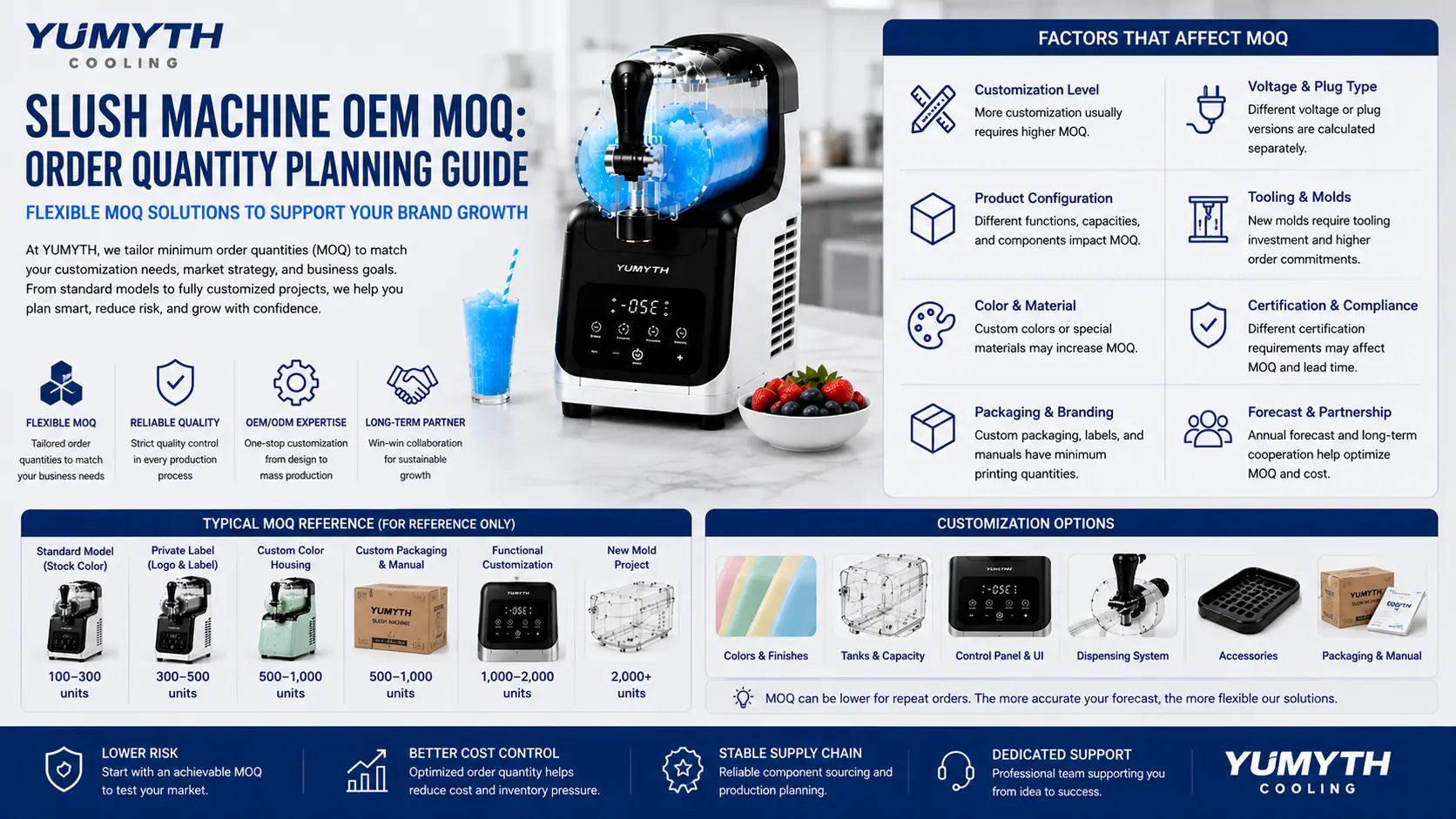
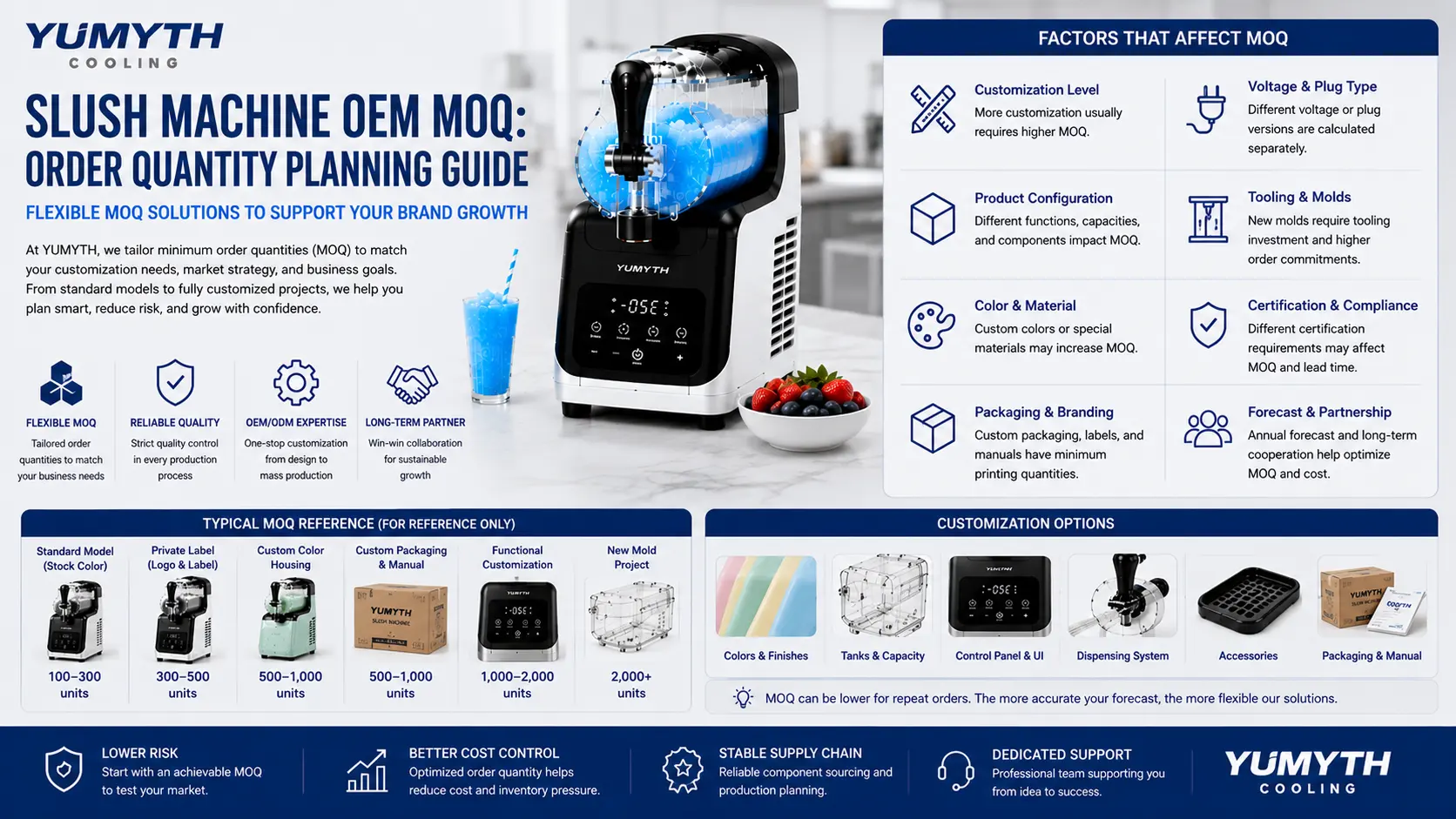
A standard private label design might be suitable for a relatively small number of units, whereas a custom colour, control panel, beverage tank, refrigeration system or a new injection mold might demand a significantly greater investment. The anticipated MOQ will depend on the level of difference between the product and the supplier's platform, as well as the number of materials, components, production processes and certification versions that need to be done specifically for the customer.
The knowledge of these factors allows brands to make their budgets, compare suppliers and prevent them from choosing a customization that is not in line with the real sales figures.
MOQ Is Not Only a Factory Production Number
Many buyers think that MOQ is only based on the number of efficient machines which a factory can produce. But in the reality, the actual number is determined by the entire value chain.
A slush machine has the following parts:
- * Compressors;
- * Start/Stop buttons and indicators; and
- * Electronic control boards;
- * Transparent beverage tanks;
- * Paint strippers; and
- * Plastic housings;
- * Printed control panels;
- Cables and plugs;
- * Protective inserts for cartons; and
- Labels and user manuals.
The minimum purchase quantity may vary from supplier to supplier. The appliance factory needs to integrate all these component requirements into a commercially viable production order.
MOQ is not only for final assembly capacity, but it also stands for material purchasing, production changeover, inventory risk, customization cost, test, and factory efficiency.
The MOQ is typically the lowest with the standard existing models.
Typically, the easiest platform to operate is an existing slush machine platform on which the platform itself is not structurally or functionally altered.
Customer can buy a model in accordance with the supplier's standard;
- * Housing color;
- * Beverage tank;
- * Control panel;
- * Programs;
- * Voltage version;
- * Packaging;
- * Accessories.
In this case, the supplier can already have all the necessary materials or they can already have the production mixed with other orders that have the same platform. This helps to minimise procurement and production risk.
The standard model is frequently the most appropriate model to use for:
- * New appliance brands;
- * Market testing;
- * Regional distributors;
- * Online retailers;
- * Initial product launches.
Brands can test the market for their brand-new products before they commit to custom materials, software, and exclusive molds.
Private Label Projects and Logo Projects.
Typically a basic PL project involves adding the customer's logo, rating label, manual and carton artwork to an existing product.
The MOQ may vary depending on:
- * Logo-printing method;
- * Label supplier requirements;
- * Manual-printing quantity;
- * Carton-printing quantity;
- * Packaging setup costs;
- * Production-line changeover.
Flexible quantities may be aided by printed labels and small instruction sheets. When the full-color carton needs to be customized, rather than being mass-produced, the plates, setup, and board production will need to be tailored to the customer, which also means that it will likely require a larger print run.
Some brands start with a neutral box carton and then add labels with their brand. Once sales volume is stable, they will shift to fully customized packaging.
Custom Colors can actually help to reduce MOQ.
Changing the color of the housing is only supposed to be simple, but can impact multiple materials and suppliers.
A custom plastic colour may need:
- * Dedicated color masterbatch;
- * Minimum resin preparation;
- * Separate molding production;
- * Color approval samples;
- * Removal of moldings from molding equipment; and
- Control of unused inventories.
For painted or metallic panels a minimum batch of coating may be required and set up may apply. When multiple plastic parts are to be colored, special attention will need to be paid to each tool/resin combination.
A standard black, white, silver or factory color typically has a lower MOQ than an exclusive custom color.
Additionally, brands should ask themselves if they will be continuing to sell their products in the same color in the future. It is easier to ingest dedicated materials over several orders with a consistent product-family color.
Every custom packaging company has their own minimum order quantity.
The commercial order quantity is often determined by the packaging suppliers.
The following is a sample of the following items that could be included in a customized package:
- * Printed retail cartons;
- * Shipping cartons;
- * Molded pulp inserts;
- * Foam protection;
- * Accessory boxes;
- * Recipe books;
- * Warranty cards;
- * Branded protective bags.
Generally, custom printing costs have set-up fees which will be more economical with the increase in the number of prints produced. Molded pulp or foam structures may also need to be tool designed.
The appliance manufacturer might accept the reduction in the number of appliances made, but the brand will still have to order additional cartons or inserts to meet the minimum order requirement of the packaging manufacturer.
Packaging that is not used may be kept for future orders, provided that storage conditions, moisture protection, artwork changes and ownership are agreed beforehand.
The voltage and plug versions are factors to consider when making orders.
There may be different electrical configurations for slush machines that are made for different countries.
Possible versions include:
- * 100–120V, 60Hz;
- * 220–240V, 50Hz;
- * USB or plug type (US, EU, UK, Australian or other);
- * Different rating labels;
- Manuals and warnings for each market.
All parts, including the compressor, motor, fan, PCB power supply, cord, plug and protection parts, need to be matched to the target market.
Creating multiple regional versions of one order can result in orders of such small size that each one is not economically viable for purchase or production. This may be done by the electrical version of the MOQ (Minimum Order Quantity) instead of the total quantity of order.
Brands with multiple markets should make estimates for each market and figure out if a single platform can support a significant portion of the platform itself and only swap out the parts that relate to the electrical requirements of each market.
Set up a control panel and customize software.Install and configure software and a control panel.
It may be required that the printed artwork on the control panel be changed and the MOQ may be moderate. More may be needed to change the actual control functions.
Functional customization can comprise:
- * New preset programs;
- * Different temperature settings;
- * Custom icons;
- * Language changes;
- * Startup screens;
- * Sound alerts;
- * Cleaning logic;
- * Jam-protection settings.
These changes involve engineering, software, testing, and independent inventory management.
Typically, a dedicated PCB or display will result in a higher MOQ since the electronics supplier will need to buy components, program boards, and print graphics, and keep a version for the customer.
The brand should not develop insignificant software distinctions that do not offer significant market value. Every iteration adds the danger of wrong firmware, mixed parts and complexity of services.
For structural changes, more commitment is needed.
Structural customization involves: Beverage tank, auger, dispensing system, housing, internal supports, or refrigeration layout changes.
These projects could involve:
- * New engineering drawings;
- * Prototypes;
- * Injection molds;
- * Assembly fixtures;
- * Reliability testing;
- * Food-contact testing;
- * Updated packaging;
- * Certification review.
The expected volume of use per year is more important than just the initial order for the supplier, as he must pay for his development and tooling costs.
In some factories it is possible to have a first batch of a design that is somewhat limited in size but the customer pays for the tooling and development separately. Others might need to make a substantial commercial commitment to support engineering effort and special production materials.
New Injection Mold Designs Pose Tooling and Volume Issues.
If a project calls for creation of a new tool for a new tank, lid, auger, handle, panel or entire housing, the brand should be talking about the tooling cost and MOQ.
Important questions include:
- Who pays for the mould?
- * Who owns it?
- * Is it exclusive?
- What is the mean life of this?
- Where will it be held?
- What is the smallest amount that the factory can produce?
- Does the cost of maintaining the property come included?
- Is there a mould that can be transferred?
Not every time you pay for a mold, the production MOQ will be eliminated. There are still sufficient units to order the resin and insure the proper molding schedule, assembly and maintain customer specific inventory.
Brands with dedicated tooling will be able to negotiate production batches around annual forecasts, material commitments or scheduled repeat orders.
Typically, high MOQ is required for refrigeration changes.
The core appliance platform is impacted by changing the compressor, refrigerant, condenser, evaporator, fan, capillary tube or change in cooling capacity.
These changes might need:
- * Refrigeration engineering;
- * New component sourcing;
- * Charge optimization;
- * Performance testing;
- * High-ambient testing;
- * Noise validation;
- * Safety review;
- * Certification updates;
- * New production procedures.
A small, one-off order is less likely to have a dedicated refrigeration system developed by a supplier. A viable annual forecast and long-term product plan are generally needed for the project.
Platform-level refrigeration customization should only be requested by brands where it is clear that it provides a benefit, e.g. for faster freezing, reduced noise, improved high-temperature performance, greater capacity or where the refrigerant is required to comply with market or regulatory requirements.
Certification Can Influence MOQ
For safety, EMC, food-contact and market compliance programs, engineering samples, test fees, documentation and controlled production components are needed.
If the proposed product is within the approved construction, then a lower starting quantity may be allowed for a certified existing model.
Laboratory review or new certification work may be necessary if the critical components, the voltage or the enclosure design or the refrigerant system or software has changed.
The customer and supplier should come to an agreement about:
- * Certification owner;
- * Test costs;
- * Sample quantities;
- * Model naming;
- * Factory inspection responsibilities;
- * Document access;
- * Future part change impacts.
When it is expected that sales will be larger than one small order, the vision of a certification investment is more easily justified.
The first order is not the most important, it's the forecast volume.
OEM suppliers will look at the entire business opportunity, not just the initial order.
A brand may request for a small trial amount but give a realistic annual forecasts, launch plan, repeat order timeline. This can enhance negotiation as the supplier can arrange material procurement and production accordingly.
A good forecast should contain:
- * Initial order;
- * Expected repeat-order timing;
- * Annual sales estimate;
- * Target countries;
- * Number of product versions;
- * Seasonal demand;
- * Planned product expansion.
Exaggerated expectations can be counterproductive. Offer a realistic, but conservative plan, is preferable.
There are ways to reduce the initial MOQ.There are methods to reduce initial MOQ.
Limiting customization can help brands to lower the first-order requirement.
Practical strategies include:
- Use an existing certified platform.
- Use standard housing colors #2.
- 3. Only customize the logo and the labels.
- 4. Carded with a neutral carton with stickers.
- 5. Choose a voltage and plug version that already exist.
- 6. Do not use separate electronic parts.
- 7. Use standard accessories.
- 8. Validate the sample before ordering it back to the lab.
- 9. Pay development or tooling costs separately.
- 10. Communicate forecasts of annual results publicly.
This way the brand can gauge the market reaction, then make further customization if necessary.
Avoid ordering based on the “Minimum Order Quantity” (MOQ).
While a very low MOQ might seem appealing, buyers need to verify exactly what's involved.
A low quantity offer can include:
- * Minimum product customization;
- * Production will be used as a proxy for existing stock;
- * Generic packaging;
- * No exclusive color;
- * No certification ownership;
- * Limited spare parts;
- * Higher unit price.
It is important for the supplier to make it clear what they are quoting for – components, documents, tests, services etc.
When the situation involves controlled materials, dedicated production, customized packaging, traceability, and reliable after-sales service, it might make sense to have a higher MOQ.
Questions to ask the OEM supplier:
Brands should ask themselves the following questions before confirming the project:
- Is MOQ based on the number of models ordered, the number of colors ordered, the number of voltages ordered or the number of orders placed?
- Which customizations will lead to MOQ being raised?
- Determine how much of the package will be needed?
- Can Unused Packaging be Stored?
- Does the company have a minimum order for pilots?
- Can the cost of the tools be negotiated separately?
- Does the MOQ contain spare parts?
- What is the change in the unit price due to volume?
- What do you do with unused custom materials?
- Will same materials and tooling be available in the future for orders?
Having clear answers avoids the unexpected costs once development has begun.
Conclusion
Each slush machine OEM project has a different MOQ, which is largely determined by the degree of customization required.
Typical models and simple private label projects generally have the maximum flexibility in terms of the amount of starting capital required. Purchase and production requirements increase with custom colors, packaging, software versions, electrical versions and food contact materials. New molds, changes to the structure and dedicated refrigeration systems demand higher investments and higher volume commitments.
For appliance brands, the minimum order quantity may not be the optimal amount. It's the amount that equates market risk, unit cost, value of customization, compliance and supply chain efficiency.
A successful platform and continuing to build customization as orders ramp up can be a practical way to make the transition from market testing to a fully differentiated product line.
Related Articles
How We Test Every Ice Maker Before Packaging
2026-09-15
BY YUMYTH
A step-by-step look at refrigerant handling, cooling verification, leak detection, corrective action and electrical safety testing For an ice maker, reliable performance is determined long before the carton is sealed. ...
Guide for Brands Looking for a Reliable Vacuum Sealer OEM Supplier
2026-09-14
BY YUMYTH
When you are sourcing kitchen appliances for your retail brand, finding a dependable vacuum sealer OEM supplier is rarely just about getting the lowest unit price. It is about protecting ...
Why Ice Shape Matters: Understanding 10mm × 15mm Cylindrical Nugget Ice
2026-09-14
BY YUMYTH
More Than Ice Production — The Ice Itself Shapes the Consumer Experience When sourcing a nugget ice maker, buyers often focus first on production capacity, water tank size, ice basket ...

Ice Maker Sourcing Guide: How to Find the Right Factory
2026-09-10
BY YUMYTH
Sourcing an ice maker looks straightforward on paper. Find a supplier, agree on a price, place an order. But anyone who has actually done this knows the process is rarely ...