
How appliance brands evaluate slush machine OEM suppliers
Share:
-

-

-

-


Copied
Share:
-
-
-
-
Copied
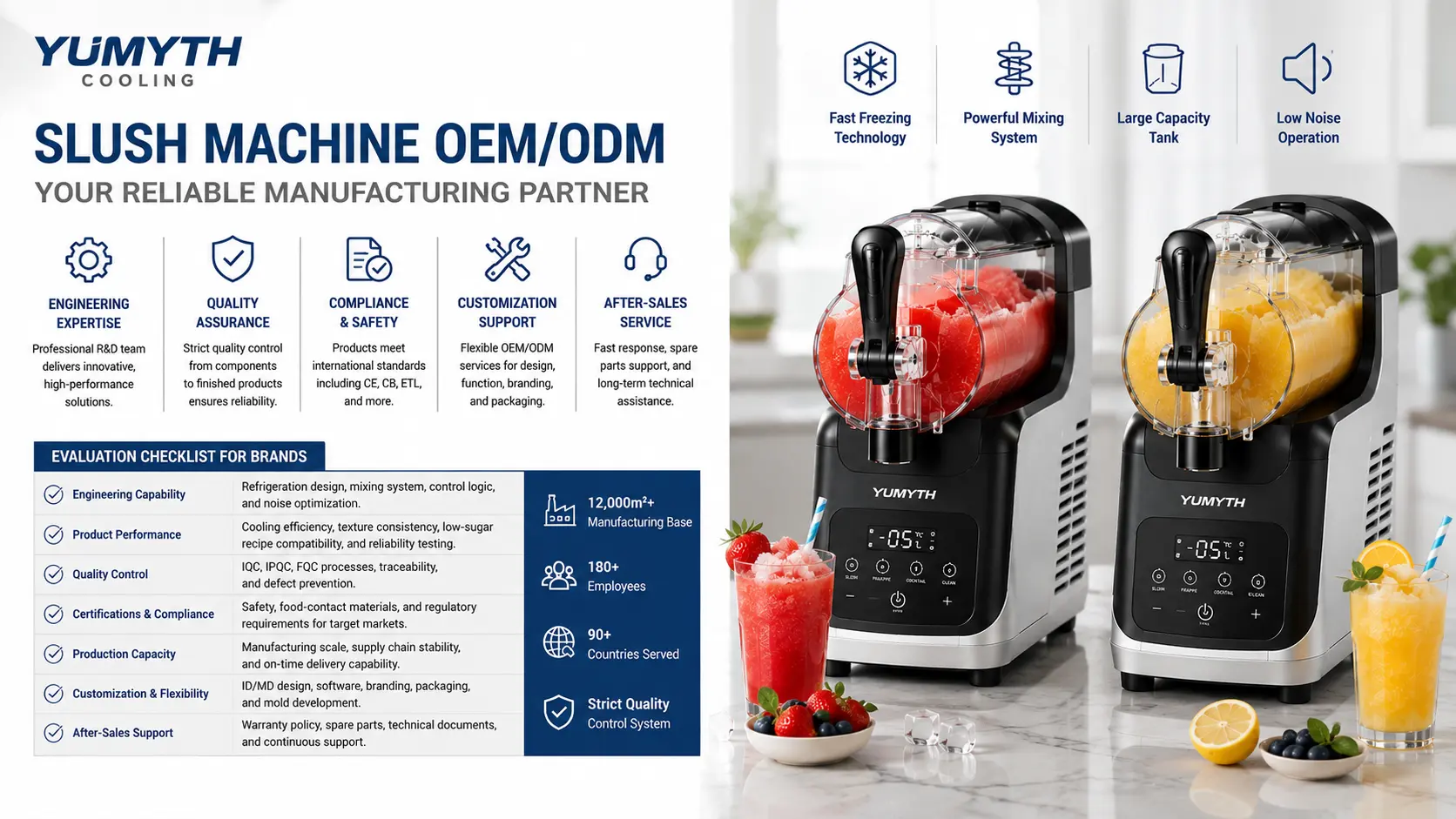
Choosing the slush machine OEM supplier is not just a product selection process but a strategic decision. The home frozen drink machine consists of a refrigeration circuit, compressor, auger drive, electronic controls, food-contact parts, dispensing parts, and cleaning systems in a single, compact countertop machine.
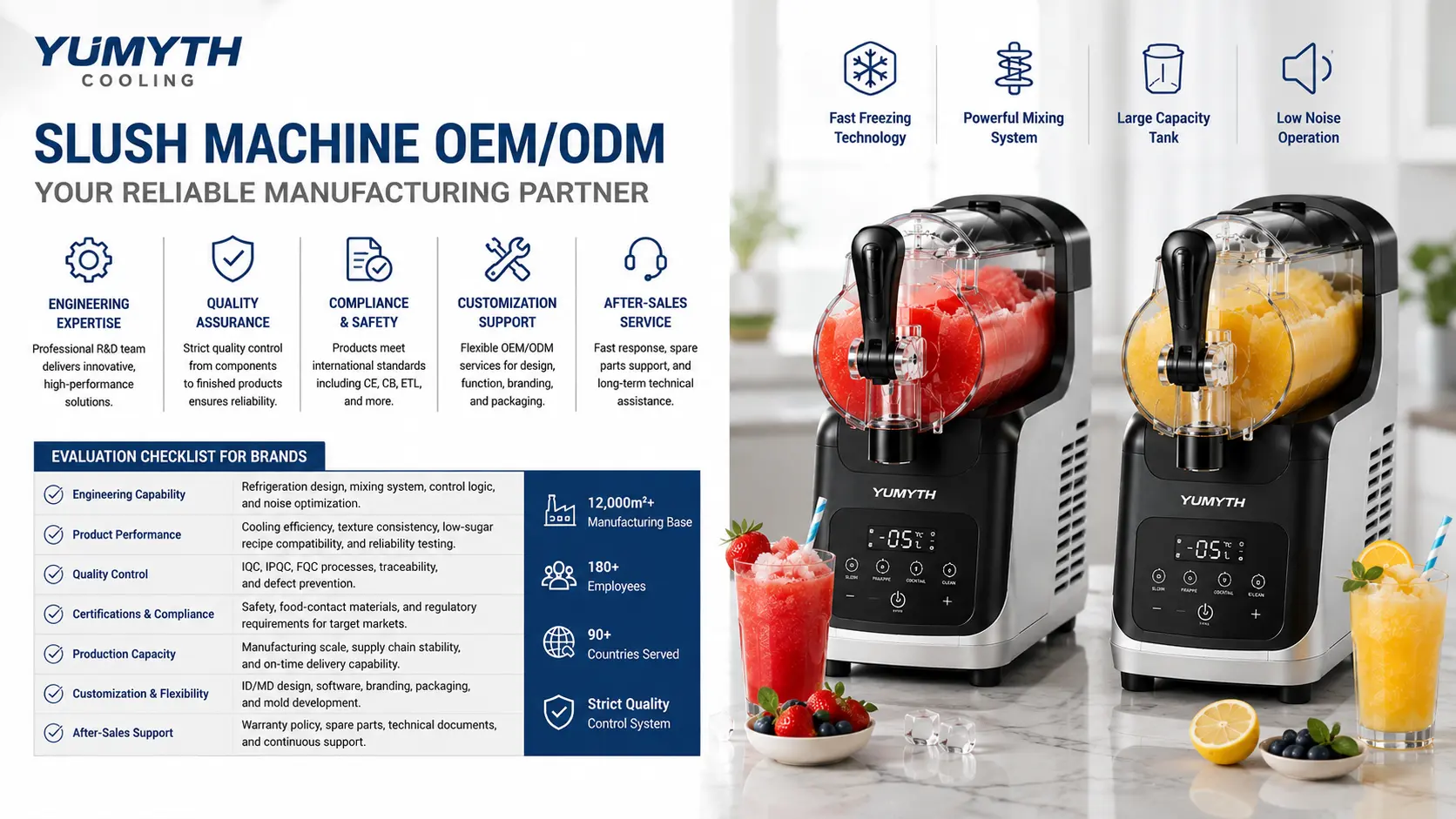
An attractive sample and competitive quotations may be provided by a supplier, but performance inconsistency, regulatory documentation, engineering changes, spares, or mass production control may still be an issue. To assess a supplier, appliance brands should go through the following steps: Document Review; Sample Testing; Factory Evaluation; Pilot Production; Commercial Risk Analysis.
Developing the Product Requirements Prior to comparing Factories
A written product requirement specification should be used to start supplier evaluation. If there is no consistent specification, it is possible for quotes to be based on products that vary in capacity, compressor, materials, control functions and even the way they are tested.
The requirement document should outline:
- * Intended use, target market and target group;
- Work and maximum capacity;
- * Supported beverage types;
- * Target freezing time;
- * Noise target;
- * Maximum working current; and
- * Refrigerant preference;
- * Preset programs;
- * Food-contact materials;
- * Cleaning method;
- * Certification markets;
- * Packaging requirements;
- * Warranty period;
- * Forecast order volume.
Test conditions should be included in performance targets. The claim “slush ready in 15 minutes” is not complete without providing the fill volume, initial beverage temperature, ambient (room) temperature, sugar concentration, chosen program and the desired serving texture.
If the same test conditions are used for all suppliers, then technical and commercial comparisons can be made more easily.
Conduct the Supplier's Refrigeration Engineering Assessment.
A slush machine supplier ought to know more than appliance assembly. The engineering team should have a good understanding of the interaction between the compressor, condenser, capillary tube, evaporator, refrigerant charge, insulation, auger, and control software.
At the technical meetings the brands should inquire of the supplier:
- * Compressor capacity;
- * Evaporator dimensions;
- * Refrigerant charge;
- * Capillary-tube specification;
- * Condenser airflow;
- * Auger speed;
- * Target beverage temperature;
- * Compressor cycling logic;
- * Overload protection settings.
An effective team would also be aware of the effects that sugar, alcohol, milk products, fruit pulp, bulk density, and initial temperature have on freezing.
Brands should ask for samples of the engineering enhancements made in prior years. Helpful proofs could consist of a noise-reduction project, a new auger to lower jamming, a new seal that didn't leak, or a modification of the control to make it more compatible with recipes for low-sugar foods.
The supplier should provide an explanation of the original problem, the engineering change, the validation method, and the measurable result.
Use the real consumer recipes for testing samples.
It is not enough to perform a short demonstration of the syrup in the factory. Appliance manufacturers should test their products using actual beverages.
The test plan can contain:
- * Fruit juice;
- * Carbonated soda;
- * Coffee drinks;
- * Dairy-based mixtures;
- * Reduced-sugar beverages;
- * Mocktails;
- * Alcoholic cocktails;
- * Minimum and maximum fill volumes.
For each test, it should document the beverage formulation, the Brix level, the alcohol percentage (if applicable), the initial beverage temperature, the ambient temperature, the freezing time, the serving temperature, the beverage stability, the auger behavior, the auger motor current, and the beverage noise level.
The machine should also be observed during prolonged holding. A product can taste good on the first hour of operating but get to hard, soft or uneven after a few hours.
Brands need to expose themselves to inappropriate environments, too. Some of these can be a lack of sugar, too much fill volume, loss of power, clogged air inlet, assembly error, or a thick recipe. The aim is to find out if the device can safely protect itself and offer instructions that are helpful rather than just defeating or destroying the drive system.
Review Product Safety and Certification Readiness
Planning for certification should start before final tooling and mass production. If a product is classified as a household frozen drink appliance, and sold to the public, the appliance would require an evaluation against applicable household appliance safety standards depending upon the product classification and consumer target market.
IEC 60335-2-24:2025 covers the specific safety requirements for household refrigerating appliances, ice-cream appliances and ice makers. Specific standards and national deviations should be verified with a competent certification body or laboratory with regards to a particular slush machine.
The supplier should be able to show a full copy of the certificate documents and not just certificates logos. Brands should verify:
- * Certificate holder;
- * Factory address;
- * Model numbers;
- * Insulation resistance; and
- * Applicable standard version;
- * Test-report number;
- * Critical component list;
- * Refrigerant information;
- The product scope reported covers what is called product construction.
The model to offer to the brand should be the same as the certified construction. The replacement of a compressor, motor, relay, PCB, power cord, thermal protector, plastic material or refrigerant component may impact compliance.
Suppliers are therefore expected to have a formal engineering change process and inform the brand of any change of the controlled parts.
Verify Food-Contact Materials
All parts that come in contact with food or beverages, condensation, splashes or residue must be food-contact compliant. These parts are typically the tank, auger, seals, lid, scraper, dispensing valve, nozzle and parts associated with the drip.
According to the FDA definition, food-contact substances are any substance used in food-processing equipment, food-preparation surfaces, cookware, packaging, food coloring, tapes, glues, etc., that may come in contact with food. The final determination of a food-contact article's regulatory status depends on the substances and uses it will have.
The general framework for the safety and inertness of food contact materials is given by Regulation (EC) No 1935/2004 for the European market. The material may also have requirements depending on what it is; plastic, rubber, metal, etc.
Brands should request:
- * Material specifications;
- * Declarations of compliance;
- * Migration-test reports;
- Identifying resin; Colourant identification;
- * Supplier traceability;
- * Quality conditions for foods; and
- * Test reports corresponding to the production material.
A general “food grade” designation is not enough. The same as the actual use, material and formulation supplied by the supplier, colour.
Review the Quality Management System
The ISO 9001 sets out a structure for controlling processes, responsibilities, documentation, corrective action and continuous improvement. But certification does not mean that the factory always has control on slush machine production.
As part of the factory audit, appliance brands should check the practical functioning of the quality system.
Important checkpoints include:
- * Incoming component inspection;
- * Compressor and motor test;
- * Brazing-process control;
- * Refrigerant charging accuracy;
- * Leak testing;
- * Electrical safety testing;
- * Functional cooling tests;
- * Noise inspection;
- * Leakage inspection;
- * Appearance standards;
- * Serial-number traceability;
- * Nonconforming product control;
- * Corrective-action records.
The completed records from real production orders should be reviewed by the auditor and not blank inspection forms.
It is also helpful to track back through a finished appliance to its batch of compressors, batch of motors, PCB version, Refrigerant Charge Record, Electrical Test, and Final Inspection. This shows if the factory is able to recognise the parts that have been used in a returned product.
Discuss Reliability and Durability Testing
The beauty doesn't indicate the reliability of a sample. Slush machines undergo repeated cycles of compressor operation, increased beverage loads, auger resistance, cleaning, dispensing and temperature fluctuations.
The supplier shall provide a detailed reliability plan that addresses:
- * Compressor operating cycles;
- * Braking distance;
- * Motor stall protection;
- * Dispensing-valve life;
- * Seal compression;
- * Control-button operation;
- * High and low voltage condition;
- * Temperature cycling;
- * Repeated cleaning;
- * Packaging vibration;
- * Drop testing;
- * Extended holding operation.
Brands should ask for the sample size, test duration, test conditions, acceptance criteria, failures, and corrective measures for each test.
If the appliance has been through an “aging test,” there is little benefit to that statement unless the supplier can answer the following questions: How long was the test? What functions of the appliance were being watched? What were the criteria for failure?
Evaluate Customisation and Development Control
When suppliers say that a product is customisable, it can be anything from including a logo to re-engineering the refrigeration platform.
There are four levels of requests that should be distinguished by brands:
- 1. Brand changes such as logo and packaging;
- 2. Finishing and coloring changes;
- 3. Functional changes, such as presets, temperatures, software;
- 4. Structure modifications such as tanks, housings, evaporators and in-house systems.
It is important that the supplier clearly communicates the following: tooling cost, engineering cost, prototype time, minimum order quantity, impact of certification, who owns the drawing, who owns the mold, who owns the firmware, and who will be responsible for approving.
All approved specifications should be documented on a controlled golden sample, bill of materials, appearance standard, software version and signed specification sheet.
Confirm Mass-Production Consistency
Brands should conduct a pilot order, using the production tools, production staff, approved suppliers, and inspection procedure they plan to use for the actual order before order is placed.
If there is an approved sample, pilot should be tested against it. Key points of comparison are: Freezing time, noise, leakage, temperature control, user-interface behaviour, cosmetic quality and packaging protection.
Brands also need to find out if the announced capacity matches the factory's available assembly lines, testing stations, refrigerant equipment, people and parts stock.
There is no value in production unless the factory can produce it at a higher volume and keep the quality.
Communication and After-Sales Support are reviewed.
Technical communication is one of the key elements to future cooperation. Good suppliers respond with drawings, data, test results and documented decisions, not with assurances.
Brands should make a point of clarifying before supplier approval:
- * Warranty responsibility;
- * Failure-analysis procedure;
- * Response time;
- * Replacement-part availability;
- * Spare-parts pricing;
- * Technical documentation;
- * Repair instructions;
- * Distributor training;
- Confirmed manufacturing defect – responsibility.
After the initial production order, common removable parts, like tanks, augers, seals, lids, valves and drip trays, should be kept on hand.
Work through a Weighted Supplier Scorecard
Purchase price is not the only factor in the final decision and a weighted scorecard should be used.
A practical examination might result in the awarding of:
- * 20% to engineering capability;
- * 15% to sample performance;
- Two of those who were injured have been transitioned to safety and compliance;
- * 15% to quality control;
- * 10% to reliability testing;
- * 10% to production capacity;
- * 5% to customization;
- * 5% to communication;
- * 5% to commercial terms.
Weighting may vary depending on the brand's strategy but technical and quality aspects should not be ignored.
Conclusion
The best slush machine OEM supplier does not have to be the factory with the lowest quotation, the biggest workshop, or the most product models. It is the supplier who can make product specifications into a program that is controlled, testable, compliant and repeatable.
Appliance manufacturers should seek out evidence through engineering data, recipe testing, certification files, material traceability, inspection records, reliability reports, pilot production, and an open change control.
A structured supplier evaluation will eliminate the delays in certifications, inconsistent performance, warranty claims and issues in the supply chain. This also establishes a better base for further product development, market expansion, and long-term cooperation.
Related Articles
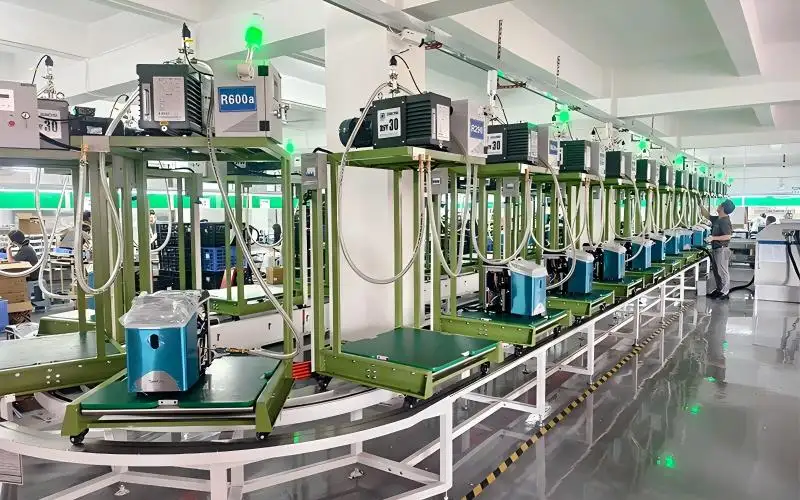
How We Test Every Ice Maker Before Packaging
2026-09-15
BY YUMYTH
A step-by-step look at refrigerant handling, cooling verification, leak detection, corrective action and electrical safety testing For an ice maker, reliable performance is determined long before the carton is sealed. ...
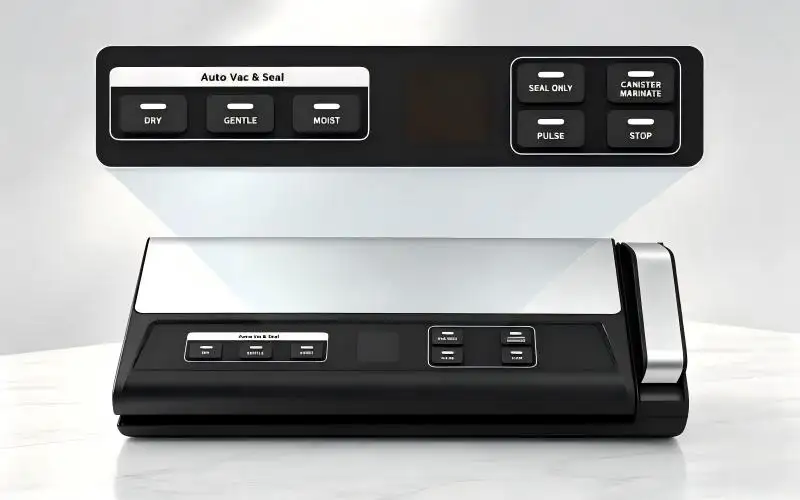
Guide for Brands Looking for a Reliable Vacuum Sealer OEM Supplier
2026-09-14
BY YUMYTH
When you are sourcing kitchen appliances for your retail brand, finding a dependable vacuum sealer OEM supplier is rarely just about getting the lowest unit price. It is about protecting ...
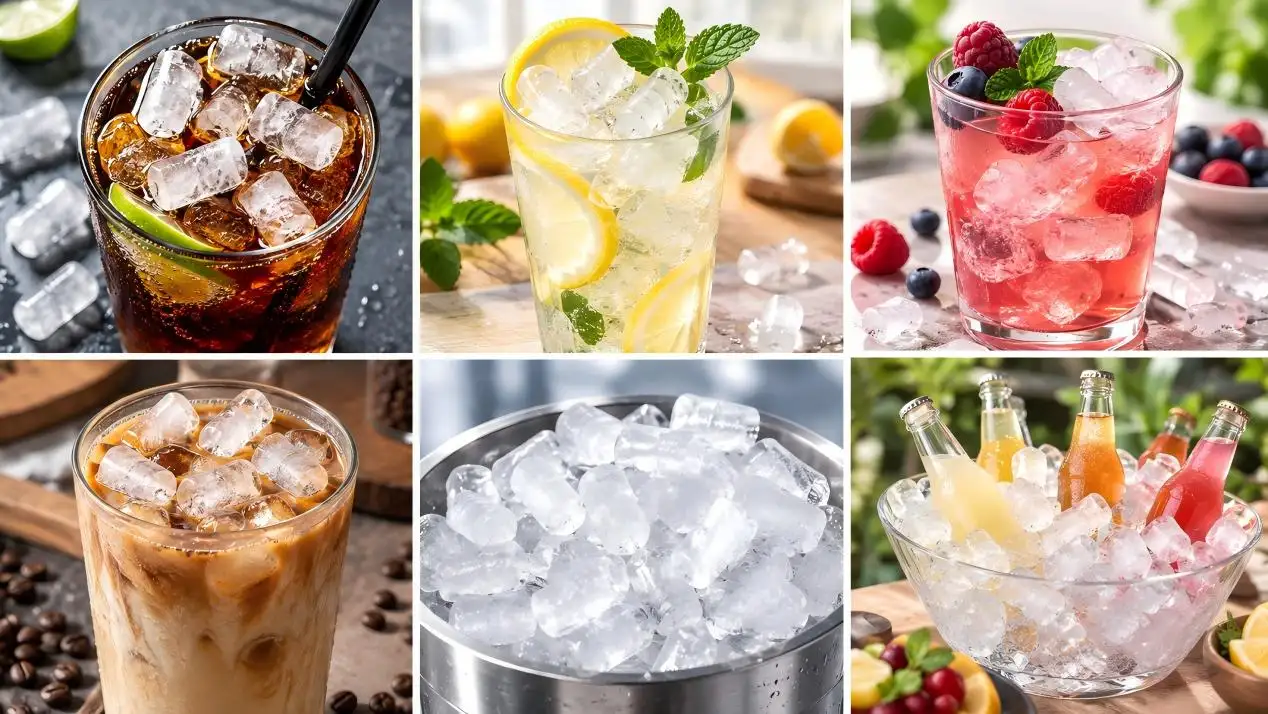
Why Ice Shape Matters: Understanding 10mm × 15mm Cylindrical Nugget Ice
2026-09-14
BY YUMYTH
More Than Ice Production — The Ice Itself Shapes the Consumer Experience When sourcing a nugget ice maker, buyers often focus first on production capacity, water tank size, ice basket ...

Ice Maker Sourcing Guide: How to Find the Right Factory
2026-09-10
BY YUMYTH
Sourcing an ice maker looks straightforward on paper. Find a supplier, agree on a price, place an order. But anyone who has actually done this knows the process is rarely ...