
Which changes may affect the refrigeration system?
Share:
-

-

-

-


Copied

Share:
-
-
-
-
Copied
The refrigeration system of a slush machine is a carefully balanced system of its compressor capacity, refrigerant, evaporator, condenser, capillary tube, airflow, insulation, charge quantity, sensors, and control logic. Even if the change in one component doesn't seem to relate to cooling, it can have an impact on other components.
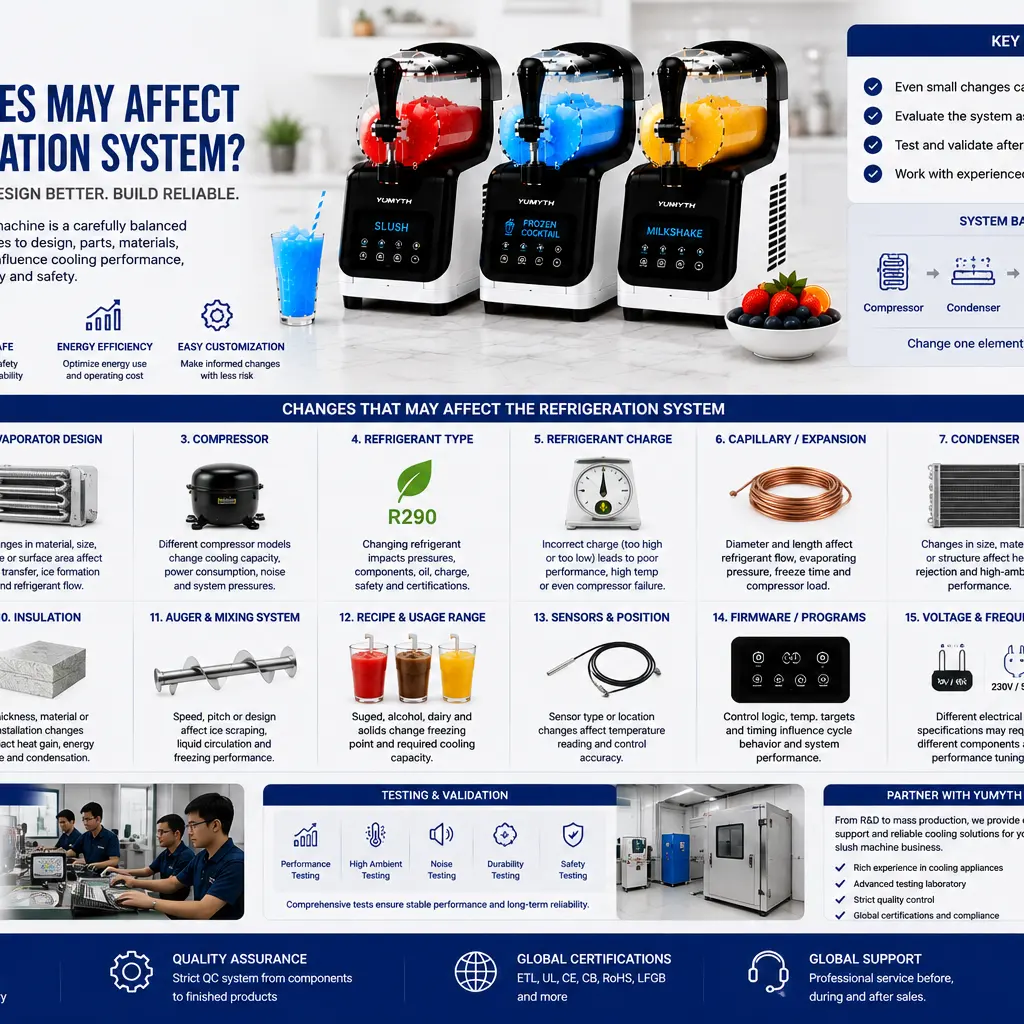
If a brand is planning to approve a customized tank, housing, recipe, program or electrical version, it is essential for the brand to grasp the interactions that take place. Even a small change that increases the cooling load or reduces heat rejection can result in longer freeze time, higher compressor temperature, higher noise levels or inconsistent beverage texture.
Any changes or modifications that are made to the system as a result of refrigeration needs to be considered as changes or modifications to the system and not as a replacement of components.
The capacity of the Beverage Tank can be changed.
The bigger the beverage tank, the more heat the refrigeration system will have to remove.
More liquid is needed with:
- * More compressor capacity;
- A higher flow rate of evaporator water; and
- * Longer preparation time;
- * less hot water consumption; and
- * Different refrigerant charge;
- * Revised control settings.
When the level of a small household serving is greatly increased, the freeze time may not be the same for a machine.
The form of the tank is also a factor. The contact area between the beverage and cooling surface can vary with a deeper and wider or irregular shaped vessel. It can also impact liquid flow, ice crystal distribution and sensor response.
Capacity changes should be tested at minimum, nominal and maximum fill volume rather than using a single convenient laboratory volume.
Changing the Evaporator Design
The evaporator absorbs heat from the drink and into the refrigerant. It has a direct impact on cooling performance due to its material, dimensions, wall thickness, internal channels and contact area.
Modification of evaporator can affect:
- * Heat-transfer rate;
- * Refrigerant distribution;
- * Pressure drop;
- * Superheat;
- * Ice formation;
- * Auger clearance;
- * Required refrigerant charge.
Adding more evaporator surface will increase heat transfer as long as the compressor, expansion device, condenser and refrigerant flow are matched.
If the internal volume of the evaporator is too large, additional refrigerant may be necessary. If there are any problems with the distribution of the refrigerant, this can cause uneven surface temperature which can result in the drink freezing more solid in one place than another.
Changing the Compressor
The compressor controls the circulation of the refrigerant and is an important component of the refrigeration capacity.
The selection of the compressor will be determined by the capacity, operating condition, evaporating and condensing temperature, condensing refrigerant, electrical power supply and system configuration. In terms of compressor selection, Copeland singles out the following factors: Application type, capacity, operating conditions, ambient range, refrigerant choice and fixed- or variable-capacity operation.
A larger Compressor can reduce the Freeze Time, but can also add:
- * Higher power consumption;
- * Increased heat; and
- * Greater condenser load;
- * Increased discharge temperature;
- * More frequent cycling;
- * Higher component cost.
A smaller compressor might lower your noise or energy consumption, but not be as effective in hot weather or when you're filling up your beverage volume.
The replacement compressor should also meet the following requirements: the intended refrigerant, oil, starting system, voltage, and frequency requirements, and safety certification.
Changing the Refrigerant
Refrigerants vary in pressure, capacity, flow, type of compressor needed, and safety classification. Never use a refrigerant as a "drop-in" replacement without a full engineering review.
Replacement of refrigerant(s) may necessitate changes to:
- * Compressor model;
- * Capillary tube;
- * Filter drier;
- * Refrigerant charge;
- * Evaporator volume;
- * Condenser capacity;
- * Lubricant;
- * Warning labels;
- * Factory charging process.
R290, propane, is an A3 refrigerant with desirable thermodynamic properties which is employed in small refrigeration systems, but with the need for proper precautions and safety. Converting equipment that is operating with a nonflammable refrigerant to R290 is risky and demands ventilation, leak control and proper working practice, says Danfoss.
IEC 60335-2-24:2025 provides requirements for household refrigerating appliances, ice-cream appliances and ice makers including appliances that are compression refrigeration type with flammable refrigerants.
Changing a refrigerant ought then to be considered a new refrigeration and compliance project.
The amount of refrigerant in the system.The quantity of refrigerant within the system.
The optimum charge for the refrigerants is usually determined for a particular volume of system and combination of components.
A not enough charge may result in:
- * Poor evaporator feeding;
- * Longer freeze time;
- * Unstable surface temperature;
- * Excessive compressor temperature;
- * Reduced cooling capacity.
An overcharge can lead to higher operating pressure, influence the loading of the compressors, modify the condenser action and cause unequal performance.
The correct charge quantity may be changed by altering the length of tubing, condenser size, evaporator volume, filter drier, or compressor.
Use carefully controlled tests to determine the charge, not to copy from a similar looking appliance. The factory is then required to employ calibrated charging equipment and to have a repeatable production tolerance.
The Capillary Tube and Expansion Device should not be changed without consulting the electrician.
A condenser-cooled compact refrigeration system includes a capillary tube that regulates the refrigerant flow between the high side and low side of the system.
It will have an effect on the following:It will affect:
- * Refrigerant mass flow;
- * Evaporator feeding;
- * Suction pressure;
- * Compressor temperature;
- * Pull-down time;
- * High-ambient performance.
If either compressor or refrigerant is changed, a different capillary tube might not function properly.
The freeze time and temperature stability of the tubes may be influenced by even slight variations in the tubes' dimensions. Therefore, the selection and validation of the expansion device should be done as a part of the complete system.
Changing the Condenser
The condenser removes the heat from the beverage and condensation, and gives it to the air around the condenser.
This can be altered by changing the material, position, fin area or tube length of the device:
- * Condensing temperature;
- * Compressor pressure;
- * Power consumption;
- * High-ambient performance;
- * Refrigerant charge;
- * Cabinet temperature.
A bigger condenser will be more effective at rejecting heat, but it does take up space for the cabinets and needs adequate airflow. A smaller condenser will fit into a small condenser case, but may result in higher condenser temperatures or slower freezing.
The condenser should be tested as installed, with the declared space clearance and under warm ambient temperature conditions.
Additionally, you can change the Fan or Airflow Path.
The condenser fan, cabinet ventilation are also part of the refrigeration system, though they might be categorized as exterior or mechanical parts.
Potential changes that could affect the air flow are:
- * Smaller ventilation openings;
- * Decorative grille modifications;
- * Thicker filters;
- * Added internal wiring;
- * New accessory storage;
- * Moving the appliance closer to a wall;
- Lowering fan speed to decrease noise.
Bad air flow can lead to a rise in condensing temperature and lower cooling capacity. The noise, power use, air flow direction, and cabinet pressure can also be changed by a different fan.
Coordinated controls can be used with adjustable-speed compressor and fan technologies to match capacity to demand. A variation in compressor or motor speed will vary refrigerant flow or airflow, and thus change system capacity, Copeland says.
Any air flow changes should be confirmed by temperature, pressure, noise and freeze-time tests.
To change the size of the Cabinet and/or its internal layout.
The distance between the hot and cold components, the movement of the compressor and/or a reduction in cabinet volume may result from a new industrial design.
These changes can impact on:
- * Condenser airflow;
- * Hot-air recirculation;
- * Compressor ventilation;
- * Refrigerant pipe length;
- * Electronic component temperature;
- * Noise and vibration;
- * Service access.
If the condenser outlet is too close to the inlet, the heated air will recirculate through the system. Tube vibration contact with panels or system volume increase can be a problem if the refrigeration tubing is moved.
The new layout should ensure that the tubing is protected from sharp edges, impacts during transportation, cleaning and removable food contact parts. In addition, Copeland application guidelines focus on proper tubing support, and it is recommended that no unsupported component weight be placed on refrigeration lines.
Changing Insulation
Insulation slows down the transfer of unwanted heat in or out of the beverage and minimizes condensation of unwanted water on cold surfaces.
Thickness, material, coverage or installation of insulation can impact on:
- * Freeze time;
- * Holding performance;
- * Surface condensation;
- * Energy consumption;
- * Compressor cycling;
- * Cabinet temperature.
By lowering the insulation, the machine itself may become smaller and this could raise the refrigeration load. Local heat bridges and irregular freezing can result from gaps or compression in the insulation.
Insulation changes should be considered at initial freezing, extended holding and high humidity operations.
The Auger and Mixing System should be replaced.
The auger itself is not a part of the sealed refrigerant circuit, but has a significant impact on heat transfer.
The auger pulls ice off the cooling surface and pumps warmer liquid up to the evaporator. It may change due to adjustment of its diameter, blade pitch, rotation rate, contact of scraper, motor power.
- * Ice removal;
- * Beverage circulation;
- * Surface temperature;
- * Freeze time;
- * Ice-crystal size;
- * Mechanical heat generation.
If the mixing is not adequate, the hard ice layer can form, which is slower and occurs in an auger. High speed can cause an increase in heat, noise, and beverage texture.
The refrigeration and auger systems should thus be tested simultaneously.
Supported Recipe Range can be changed.Supported Recipe Range can be modified.
The freezing point and viscosity of the beverage are affected by sugar, alcohol, dairy ingredients, fruit pulp and dissolved solids.
If a low-sugar program or frozen-cocktail mode are added, the temperature range needed to create slush may change. Optimizing a refrigeration system for a standard sugary drink might not result in acceptable product with a high-alcohol recipe.
There may be a need to expand the recipe for:
- * Lower temperature capability;
- * Improved sensor accuracy;
- * Revised compressor cycling;
- * New auger-load limits;
- * Automatic reversal;
- * Different holding logic.
Declared beverage categories must be verified using specified formulations, fill capacities, initial beverage temperatures, and environmental factors.
Replacement and repositioning of Sensors
The temperature sensors are used to establish if it is time for the compressor to turn on, to stop the compressor from cooling, to enter holding mode, or for an error to be displayed.
A slight change in position of a sensor may alter what it measures. A sensor near the evaporator might be sensitive to surface temperature, and a sensor farther from the evaporator might be more representative of the average beverage temperature.
Changes in sensor type, location, thermal contact or insulation can result in:
- * Premature compressor shutdown;
- * Excessive freezing;
- * Longer preparation time;
- * Unstable holding;
- * Incorrect error detection.
The position of the sensors should be controlled in drawings and through assembly fixtures. Production sensor arrangement is required in lieu of the firmwares settings.
Changing the Firmware
Control of interaction between the compressor, fan, auger, sensors, alarms, and user programs is handled by the firmware.
Refrigeration performance can change without any physical component change for changes to the target temperature, compressor delay, holding cycle, fan behavior or overload protection.
An example would be if the compressor was run for a longer period, then the quantity of preparation time would be shortened, but there would be a risk of hard freezing or auger overloading. More frequent cycling can lead to less temperature variation, and more switching activity and noise.
Changes to the firmware should be version controlled and tested over a range of temperatures, recipes, fill volume and abnormal conditions.
Changing the voltage or the frequency.
More than a new plug may be needed to adapt a product for another market.
These devices come in a variety of types including compressors, fans, motors, power supplies, relays and protection components, all of which require the correct rated voltage and frequency. Some motors/compressors are meant for 60Hz operation and may not perform the same at 50Hz.
Different electrical versions may call for different refrigeration parts, air flow requirements, firmware settings, labels and certificate records.
The entire system configuration should be tested for each targeted market configuration.
Conclusion
A slush machine's refrigeration system can be impacted by changes to the tank, compressor, refrigerant, charge, capillary tube, condenser, fan, cabinet, insulation, auger, sensors, etc., and changes to its recipe, electrical supply, or its firmware.
The most crucial factor is that refrigeration components cannot work separately. All changes can affect cooling ability, heat rejection, pressure, temperature, noise, energy consumption, texture, and reliability.
Refrigeration impact reviews should be completed prior to the introduction of customized parts to tooling and/or certification for appliance brands and/or OEM manufacturers. The following controlled engineering tests should then be conducted: freeze time, high ambient performance, temperature stability, auger load, noise and component safety.
This system-level thinking minimizes the chance that a simple customization will result in slower freezing, performance variability or expensive re-designs when going to mass production.
Related Articles
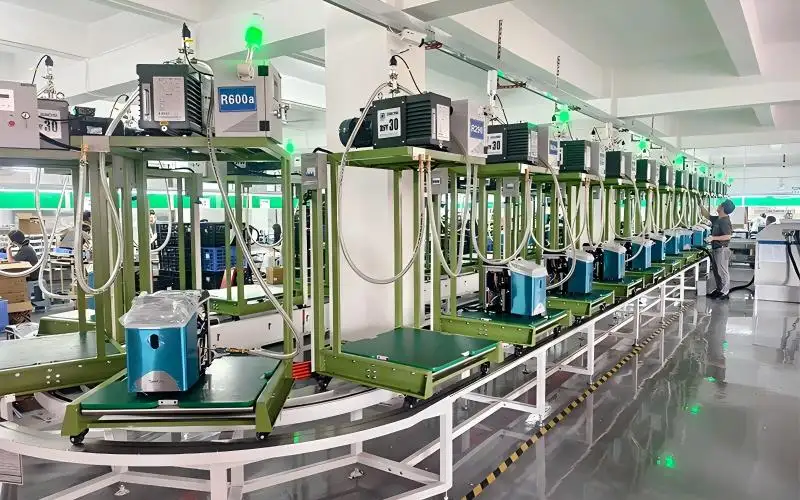
How We Test Every Ice Maker Before Packaging
2026-09-15
BY YUMYTH
A step-by-step look at refrigerant handling, cooling verification, leak detection, corrective action and electrical safety testing For an ice maker, reliable performance is determined long before the carton is sealed. ...
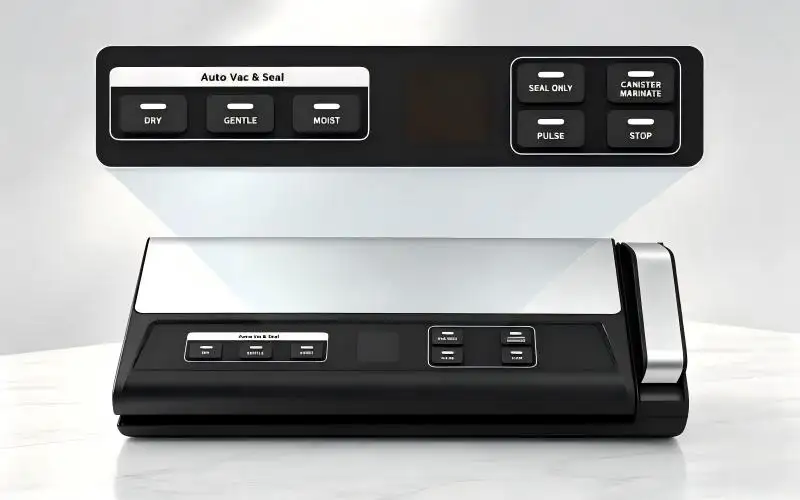
Guide for Brands Looking for a Reliable Vacuum Sealer OEM Supplier
2026-09-14
BY YUMYTH
When you are sourcing kitchen appliances for your retail brand, finding a dependable vacuum sealer OEM supplier is rarely just about getting the lowest unit price. It is about protecting ...

Why Ice Shape Matters: Understanding 10mm × 15mm Cylindrical Nugget Ice
2026-09-14
BY YUMYTH
More Than Ice Production — The Ice Itself Shapes the Consumer Experience When sourcing a nugget ice maker, buyers often focus first on production capacity, water tank size, ice basket ...

Ice Maker Sourcing Guide: How to Find the Right Factory
2026-09-10
BY YUMYTH
Sourcing an ice maker looks straightforward on paper. Find a supplier, agree on a price, place an order. But anyone who has actually done this knows the process is rarely ...