What should I check before ordering a slush machine sample?
Share:
-

-

-

-


Copied

Share:
-
-
-
-
Copied
One of the key part of choosing an OEM or ODM supplier is ordering a sample of a slush machine. But a sample is only useful if it is a representation of the product configuration you might someday buy and if you have a clearly defined evaluation plan.
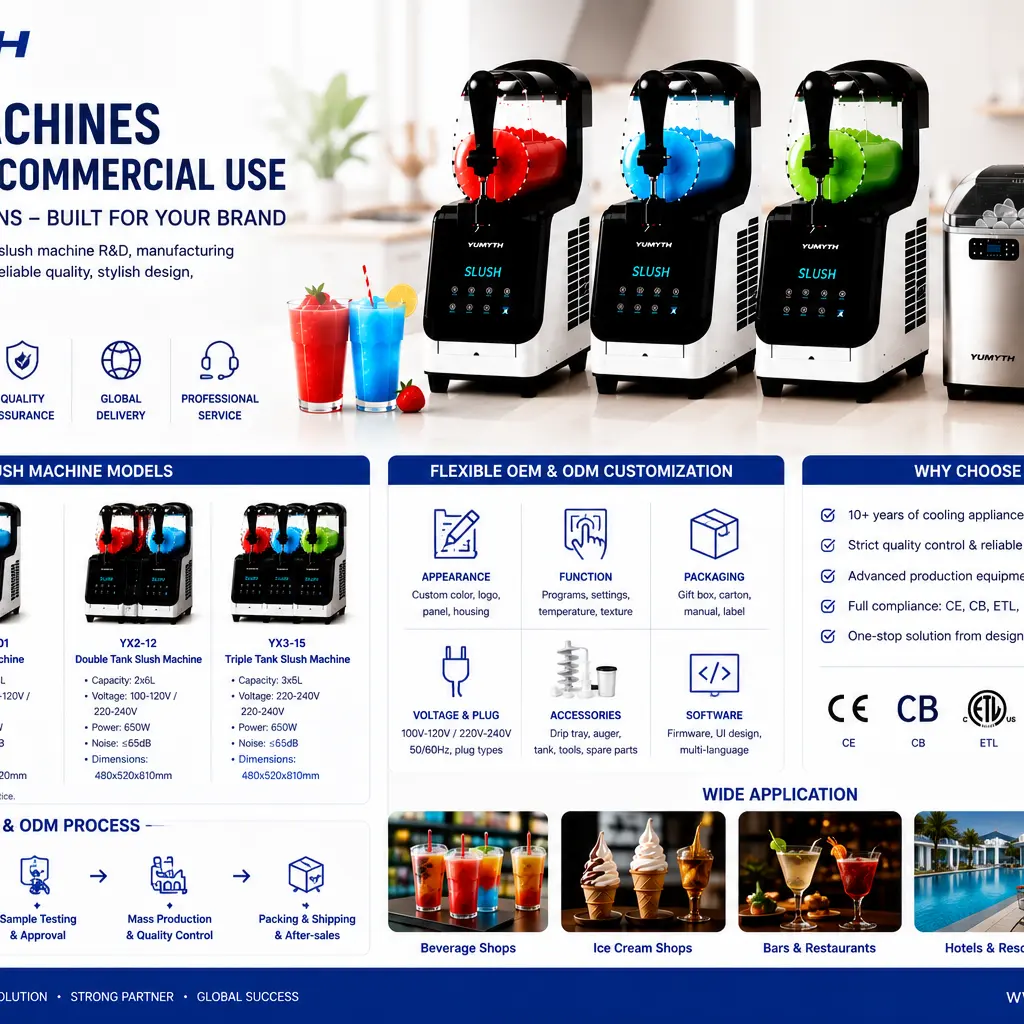
A lot of buyers ask for a machine prior to confirming the market, voltage, beverage capacity, recipes that can be utilized, certification necessities, or customization range. Consequently, they might be given a sample which appears to be attractive but may not be able to give reliable information for certification or mass production approval.
Prior to payment of a sample, verify the following with the manufacturer: technical, commercial and logistic details.
Explain the purpose of the sample.
The first step is to determine what you want to learn from the sample.
The standard evaluation sample will be used to look at the manufacturer's current platform. It can aid in the evaluation:
- * Freezing performance;
- * Beverage texture;
- * Noise;
- * Dispensing;
- * Cleaning;
- * Product dimensions;
- * General workmanship.
You could also have your logo, control panel art, housing color, firmware, packaging, or accessories added to a customized sample.
Never ask for a complete branded sample before the basic performance of the machine is approved. It is recommended to test the standard platform before you prepare a production representative branded sample after the machine passes the technical test procedure.
YUMYTH's OEM/ODM process is broken down into product design, prototype development and verification, tooling, electronic development, compliance testing, pilot production and mass production. This progressive process avoids the avoidance of engineering problems in branding work.
Ask about the exact MODEL and CONFIGURATION of the item.
Don't place a sample order until the complete model number and specification sheet is requested.
The specification should include a clear indication of:
- * Operation within the limits of safety; and
- * Impedance; and
- * Rated power;
- * Refrigerant;
- * Product dimensions;
- * Net weight;
- * Noise rating;
- * Materials;
- * Preset programs;
- * Quality of the meat; and
- * Included accessories.
The Mini Slush Machine YUMYTH, for example, has a 1.8L capacity, 200W rated power, no louder than 55 dB and is made of ABS, silicone and SUS304 materials. It also has pre-loaded programs, six levels of temperature, intelligent auger reversal, quick rinse and detachable parts.
A sample quotation, specification sheet, invoice and machine rating label must all specify the same model and configuration.
Choose correct voltage and plug.
A sample of the electrical version should be similar to the kinds you are going to be sending to the target market.
Confirm:
- * 100–120V or 220–240V;
- * 50Hz or 60Hz;
- * USB plug (US, EU, UK, Australian or other);
- * Power-cord length;
- * Grounding requirements;
- * Rating-label information.
This can lead to the final cooling, motor, fan, and/or compressor performance results not being accurately representative if the machine is prepared at the wrong voltage or frequency.
Do not expect the factory to just be able to change over production version without replacing the plug. Variations in market applications can call for different compressors, motors, relays, power supplies, labels, and safety documents.
Explain to which drinks you are going to test.
The sample of a slush machine should be tested using drinks that will be consumed by the target audience.
Explain to the supplier if you will be making:
- * Juice slush;
- * Soda slush;
- * Frozen lemonade;
- * Coffee beverages;
- * Milkshakes;
- * Mocktails;
- * Wine slush;
- * Frozen cocktails;
- * Reduced-sugar drinks.
Freezing behavior is influenced by the presence of sugar, alcohol, dairy ingredients, fruit pulp, starting temperature, and fill volume. A recipe that doesn't have enough dissolved solids can freeze too hard, and if a drink has too much alcohol, it may not form an adequate amount of ice.
Inquire about the recommended range of sugar (Brix), alcohol, minimum fill level, maximum capacity and tested recipes from the supplier.
Also check if solid food like ice blocks or frozen fruits, seeds or fruit chunks are permitted. Compressor based slush machines typically do not need to be used as high-speed blenders, and will freeze a mixture of prepared liquid.
Ask for the test conditions used to determine the claims for performance.
The term slush ready in 15 minutes has little meaning if not under controlled test conditions.
Request the supplier to explain:
- * Ambient temperature;
- * Starting liquid temperature;
- * Beverage volume;
- * Brix level;
- * Alcohol percentage;
- * Supply voltage;
- * Selected program;
- * Ventilation clearance;
- The texture is the final definition of a texture.
If possible, use the same conditions as you used in your assessment.
The sample must be tested for multiple freezes and cleans. Repeatability, holding stability and component durability can only be proven to be successful after one or more drinks.
Based on the published sample-evaluation guidance from YUMYTH, the following points are recommended for testing prior to mass production: freezing performance, texture, dispensing, noise, leakage, cleaning access, control logic and repeated operation.
Review the Sample's Material and Food-Contact Parts.Review the Sample's Materials and Food-Contact Parts.
Ask them for a list of all parts that touch the beverage.
These may include:
- * Beverage tank;
- * Auger;
- * Lid;
- * Silicone seals;
- * Dispensing valve;
- * Nozzle;
- * Evaporator surface.
Be sure to specify the material grade, not just the “food grade.”
Useful documentation could consist of:
- * Material specifications;
- * Supplier declarations;
- * LFGB reports;
- * FDA food-contact documentation;
- * BPA-related declarations;
- * Dishwasher-resistance information.
These reports must be the same resin, silicone, metal, supplier and color as the actual resin used.
A good sample should also enable you to remove and examine the tank, auger, seal ring, valve, lid and drip tray. Smooth surfaces, easy to remove seals, detachable mixing components and easy accessibility to dispensing channels facilitate the cleaning process and verification.
Ensure the Certification Status is double-checked.
Ask: Does the sample represent:
* An existing platform with certification; or
An idea that is being tested;
A working model of an engineering design that is not certified.
A customized version with new certification.
Use a model-specific piece of evidence rather than a logo from a brochure or website.
The compliance package could include:
- * Electrical safety;
- * EMC;
- * Food-contact materials;
- * RoHS and REACH;
- * Target-market labels;
- * User instructions.
Verify the voltage of the sample, compressor, motor, PCB, refrigerant, power cord and factory address with the documents.
Any of the above changes, such as changing the firmware, housing, ventilation, critical components or refrigeration system, may alter existing certification coverage. When it becomes impossible to use the original test file for a customization, implications for certification should be reviewed before approving the customization.
Check the Control Panel and Firmware.
Write down the version of the firmware and PCB that you are using in your sample.
Test:
- * Every preset program;
- * Oil painting; and
- * Cleaning mode;
- * Child lock;
- * Completion alerts;
- * Error codes;
- * Auger reversal;
- Power outage and power-up.
The icons and the names of the program have to be identical in the printed and the actual operating logic.
If custom firmware is provided, ask for a list of changes in writing that explains the differences between the standard and the custom firmware. The factory should also state the means of controlling the approved firmware during mass production.
Verify the conditions of brand and customisation.
If requesting a sample that is to be branded, submit artwork and directions for production.
Confirm:
- * Logo file format;
- * Size and placement of logos;
- Printing or marking process;
- * Pantone color;
- * Control-panel language;
- * Carton artwork;
- * Manual language;
- Label data and bar code information.
Request if the sample is obtained through the final production process and/or a temporary process.
Markings on one sample cannot necessarily be a good gauge of mass-production screen prints, laser marks, molded branding or control-panel films. Any temporary sample treatment should be clearly identified by the supplier.
There are various customization options that can be applied to existing YUMYTH platforms, including appearance and functions, branding, control panels and packaging; the extent and requirements vary according to the project.
What questions do you have regarding the sample price?
A sample quotation should be broken up:
- * Machine price;
- * Custom logo fee;
- * Color-matching fee;
- * Packaging sample fee;
- * Firmware development fee;
- * Certification-related cost;
- * International freight;
- Import duties and taxes.
Verify if sample fee is acceptable to be credited to a future mass production order.
Ask if it will be one or multiple units being sent from the supplier. Single machine may be enough for initial testing, but may need more if the product is to be certified, photographed, reviewed by retailers, destructively tested, or validated by the engineering department.
Check Shipping and Packaging Arrangements
The slush machines have compressors and sealed refrigeration systems, which makes the way they are transported important.
Before shipment, confirm:
- * Outer carton height, width, and length; and
- * Freight method;
- * Shipping orientation;
- * Customs description;
- * Refrigerant declaration;
- * Importer requirements;
- * Insurance;
- Address of delivery and contact information.
Request supplier to do final functional, leakage, appearance and accessory testing prior to packing.
Once the sample is received, take a picture of the carton prior to opening it. Document any dents, punctures, misalignment or internal movement. Once unpacked, leave the machine as described in the manufacturer's manual and operate the machine, especially if it has been transported on its side.
Create an Evaluation Checklist prior to arrival of the Sample
Develop written acceptance criteria for:
- * Configuration accuracy;
- * Appearance;
- * Assembly and fit;
- * Freezing performance;
- * Recipe compatibility;
- * Texture consistency;
- * Noise and vibration;
- * Dispensing and leakage;
- * Cleaning and reassembly;
- * Controls and firmware;
- * Documentation;
- * Packaging.
Indicate each item as either passed, failed or in need of correction.
YUMYTH's sample-testing guidance also suggests a comparison of the logo positioning, colors, panel labels, packaging, accessories, spare parts and carton protection with the confirmed order requirements.
Do not approve the product without explicit feedback or a video call. A written sample report provides reference for corrective actions and future pilot production.
Conclusion
Check the sample's intended use, exact model, voltage, plug, recipes, performance conditions, materials, certification, firmware, branding process, costs, and shipping options before ordering a slush machine sample.
It's not always the best when you make it as customized as you can. It is the sample that is correct in answering the next project decision.
Start with a manufacturer's default platform. If performance, cleaning, noise or documentation of safety are acceptable, then advance to a brand representative production sample.
Having a clear pre-order checklist helps avoid confusion and helps to ensure that the sample is a solid base for certification, pilot production and mass production.
Related Articles
How We Test Every Ice Maker Before Packaging
2026-09-15
BY YUMYTH
A step-by-step look at refrigerant handling, cooling verification, leak detection, corrective action and electrical safety testing For an ice maker, reliable performance is determined long before the carton is sealed. ...
Guide for Brands Looking for a Reliable Vacuum Sealer OEM Supplier
2026-09-14
BY YUMYTH
When you are sourcing kitchen appliances for your retail brand, finding a dependable vacuum sealer OEM supplier is rarely just about getting the lowest unit price. It is about protecting ...
Why Ice Shape Matters: Understanding 10mm × 15mm Cylindrical Nugget Ice
2026-09-14
BY YUMYTH
More Than Ice Production — The Ice Itself Shapes the Consumer Experience When sourcing a nugget ice maker, buyers often focus first on production capacity, water tank size, ice basket ...

Ice Maker Sourcing Guide: How to Find the Right Factory
2026-09-10
BY YUMYTH
Sourcing an ice maker looks straightforward on paper. Find a supplier, agree on a price, place an order. But anyone who has actually done this knows the process is rarely ...