How long does sampling take?
Share:
-

-

-

-


Copied
Share:
-
-
-
-
Copied
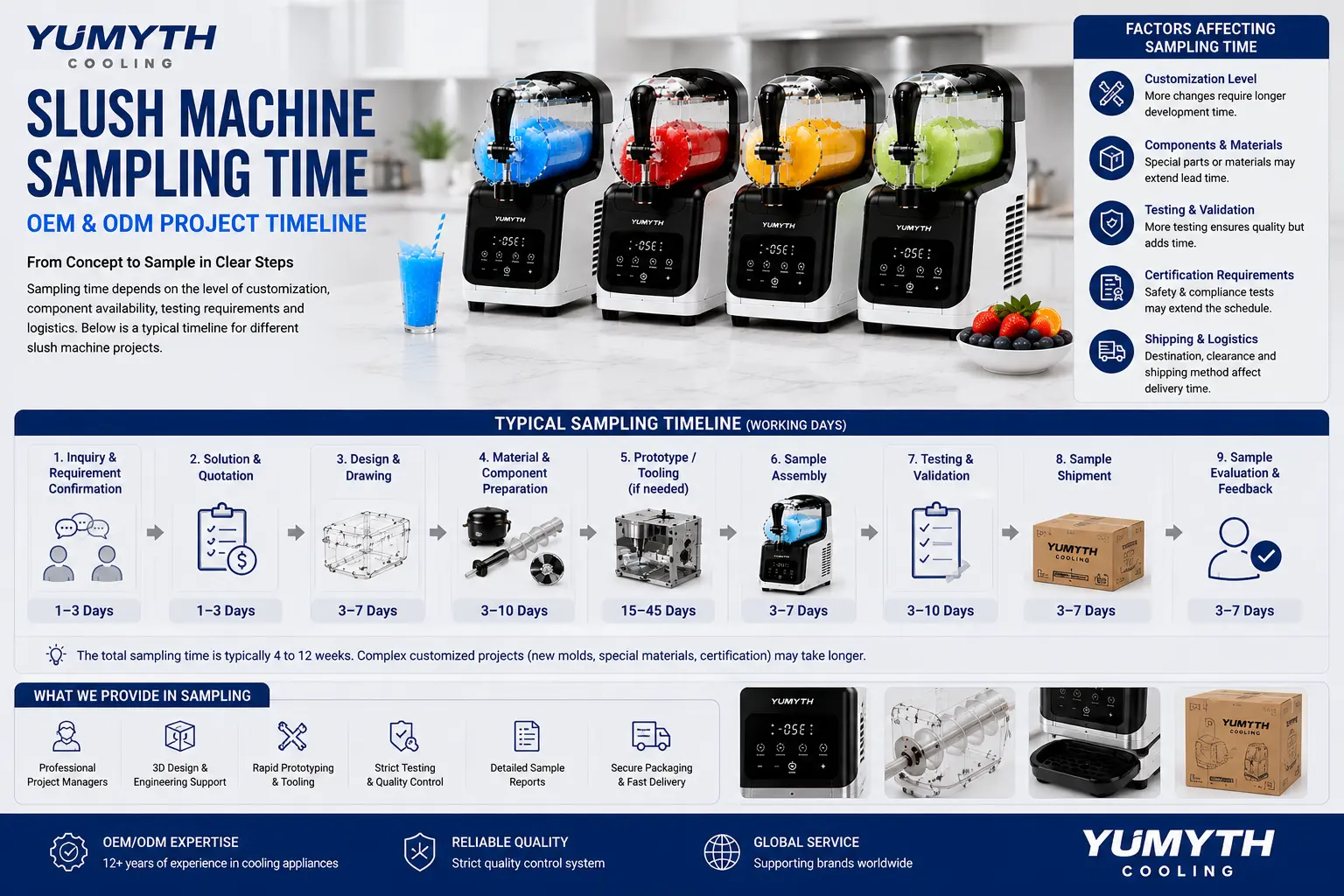
Among all the process steps in a slush machine OEM or ODM project, sampling is one of the most crucial steps. It lets appliance manufacturers judge product appearance, refrigeration performance, frozen-drink texture, noise, cleaning, packaging and customization before ordering a large quantity of a product.
But no single sampling time would be applicable to all projects. A standard machine from the available inventory can be ready to go in a short time, and a fully customized engineering sample could require new parts, firmware, molds, testing and certification preparation.
Typically sampling time for most projects is a function of four parameters: type of sample, level of customization, availability of components and testing prior to shipment.
The standard samples typically will consume the least amount of time.
For a standard sample, the sample is built with the same product configuration as the supplier, with no changes to the configuration.
It normally includes the factory’s standard:
- * Housing color;
- * Beverage tank;
- * Auger;
- * Control panel;
- * Preset programs;
- * Voltage version;
- * Packaging;
- * Accessories.
If the required model and electrical version have been produced and are already available, the preparation of samples may take about three to seven working days. During this time, the factory can choose the unit, carry out the functional inspection, verify accessories, finalize the documentation and package the unit.
However, the supplier should still check the sample prior to shipping. While sometimes it might be faster to send an untested stock unit, it can lead to unnecessary confusion if the product is damaged, leaks, has incorrect accessories or has performance issues upon arrival.
A standard sample is helpful if the buyer would like to view the basic platform before discussing further customization.
Additional preparation is required for logo and Private-Label Samples.
Simple private label sample can be a customer logo, product label, manual cover or basic packaging artwork.
This will take around 1-3 weeks depending on the type of branding and the availability of materials.
There are a number of possibilities for logotype customization including:
- * Screen printing;
- * Pad printing;
- * Laser marking;
- * Adhesive labels;
- * Printed control-panel films;
- * Metal badges.
A temporary logo label can be prepared in a shorter time than the time to make a production-representative printed house. It might not precisely reflect the final color, adhesion properties, surface quality or cleaning effectiveness of the final product, however.
Brands must determine if the first sample is for product performance confirmation, or to ensure the product will look as it will when it is sold. A concept sample may be suitable for internal evaluation, whilst a customer presentation or photography sample should be a more realistic branding process.
Custom color samples will need a material match.
If the colors are customized, the sampling time may be extended since the factory must design and verify the same material or surface finish.
The process can consist of:
- 2. Ensuring a sufficient supply of correct Pantone or actual colour sample;
- 2. Making a color masterbatch or paint sample;
- 3. Making a small sample part;
- 4. Checking colours under controlled lighting;
- 5. Adjusting the formulation;
- #6 Making the final sample pieces.
If existing moulds can be used, a custom colour sample will take 2-4 weeks. If multiple plastic components or painted surfaces are required to have the same color, more time may be needed.
Color appearance may be glossy plastic, textured plastic, painted metal or printed control panels. Do not assume that all surfaces will look the same if there is no controlled color development.
Approval should be a physical sample – not just screen images.
Packaging samples will follow their own timeline.
Time is often required for customized retail packaging in addition to the appliance.
All of the following may be part of a packaging sample:
- * Printed carton;
- * Protective inserts;
- * Accessory box;
- * User manual;
- * Recipe guide;
- * Warranty card;
- * Barcode labels;
- * Shipping marks.
A printed carton can be prepared more quickly than a full production-printed carton using a digitally printed carton. It can be used to examine artwork, dimensions, art content and overall appearance, but it may not match colors or surface finish of the final mass production process.
A representative sample for the production may need to be printed, correct carton board used, die cut, laminated and printed final inserts. This can lengthen the time by an extra week or two.
If the packaging structure changes, the sample should also be assessed for product movement, accessories protection, unboxing sequence and for responsiveness to the transport testing requirements.
It takes longer to do functional customization.
Changes to control panel, programs, temperature setting, display, alerts, cleaning logic or auger protection are examples of functional customization.
These projects may require:
- * Firmware development;
- * PCB programming;
- * Control-panel artwork;
- * New display content;
- * Software debugging;
- * Recipe testing;
- * Safety review.
This can take anywhere from a few weeks to a few months depending on the amount of changes that needs to be done to the current control platform.
It is quite easy to change the label text on a button. If you want to create a new low-sugar mode, frozen-cocktail program or automatically recover the jam, then you need to test it more thoroughly.
Engineering team must ensure the new software is able to operate the compressor, auger, properly, across recipes and ambient temperatures. There should be no program approval until the declared operating range has been tested with a program that works with one beverage.
Soft Tooling or new molds may be required for some structural samples.
Structural modification may be a new tank, new lid, new auger, new handle, new drip tray, new control panel or a reworked exterior.
If the new part can be manufactured with CNC, 3D printing, silicone molding or with modifications to existing parts, an engineering sample can be provided in 4 to 8 weeks.
These early prototypes are used to test the following:
- * Overall dimensions;
- * Assembly;
- * Appearance;
- * User handling;
- * Component interference;
- * Basic function.
But prototype materials do not necessarily reflect the performance of the final products. For instance, a 3D-printed tank might not be as clear, durable, resistant to chemicals, dimensionally stable, or suitable for food contact as desired for mass production.
If a new injection mould needs to be created, the process takes even longer. It can take eight to sixteen weeks or longer to design parts, machine the tools, assemble the tool, try mold the parts, correct and approve the sample. Part size and complexity.
It will take several tooling corrections prior to obtaining dimension, surface quality, sealing and assembly to the approved standard.
Refrigerated changes will need to meet engineering requirements.
Any modification of the compressor, refrigerant, evaporator, condenser, fan, capillary tube, insulation or refrigerant charge will impact the basic slush machine operation.
It takes between 6 and 12 weeks or more for a refrigeration-development sample to be processed, as the supplier needs to process several additional steps:
- * Component selection;
- * System assembly;
- * Refrigerant-charge optimization;
- * Freeze-time testing;
- * High-ambient testing;
- * Power measurement;
- * Noise evaluation;
- * Component-temperature monitoring;
- * Safety review.
The first sample may not be the final sample that is approved. A few rounds of adjustments may be necessary to obtain a successful refrigeration performance.
For instance, the larger the compressor, the faster it freezes, but it may also raise the noise level, cabinet temperature, energy usage or cost. The entire system should be balanced, not just optimised for one specification.
While sample testing does add time to the process, it also helps to minimize risk.
A supplier may put a sample together physically quickly, but should not be shipped until the necessary testing has been completed.
Sample validation can consist of:
- * Electrical safety checks;
- * Leakage inspection;
- * Freeze-time testing;
- * Sugar/Brix testing;
- * Noise testing;
- * Auger jam-protection testing;
- * Cleaning evaluation;
- * High-ambient operation;
- * Repeated freezing cycles;
- * Packaging inspection.
A standard sample could require only a brief last inspection. Several days or weeks of testing may be needed to create a customized engineering sample.
Brands should enquire if the sample lead time is for testing or for physical assembly. A sample that is shipped at the time of completion will arrive sooner, but may not have a good basis for actual performance.
Certification Samples will have special requirements.
Samples used for UL, ETL related, CE, EMC testing, food contact testing or any other compliance testing work will closely reflect the final production construction.
These samples should employ the approved:
- * Compressor;
- * Motor;
- * PCB;
- * Wiring;
- * Power cord;
- * Refrigerant system;
- * Plastic materials;
- * Seals;
- * Labels;
- * Firmware.
Samples for certification could be required to be prepared differently than they would be for the production process due to the need for several identical samples, special component documentation, modified test access or extra parts that the laboratory might want.
It may take weeks after the design is frozen to prepare certification samples. If a significant deviation occurs after laboratory testing has started it may necessitate retesting or obtaining of new samples.
Shipping Time is to be added separately.
Sample lead time is not the same as the transportation time.
International express shipment can take several working days to finish after the factory has finished the sample. Products with refrigerant, batteries, special documentation and customs sensitive components may take longer to deliver.
The buyer should supply all shipping address, contact, tax and any necessary import documents in advance.
The delay is usually due to items being ready for sampling but the freight is not arranged, the customs documents are not made or the payment is still to be confirmed.
Reasons for Delaying Sampling
Samples may be collected at a longer interval than the following:
- * Incomplete product requirements;
- * Repeated color changes;
- * Late artwork approval;
- * Unavailable voltage components;
- * New PCB development;
- * Mold corrections;
- * Failed leakage tests;
- * Unstable refrigeration performance;
- * Certification-related changes;
- * Delayed customer feedback.
Clearly stating requirements and quickly approving each step is the quickest way to shorten sampling.
Brands should supply logo graphics, colours, voltage, plug type, target market, packaging needs and expectations of performance at the outset of the project.
The following is an example of a typical sampling schedule.
A representative schedule might be as follows:
- Standard sample size: 100–500 samples; and
- * Advanced private label sample: 4–6 weeks; and
- * Custom quorum: 2-4 weeks;
- Designed to be used for 3-8 weeks per functional software sample.
- * Production molds: 6–8 weeks; and
- The new injection-mold sample is ready in 8–16 weeks or more;
- * Customized refrigeration platform: 6-12 weeks or more.
These ranges represent planning reference periods and not guaranteed periods. Once the complete requirement is analysed, the supplier must give a project specific schedule.
How Brands Can Accelerate Sampling
Appliance brands can help decrease delays by:
- Identifying an existing platform with proven success; and
- * Keeping only the most important changes in the first sample;
- - Filling out art work in proper format;
- *Determining the plug type and voltage at an early stage;
- Manually approving colors using samples;
- Promptly answering engineering inquiries;
- * Improving the efficiency of the approval process; and
- Do not make specification changes once tooling has started.
A gradual process can be successful. The buyer may approve a standard performance sample, then look at the branding and color and then approve the production-representative sample.
Conclusion
The amount of time required for slush machine sampling depends on the amount of customization needed and could range from several working days to several months.
Typically, the fastest are standard and private label. New colors, packaging, new firmware and part changes, new molds, and refrigeration changes take increasingly more development and testing.
The objective for appliance brands is not to get the quickest sample, but to get the right sample. The sample should be representative of the features being evaluated, and should be informative to the next project decision.
Clear requirements, realistic timelines, timely approvals and structured testing facilitate the transition from sampling to mass production and minimize changes, risk and product quality issues for the brand and OEM supplier.
Related Articles
How We Test Every Ice Maker Before Packaging
2026-09-15
BY YUMYTH
A step-by-step look at refrigerant handling, cooling verification, leak detection, corrective action and electrical safety testing For an ice maker, reliable performance is determined long before the carton is sealed. ...
Guide for Brands Looking for a Reliable Vacuum Sealer OEM Supplier
2026-09-14
BY YUMYTH
When you are sourcing kitchen appliances for your retail brand, finding a dependable vacuum sealer OEM supplier is rarely just about getting the lowest unit price. It is about protecting ...

Why Ice Shape Matters: Understanding 10mm × 15mm Cylindrical Nugget Ice
2026-09-14
BY YUMYTH
More Than Ice Production — The Ice Itself Shapes the Consumer Experience When sourcing a nugget ice maker, buyers often focus first on production capacity, water tank size, ice basket ...

Ice Maker Sourcing Guide: How to Find the Right Factory
2026-09-10
BY YUMYTH
Sourcing an ice maker looks straightforward on paper. Find a supplier, agree on a price, place an order. But anyone who has actually done this knows the process is rarely ...