
What affects tooling cost?
Share:
-

-

-

-


Copied
Share:
-
-
-
-
Copied
One of the biggest initial expenditures of a customized slush machine project is the cost of the tooling. Injection molds may be needed for beverage tanks, beverage lids, augers, beverage dispensing handles, drip trays, control panel housings, ventilation grills, internal brackets, and exterior enclosures, etc.Injection molds can be needed for Beverage Tanks, Beverage Lids, Augers, Beverage Dispensing Handles, Drip Trays, Control Panel Housings, Ventilation Grills, Internal Brackets, and Exterior Enclosures, etc.
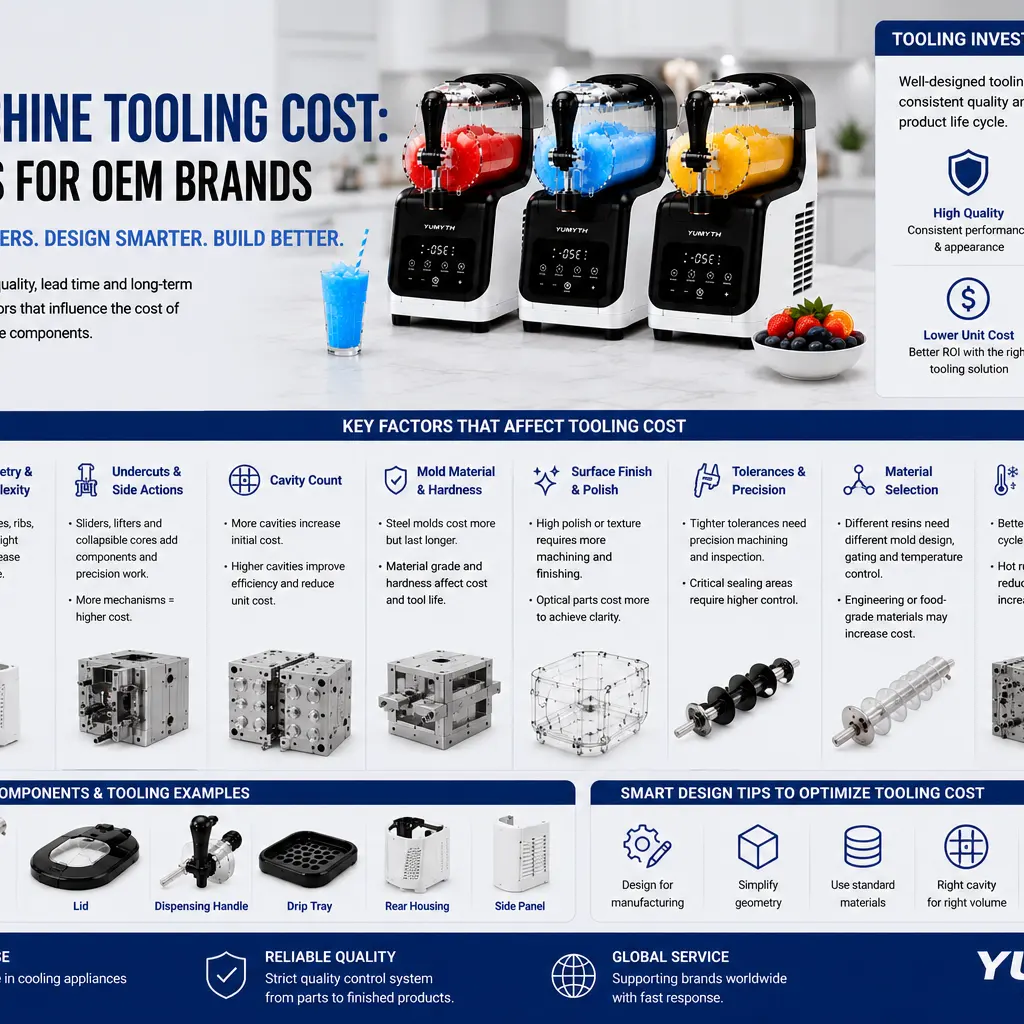
However, there is no one standard price for an injection mold as each mold is created for a specific part, material, number of parts, quality specification, and manufacturing method. A one cavity mold can be much cheaper than a large clear tank that must have precise sealing surfaces, sliders, advanced cooling and a high polish steel.
When considering appliance brands and their quotes, it's much easier to gauge the areas of unnecessary complexity and the areas where investment is making product value.
Part size and mold dimensions.
The physical size of the component affects the cost of the mold.
The larger the size of the rear housing or beverage tank, the larger the size of the steel blocks, more processing time, heavier mold base, stronger supporting structure and larger molding equipment. More complex cooling channels may also be needed to ensure even cooling of the part using the tool.
Generally, larger molds result in more handling and maintenance needs. They might require injection molding machines with a higher clamping force and shot capacity, larger storage spaces and lifting equipment.
The dimensions of the mold blocks and their design are dependent on the part size, machine specifications, material requirements and part geometry. All of these affect both the construction of the tool and the machine necessary to power the mold.
If you want to create a slush machine project, mixing multiple decoration components that are not necessary will add to the tooling costs without adding to the machine's effectiveness.
The intricate nature of the parts is what makes this so challenging.
One of the most powerful factors of tooling cost is geometry. Protolabs determines the amount of time needed to make the tool, and consequently the complexity of the part, as one of the biggest contributors to mould cost.
Parts that have open shapes and can be molded only in one direction are typically cheaper to make. The higher the cost is when the components are:
- * Deep cavities;
- * Complex internal ribs;
- * Narrow slots;
- * Thin walls;
- * Multiple sealing surfaces;
- * Tall bosses;
- * Complicated locking features;
- * Difficult ejection areas.
For instance, if you are using a transparent beverage tank, you will need a smooth inside geometry, proper wall thickness, dimensional stability and a good outside finish. These specifications are more difficult than a simple, hidden, internal bracket.
Design for manufacturing analysis should be done prior to the release of the tool. Sometimes, minor design changes can make the part easier and less expensive to manufacture and eject from the mold.
Undercuts, Side Actions, and Sliders
Undercut is a feature that is not allowed to be removed by the standard mold-opening direction. Typically these are side holes, hooks, recessed locking spaces and internal projections.
Undercuts can use sliders, lifters, collapsible cores, removable inserts, etc. or side-action. These systems include parts, accuracy, assembly, maintenance and potential failures.
Protolabs says that side actions, inserts and other related processes can create undercuts, but increase the complexity of the tooling. Undercuts are possible with tooling, but will cost more in the mold.
Undercuts are common at tank locks, the interface between the dispensing-valve, lid clips and decorative openings for slush machine components. Engineers should find out if it can be done simpler in another direction of pull, or using an assembled component.
The construction of draft angles and requirements for ejection.
The slight incline of vertical walls that is added to allow the molded part to be removed from the tool.
Too little draft can cause the part to stick to the mold, may result in damage to textured surfaces, raise ejector force, or necessitate more complex tool design. The more rugged the surface area or deep parts, the more draft is needed.
The amount of practical draft to be added depends on the dimensions of the cavity, texture of the product, material and geometry of the product and is recommended by Protolabs.
Drafts on a slush machine tank, housing or lid not designed correctly can require design changes, extra ejector outlets or expensive mold changes after the initial test.
The number of cavities in the mold.
In a single cavity moulding, the mould makes a single component in a single moulding cycle. A multi-cavity mold is a mold that makes multiple identical parts simultaneously.
More cavities means the initial tool cost increases as the mold needs an increase in the number of cavities, runners, cooling channels, gates, and a need for more accurate flow balancing. Multi-cavity tooling, however, can lower the unit cost in the long run and boost the production rate.
The number of cavities is determined by:
- * Annual order volume;
- * Target unit cost;
- * Part size;
- * Material;
- * Cycle time;
- * Required production capacity.
Protolabs says that the decision for choosing single- or multi-cavity molds will be based on production volume, type of resin, and geometry of the product. It also mentions multi-cavity tooling as a method to lower per-part cost in higher volume production.
A new appliance brand might start on a single-cavity tool, and a high-volume program might warrant more cavities.
Mold Material and Expected Service Life
Aluminum or various types of tool steel are the materials that are frequently used in injection molding.
Using aluminum tools may be appropriate for low volume production, bridge production or prototype. Steel tools are typically more durable for high-volume production, abrasive materials, complex geometries and extended use.
The three biggest contributors to tooling cost, identified by Protolabs, are the type of mold material, shape of the part, and design of the cooling system. It also says steel is generally used for high-volume production, abrasive resins and for higher demand geometries.
Therefore the quotation will have to include:
- * Mold-base material;
- * Concrete blocks or castings; and
- * Hardness;
- * Expected tool life;
- * Replaceable inserts;
- * Maintenance requirements.
If the product is likely to be produced for several years, then perhaps a cheaper mold isn't the most economical choice.
The surface finish and optical requirements are not applicable to this product.
Adjusting surface requirements may substantially affect the machining and polishing costs.
A normal machining mark may be acceptable for a hidden bracket, but a highly polished surface may be necessary to make a transparent beverage tank clear. Decorative housings can be asked for to have textures, need to be controlled for gloss, or need to be the same color on multiple parts.
Careful selection of steels, hand finishing and protection during production and maintenance is required for high polish surfaces. The textured surfaces must also be applied uniformly and may need extra draft for consistent ejection.
Flow marks, weld lines, sink marks, scratches and non-uniform gloss are visible faults that are especially apparent on transparent and high-gloss components.
Brands should identify the surfaces they are looking to have finished to a high level and then only have them finished to that standard where they will be seen by customers, touched by food, used for decoration, or used in a hidden location.
The following table shows the tolerances and sealing performances of the various models.
Costs of manufacturing tools, molding, and inspecting and maintaining the tools, as well as molding conditions, increase when tolerances become tighter.
Tolerances are important for a slush machine because it might affect:
- * Tank locking;
- * Auger clearance;
- * Seal compression;
- * Dispensing-valve fit;
- * Drive-coupling alignment;
- * Lid installation;
- * Housing gaps.
Tolerances do not need to be the most precise. Excessive tolerance will not benefit the performance but will add to the cost of machining and testing.
The engineering drawing should identify the functional dimensions and ordinary cosmetic dimensions. The most robust control should be applied to sealing areas and moving interfaces.
Plastic Material Selection
The properties of the resin chosen influence the mold design as different plastics have varying shrinkage, flow properties, processing temperatures, abrasiveness and cooling requirements.
The common assumption of being able to produce a clear copolyester tank, reinforced engineering plastic, soft elastomer and standard housing resin is not always an effective method.
Choices of materials can impact:
- * Number, size, and location of gates; and
- * Cooling system;
- * Mold steel;
- * Surface polish;
- * Venting;
- * Shrinkage compensation;
- * Wear resistance.
If the plastic is changed after the mold has been designed, it may cause dimensional deviation, distortion, inadequate filling or surface defects. Protolabs states that before transitioning from prototype to injection molding, material selection, part performance, geometry, and production requirements need to be taken into account.
Some materials, such as food-contact, dishwasher resistant, transparent, or chemically resistant materials, may also need more controlled processing.
Hot Runners, Cooling and Production Efficiency.
A simple cold-runner mold might be cheaper up-front, but can be wasteful with materials. A hot runner system is designed to keep the plastic molten in the runner and can result in increased material utilization, cycle efficiency, and gate control.
Hot runners are expensive because of the manifold, heaters, controllers, wiring and maintenance. They are typically assessed on factors such as production volume, part size, resin cost and quality objectives.
Another factor involved in the investment in tools is cooling. The more advanced cooling channels can cut cycle time, dimensional stability and avoid shrinkage variations. Integrated melt-delivery, cooling and molding systems are key for production consistency and cycle efficiency, Husky says.
The initial tooling quote might thus be the lowest but could lead to slower production speeds and increasing part costs over time.
Family Molding and Common Tooling
Several parts are made in a family mold in a single molding. For instance, if the same material is used for the small parts of the slush machine, they might use the same tool.
This can decrease the number of separate molds but it is important that the parts have matching material, volume, filling, cooling and production requirements.
When several appropriate parts can be molded simultaneously, Protolabs considers family tooling a potential cost reduction option.
Inconsistent or over filled family molds can result from poorly balanced family molds. Moulding analysis is the consideration, not just the wish to minimise the quotation for the tool.
A set of three rounds is conducted to test, correct, and validate the tool.
The first molded sample does not necessarily go through the total tooling process.
Once the initial trial, the team might need to make a modification:
- * Dimensions;
- * Gate location;
- * Surface finish;
- * Ejection;
- * Seal compression;
- * Warping;
- * Assembly interfaces;
- * Color or appearance.
It's essential that tooling quotations make it clear how many trial and correction runs will be provided. Any changes resulting from manufacturing defects must be distinguished from customer requested changes following approval.
Late changes can be especially costly as it can involve welding, new inserts, extra machining or replacement of large sections of the tools.
Owners, maintenance and long term costs.
The initial quotation should not be the only consideration.
Brands should confirm:
- Who is the owner of the mold;
- * How it will be stored; and
- * Whether it is on an all-season basis; and
- Who is responsible for paying maintenance;
- * The amount of data that it traverses; and
- * The availability of a maintenance service; and
- * Whether the tool is suitable for dissemination; and
- What is the fate of it at the end of its useful life?
Routine maintenance ensures dimensional accuracy, surface quality, cooling efficiency and production availability. Husky points out that the maintenance of the mold and mold systems is important to ensure performance is maintained with no unnecessary downtime.
The issues of tooling cost control for appliance brands.
In order to manage the investment in the tooling, the brands can:
- Reusing existing platform components where it is not needed to differentiate.
- Removing unnecessary undercuts and side actions.
- 3. Applying realistic tolerances.
- 4. Restricting premium surface finishes to visible surfaces.
- 5. Determining the number of cavities based on believable annual volume.
- 6. Preparing materials prior to tooling design.
- 7. Early DFM and Mold Flow Review.
- 8. Freezing of the design before machining is performed.
- 9. Distinguishing between functional product design and ornamental complexity.
- 10. Making a total cost of production comparison instead of just a mold price comparison.
Conclusion
The part size, part geometry, the number of cavities, the type of mould, the undercuts, the surface finish, tolerances, the mould resin behaviour and cooling, the production volume and the validation requirements are all factors that influence the cost of the tool.
In slush machine applications, beverage tanks, dispensing elements, augers, seals and visible housings may need higher precision than standard cosmetic plastic products. It is important to remember that reducing tooling cost should not be at the expense of food-contact safety, leakage control, assembly accuracy, or product reliability.
The most successful OEMs conduct design-for-manufacturing assessments prior to the release of tooling, and only customize if it provides market value. This allows appliance brands to optimise initial investment, production effectiveness, product quality and unit cost.
Related Articles
How We Test Every Ice Maker Before Packaging
2026-09-15
BY YUMYTH
A step-by-step look at refrigerant handling, cooling verification, leak detection, corrective action and electrical safety testing For an ice maker, reliable performance is determined long before the carton is sealed. ...

Guide for Brands Looking for a Reliable Vacuum Sealer OEM Supplier
2026-09-14
BY YUMYTH
When you are sourcing kitchen appliances for your retail brand, finding a dependable vacuum sealer OEM supplier is rarely just about getting the lowest unit price. It is about protecting ...

Why Ice Shape Matters: Understanding 10mm × 15mm Cylindrical Nugget Ice
2026-09-14
BY YUMYTH
More Than Ice Production — The Ice Itself Shapes the Consumer Experience When sourcing a nugget ice maker, buyers often focus first on production capacity, water tank size, ice basket ...

Ice Maker Sourcing Guide: How to Find the Right Factory
2026-09-10
BY YUMYTH
Sourcing an ice maker looks straightforward on paper. Find a supplier, agree on a price, place an order. But anyone who has actually done this knows the process is rarely ...