
Sous Vide Vacuum Sealer: How to Choose a Reliable System
Share:
-

-

-

-


Copied

Share:
-
-
-
-
Copied
A reliable sous vide vacuum sealer must do more than remove a large amount of air. It must create a consistent seal, handle the moisture level of your food, work with suitable pouches, and repeat the process without overheating or slowing down excessively.
For occasional portions of steak, vegetables, or other relatively dry foods, a well-designed external sealer is often sufficient. Frequent sauces, marinades, free-flowing liquids, or high-volume preparation may justify a chamber sealer. A hybrid machine can serve buyers who need both workflows.
Maximum vacuum pressure is only one part of the decision. Pump speed, sealing performance, bag compatibility, cycle recovery, maintenance, and technical support also affect whether a system is dependable in daily use.
Start With Your Food, Moisture Level, and Workload
Before comparing models, define what the machine will actually seal. This prevents paying for unnecessary capacity or choosing a compact machine that cannot handle the intended workload.
Consider these requirements:
-
Foods being packaged, including meat, fish, vegetables, sauces, and marinades
-
Dry, moist, or free-flowing liquid contents
-
Fragile foods that could be compressed or deformed
-
Maximum pouch and portion dimensions
-
Packages prepared during each session
-
Expected daily or weekly operating volume
-
Available counter and storage space
-
Home, meal-prep, restaurant, or production use
-
Required voltage, frequency, and plug type
-
Availability of compatible bags and replacement parts
Moisture level is especially important. An external sealer removes air through the open end of the pouch, so liquid can move toward the vacuum channel and sealing area. A chamber machine removes air from the space surrounding the entire pouch, which makes liquid-rich products easier to package.
Workload also changes the decision. A machine that handles several portions each weekend does not need the same cycle recovery or duty capability as one processing repeated restaurant batches.
When a Vacuum Sealer Is Optional
A vacuum sealer is not mandatory for every sous vide cook. The water-displacement method can remove much of the air from a suitable resealable bag by lowering the bag into water while keeping its opening above the surface.
This method can be practical for occasional cooking, but it provides less repeatable air removal and becomes inconvenient for frequent meal preparation. A machine is more valuable when consistent packaging, marinades, extended storage, repeated batches, or professional workflows are involved.
External, Chamber, or Hybrid: Which System Fits Sous Vide?
The correct system depends mainly on what is being packaged and how often it will be used.
| System type | How it works | Best suited to | Main limitations |
|---|---|---|---|
| External edge sealer | Draws air through the open end of the pouch before heat-sealing it | Occasional home use, dry foods, moderately moist portions, limited counter space | Usually requires textured bags and can draw liquid toward the vacuum channel |
| Chamber sealer | Removes air from the chamber and pouch before sealing | Liquids, marinades, repeated batches, meal preparation, professional use | Larger footprint and higher initial equipment cost |
| Hybrid chamber/external sealer | Provides separate chamber and external operating modes | Mixed workflows using both chamber pouches and external textured bags | Each mode may have different pressure, flow, seal, and capacity specifications |
When an External Sealer Is Enough
An external sealer is usually suitable when:
-
Most portions are dry or only moderately moist
-
The machine will be used occasionally
-
Counter space is limited
-
Textured bags are readily available
-
The machine includes pulse or manual vacuum control
-
The sealing cycle can be stopped before liquid reaches the seal area
Pulse control is useful for fish, soft vegetables, baked items, and moist proteins because the operator can reduce air gradually instead of allowing the machine to complete an aggressive automatic cycle.
Dry, moist, pulse, and seal-only controls are explained in more detail in the guide to choosing a tabletop vacuum sealer.
When a Chamber Sealer Is the Better Fit
A chamber sealer becomes more practical when the workflow regularly includes:
-
Sauces, soups, or free-flowing liquids
-
Meat or fish packed with a large amount of marinade
-
Repeated meal-prep or restaurant batches
-
Smooth chamber pouches
-
Larger operating volumes
-
A need for more controlled liquid packaging
Because pressure changes around the entire pouch, liquid is less likely to be pulled directly toward an external suction port. Liquids can still react under reduced pressure, so chamber settings, product temperature, and cycle control remain important.
Readers dealing primarily with sauces, juices, and marinades should review the dedicated guidance on selecting a vacuum sealer for liquids.
When a Hybrid System Makes Sense
A hybrid system can be useful when one operation handles both standard textured bags and chamber pouches. For example, a buyer may use external mode for individual dry portions but require chamber mode for liquids or repeated production.
Do not assume that both modes have identical performance. Compare each mode separately, including:
-
Maximum vacuum pressure
-
Pump flow
-
Maximum working width
-
Seal configuration
-
Compatible bag type
-
Cycle controls
Yumyth’s CVS101 chamber and external vacuum sealer is one company-specific example of this architecture. Its published specifications separate chamber and external pressure, flow, sealing, capacity, and bag requirements rather than presenting one combined rating.
What “Reliable” Means Beyond Maximum Vacuum Pressure
Vacuum pressure is usually shown in kilopascals, or kPa. It indicates the pressure level a system can reach, but it does not show how quickly the machine removes air, how consistently it seals, or how it behaves during repeated cycles.
| Specification | What it tells the buyer | What it does not prove |
| Vacuum pressure | The pressure level the system is designed to reach | Seal quality, cycle speed, liquid control, or durability |
| Pump flow | How quickly the pump can move air | Final seal integrity or suitability for continuous use |
| Cycle time | Approximate time needed for one package | How quickly the next cycle can begin |
| Recovery time | Delay needed between repeated cycles | Overall service life |
| Duty capability | Suitability for occasional or repeated operation | Performance under every food and bag condition |
| Seal length | Maximum width that can be sealed | Whether the food or pouch fits inside a chamber |
| Seal width or double seal | Size or number of closure lines | A leak-free result when the bag is dirty or wrinkled |
| Chamber dimensions | Physical space available around the pouch | Compatibility with external bags or accessories |
Pump flow and chamber size interact. A large chamber generally contains more air to remove, so a pressure rating should not be evaluated without considering pump capacity and cycle time.
Seal performance deserves equal attention. The vacuum pump removes air, but the seal bar creates the closure that must withstand handling and immersion. Uneven heat, incorrect sealing time, contaminated pouch surfaces, or worn components can cause failure even when the machine reaches a strong vacuum.
Core Reliability Features Versus Convenience Features
Not every visible feature contributes equally to sous vide performance.
| Core reliability features | Convenience features |
| Consistent heat sealing | Built-in bag cutter |
| Pulse or manual vacuum control | Roll storage |
| Moist-food control | Digital display |
| Seal-only function | Accessory hose |
| Suitable bag compatibility | Canister port |
| Replaceable gasket and heating components | Dedicated marinate button |
| Adequate bag width or chamber capacity | Automatic lid release |
| Appropriate cycle recovery | Cord storage |
Convenience features can improve the preparation process, but they should not distract from sealing consistency, moisture control, or serviceability. A broader overview of feature development is available in the article on the modern vacuum sealer.
Choose Bags That Match the Machine and Cooking Conditions
External machines generally require textured or embossed bags. Their internal channels allow air to continue moving toward the vacuum port as the two sides of the pouch are compressed.
Chamber machines commonly use smooth pouches because air is removed from the entire chamber rather than pulled through channels at the bag opening. Some chamber systems can also work with textured pouches, but compatibility should be confirmed for the exact model and operating mode.
Bag selection should cover more than machine compatibility:
-
Maximum pouch width
-
Pouch length and required headspace
-
Film thickness
-
Puncture resistance
-
Food-contact documentation
-
Intended cooking time and temperature
-
Oxygen and moisture barrier properties
-
Availability and recurring cost
A “BPA-free” label alone does not prove that a pouch is appropriate for heated food contact. The material should be documented for its intended food type, contact duration, and temperature conditions. The U.S. Food and Drug Administration explains that the safety of food-contact substances is evaluated according to their intended conditions of use.
Sharp bones, shells, and hard food edges also create puncture risks. These products may require stronger pouches, protective wrapping, or different portion preparation.
Prevent Weak Seals, Leaks, and Water Entry
A powerful pump cannot compensate for a poorly prepared sealing area. Many pouch failures begin at the opening rather than inside the vacuum system.
Use this inspection sequence before placing a package in the water bath:
-
Leave clean headspace. Keep enough unused pouch material above the food to lay the opening flat across the seal bar.
-
Remove contamination. Wipe away liquid, oil, seasoning, and food particles from the sealing area.
-
Flatten the pouch opening. Folds and wrinkles can create channels through the finished seal.
-
Control moving liquid. Use pulse, manual vacuum, or seal-only operation before liquid reaches the machine.
-
Inspect for punctures. Check areas around bones, shells, skewers, or sharp edges.
-
Examine the complete seal. Look for uniform bonding without gaps, bubbles, burned areas, or creases.
-
Add a second seal when justified. A second closure line can provide extra redundancy for long cooks or demanding handling, but it cannot correct a dirty or folded bag.
-
Check wear components. A damaged gasket can reduce evacuation, while a worn heating wire or sealing tape can create inconsistent closures.
If liquid repeatedly reaches an external machine’s vacuum channel, changing the operating technique may not be enough. The application may require a chamber system or a machine designed specifically for wet-food control.
Match the Sealer to the Way You Cook
| Use case | Suitable system direction | Features to prioritize | Main trade-off |
| Occasional steaks or vegetables | External sealer | Reliable heat seal, textured bags, compact size | Less convenient for liquids |
| Delicate fish or soft foods | External or adjustable chamber system | Pulse, gentle, or manual vacuum control | Requires closer operator attention |
| Moist meat or light marinades | Controlled external or chamber system | Moist mode, seal-only control, cleanable drip area | External systems require careful liquid management |
| Sauces, soups, and free-flowing liquids | Chamber sealer | Chamber capacity, adjustable cycle, reliable seal bar | Larger footprint and higher equipment cost |
| Weekly meal-prep batches | External, chamber, or hybrid depending on moisture | Cycle recovery, bag availability, replaceable parts | Higher volume can expose limitations of light-duty equipment |
| Restaurant production | Commercially suitable chamber or hybrid system | Repeated-cycle capacity, cleaning access, service support, local compliance | Greater purchase and maintenance requirements |
| Mixed dry and liquid workflow | Hybrid chamber/external system | Independent controls and bag compatibility for each mode | More specifications to evaluate |
Professional sous vide packaging involves more than choosing a larger machine. Repeated cycles, cleaning, staff workflow, spare parts, and food-safety procedures also matter. These considerations are covered more specifically in the Vacuum Sealer for Restaurant guide.
Vacuum Packaging Does Not Replace Food-Safety Controls
Vacuum packaging creates a reduced-oxygen environment. It does not sterilize food or prevent every microorganism from growing.
Food safety still depends on:
-
The type and condition of the food
-
Controlled cooking time and temperature
-
Hygienic preparation
-
Rapid cooling when food is not served immediately
-
Correct refrigeration
-
Controlled storage duration
-
Applicable local food regulations
The 2022 FDA Food Code identifies organisms such as Clostridium botulinum and Listeria monocytogenes as relevant hazards in reduced-oxygen packaging operations. Professional sous vide or cook-chill processes may require a documented HACCP plan or approval under the rules of the local authority.
Because regulations differ by country and jurisdiction, worldwide buyers should follow their applicable food authority rather than treating one regional code as universal law. More focused packaging and temperature-control context belongs in the dedicated Vacuum Sealing Food Safety resource.
Evaluate the Machine and Supplier Before Buying
A specification sheet is useful, but it should be supported by testing under realistic conditions.
Performance and application checks
-
Test the actual foods and moisture levels that will be packaged.
-
Use the intended pouch material and dimensions.
-
Run several consecutive cycles rather than one demonstration.
-
Check whether liquid reaches the seal area.
-
Inspect seals after handling and immersion.
-
Compare pressure, flow, cycle time, recovery time, and capacity separately.
-
Confirm that delicate foods can be controlled without crushing.
Maintenance and support checks
-
Ask whether gaskets are replaceable.
-
Confirm availability of heating wires, sealing tape, and other wear parts.
-
Review cleaning access around the vacuum channel or chamber.
-
Confirm technical-support procedures.
-
Request written warranty terms rather than assuming coverage.
Worldwide procurement checks
-
Voltage and frequency
-
Plug configuration
-
User manual language
-
Product and carton labelling
-
Food-contact documentation for recommended pouches
-
Model-specific conformity documents
-
Destination-market requirements
-
Replacement-part availability in the target region
A company-level certification page does not prove that every approval applies to every model, voltage, or market. Buyers should request documents tied to the exact product configuration being ordered.
For private-label or customized projects, Yumyth publishes a vacuum sealer OEM and ODM development process covering product development, engineering, tooling, electronics, prototypes, compliance testing, packaging, pilot production, and mass production. The suitability of any requested feature or certification still needs project-specific confirmation.
Relevant Yumyth System Examples
Yumyth currently presents external and chamber-based systems that illustrate different parts of the selection framework.
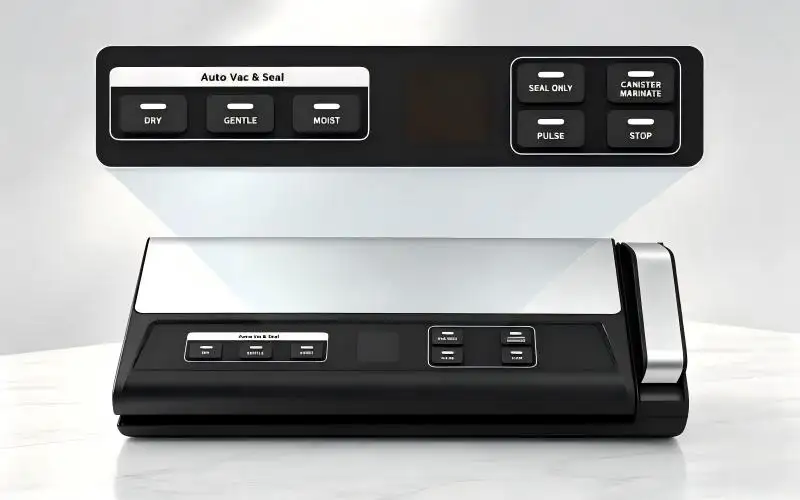
The VS8001G external vacuum sealer is listed with dry, moist, moist-plus, pulse, seal, and canister or marinate functions. The product page also lists a removable drip tray, a maximum bag width of 30 cm, and optional sealing configurations. These controls make it an example of the features buyers may consider for home portions, moderately moist food, and controlled external sealing.
The CVS101 combines chamber and external modes. Yumyth lists separate pressure and pump-flow specifications for each mode, chamber double sealing, external single sealing, different work widths, and different bag requirements. This demonstrates why buyers should evaluate each operating mode independently rather than relying on one headline specification.
These examples do not make either machine universally suitable. The final choice should still be based on the actual food, liquid content, pouch size, workload, electrical market, and required documentation.
Build a Requirement List Before Requesting a Quote
A clear inquiry makes it easier for a supplier to recommend a suitable system and identify configuration limits. Include:
-
Food types
-
Moisture and liquid content
-
Pouch material and dimensions
-
Packages per batch or day
-
Preferred external, chamber, or hybrid format
-
Maximum product dimensions
-
Available operating space
-
Destination country
-
Voltage, frequency, and plug
-
Required compliance documents
-
Branding or packaging needs
-
Sample-testing expectations
-
Required spare parts and support
Once these details are defined, you can review Yumyth’s current vacuum sealer range or discuss your vacuum-sealer requirements with the company’s project team.
Related Articles
How We Test Every Ice Maker Before Packaging
2026-09-15
BY YUMYTH
A step-by-step look at refrigerant handling, cooling verification, leak detection, corrective action and electrical safety testing For an ice maker, reliable performance is determined long before the carton is sealed. ...
Guide for Brands Looking for a Reliable Vacuum Sealer OEM Supplier
2026-09-14
BY YUMYTH
When you are sourcing kitchen appliances for your retail brand, finding a dependable vacuum sealer OEM supplier is rarely just about getting the lowest unit price. It is about protecting ...

Why Ice Shape Matters: Understanding 10mm × 15mm Cylindrical Nugget Ice
2026-09-14
BY YUMYTH
More Than Ice Production — The Ice Itself Shapes the Consumer Experience When sourcing a nugget ice maker, buyers often focus first on production capacity, water tank size, ice basket ...

Ice Maker Sourcing Guide: How to Find the Right Factory
2026-09-10
BY YUMYTH
Sourcing an ice maker looks straightforward on paper. Find a supplier, agree on a price, place an order. But anyone who has actually done this knows the process is rarely ...