
Sugar/Brix freezing test
Share:
-

-

-

-


Copied
Share:
-
-
-
-
Copied
Sugar/Brix Freezing Test for Home Slush Machines
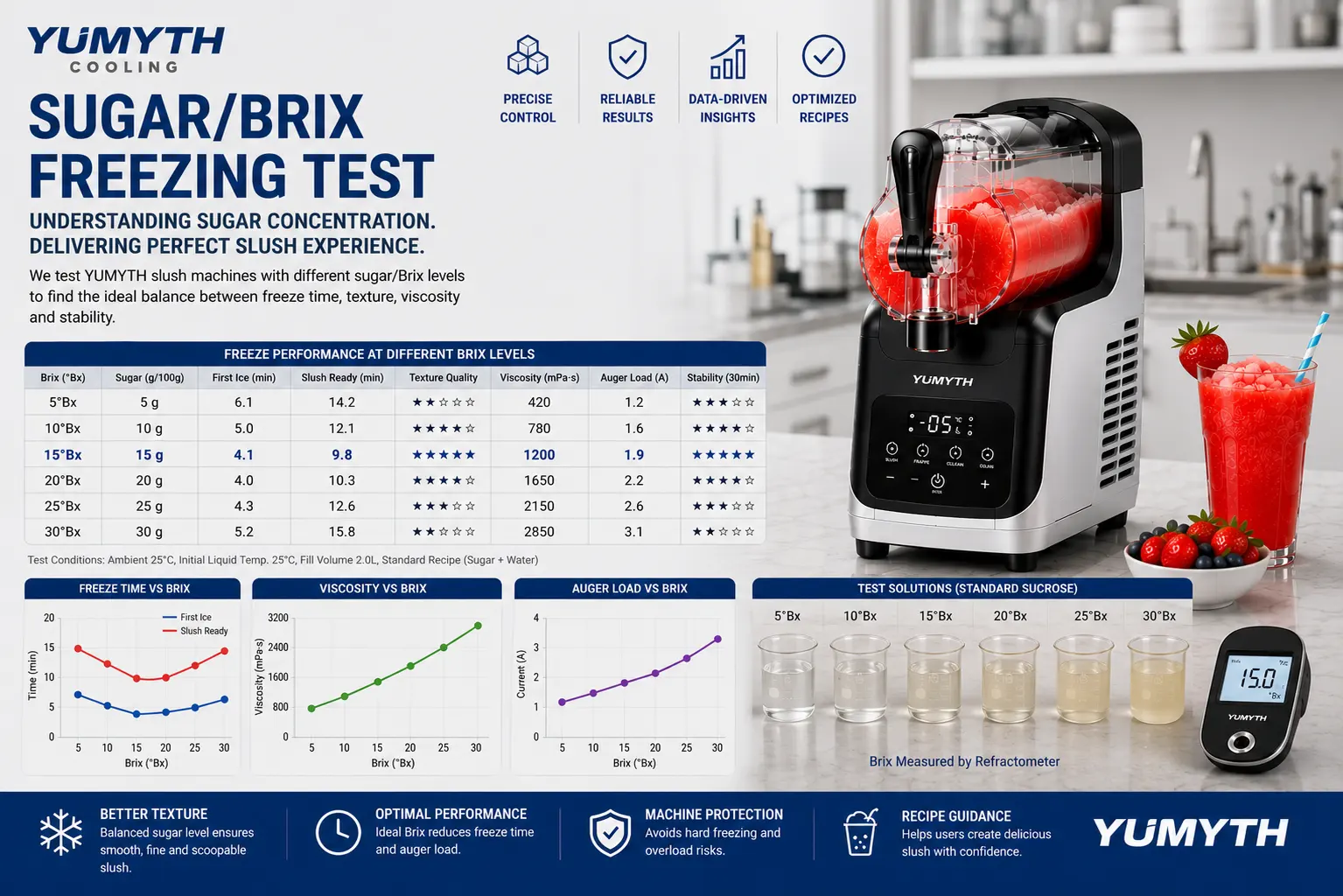
One of the most crucial factors to consider when using your home slush machine is the concentration of sugar. It affects the freezing point, ice crystal growth, beverage viscosity, preparation time, final texture, dispensing performance and auger loading.
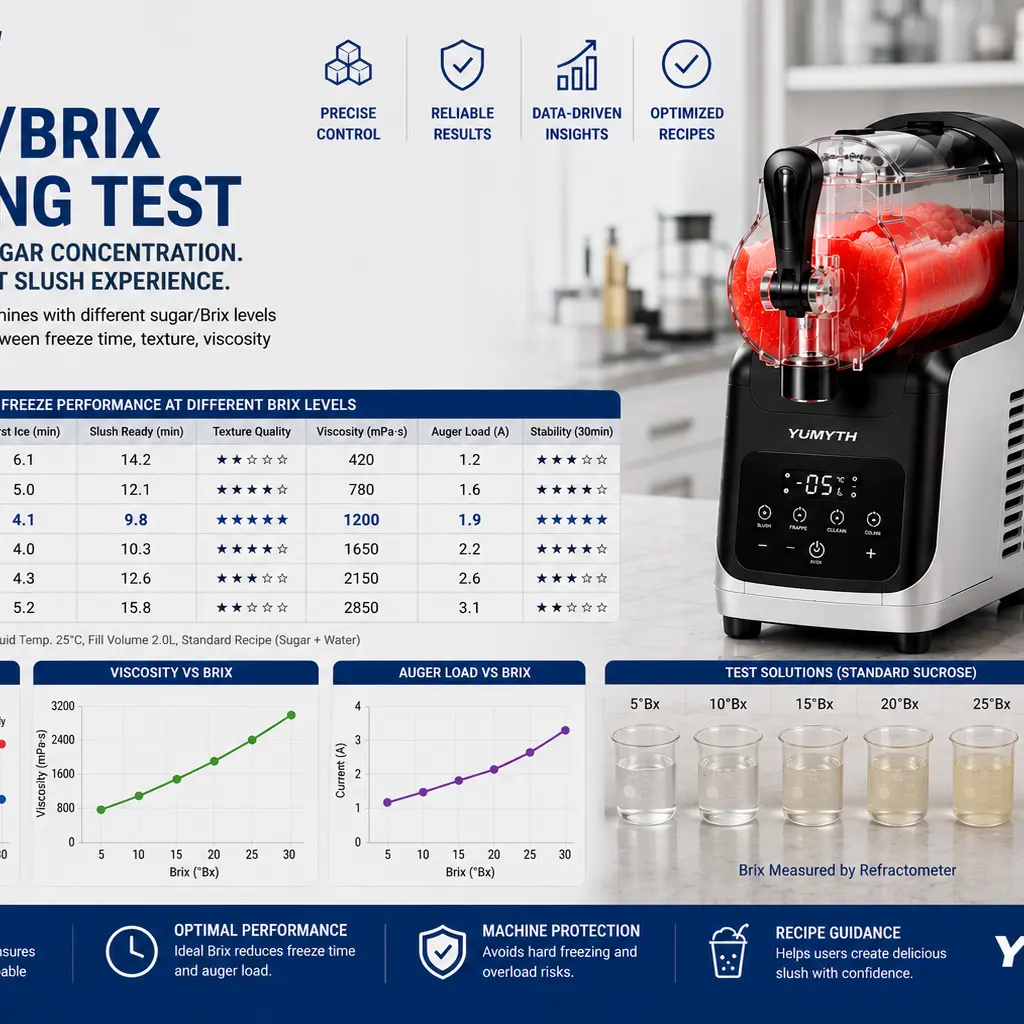
If there isn't enough dissolved sugar in the drink, it can freeze as a solid block rather than as a smooth slush. The mixture can be too soft or get very thick if the sugar content is too high, adding to the work load of the mixing system. A controlled Sugar/Brix freezing test is beneficial to appliance brands and OEM manufacturers in the machine's supported recipe range and in reaching to avoid mis-leading performance claims.
This is why a professional test should assess more than just if a beverage freezes in the end. It should be designed to determine the effect of sugar concentration on the total cooling and mixing operation.
What is Brix and why is it used when testing frozen drinks?
Traditionally, the °Bx will indicate the number of grams of sucrose per 100 grams of solution. If the solution is mainly sucrose and water, then there are about 12 grams of sucrose in a 12°Bx solution for every 100 grams of solution.
A refractometer is used to measure the brix. This tool is used to determine the amount of dissolved solids by using the effect it causes on light bending.
A refractometer can be used for a simple test solution of sugar and water. In commercial drinks, however, there are acids, salts, fruit solids, other sweeteners, dairy products, alcohol and other soluble components. These products contain Brix value as a measure of total refractive effect and not per cent sucrose concentration.
The refractometer reading and a full recipe should thus be recorded in test reports.
There are good reasons why sugar affects the freezing process.Sugar affects the freezing process for good reasons.
A sugar solution freezes at a lower temperature than pure water. Part of the drink will still be liquid while the ice is being created, as the sugar is dissolving and making the mixture's freezing point drop.
The mixture of liquid and small ice crystals results in the semi-frozen "slush" that is necessary for slush. The crystals are continuously scraped off the cooling surface and evenly spread through the beverage by the auger.
If the sugar level is low, more of the water available could freeze quickly. Thick ice can form around the evaporator, which could cause the auger to become overloaded or jam.
The higher the concentration, the lower the freezing point and the machine may need to run longer or lower the evaporator temperature to generate enough ice. The specific mixture may not set to a solid frozen form at very high concentrations.
But there is more to it than just “more sugar is better slush.” There needs to be a validated operating range for each appliance.
Determine the meaning of the test.
The goal of the test must be determined before preparing beverages.
The Sugar/Brix freezing test can be used to:
- Calculate the lower limit of sugar concentrations that can be supported;
- * Identify the optimum range for smooth texture;
- Determine the maximum allowable concentration;
- * Compare refrigeration platforms;
- Evaluate auger and motor loading;
- Create recipes to be used in the user Manual;
- * Check low sugar operating modes;
- Check on complaints of freezing or jamming.
A broad range of concentrations can be included in an engineering development test to determine the system limits. A product validation test should be final product and should involve production representative appliances and the declared recipe range.
Complete a Controlled Brix Test Matrix.
More than one standard recipe should be in the matrix with the other Brix levels set evenly.
Here is an example of a test plan:
- A very low concentration that is hard freezed protection challenge concentration;
- A reduced ACOE level;
- A typical recipe;
- The highest level of concentration of the normal range;
- High concentration to which freezing capacity and viscosity are challenged.
Actual values will depend on the design of the appliance, the beverage to be controlled, the range of control, and the market for the appliance. If a minimum Brix is to be published it should be a universal minimum and not be validated for the specific product.
All solutions should be prepared by weight using a calibrated scale. Add water and sugar and mix until the sugar is dissolved. The Brix value should then be checked using a calibrated refractometer.
Control other test variables, such as the temperature of the water and air.
Main changing variable is brix. All other factors need to be kept constant in order to be able to distinguish the effect of sugar concentration from any other effects.
The report should have the following standards:
- * Mass or volume of a liquid.
- * Starting liquid temperature;
- * Ambient temperature;
- * Relative humidity;
- * Electrical and electronic performance; and
- * Appliance program;
- * Target texture setting;
- * Tank installation;
- * Ventilation clearance;
- * Test endpoint.
If using a colder starting drink was done for every Brix number, comparisons for the different times of the year would not be reliable, as the starting drink would vary. The appliance should also return to a predetermined state at the beginning of each cycle.
Sample to sample variation should be minimized by using a test order if possible when multiple machines are tested.
Measure Brix Correctly
A refractometer needs to be calibrated as directed, which is usually using clean water prior to use.
The sample to be measured should be uniform and free of undissolved crystals. Temperature compensation must be verified as refractive measurements may vary with sample temperature.
If a carbonated drink, then carbonation should be removed prior to measurement as it will affect the stable reading. However, fruit pulp and suspended solids may need to be filtered or sampled following a specific method.
Pre-freeze measurements should be done. A second determination may be made from the liquid remaining after freezing or during the freezing process, but the interpretation of such a result should be carefully considered. Dissolved solids accumulate in the unfrozen portion of the water as it freezes, and the measured Brix value may increase even if no more sugar is added to the water.
Set up the Freeze-Time Endpoint.
The test must have a consistent definition of “slush ready.”
Possible endpoints include:
- Atmospheric temperature at which ice first starts to form;
- * Temperature recorded by a beverage;
- * Machine completion indicator;
- * Most suitable mixing additives; and
- Continuous dispensing without big chunks of ice;
- An accepted "flow" or "spoon" test.
A uniform and constantly dispensable slush texture is typically the most helpful endpoint for performance seen by the consumer.
Time to first ice formation also should be recorded. The comparison of first-ice time to final serving time can be used to help the engineer determine if a high-Brix beverage is causing a delay in first freezing or merely prolonging the texture-developing portion of the freezing time.
Keep an eye on the temperature and mechanical load
Freeze alone can't show mechanical response of the appliance.
Recommended measurements include:
- * Beverage temperature;
- * Evaporator temperature;
- * Ambient temperature;
- * Auger motor current;
- * Compressor operating time;
- * Appliance power;
- * Automatic reversal events;
- * Overload warnings;
- * Final texture stability.
If hard ice is forming in the beverage, the resulting rapid rise in auger current may be due to a beverage with low Brix. The longer the run time of the compressor on high brix beverages may be than expected to get the desired amount of ice.
The data for motor current is particularly important because it supplies an objective measurement of the growing resistance of the mixture. It may assist engineers in determining the operating envelope for overload protection and designing control logic that will stop the cooling system from freezing out the drive system.
Evaluate Texture, Not Just Temperature
Two drinks can have the same temperature but have different consistencies.
In the final evaluation, you should take into account:
- * Ice-crystal size;
- * Uniformity;
- * Smoothness;
- * Pourability;
- * Dispensing speed;
- * Separation;
- * Melting behavior;
- A stable texture in the holding phase.
When the average sample temperature in the tank is acceptable, a low-Brix sample can have hard flakes or frozen areas. If there is not enough ice formation in a high-Brix sample, the sample may not lose its shine and liquefy.
A flow test may be used to assist in texture evaluation. Typically, the amount of time needed for a specified amount to flow through the dispensing outlet at the same operating conditions will be recorded by the laboratory.
The method used should be documented and used regularly.
Include Extended Holding Tests
The beverages are acceptable at the end of the first cycle but could change in holding.
Low-Brix drinks will keep on freezing and will eventually overload the auger. For high Brix mixtures, softening, separating, or consistency changes can occur as the compressor cycles.
There should then be a set holding period for each Brix level. The report shall contain:
- * Texture changes;
- * Compressor cycling;
- * Auger load;
- * Automatic reversals;
- * Dispensing consistency;
- * Surface ice formation;
- * Error messages.
The holding test is used to identify if the machine can hold a recipe safely, or just make it once.
Use alternative sweeteners individually.
A drink can be sweet, but not act like a sucrose solution.
A few of the high-intensity sweeteners are not very contributing to the dissolved solids content, so that a drink with zero sugar can be very sweet and freeze much the same as a low solids water drink. Sugar alcohols or specialty sweeteners may have different freezing point effect than sucrose.
Recipes that use alternative sweeteners should thus be tested individually. They should not be judged on their sweetness alone.
The report should state the exact ingredient, concentration, supplier and full beverage formulation. Freezing in complex low-sugar recipes may not be accurately represented by a refractometer reading.
Analyze what went wrong and what was done to protect from failure
Testing should be carried out purposely at the limits of the operating range.
The engineering team should see if the appliance reacts to the mixture being too hard or if it doesn't freeze.
Protective responses might involve:
- * Automatic auger reversal;
- * Compressor interruption;
- * Increased target temperature;
- * Motor overload shutdown;
- * Recipe warning;
- * User-adjustment instruction.
If a recipe test fails, then it does not necessarily indicate that the appliance design is faulty. It might give an out-of-range formulation. The machine should, however, enter a controlled condition, and not cause any harm to the auger, motor, gearbox, or drive coupling.
The Final Test Report is organized by the following sections:
A full report of the Sugar/Brix freezing test should contain:
- * Model and serial number of the appliance;
- * Sample quantity;
- * Type of test; and
- * Instrument information;
- * Refractometer calibration;
- * Complete recipe formulations;
- * Measured Brix values;
- * Weight, Mass or Volume (full or empty);
- * Starting beverage temperature;
- * Ambient conditions;
- * Selected operating program;
- * Freeze-time definition;
- * Wind chill and expected frost times; and
- * Water flow and water temperature; and
- * Motor-current observations;
- * Texture evaluation;
- * Holding performance;
- * Events involving the use of multiple circuits or an overload; and
- * Data curves and data streaks;
- * Engineering conclusion.
Individual samples, averages and variation should be included in the results. It is not appropriate to use the result of one of the very fast cycles as the declared result if other cycles have different results.
Conclusion
Sugar/Brix freezing tests are useful for both understanding the relationship between beverage formulation and refrigeration performance and also to understand the relationship between auger load and refrigeration performance.
If the sugar content is too low then there is a risk of aggressive ice formation and jamming, and if the sugar content is too high, the freeze time can be extended or there may not be enough crystals formed. The suitable operating range is determined by the refrigeration capability, evaporator design, mixing system, sensors and control software of the appliance.
Ideal Brix never exists, it is the objective of appliance manufacturers and OEMs to find one that fits the majority of their products. It is to validate a recipe range, give the user valid instructions and protect the machine if a beverage is outside the specified range.
By having a controlled and transparent test, it helps for achieving more uniform product texture, safer operation, more believable performance claims, and less customer complaints.
Related Articles
How We Test Every Ice Maker Before Packaging
2026-09-15
BY YUMYTH
A step-by-step look at refrigerant handling, cooling verification, leak detection, corrective action and electrical safety testing For an ice maker, reliable performance is determined long before the carton is sealed. ...
Guide for Brands Looking for a Reliable Vacuum Sealer OEM Supplier
2026-09-14
BY YUMYTH
When you are sourcing kitchen appliances for your retail brand, finding a dependable vacuum sealer OEM supplier is rarely just about getting the lowest unit price. It is about protecting ...

Why Ice Shape Matters: Understanding 10mm × 15mm Cylindrical Nugget Ice
2026-09-14
BY YUMYTH
More Than Ice Production — The Ice Itself Shapes the Consumer Experience When sourcing a nugget ice maker, buyers often focus first on production capacity, water tank size, ice basket ...

Ice Maker Sourcing Guide: How to Find the Right Factory
2026-09-10
BY YUMYTH
Sourcing an ice maker looks straightforward on paper. Find a supplier, agree on a price, place an order. But anyone who has actually done this knows the process is rarely ...